
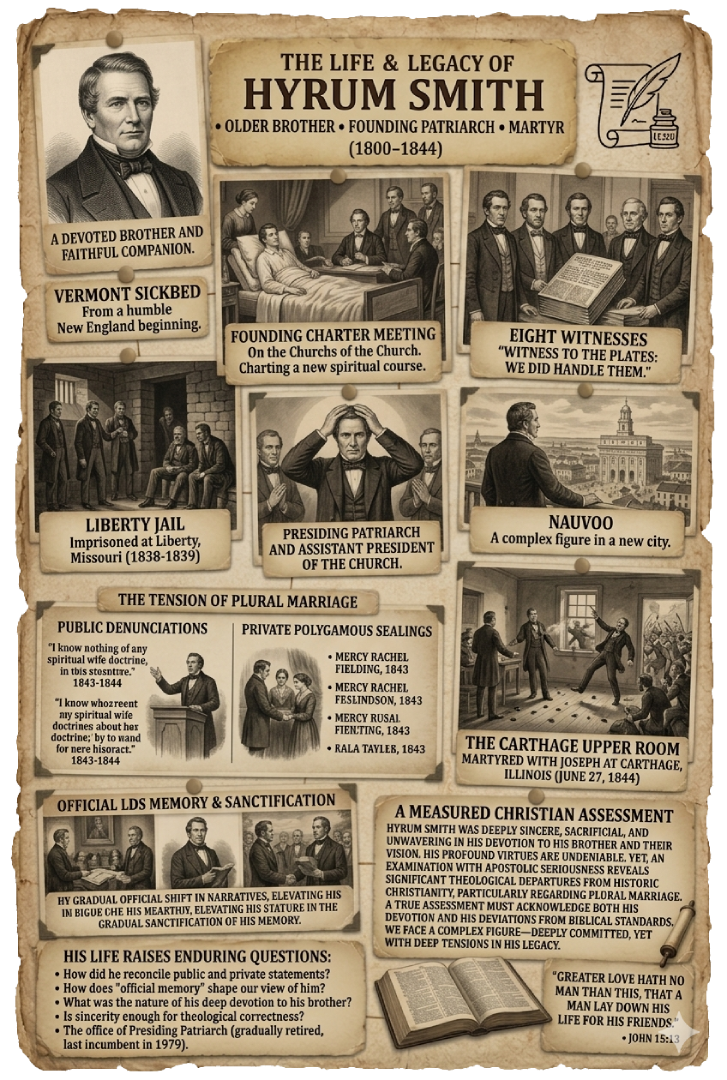
Seventh in the Early Mormon Personalities Series
The Faithful Witness: How Hyrum Smith’s Loyalty Carried
A Movement and Concealed Its Contradictions
❦ ❦ ❦
I. Carthage, June 27, 1844 — A Cinematic Opening
The afternoon was hot and slow on the Illinois prairie. Inside an upstairs room of the Carthage Jail, four men in shirtsleeves talked in muted voices, fanned themselves, and waited. A bottle of wine, brought up to revive their flagging spirits, sat half-drunk on the table. John Taylor had been singing “A Poor Wayfaring Man of Grief.” Joseph Smith — prophet, mayor, lieutenant general of the Nauvoo Legion, declared candidate for the presidency of the United States — lay across the bed in a state of resigned exhaustion. And beside him, calm, unshaken, almost preternaturally still, sat his older brother. Hyrum.
He was forty-four years old. He had spent more than half his life walking three paces behind his younger brother, defending him, anchoring him, suffering for him. He had been beaten by mobs in Missouri, frozen in the dungeon of Liberty Jail, robbed in Kirtland by the very men who had once shared his bread, and now, at the request of an Illinois governor whose protection meant nothing, he had ridden willingly into a town that was already loading its rifles.
Two days earlier, on the western bank of the Mississippi, Joseph had asked him, “You are the oldest, what shall we do?” Hyrum had answered without flourish: “Let us go back and give ourselves up and see the thing out. … If we have to die, we will be reconciled to our fate.” That was Hyrum Smith — plain, deliberate, unhurried. The words could have been carved on his headstone.
At a little past five o’clock that afternoon, a mob of perhaps two hundred men with blackened faces stormed up the stairs. A musket ball passed through the panel of the wooden door and struck Hyrum on the left side of the nose. A second ball, fired through the window from outside, drove through his back, exited his chest, and shattered the watch in his vest pocket. He staggered, fell, and said simply, “I am a dead man.” In the next forty-five seconds, his younger brother would also be dead, John Taylor would be lying behind a bedstead with four bullets in him, and the whole edifice of early Mormonism would suddenly be standing on the corpses of its two founders.
To understand Mormonism, you must understand Hyrum Smith. He was the first to believe Joseph and the last to leave him. He was the lever that gave the prophet leverage. Without Hyrum’s integrity, his Masonic standing in Palmyra, his school-trustee respectability, his quiet endurance under pressure, the new church might never have survived its New York and Ohio infancy at all. And yet — and this is the heart of the matter — the Hyrum Smith celebrated in modern Latter-day Saint discourse is in important ways a curated Hyrum, his contradictions sanded smooth, his hardest sayings reframed, his actual final words on the subject of plural marriage relegated to footnotes the average member never sees.
This essay walks the long road with him. From a fever-ravaged Vermont farmhouse to a jail cell on the Mississippi. From the printer’s shop in Palmyra, where he hid the Book of Mormon manuscript under his vest, to the upper room of a red brick store in Nauvoo, where he received endowment ordinances his Methodist neighbors would have called blasphemy. From a public sermon in which he threatened to “wring the nose” of any elder who taught the spiritual-wife doctrine, to two private polygamous marriages contracted within months of that very sermon. We will examine him through Latter-day Saint eyes, through hostile eyes, and through the eyes of historic biblical Christianity, and we will let the contradictions stand where they stand. He deserves, above all, an honest reading.
❦ ❦ ❦
II. Origins: A Vermont Childhood and the Forging of a Bond
Hyrum Smith was born on February 9, 1800, in the hill town of Tunbridge, Vermont, to Joseph Smith Sr. and Lucy Mack Smith. He was the third son, but the firstborn had died at birth, so in practical terms, he stood second after Alvin in a household that would eventually number eleven children. The Smiths were New England yeoman stock — farmers, coopers, occasional storekeepers, restless and devout, persistently chased by debt and bad weather and the thin soil of the upper Connecticut River valley. Between Hyrum’s birth and his fifteenth year, the family moved at least eight times, drifting from Tunbridge to Royalton to Sharon to Lebanon, New Hampshire, and finally west to Palmyra in upstate New York.
In the autumn of 1811, Hyrum, then eleven, was enrolled in Moor’s Indian Charity School on the campus of Dartmouth College, an opportunity none of his siblings would equal. He stayed roughly two years — enough to lift him slightly above the educational average of the New England farm boy and enough, later, to qualify him as a Palmyra schoolteacher and trustee. The historian Richard K. Behrens has argued that Hyrum’s exposure at Moor’s to Dartmouth Arminian theology — with its emphasis on free moral agency, the perfectibility of man, and the rejection of strict Calvinist predestination — quietly shaped the entire Smith family’s religious imagination, and through them shaped Mormonism itself. It is a striking thought: that the doctrinal soil of Latter-day Saint theology was tilled, in part, by an itinerant Indian-mission school in Hanover, New Hampshire.
But the formative event of Hyrum’s boyhood was not academic. It was a sickness. In late 1812, a typhus epidemic swept the upper valley. Several Smith children fell ill. The youngest brother to be stricken seriously was seven-year-old Joseph Jr., whose infection settled in his left leg and decayed into the bone. The agony was extraordinary. There was no anesthesia. The decision to operate without amputation — unusual at the time — was made over the desperate pleading of Lucy. And throughout the long ordeal, it was Hyrum, then twelve or thirteen, who took up the bedside vigil. Lucy Mack Smith’s description of it has become one of the iconic passages of early Mormon family memory:
“Hyrum, who was rather remarkable for his tenderness and sympathy, now desired that he might take my place. As he was a good, trusty boy, we let him do so, and, in order to make the task as easy for him as possible, we laid Joseph upon a low bed and Hyrum sat beside him, almost day and night for some considerable length of time, holding the affected part of his leg in his hands and pressing it between them, so that his afflicted brother might be enabled to endure the pain.”
— Lucy Mack Smith, History of Joseph Smith by His Mother, p. 55
Modern Latter-day Saint writers return to that scene almost reflexively, and rightly so. It is the spiritual hinge of the brothers’ entire relationship. From that bedside forward, Joseph would never doubt Hyrum, and Hyrum would never abandon Joseph. When, eight years later, the fourteen-year-old Joseph would tell his startled family that he had seen God the Father and Jesus Christ in a Palmyra grove, Lucy reports that Hyrum and the rest of the family heard him “joyfully,” giving “the most profound attention” to a boy “who had never read the Bible through in his life.” There is no recorded moment, in twenty-four years of subsequent prophetic claim and counter-claim, when Hyrum publicly questioned his younger brother.
From a Christian historical standpoint, this fraternal devotion — born in a sickroom — is exactly what makes Hyrum’s case so consequential. The credibility of early Mormonism, especially among its first New York neighbors, leaned heavily on the unimpeachable reputation of the older brother. Hyrum was the steadier figure. He was admitted in 1828 to the Mount Moriah Masonic Lodge No. 112 in Palmyra and elected by his neighbors that same year as a trustee of the local school board. Even Presbyterian skeptics conceded the point. “Whatever other Mormons may have been,” one Kirtland Presbyterian minister later wrote, “Hyrum was a perfect gentleman.” That kind of social capital, in a tight rural community, was not transferable; it was earned. And Joseph would draw on it, again and again, for the rest of his life.
❦ ❦ ❦
III. Spiritual Quest: Why a Sober Older Brother Believed
To understand why a respectable, Mason-affiliated, school-trusted thirty-year-old farmer-cooper from western New York would bind his entire fortune to his younger brother’s claim of golden plates and angelic visitations, one must understand the religious atmosphere of the so-called Burned-Over District in the 1810s and 1820s. Western New York in those years was the spiritual equivalent of a brushfire: Methodist circuit riders, Presbyterian revivals, Baptist camp meetings, Universalists, Restorationists, Shakers, and every flavor of millenarian and primitivist preacher passing through every season. The prevailing question was not “Is Christianity true?” — nearly everyone assumed it was — but “Which Christianity?”
The Smith family’s answer, by Joseph Sr.’s lights, was: none of them. Joseph Sr. drifted toward folk universalism and seer-stone treasure-seeking; Lucy oscillated between Methodist sympathies and a yearning for a more visionary form of faith; the children grew up in an atmosphere of restless searching that the historian Richard Bushman has called “rough-stone rolling.” (PDF download). Hyrum himself was briefly — reports differ — either a Presbyterian sympathizer or simply a religiously serious young man without firm sectarian commitment. What is certain is that he, like his younger brother, found the existing denominations inadequate.
When Joseph announced in 1820 that two heavenly personages had told him to join none of them, Hyrum heard it with a believing heart. When Joseph began producing the Book of Mormon manuscript in 1828–1829 in Harmony, Pennsylvania, Hyrum traveled there at his own expense to learn how the work was progressing. By late May or early June 1829, the work was nearly finished. It was on one such visit that Joseph received what is now Doctrine and Covenants section 11, addressed to Hyrum, with the now-famous instruction:
“Seek not to declare my word, but first seek to obtain my word, and then shall your tongue be loosed; then, if you desire, you shall have my Spirit and my word, yea, the power of God unto the convincing of men.”
— Doctrine and Covenants 11:21
Latter-day Saint commentators read this as the founding charter of Hyrum’s scriptural ministry; a Christian reader, by contrast, may notice the language’s functional resemblance to a workplace probation study before you preach. Either way, Hyrum took it seriously. In June 1829, he was baptized in Seneca Lake. Within weeks, he became one of the Eight Witnesses to the Book of Mormon plates, signing the Testimony that has since appeared in every printed edition of that book:
“We have seen and hefted, and know of a surety that the said Smith has got the plates of which we have spoken. … And we lie not, God bearing witness of it.”
— Testimony of Eight Witnesses, Book of Mormon (1830)
Two doctrinal observations follow. First, in his own theological self-understanding, Hyrum was not joining a new religion — he believed he was joining the restored ancient Christianity that all the surrounding sects had lost. The conceptual force of the move, for him, was not “leave Christianity” but “rejoin true Christianity.” That sincerity must be conceded. Second, the historic-Christian objection is not principally that Hyrum lied about handling plates — it is that the Book of Mormon, even granting his subjective sincerity, presents a gospel that diverges from the apostolic faith on the nature of God, the nature of man, the means of salvation, and the closed canon of Scripture (Galatians 1:8–9; Jude 3; Revelation 22:18–19). On those issues, the Christian and the Latter-day Saint reach a sober but real impasse.
Hyrum’s convictions, however, were not driven by abstract systematic theology. They were driven by his brother. Joseph said it; therefore, Hyrum believed it. The faith was personal long before it was creedal. That is honorable in the manner of Ruth’s loyalty to Naomi, and tragic in the manner of any deeply loyal man whose loyalty has been pledged to the wrong altar.
❦ ❦ ❦
IV. Role in the Early Movement: The Indispensable Lieutenant
The Charter Member and Book of Mormon Facilitator
On April 6, 1830, in the log Whitmer cabin at Fayette, New York, six men signed their names as charter members of the new Church of Christ. At thirty, Hyrum was the eldest. He had not founded the movement. He had not received the visions. He had not produced the book. But every visible piece of organizational scaffolding around the prophet bore Hyrum’s fingerprints.
During the printing of the Book of Mormon at Egbert B. Grandin’s shop in Palmyra, Hyrum was entrusted with the printer’s manuscript. Royal Skousen’s textual study has shown that Hyrum himself briefly served as scribe on five separate stretches between Mosiah 28 and Alma 5, and the typesetter John Gilbert later recalled that Hyrum carried installments of the manuscript daily “under his vest, and vest and coat closely buttoned over it. At night, Smith came and got the manuscript, and with the same precaution carried it away.” Even more dramatically, when Hyrum felt a sudden Sunday-afternoon impression that something was amiss at the print shop, he and Oliver Cowdery went and discovered the local newspaperman Abner Cole using Grandin’s press to print pirated excerpts of “Joe Smith’s Gold Bible” in his own paper. Hyrum confronted Cole, who threatened to fight him. Hyrum simply outlasted him, calmly waiting until Joseph could return from Pennsylvania to negotiate the cessation of the unauthorized printing. The episode is small but characteristic. Throughout his ministry, Hyrum supplied the practical, calm, executive courage that his more volatile brother often lacked.
Missionary, Foreman, and Builder of Temples
Between 1830 and 1840, Hyrum filled almost every conceivable practical office in the new Church. He presided as branch leader at Colesville, New York. He preached evangelistically through New York, Pennsylvania, Indiana, and Ohio, and once was sent on a thousand-mile assignment by way of separate routes with John Murdock to Missouri and back. He took up a scythe and helped clear the temple ground at Kirtland, Ohio, in 1833 — the first man, by his own boast to his mother, to strike the first blow on the foundation. He served as foreman of the stone quarry that supplied the limestone for the Kirtland Temple’s walls. In 1834, he and Lyman Wight recruited Michigan Saints into Joseph’s ill-fated paramilitary expedition known as Zion’s Camp.
From the autumn of 1837 onward, he held real ecclesiastical office: Assistant Counselor in the First Presidency from September of that year, then Second Counselor from November. From January 24, 1841, until his death, he held the unique double office of Assistant President of the Church (replacing Oliver Cowdery, excommunicated three years earlier) and Presiding Patriarch (replacing his father, who had died in September 1840). His doctrinal and administrative reach was vast. As a member of the Council of Fifty, the Nauvoo Temple Building Committee, the Nauvoo City Council, the Nauvoo Legion (with the rank of brevet major general), and even the vice-mayoralty of the City of Nauvoo, Hyrum touched virtually every lever of early Mormon civic and religious life.
The Living Anchor of the Smith Family
All of this happened against the backdrop of constant family upheaval. After his older brother Alvin’s death in November 1823, the dying twenty-five-year-old had charged Hyrum with the family’s welfare in words that became, in effect, the second commission of his life: “I have done all I could to make our dear parents comfortable. I want you to finish the house and take care of them in their old age.” Hyrum did. When the Smiths lost their farm to predatory creditors during Joseph’s adolescence, Hyrum and his first wife, Jerusha Barden — whom he married on November 2, 1826 — took the entire extended family into their small log cabin. He did this without complaint and apparently without regret.
The toll of public ministry on his private life was crushing. He was on a missionary assignment in Far West, Missouri, in October 1837 when he received the news that Jerusha had died, two weeks after delivering their sixth child. The letter, jointly drafted by his younger brothers Samuel and Don Carlos, included the chilling line that Jerusha’s last message to Hyrum had been: “the Lord had taken their mother and left them for you to take care of.” He left immediately for home. Within ten weeks, on Christmas Eve 1837, on Joseph’s explicit revelatory direction, Hyrum had married a thirty-six-year-old English convert named Mary Fielding, who would bear him a son and a daughter and rear his five surviving children from Jerusha. Their son, Joseph F. Smith, born in November 1838 while Hyrum was already in Missouri custody, would one day become the sixth president of the LDS Church.
Three weeks of married life. Then Mary saw him taken away in chains.
❦ ❦ ❦
V. Liberty Jail: The Crucible of the Patriarch
On the morning of November 1, 1838, in the wake of the so-called Mormon-Missouri War and Governor Lilburn W. Boggs’s notorious Extermination Order, a militia company arrived at Hyrum’s home in Far West with bayonets fixed. Mary, sick, was within days of giving birth to Joseph F. The militia did not care. They marched Hyrum at bayonet point to the camp where his brother was already held, and from there, with Joseph and three others — Lyman Wight, Caleb Baldwin, and Alexander McRae, plus Sidney Rigdon, who would later be released — they were transferred to the small unheated stone-and-log jail at Liberty, Clay County, Missouri.
They were confined there from December 1, 1838, until April 6, 1839 — four months and six days in a cell so cramped that men could not stand fully upright in the lower dungeon, where straw beds rotted on the stone floor. Hyrum later testified, in a sworn statement before the Nauvoo Municipal Court, that during their confinement “poison was administered to us three or four times,” producing violent vomiting; and that on one occasion they were offered for food “human flesh — for the space of 5 days or go without food, except a little coffee or a little corn bread—the latter I chose in preference to the former. We none of us partook of the flesh except Lyman Wight.” Whether his perception of the meat was accurate or whether the guards were taunting them with that lie, the psychological reality was the same: he believed it was human flesh.
Yet of all the prisoners, Hyrum left the most extensive paper trail of the experience. Eight letters written from his hand survive, written between mid-March and early April 1839, all but one addressed to Mary Fielding Smith. The Brigham Young University historians Kenneth Alford and Craig Manscill have shown that several of these letters predate Joseph’s great March 20 letter to the Church, the letter portions of which would be canonized as Doctrine and Covenants sections 121, 122, and 123. The two brothers, in other words, talked through the doctrines together in the cell before either of them committed them to paper. The serene voice of D&C 121 — “My son, peace be unto thy soul” — has Hyrum’s breath in it as well as Joseph’s.
Hyrum’s own most affecting line, written in March 1839 to Mary, is a small monument to spousal love under impossible circumstances:
“O God in the name of thy son preserve the life and health of my bosom companion, and may she be precious in thy sight, and all the little children, and that is pertaining to my family; and hasten the time when we shall meet in each other’s embrace.”
— Hyrum Smith to Mary Fielding Smith, Liberty Jail, March 16, 1839
On April 6, 1839, the prisoners were finally transferred to a venue change. The sheriff, almost certainly under unspoken instructions, allowed them to escape. Hyrum, weakened by months of confinement and by acute rheumatism in his hands, made his way slowly across Missouri and into Illinois. By April 22, he and Joseph had reached Quincy and rejoined their families. Their misery had ended. Their public significance had only begun.
From a Christian theological vantage, Liberty Jail forces an honest reckoning. Whatever one concludes about Joseph Smith’s claims, no fair reader can question that Hyrum suffered, that he refused to recant, and that he believed himself to be suffering for the cause of Christ. The book of Hebrews praises those “of whom the world was not worthy” who were “destitute, afflicted, tormented” (Hebrews 11:37–38). Hyrum stood in that suffering. The question — the searching, painful question for the Christian — is whether the cause for which he suffered was, in its deepest doctrinal claims, the gospel of Jesus Christ as preached by the apostles. On that point, honest disagreement remains unavoidable. But the suffering itself we honor; we do not minimize it.
❦ ❦ ❦
VI. Nauvoo: The Patriarch at His Zenith
In the malarial bend of the Mississippi at the swampy hamlet then called Commerce — soon renamed Nauvoo — the Saints rebuilt themselves with astonishing speed. By 1842, the city had over ten thousand inhabitants, a temple rising on the bluff, a militia of perhaps four thousand men, and a charter of municipal liberties extracted from the Illinois legislature so generous that the city’s council could legally declare martial law in its own jurisdiction — a clause that, four years later, would be the immediate trigger of Joseph and Hyrum’s deaths.
In this miniature theocracy, Hyrum stood second only to his brother. On January 19, 1841, in the revelation now canonized as Doctrine and Covenants 124, the Lord (in Joseph’s voice) told the Church:
“First, I give unto you Hyrum Smith to be a patriarch unto you, to hold the sealing blessings of my church, even the Holy Spirit of promise, whereby ye are sealed up unto the day of redemption … that he may be a prophet, and a seer, and a revelator unto my church, as well as my servant Joseph; … that he may act in concert also with my servant Joseph.”
— Doctrine and Covenants 124:124, 91, 94
And further, in language that has provoked Latter-day Saint historians ever since:
“Blessed is my servant Hyrum Smith; for I, the Lord, love him because of the integrity of his heart, and because he loveth that which is right before me, saith the Lord.”
— Doctrine and Covenants 124:15
Two things must be said about this revelation. First, it elevated Hyrum to the rare and ambiguous office of “Assistant President of the Church” — only ever held by Oliver Cowdery before him — making Hyrum the formally designated successor to Joseph. Had he survived his brother by even one hour, he would have become president of the LDS Church. The entire subsequent leadership trajectory of Mormonism — Brigham Young, the Quorum of the Twelve, the move to the Great Basin — ran on the historical contingency that Hyrum did not survive. Second, the revelation explicitly inherited the office of Patriarch from Joseph Smith Sr., on the principle of bloodline. Joseph Jr. famously declared in 1843 that “the patriarchal office is the highest office in the Church” — a staggering claim that, as Apostle LeGrand Richards later observed, modern Saints find difficult to accept.
This is where one of the most embarrassing later sanitizations of Hyrum’s legacy will eventually occur, and we will return to it below.
In the meantime, his Nauvoo work was relentless. He chaired the temple committee. He served on the Nauvoo City Council. He was vice-mayor of Nauvoo. He held membership in the Council of Fifty, an extra-constitutional theocratic body that prepared for the literal political kingdom of God. He sat in the Nauvoo Masonic Lodge. He pronounced — by O’Driscoll’s tally — hundreds of patriarchal blessings, working his way through immigrant convert after immigrant convert, often in his cramped front room, with a clerk taking down each blessing in longhand. In 1842, it fell to him publicly to clarify that the “hot drinks” forbidden in Joseph’s 1833 Word of Wisdom revelation were tea and coffee — a rule of Mormon practice that endures, virtually unaltered, into the twenty-first century.
And on May 4, 1842, when Joseph realized that he might not live to see the Nauvoo Temple finished, he gathered nine men in the upper room of his red brick store on Water Street and administered to them, for the first time in this dispensation, the temple endowment ceremony. Hyrum was among those nine. Whatever one believes about the legitimacy of that ceremony — a question to which this essay will return — it is striking how completely Hyrum stood at the center of Mormonism’s most innovative, most theologically distinctive, most non-Protestant ritual development. He was not a peripheral figure. He was an architect.
❦ ❦ ❦
VII. The Polygamy Problem: Hyrum’s Two Voices
Of all the painful questions surrounding Hyrum Smith, none is more difficult — and none more carefully managed by official LDS historiography — than the question of plural marriage. The standard Latter-day Saint biographical line, repeated in Church Manuals and in lay biographies like Pearson H. Corbett’s and Jeffrey S. O’Driscoll’s, runs roughly as follows: Hyrum initially opposed plural marriage when Joseph introduced it to him; he came to accept it after a personal spiritual struggle in 1843; he then married two plural wives — Mercy Fielding Thompson (his deceased wife’s sister) and Catherine Phillips — and helped present the revelation now known as Doctrine and Covenants 132 to the Nauvoo High Council on August 12, 1843.
That account is not false. But it is selective in a way that obscures something important: in the very months that he was contracting his own plural marriages and presenting the revelation to the High Council, Hyrum Smith was publicly and with unmistakable vehemence denouncing plural marriage as an abomination, threatening to disgrace any elder who taught it, and stating in writing in the Church’s newspaper that “there is no such doctrine taught here, neither is there any such thing practiced here.”
Three primary documents establish this beyond dispute.
Sermon at the Temple, May 14, 1843
In a sermon at the unfinished Nauvoo Temple, three months before his own first plural sealing, Hyrum addressed the people from the second chapter of Jacob in the Book of Mormon — the very passage in his church’s scripture that explicitly condemns the David-and-Solomon model of plural wives. The minute-book recorder wrote down what he said:
“There were many that had a great deal to say about the ancient order of things as Solomon and David having many wives and concubines — but it’s an abomination in the sight of God — if an angel from heaven should come and preach such doctrine [I] would be sure to see his cloven foot and cloud of blackness over his head, — though his garments might shine as white as snow. … A man might have one wife, — concubines he should have none. … I am a plain man, to God I am responsible, I deal in plainness. … I feel myself ashamed of such conduct amongst us, trifling with property and chastity of one another.”
— Hyrum Smith, Temple Sermon, May 14, 1843; Church History Library, Volume 18
Public Letter to the China Creek Saints, March 15, 1844
On March 15, 1844 — just over three months before his death, and seven months after his own plural marriages — Hyrum wrote a public letter, later printed in the Times and Seasons, to the Saints living on China Creek in Hancock County, Illinois. A man named Richard Hewitt had told Hyrum that local elders were teaching that men holding a certain priesthood could take “as many wives as he pleases.” Hyrum’s reply was unambiguous:
“I say unto you that that man teaches false doctrine, for there is no such doctrine taught here, neither is there any such thing practiced here. And any man that is found teaching privately or publicly any such doctrine is culpable, and will stand a chance to be brought before the high council, and lose his license and membership also.”
— Hyrum Smith, Public Letter, March 15, 1844, Times and Seasons
This letter, it should be noted, was edited out of the official six-volume manuscript History of the Church when that history was prepared for publication. It was an inconvenient document. The Joseph Smith Papers Project has since restored it to its proper place in volume E-1 of the manuscript history.
Conference Address, April 9, 1844
Less than three months before he was killed, with both his plural wives still living and the revelation on plural marriage already drafted and circulating among insiders, Hyrum addressed the Church’s general conference. His language was so emphatic that it has rarely been quoted in full in faith-promoting literature:
“Any man who comes in and tells any such damn fool doctrine, [tell him] to give up his license. None but a fool teaches such stuff; the devil himself is not such a fool, and every Elder who teaches such stuff ought to have his nose wrung. … I despise a man who teaches a pack of stuff that will disgrace himself so; for a man to go into the world, and talk of this spiritual wife system he is as empty as an open sepulchre. … I would call the Devil my brother before such a man.”
— Hyrum Smith, General Conference Address, April 9, 1844
How does one reconcile this with the documented fact — confirmed by Brian C. Hales’s exhaustive Joseph Smith’s Polygamy and acknowledged by the Church’s own “Hyrum Smith” Topics essay — that Hyrum had himself been sealed for time and eternity to Mercy Fielding Thompson on August 11, 1843, and to Catherine Phillips that same month? The standard apologetic answer is that Hyrum drew a sharp distinction between the public spiritual-wife teaching of the Cochranite/Bennett type — unauthorized, lecherous, often de facto adulterous — and the private, sealed, divinely-authorized plural marriages performed under priesthood keys. He could publicly denounce the former while privately accepting the latter, on the theory that the former was a counterfeit and the latter was the divine original.
That distinction is intellectually intelligible. It is also, from a Christian standpoint, deeply troubling. It requires Hyrum, as Patriarch and second president of the Church, to knowingly deceive the Saints from the public pulpit about what their leaders were practicing in private. It requires him to use the strongest possible language of moral disgust — “damn fool doctrine,” “abomination,” “as empty as an open sepulchre” — against a practice he was at that moment engaged in himself. The Apostle Paul’s instruction in 1 Timothy 3:2 that an overseer “must be … the husband of one wife,” and the requirement of all Christian ministry that we “refuse to walk in craftiness” and “not handle the word of God deceitfully” (2 Corinthians 4:2), bear directly on the difficulty.
It is fair to say, charitably, that Hyrum was caught between competing loyalties he could not openly resolve: to his brother’s revelations, to the doctrinal sensibilities of the rank-and-file Saints, to public order, to his own conscience. It is also fair to say that the modern LDS treatment of this episode — emphasizing the eventual private acceptance and minimizing the documented public denunciations — sands the moral grain in one consistent direction. The China Creek letter is essentially absent from Sunday lesson manuals. The April 9, 1844, conference quotation about wringing noses and damning fool doctrine is essentially absent from Ensign articles. And the contemporaneous claim in the Manuscript History that Hyrum’s first wife Jerusha would speak from beyond the grave through Mary Fielding to be sealed to Hyrum — a passage that, as the researcher Lucas Jackson has shown, was added to the manuscript history by post-Nauvoo editors and is not in the original — has been used for more than a century to soften the picture, even though it is not what Hyrum actually said.
On the matter of plural marriage, then, we must at minimum say: Hyrum’s legacy is more complicated than the official narrative permits, and his integrity — the very quality the revelation in D&C 124:15 most praises — is the quality most strained by the documentary record.
❦ ❦ ❦
VIII. Theological Departure from Biblical Christianity
Hyrum Smith was no theologian in the academic sense. He produced no systematic treatises. The doctrines he defended in print and pulpit — chiefly the divinity of the Book of Mormon, the literal authority of the Restoration priesthood, baptism for the dead, the necessity of latter-day temple ordinances, and the patriarchal-priesthood succession through Smith family bloodlines — were articulated by Joseph and faithfully transmitted by Hyrum. Hyrum’s theological role was thus the indispensable mediating one: he was the steady, plain-speaking older brother who lent his unimpeachable reputation to Joseph’s most innovative ideas, making them seem reasonable to ordinary, hard-working converts who would never have accepted them on Joseph’s authority alone.
From the standpoint of historic, biblical, creedal Christianity — the Christianity of the Apostles’ Creed, the Nicene Creed, the Reformation confessions, and the consensus of the Christian centuries — the doctrines Hyrum defended depart from the apostolic faith on at least seven significant points.
First, on the nature of God. Joseph’s mature theology, articulated most fully in the King Follett Discourse of April 1844 — a sermon Hyrum heard, less than three months before his death — taught that God the Father is an exalted, embodied man who once lived as a mortal and progressed into deity. “God himself was once as we are now, and is an exalted Man,” Joseph said. The biblical witness contradicts this directly. “God is spirit” (John 4:24); He is “the King eternal, immortal, invisible” (1 Timothy 1:17); “From everlasting to everlasting, thou art God” (Psalm 90:2). The doctrine of an embodied, formerly mortal Father is not a Christian distinctive sharpening but a categorical departure.
Second, on the nature of man. Mormon doctrine teaches that human beings are pre-existent spirit children of heavenly parents and may, through priesthood ordinances and obedience, progress to godhood — the famous Lorenzo Snow couplet, “As man is, God once was; as God is, man may become.” Hyrum, as Patriarch, sealed people “up unto eternal life” under that covenant. Scripture is unambiguous: “Ye shall be as gods” was the serpent’s lie in Eden (Genesis 3:5). The biblical doctrine of glorification (Romans 8:30; 1 John 3:2) speaks of conformity to the image of Christ, not ontological transition into deity.
Third, on the canon. The Book of Mormon, the Doctrine and Covenants, and the Pearl of Great Price stand alongside the Bible as scripture in the LDS view. Hyrum testified to the divine origin of the Book of Mormon at the cost of his life. The Bible declares its own sufficiency: “All Scripture is breathed out by God and profitable” (2 Timothy 3:16); “If any man shall add unto these things, God shall add unto him the plagues that are written in this book” (Revelation 22:18). The closure of the apostolic canon is not a Catholic-versus-Protestant question; it is a settled matter for both.
Fourth, on the priesthood. Hyrum, as Patriarch, exercised what Mormonism calls the patriarchal priesthood, an Old Testament office allegedly restored. The Book of Hebrews teaches that the entire Levitical and patriarchal priesthood structure has been fulfilled and superseded in Christ, our “great high priest who has passed through the heavens” (Hebrews 4:14). The New Covenant priesthood is the priesthood of all believers (1 Peter 2:9), not a hereditary office passed through Smith family bloodlines.
Fifth, on the temple ordinances. Hyrum was among the first to receive the endowment in the upper room of Joseph’s store on May 4, 1842 — a ritual indebted, as both LDS and non-LDS historians acknowledge, in significant part to Joseph’s March 1842 induction into Freemasonry. The biblical pattern is the opposite: the veil of the temple was torn at the crucifixion (Matthew 27:51), and access to God is now “by a new and living way which He has consecrated for us through the veil, that is, through His flesh” (Hebrews 10:20). The closed-door temple ordinance, restricted to the worthy, runs against the grain of the open-door gospel.
Sixth, on plural marriage. We have already explored the documentary tangle. Christian biblical theology rejects polygamy, both as a Christian moral standard (Matthew 19:4–6; 1 Timothy 3:2) and as the model of the kingdom (Ephesians 5:31–32).
Seventh, on the gospel itself. The Book of Mormon and the Doctrine and Covenants, taken in their fullest doctrinal expression, proclaim a salvation conditioned on continuing obedience, ordinances, and progression. The Pauline gospel proclaims salvation by grace through faith in Christ, “not of works, lest any man should boast” (Ephesians 2:8–9). Hyrum was a profoundly moral man working within the only theological framework he had ever truly known, and he labored as a Christ-loving man within it. But the framework itself, in the historic Christian judgment, miscarries the gospel.
These differences are not nuances. They are foundations. To name them is not to despise Hyrum or to deny his sincerity. It is simply to be honest about the doctrinal cost of confusing the warm word with the right word.
❦ ❦ ❦
IX. Eyewitnesses: How Contemporaries Saw Him
To leave Hyrum in the abstract would be to misrepresent him. The most extensive single tribute in the historical record is from his younger brother. Joseph Smith wrote in his journal:
“I could pray in my heart that all my brethren were like unto my beloved brother Hyrum, who possessed the mildness of a lamb, and the integrity of a Job, and in short, the meekness and humility of Christ; and I love him with that love that is stronger than death.”
— Joseph Smith, Journal, History of the Church 2:338
And again, in tribute to a brother who had been at his side through Liberty and Carthage and every disaster between:
“Brother Hyrum, what a faithful heart you have got! Oh may the Eternal Jehovah crown eternal blessings upon your head, as a reward for the care you have had for my soul! O how many are the sorrows we have shared together.”
— Joseph Smith to Hyrum Smith, History of the Church 5:107–108
John Taylor, who was wounded grievously beside Hyrum in the upper room of the Carthage Jail, recorded a graveside meditation that captures the man as the survivors saw him:
“There he lay as I had left him. … He had not moved a limb; he lay placid and calm, a monument of greatness even in death. … If ever there was an exemplary, honest and virtuous man, an embodiment of all that is noble in the human form, Hyrum Smith was its representative.”
— John Taylor, in B. H. Roberts, The Life of John Taylor, p. 142
Lucy Mack Smith, his mother, characterized him in a phrase: “rather remarkable for his tenderness and sympathy.” Apostle Heber C. Kimball, sent in 1837 on the historic mission to England, recalled that Hyrum “was continually blessing and encouraging me” when he felt unequal to the task. The Methodist convert Mary Fielding, before she became Hyrum’s second wife, watched him preach in Kirtland and wrote that he “seemed to be filled with the Spirit and power of God,” after “sitting down for a short time to give vent to his feelings.” William E. McLellin, before his eventual disaffection, recorded that he had heard Hyrum speak “of the truth of the book” to a congregation of some five hundred people, and was persuaded by the testimony.
Even neighbors who never accepted Joseph’s religious claims spoke generously of Hyrum. Lorenzo Saunders of Manchester, New York — no friend to Mormonism — remembered Hyrum at the time of the Saunders family’s bereavement: “Hyrum Smith in particular … was at our house all the time … he was attentive, … always ready to bestow anything.” That is the testimony of an outsider, and it is consistent with his lodge records and his school-trustee election.
Hostile contemporaries are conspicuously rare. The polemical anti-Mormon literature of the 1830s and 1840s, including Eber D. Howe’s Mormonism Unvailed (PDF download), has very little personally to say against Hyrum. The standard hostile move is to subsume Hyrum under the criticisms made of Joseph and the Smith family generally; few critics felt able to attack Hyrum on his own conduct. Even his disaffected brother William, who broke with the Twelve in 1845 and was excommunicated, never publicly impugned Hyrum’s personal character. The reason is plain: there was nothing personal to impugn.
The single area where the evidence pulls against the official portrait is, again, plural marriage — not because contemporaries denounced Hyrum for it (most did not know), but because Hyrum’s own surviving public addresses contradict his private practice in ways that any unbiased reader would describe as duplicitous. That is a real shadow on the picture. Honesty requires that it be named.
❦ ❦ ❦
X. Carthage: The Slow Walk to the Window
On June 7, 1844, dissident former Mormons led by William Law and Wilson Law published the first and only issue of the Nauvoo Expositor (replica PDF download), a four-page newspaper denouncing Joseph Smith’s theological innovations — chiefly plural marriage and the doctrine of plurality of gods — and calling for repeal of the Nauvoo charter. Three days later, the Nauvoo City Council, with Joseph as mayor and Hyrum as a councilor, declared the press a public nuisance. On June 10, the city marshal, acting under a council order, destroyed the Expositor press.
It was, in legal hindsight, a defensible municipal action under the doctrine of public nuisance as it then stood; it was also catastrophic as a public-relations matter. To Illinois settlers already alarmed by Mormon political bloc-voting and the size of the Nauvoo Legion, the destruction of an opposition press by a Mormon mayor looked like the opening move of a theocratic seizure of state power. Within ten days, a citizens’ militia was massing around Carthage, the county seat, demanding Joseph’s arrest. Governor Thomas Ford traveled to Carthage and issued a written promise of safe conduct.
On the night of June 22, Joseph and Hyrum crossed the Mississippi to Iowa, intending to ride west and disappear. By the morning of June 23, accusations of cowardice were already racing through Nauvoo. Joseph wavered. It was at this moment, on the riverbank, that he turned to his older brother and asked: “You are the oldest, what shall we do?” Hyrum’s answer — “Let us go back and give ourselves up and see the thing out” — sealed both their fates.
They returned. On June 24, escorted by Captain Robert Dunn, the brothers rode east toward Carthage. Joseph said, in one of his last public utterances, “I am going like a lamb to the slaughter, yet I am calm as a summer’s morning. … I shall die innocent.” They reached Carthage near midnight. Crowds jeered as they passed.
On June 25, they were charged with riot and posted bail. They were then re-arrested on the additional charge of treason — stemming from their having put Nauvoo under martial law to defend it — a non-bailable offense. They were transferred to the Carthage Jail. There they spent forty hours: praying, talking, reading the Book of Mormon, singing “A Poor Wayfaring Man of Grief.” Hyrum, on the morning of his death, opened the Book of Mormon to Ether 12:36–38 and folded the page. The passage reads, in the tongue of the Book of Mormon’s Moroni:
“If they have not charity it mattereth not unto thee, thou hast been faithful; wherefore thy garments are clean. … Thou shalt be made strong, even unto the sitting down in the place which I have prepared in the mansions of my Father. … I bid farewell unto the Gentiles; yea, and also unto my brethren whom I love, until we shall meet before the judgment-seat of Christ.”
— Book of Mormon, Ether 12:37–38, marked by Hyrum Smith on his last morning
At about 5:00 p.m. on June 27, 1844, the mob from Warsaw arrived at the jail with blackened faces. Most of the Carthage Greys, ostensibly guarding the brothers, joined them. The mob rushed the stairs. The four men in the upper room — Joseph, Hyrum, John Taylor, Willard Richards — leaned against the door. A musket ball through the panel struck Hyrum in the face. A second ball, fired through the window from outside, struck him in the back, exited through his chest, and shattered the watch in his vest pocket. He fell, said, “I am a dead man,” and died. Joseph emptied a six-shooter through the partly open door, leapt to the window, and was shot from front and rear. He fell two stories to the ground. “O Lord, my God” were his last reported words — a phrase, the historian D. Michael Quinn has noted, that was also a Masonic distress call. He was finished off against the well curb in the yard.
Hyrum was forty-four; Joseph was thirty-eight. The two bodies were carried back to Nauvoo on June 28 and viewed, weeping, by perhaps ten thousand mourners. They were quietly buried in secret, by night, in the basement of the Nauvoo House and afterward in unmarked ground at the Smith homestead, to keep them safe from desecration. They lay there, reburied at intervals, until 1928, when their bodies were finally exhumed and re-interred in the Smith Family Cemetery overlooking the Mississippi.
On August 8, 1844, in a famous open-air meeting, the Saints in Nauvoo had to choose between Sidney Rigdon’s claim to be “guardian” of the Church and the Quorum of the Twelve’s claim of collegial succession. Most accounts — mythologized later — say that Brigham Young, when he rose to speak, was momentarily transfigured into the appearance of Joseph Smith. The vote went to the Twelve. Within two years, the main body of Saints would leave for the Great Basin. Hyrum, the designated assistant president and theoretical successor, was already in his grave.
❦ ❦ ❦
XI. The Newspapers: A Continent Reacts
News of the Carthage murders raced across the country. The reaction is itself a small portrait of antebellum America. The New York Sun, more sympathetic than most, wrote:
“It is no small thing, in the blaze of this nineteenth century, to give to men a new revelation, found a new religion, establish new forms of worship, to build a city, with new laws, institutions, and orders of architecture, to establish ecclesiastic, civil and military jurisdiction, found colleges, send out missionaries, and make proselytes in two hemispheres: yet all this has been done by Joe Smith.”
— The New York Sun, July 1844
The Boston Daily Evening Transcript, with cooler eyes, foresaw what would actually happen:
“He will be eulogized by his disciples, and worshiped as a God. Time and distance will embellish his life with new and rare virtues, and more than earthly power; his doctrines will flourish, his influence will extend to ages yet unborn, and future generations will celebrate his birth and death by public festivals, public prayers, and an unlimited devotion.”
— Daily Evening Transcript, Boston, July 1844
The Quincy Herald in Illinois, neighbor and witness to the affair, drew a line many secular Americans drew — disbelief in the prophet, condemnation of the murder:
“It will probably never be known who shot Joseph and Hyrum Smith — but their murder was a cold-blooded cowardly act, which will consign the perpetrators if discovered to merited infamy and disgrace.”
— Quincy Herald, July 1844
The Reverend William G. Brownlow’s Jonesborough Whig, by contrast, exhibited the worst of frontier Protestantism unrestrained by charity:
“Some of the public Journals of the country, we are sorry to see, regret the death of that blasphemous wretch Joe Smith, the Mormon Prophet. Our deliberate judgment is, that he ought to have been dead ten years ago. … THREE CHEERS to the brave company who shot him to pieces!”
— Rev. W. G. Brownlow, Jonesborough Whig, July 1844
That last quotation belongs in this essay for one reason: it shames the Christian reader. Whatever theological objections we hold against Joseph Smith’s and Hyrum Smith’s doctrines — and the objections are real and weighty — a vigilante mob breaking into a jail to murder the prisoners is a sin against God and man. The cheering of that murder by a Protestant minister is not Christian conduct. The Apostle Paul’s direction to “overturn arguments and every lofty opinion raised against the knowledge of God” (2 Corinthians 10:5) is a war fought with words and prayer, not with rifles. Hyrum Smith was killed by men whose moral universe was, on that day, even smaller than his own.
❦ ❦ ❦
XII. Character Study: Strengths, Contradictions, Blind Spots
To assess Hyrum Smith honestly, we must hold three things in view simultaneously: his genuine virtues, his genuine contradictions, and the social and theological context that shaped both.
His virtues are formidable. He was, by every contemporary account, gentle, honest in business, faithful in marriage to whichever woman he was at that moment treating as his sole spouse, hard-working, generous to strangers, devoted to his children, slow to anger, and almost incapable of holding a grudge. He sustained his mother and father in old age. He nursed his younger brother through agony. He sat through Liberty Jail without breaking. He was so good a peacemaker that Joseph quipped, “If Hyrum could not make peace between two who had fallen out, the angels themselves might not hope to accomplish the task.” He was, in the simple older sense of the word, a good man.
His contradictions are also formidable. He preached repentance and the moral law from Joseph’s pulpit while quietly inhabiting Joseph’s most legally questionable innovations. He denounced spiritual wifery from the General Conference rostrum while sealed to two plural wives. He gave hundreds of patriarchal blessings to ordinary Saints, assuring them of glorious eternal destinies, while being one of the very small number of insiders aware that the public theology of the Church and the inner-circle theology of the Church were significantly different. He defended the destruction of the Nauvoo Expositor press — an act not only legally dubious but, on the merits, an act against the very freedom of inquiry that Hyrum himself had benefited from in 1820 when his teenage brother had announced an unpopular theological discovery and the surrounding world had merely mocked rather than mob-attacked him.
His blind spots are inseparable from his deepest virtue. The very loyalty to his brother that made him heroic also made him uncritical. The Apostle Paul, in writing of his rebuke of the Apostle Peter at Antioch (Galatians 2:11–14), gave Christianity a permanent example of the duty of correction even toward the closest brother in the faith — “I withstood him to the face, because he was to be blamed.” That kind of correction, addressed to Joseph by Hyrum, would have changed the whole course of Mormon history. There is no record that Hyrum ever offered it on substantive doctrinal innovations — only on smaller domestic and procedural matters. The historian who longs for a Hyrum who, at some point in 1842 or 1843, had sat his younger brother down and said, “Joseph, the spiritual-wife system has to stop, and I cannot follow you here” — that historian is left wishing for what does not exist in the documents.
In Christian terms, the deepest tragedy of Hyrum Smith is the tragedy of misplaced loyalty. “He that loveth father or mother more than me is not worthy of me,” Jesus said (Matthew 10:37). The principle applies to brothers as well as to parents. Hyrum loved his brother — honorably, beautifully — with a love stronger than death. But when love of a brother becomes the structure inside of which we adjudicate all doctrinal questions, the brother has displaced Christ at the center, however unintended the displacement. From the outside, looking in, that is the sorrowful single sentence one wants to write across Hyrum’s entire life.
❦ ❦ ❦
XIII. Legacy and the Manufacture of Sainthood
After Hyrum’s death, the LDS movement did something quite specific with him. It made him a saint. Not in the Catholic juridical sense — there is no LDS canonization process — but in the sociological and devotional sense. His name was “written in the book of the law of the Lord” under D&C 124:96, “had in honorable remembrance from generation to generation, forever and ever.” Hymns were written about him. Statues were erected of him, most notably the Stanley J. Watts and Kim Corpany sculpture group of the brothers riding to Carthage on horseback that stands today in front of the Nauvoo, Illinois Temple. His descendants intermarried into the highest tiers of Latter-day Saint ecclesiastical aristocracy: Joseph F. Smith, his son by Mary Fielding, served as President of the Church from 1901 to 1918; Joseph Fielding Smith, his grandson, served as President from 1970 to 1972; M. Russell Ballard, the late acting president of the Quorum of the Twelve, was a direct descendant. By the year 2000, his living descendants numbered an estimated 31,000.
In Catholic tradition, the cult of a saint develops through canonization, intercessory prayers, relics, and holy days. In Latter-day Saint tradition, the equivalent process happens through a different vocabulary: revelations attesting to the saint’s unique standing (D&C 124:15, 96; D&C 135:3); General Conference addresses in which apostles, often themselves descendants of the figure, urge the Saints to “pattern after his works” (Elder M. Russell Ballard’s October 1995 address “Hyrum Smith: ‘Firm As the Pillars of Heaven’” being the canonical modern example); Ensign articles fronting his “mildness of a lamb, integrity of Job” characterization (Ronald K. Esplin, February 2000); books with the indicative subtitles A Life of Integrity (O’Driscoll, 2003) and Patriarch (Corbett, 1963); and a steady flow of devotional artwork. The cumulative effect is a Hyrum so smooth, so tender, so resigned, so unconflicted, so saintly that he ceases to look like the actual flesh-and-blood man of the documentary record.
In the Joseph Smith Foundation tradition, the rhetoric edges further still. Hyrum is invoked as a figure of singular spiritual authority; some authors speak of him in language reserved in Catholic tradition for the canonized blessed. Whitney Horning’s 2022 book Hyrum: The Prophet, Unsung, makes the explicit case that Hyrum, not Brigham Young, ought to have led the Church after Joseph — a position with theological as well as historical implications, since it suggests the entire post-1844 development of Mormonism rests on a defective succession.
All of this hagiography would be merely sentimental if it did not also operate to suppress the harder edges of the documentary record. As the LDS independent ministry Mormonism Research Ministry has documented in detail in “The Presiding Patriarch Problem,” the office of Presiding Patriarch — the very office Hyrum filled, the office that Joseph called “the highest office in the Church” in 1843, the office whose succession through Smith family bloodlines the revelations of 1841 explicitly ratified — was quietly and permanently discontinued by President Spencer W. Kimball in October 1979. The last incumbent, Eldred G. Smith, was “relieved, not released” and given the title Patriarch Emeritus until he died in 2013 at the age of 106. No replacement was ever appointed.
The implications are searching. If the office Joseph identified as “highest in the Church” — the office that revelation declared would be inherited “forever” through Hyrum and his posterity — has been silently retired, then either the original revelation was mistaken, or the modern Church has departed from a divinely-instituted office. By the LDS Church’s own logic, applied to historic Christianity in the doctrine of the Great Apostasy, the discontinuation of an apostolically-instituted office is itself a marker of apostasy. As the MRM article asks: “If the Presiding Patriarch held the keys of the patriarchal priesthood, what has become of those keys?”
Christians watching this from outside should resist any temptation to triumphalism. The deeper observation is simply that Hyrum Smith was a real man trapped inside a system whose later developments his own theological framework cannot fully sustain. The system venerates him with one hand and edits him with the other. The man we meet on the page — with his China Creek letter, his temple-quarrying scythe, his bedside vigil over a feverish little brother, his polygamous sealings, his disgust at the spiritual-wife teaching, his unflinching last walk to Carthage — is more interesting and more tragic than the saint in the lithograph.
❦ ❦ ❦
XIV. The Intensity of Hyrum’s Belief
How deeply did Hyrum Smith actually believe? The question deserves direct attention. Critics of Mormonism sometimes imply that the early leadership was a self-aware confidence game; defenders sometimes imply that doubt never touched the inner circle. Both pictures are too simple.
The evidence overwhelmingly supports the conclusion that Hyrum Smith’s belief was profound, sincere, and continuous. Several considerations converge on this assessment. First, the cost. He spent four months in Liberty Jail, was poisoned, was repeatedly threatened, lost his first wife while he was on assignment, lost most of his property at least three times to mob violence, and ultimately gave his life. Self-interest does not explain his trajectory. Second, the privacy. His private letters from Liberty — to Mary, to Hannah Grinnals, to his children — contain no detectable note of doubt. They describe sufferings, longings, weariness, and quiet faith. The man writing those letters believed what he professed. Third, the death scene. On the morning of his murder, knowing he was about to be killed, Hyrum opened the Book of Mormon to Ether 12 and read its promise that “thou hast been faithful … thy garments are clean.” He read it for himself. He folded the leaf. That is not the gesture of a fraud.
In his December 1839 letter “To the Saints Scattered Abroad,” published in the Times and Seasons, he wrote, in a voice that does not waver:
“I had been abused and thrust into a dungeon, and confined for months on account of my faith, and the testimony of Jesus Christ. However I thank God that I felt a determination to die, rather than deny the things which my eyes had seen, which my hands had handled, and which I had borne testimony to, wherever my lot had been cast.”
— Hyrum Smith, Times and Seasons 1, no. 2 (Dec. 1839)
It does not follow from this that the things he saw and handled were what he believed them to be. The Christian assessment of the Book of Mormon’s historical claims rests on independent grounds — archaeology, linguistics, anachronism, and theological coherence — that this essay has not attempted. But the question of Hyrum’s personal sincerity must be answered in his favor. He believed. He died believing. The point is significant pastorally: Latter-day Saint friends and neighbors who sense in their hearts the same kind of devotion Hyrum had are not necessarily insincere. They may simply be loyal, as Hyrum was, to the only doctrinal world they have ever known. Christian witness to such friends is best modeled on the Apostle Paul on Mars Hill (Acts 17): respect the existing devotion, name what is unknown, point to the resurrected Christ.
❦ ❦ ❦
XV. Conclusion: The Older Brother in the Mirror
To stand at the small Smith family cemetery on the bluff above Nauvoo and look down at the bend of the Mississippi is to look back through Hyrum Smith’s eyes at a long story. He was forty-four years old and had been on the road, by every kind of horse and wagon and flatboat, for most of his adult life. He had buried a daughter at age two, a wife in her thirties, his father, an older brother, and finally, in the next plot, his younger brother to whom he had given his entire life. He had endured Liberty Jail without breaking. He had carried the manuscript of the Book of Mormon under his vest down the streets of Palmyra. He had laid the first stone of two temples and seen a third begun. He had pronounced patriarchal blessings on hundreds of people whose names he barely knew. He had married three times. He had served as a councilor, a city councilor, a major general, a mayor in waiting, an Assistant President, and a Presiding Patriarch. He had taken a musket ball in the face for a doctrine he believed to be the gospel of Jesus Christ.
The Christian historian will not pretend the doctrines were what he thought them to be. Where the Book of Mormon contradicts Galatians, Galatians wins; where the Doctrine and Covenants contradicts Hebrews, Hebrews wins; where Hyrum’s plural sealings contradict the Sermon on the Mount, the Sermon on the Mount wins. The integrity of the apostolic faith is not negotiable, however attractive the older brother might be.
But the Christian historian will also refuse, on pain of the eighth commandment, to slander Hyrum Smith. He was a man of demonstrable kindness, a sufferer, a comforter, a husband and father who longed to see his children grow up. He was a martyr in the etymological sense — a witness who sealed his testimony with his blood. We may grieve that he sealed it for the wrong testimony. We will not grieve his death.
The deeper question Hyrum Smith poses to the modern reader is the question all sincere people pose: To whom shall I be loyal, and how shall I test the worth of that loyalty? Loyalty to a brother is one of the oldest and best of the human virtues; Cain’s sneering question “Am I my brother’s keeper?” is the moral counter-image, and Hyrum’s entire life is the answer. But loyalty to a brother that is never tested by loyalty to truth becomes, in the end, complicity. “Faithful are the wounds of a friend,” Solomon wrote (Proverbs 27:6). Joseph never had to bear those wounds from Hyrum. We may suspect, charitably, that Joseph would have been the better man if he had.
The story closes the way it opened: in the upper room of a small Illinois jail, on a hot Thursday afternoon, with four men praying and singing and waiting. The door panels splinter. The musket ball passes through. Hyrum Smith says, “I am a dead man,” and his eldest brother’s chapter ends. The chapter of his historiographical sanctification then opens, and has run, virtually unbroken, for one hundred and eighty years. To read him fairly today — to honor what is honorable in him, to lament what is lamentable, and to use his story as a sober occasion for renewed clarity about the apostolic gospel — is the work of any Christian who takes both history and the love of neighbor seriously. He deserves at least that. So do we.
In life, he was not divided from his brother;
In death, they were not separated. The truth, however, must be.
❦ ❦ ❦
Primary Sources Consulted
This essay is documented from the following sources, drawn from both Latter-day Saint and independent venues. URL citations follow.
• Wikipedia, “Hyrum Smith”: https://en.wikipedia.org/wiki/Hyrum_Smith
• Church History Topics, “Hyrum Smith” (LDS Church): https://www.churchofjesuschrist.org/study/history/topics/hyrum-smith?lang=eng
• M. Russell Ballard, “Hyrum Smith: Firm As the Pillars of Heaven” (Oct. 1995): https://www.churchofjesuschrist.org/study/general-conference/1995/10/hyrum-smith-firm-as-the-pillars-of-heaven?lang=eng
• Ronald K. Esplin, “Hyrum Smith: The Mildness of a Lamb, the Integrity of Job” (Ensign, Feb. 2000): https://www.churchofjesuschrist.org/study/ensign/2000/02/hyrum-smith-the-mildness-of-a-lamb-the-integrity-of-job?lang=eng
• Lawrence R. Flake, “Hyrum Smith,” BYU Religious Studies Center: https://rsc.byu.edu/prophets-apostles-last-dispensation/hyrum-smith
• Kenneth W. Godfrey, “Remembering the Deaths of Joseph and Hyrum Smith”: https://rsc.byu.edu/joseph-smith-prophet-man/remembering-deaths-joseph-hyrum-smith
• Alford and Manscill, “Hyrum Smith’s Liberty Jail Letters”: https://rsc.byu.edu/foundations-restoration/hyrum-smiths-liberty-jail-letters
• Bradley Campbell, “The Presiding Patriarch Problem” (MRM): https://mrm.org/the-presiding-patriarch-problem
• Lucas Jackson, “Hyrum Smith Discourse on Polygamy” (Awake and Arise): https://www.adamawake.com/hyrum-smith-polygamy/
• Daniel Peterson, “Hyrum Smith Is an Impressive Witness” (Deseret News): https://www.deseret.com/2016/9/29/20597155/hyrum-smith-is-an-impressive-witness/
• Scripture Central, “How Did Hyrum Smith Help Bring Forth the Book of Mormon?”: https://scripturecentral.org/knowhy/how-did-hyrum-smith-help-bring-forth-the-book-of-mormon
• Scripture Central, “Why Was Hyrum Faithful to His Witness?” (republished at Meridian): https://latterdaysaintmag.com/why-was-hyrum-faithful-to-his-witness-of-the-book-of-mormon/
• Bruce A. Van Orden, “Hyrum Smith,” Encyclopedia of Mormonism (LightPlanet): https://www.lightplanet.com/mormons/people/hyrum_smith.html
• “Hyrum Smith, Part I”, History of Mormonism: https://historyofmormonism.com/2009/12/04/hyrum-smith/
• “Hyrum Smith, Part II”, History of Mormonism: https://historyofmormonism.com/2009/12/04/hyrum-part2/
• Jannalee Sandau, “What Newspapers in the 1800s Said about the Martyrdom” (LDS Living): https://www.ldsliving.com/what-newspapers-in-the-1800s-said-about-the-martyrdom-of-joseph-and-hyrum/s/81932
A Note on Research Methods and Accuracy
In recent years, some have voiced concern that artificial intelligence may distort facts or introduce inaccuracies into serious research. That criticism deserves acknowledgment. However, AI has now evolved into the most powerful research instrument available to any dedicated scholar—capable of analyzing vast datasets, cross‑referencing historical records, and surfacing overlooked connections across sources. This work represents a collaboration between the author’s investigative inquiry, verified primary documentation, and the advanced analytic capabilities of AI research tools. Here, AI was not used as a ghostwriter or a shortcut for scholarship, but as a disciplined research partner devoted to rigor, accuracy, and transparency.
Every factual claim in this work has been subjected to active verification. Where AI‑generated content was used as a starting point, it was tested against primary sources, peer‑reviewed scholarship, official institutional documentation, and established historical records. Where discrepancies were found—and they were found—corrections were made. The author has made every reasonable effort to ensure that quotations are accurately attributed, historical details are precisely rendered, and theological claims fairly represent the positions they describe or critique.
That said, no work of this scope is immune to error, and the author has no interest in perpetuating inaccuracies in the service of an argument. If you are a reader—whether sympathetic, skeptical, or hostile to the conclusions drawn here—and you identify a factual error, a misattributed source, a misrepresented teaching, or a claim that cannot be substantiated, you are warmly and genuinely invited to say so. Reach out. The goal of this work is not to win a debate but to get the history right. Corrections offered in good faith will be received in the same spirit, and verified corrections will be incorporated into future editions without hesitation.
Truth, after all, has nothing to fear from scrutiny—and neither does this work.