
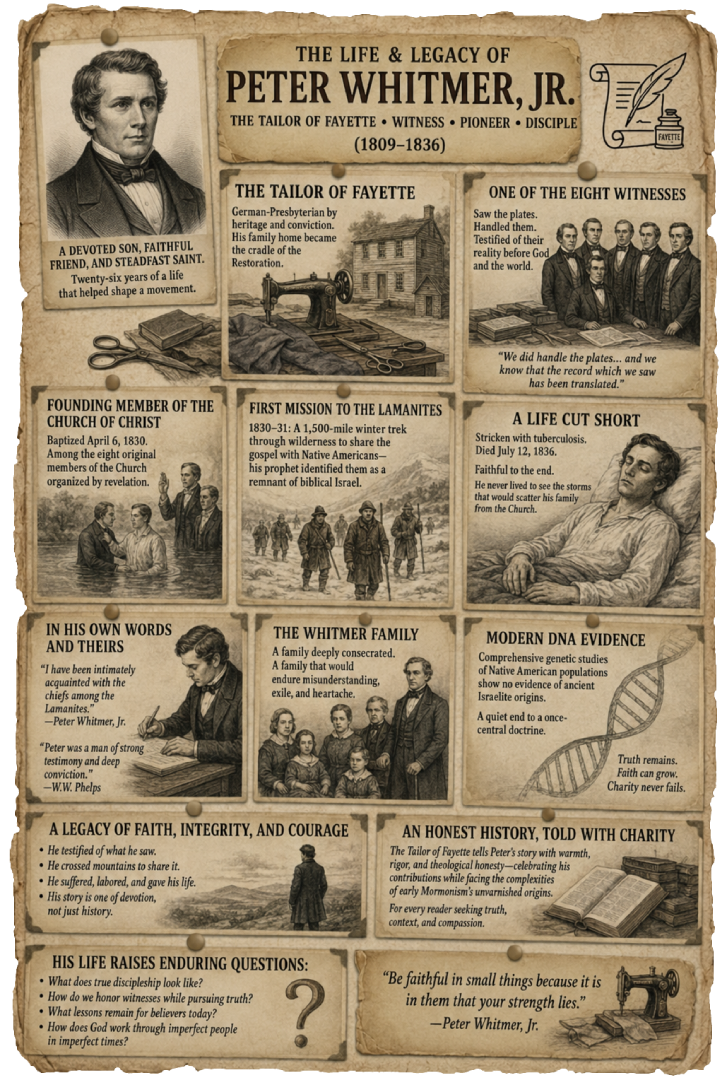
Seventh in the Early Mormon Personalities Series
1,500 Miles to a Mistaken Identity: Peter Whitmer, Jr.’s
Mission to a People Who Were Never There
1809 – 1836
❦ ❦ ❦
I. Prologue: A Cabin, a Cow, and the Birth of an American Religion
On a humid June evening in 1829, in a log cabin tucked into the rolling farmland of Seneca County, New York, a slender, dark-haired young man named Peter Whitmer, Jr.—not yet twenty years old, the son of a German-speaking Presbyterian farmer—stepped out into the pasture to bring in the cows. He could not have known, on that ordinary frontier evening, that his family’s modest farmhouse had become the geographic center of what would soon become one of the largest indigenous American religions. His older brother David was harvesting hay. His mother, Mary Musselman Whitmer, was managing the boarding-house chaos of having two extra mouths—a charismatic young man named Joseph Smith and his wife Emma—living under her roof. And in the upstairs room, Joseph and his scribe, the schoolteacher Oliver Cowdery, were doing something Peter could only have heard about in fragments: they were translating, by means Peter never quite saw, what would shortly be published as the Book of Mormon.
Peter Whitmer, Jr.’s name does not blaze across early Mormon history with the heat of a Joseph Smith, the controversy of a Sidney Rigdon, or the longevity of a Brigham Young. He died at twenty-six. He left behind no journals of theological reflection, no extended sermons, no rivalries that fractured the movement. His personal account of his eighteen-month, 1,500-mile missionary expedition into the wilderness of the American frontier consists, almost entirely, of the disarmingly simple sentence: “We declared the Book of Mormon.” And yet this quiet, capable young tailor stands at the very headwaters of the Latter-day Saint movement. He was one of the original Eight Witnesses to the gold plates. He was one of six men officially constituting the Church of Christ on April 6, 1830. He was the youngest of all eleven Book of Mormon witnesses. He was a participant in the first organized missionary effort outside the original American states. And he was the bearer of a doctrine—the identification of Native Americans as a literal remnant of biblical Israel called Lamanites—that would, within his own family’s lifetime, swell into a continent-spanning theological claim, and within ours, collapse under the weight of modern population genetics.
To tell Peter’s story, then, is not merely to recover a minor figure. It is to walk a narrow, well-lit corridor through the founding moment of Mormonism—through a single, closely knit family that, more than any other, gave the new movement its earliest credibility, its first crisis of authority, and, eventually, the fault line on which most of its founding witnesses would walk away. That Peter himself never walked away is, in part, because he never had to: he died too young. Whether he would have stayed, had he lived another two years until his brothers David, John, and Jacob, his brother-in-law Oliver Cowdery, and his other brother-in-law Hiram Page were all excommunicated or had quietly drifted out, is a question history can only ask, never answer.
❦ ❦ ❦
II. Origins and Early Life: A German Family on the Burned-Over District
The Whitmer Household
Peter Whitmer, Jr. was born September 27, 1809, in Fayette, Seneca County, New York, the sixth child and fifth son of Peter Whitmer, Sr., and Mary Musselman. The family was Pennsylvania Germans of devout Reformed Protestant stock, and like so many other German immigrants of the late eighteenth and early nineteenth centuries, they had moved north and west in search of cheaper, more arable land. By 1809, the Whitmers had settled near Seneca Lake on a working farm large enough to support multiple sons and, eventually, two homes for the extended family.
Religious life in the Whitmer household was structured by their German heritage. The family worshipped at Zion’s Church, a German-speaking Presbyterian congregation, an arrangement that placed them culturally adjacent to but slightly outside the mainstream of New York Yankee Protestantism. Joseph Smith’s father once observed that David Whitmer, even as an old man, retained a noticeable “German twang” in his speech, suggesting that German remained the language of family and worship even as English became the language of commerce. The Whitmer children, including Peter, grew up bilingual, biblically literate, and shaped by the deep, sober pietism of their tradition: a piety that prized personal experience of God, plain speech, and the quiet authority of the patriarch over the household.
The geographic setting mattered enormously. Seneca County lay in the heart of what historians have come to call the “Burned-Over District” of western New York—so named because, by the 1820s, wave after wave of religious revival had swept across it like brushfires, leaving the spiritual landscape charred and craving something new. Methodists, Baptists, Presbyterians, Reformed Baptists, Universalists, Shakers, Millerites, and a host of more exotic sects competed for souls in a region whose population was young, mobile, and theologically restless. Camp meetings, anxious benches, ecstatic conversions, and visions of angels were so common as to be almost ordinary. For a thoughtful young man like Peter Whitmer, growing up amid this cacophony of competing claims to apostolic authority, the question “which church is right?” was not a quaint abstraction. It was the air he breathed.
A Family Built on Cohesion
If the Whitmer family had any defining trait beyond their German piety, it was their extraordinary cohesion. Susan Easton Black, surveying their later history, would describe them as “a relatively wealthy and extremely close-knit family with very deep family ties.” Their farm housed multiple buildings; their children, even after marriage, tended to remain physically near and emotionally entangled. This trait would prove a double-edged sword: it gave the early Mormon movement, in its most fragile months, a stable household in which to gestate, but it also meant that when the Whitmers as a family took offense at Joseph Smith, they took offense together, and when they left the church, they left together. Peter’s loyalty to his brothers was, in this sense, a stronger force than perhaps any theological conviction. The question of whether his “conversion” to the new faith was theologically deliberative or fundamentally familial is a question we shall have to keep asking.
The five Whitmer brothers—Christian (b. 1798), Jacob (b. 1800), John (b. 1802), David (b. 1805), and Peter, Jr. (b. 1809)—formed a tightly bonded fraternal block. Three sisters—Catherine (who married Hiram Page), Nancy, and Elizabeth Ann (who would marry Oliver Cowdery)—rounded out the immediate household. The future entanglements of the Whitmers with the Smith family of Manchester, twenty-five miles to the north, were in 1828 still entirely unimagined; but the social mechanism by which they would soon become entangled—the Burned-Over District’s small, gossipy network of religious seekers passing letters back and forth—was already in place.
❦ ❦ ❦
III. The Spiritual Quest and the Path to Mormonism
A Letter, a Plowed Field, and a Prophet on the Road
The story of the Whitmers’ encounter with Joseph Smith does not begin with Peter, but with David. In the spring of 1829, Oliver Cowdery, a Vermont schoolteacher who had boarded with the Joseph Smith Sr. family in Manchester, traveled south to Harmony, Pennsylvania, to assist Joseph Jr. in translating the gold plates Joseph claimed to have received from an angel. Oliver was already acquainted with David Whitmer—the two appear to have met during Oliver’s teaching circuit—and, finding the work in Harmony increasingly endangered by mob hostility, Oliver wrote to David asking whether the translation could be moved to the Whitmer farm in Fayette.
What followed has passed into Mormon hagiography. According to David Whitmer’s later account, the family was at the busiest point of the planting season; David could not leave to fetch Joseph and Oliver until his fields were plowed and fertilized. Then, supposedly, on consecutive days, his fields were miraculously plowed by unseen hands, and his sister Catherine Page reported that three strangers had appeared and skillfully spread the family’s plaster of paris fertilizer with extraordinary speed. The elder Peter Whitmer, Sr., reportedly remarked: “There must be an overruling hand in this, and I think you had better go down to Pennsylvania.” These miraculous interventions—repeated, expanded, and polished in Whitmer family retellings over the next half-century—became the foundational narrative by which the Whitmers explained, to themselves and to their posterity, why they had embraced the new prophet.
By June 1829, Joseph and Emma Smith, with Oliver Cowdery as scribe, had taken up residence in the Whitmer log cabin in Fayette. They would live there—with the Whitmers feeding, housing, and supporting them—for nearly six months. It was an extraordinary act of hospitality and an even more extraordinary financial sacrifice for a working farm family. Mother Mary Whitmer, according to family tradition recorded decades later, was so burdened by the additional labor that she received her own private vision: an angel, identified by family tradition as the Nephite figure Moroni, allegedly showed her the gold plates as compensation for her toil. (The historical reliability of this anecdote, recorded only in the 1870s by her grandson John C. Whitmer, has been questioned even within Latter-day Saint scholarship.) Whether one credits the account or not, the social significance is undeniable: the Whitmer home had become, by midsummer 1829, the operational headquarters of an entirely new religious movement.
Peter’s Personal Revelation: D&C 16
Into this charged household, the nineteen-year-old Peter Whitmer, Jr. was drawn not as a leader but as a younger sibling caught up in something his older brothers had decided was real. There is no surviving record of a personal spiritual crisis on Peter’s part, no account of an extended period of seeking, no anguished journal entries, no preserved sermon describing his decision to embrace Joseph Smith’s claims. What we have, instead, is a short revelation Joseph dictated in Peter’s name—what the Latter-day Saints would later canonize as Doctrine and Covenants 16, given in June 1829. The substance of the revelation was brief and pointed:
Behold, I say unto you, that the thing which will be of the most worth unto you will be to declare repentance unto this people, that you may bring souls unto me, that you may rest with them in the kingdom of my Father.
— Doctrine and Covenants 16:6
It is a striking text. There is no doctrinal exposition; no theology of grace, sin, or atonement; no echo of the Reformed sacramental tradition in which Peter had been raised. It is, rather, a personal commission cast in the syntax of the King James Bible. Peter was being told that his calling, in this newly forming religious movement, was simply to preach. Whether the revelation produced the missionary impulse in Peter or merely sanctified an impulse already there, it would shape the next seven years of his short life.
From the standpoint of historic Christian theology, the revelation is unremarkable in content but unsettling in form. The Reformed tradition in which Peter had been raised affirmed the sufficiency of Scripture—the closed canon of the Old and New Testaments—as the rule of faith and life. The Apostle Paul, writing to a young Timothy, had insisted that “all Scripture is given by inspiration of God” and is “profitable for doctrine, for reproof, for correction, for instruction in righteousness, that the man of God may be perfect, thoroughly furnished unto all good works” (2 Timothy 3:16–17). For a German Presbyterian son to receive a personal, named, dictated oracle through a twenty-three-year-old farmer-prophet was, theologically, a radical break with everything he had ever been taught about how God speaks. That Peter accepted it without hesitation tells us something important. Either his catechetical formation was thinner than the family’s church attendance suggests, or the social pull of his older brothers—David, John, Jacob, and the brother-in-law Hiram Page, all of whom were already deeply involved—was simply too strong for a younger sibling to resist.
❦ ❦ ❦
IV. Role in the Early LDS Movement
Witness to the Plates
Peter Whitmer, Jr., is canonized in Mormon memory primarily for one act: he was one of the Eight Witnesses to the Book of Mormon’s gold plates. The Eight Witnesses—Christian Whitmer, Jacob Whitmer, Peter Whitmer, Jr., John Whitmer, Hiram Page, Joseph Smith, Sr., Hyrum Smith, and Samuel H. Smith—signed a printed statement, included in every edition of the Book of Mormon to this day, declaring that Joseph Smith had “shown unto us the plates of which hath been spoken, which have the appearance of gold; and as many of the leaves as the said Smith has translated, we did handle with our hands; and we also saw the engravings thereon.” The statement is markedly different in tone from that of the Three Witnesses (Oliver Cowdery, David Whitmer, and Martin Harris), who claimed to have seen an angel and heard a heavenly voice. The Eight, by contrast, claimed only a tactile, visual experience of the plates as physical objects.
It is also worth noting how heavily this collective testimony was loaded onto a single extended family. Of the eight names appended to the statement, four are Whitmer brothers (Christian, Jacob, Peter Jr., and John), one is a Whitmer son-in-law (Hiram Page, married to Catherine Whitmer), and three are members of the Smith family (the prophet’s father and two of his brothers). There is not a single uninterested neutral party among them. To a modern observer, the social dynamic looks less like a courtroom of disinterested witnesses and more like the standard kinship-based testimony patterns of nineteenth-century rural America, where extended family bonds and patriarchal pressure routinely produced unanimity on matters of religion. The Latter-day Saint apologetic tradition has long emphasized that none of the Eight Witnesses ever publicly denied their testimony; what is less often emphasized is that several of them—including, eventually, every Whitmer—left the institutional Church Joseph Smith founded, while still maintaining that they had “hefted” the plates.
Peter’s specific role, of all eight, is the least documented. He was nineteen, the youngest of the witnesses. He left no separate, expansive testimony of the experience—only the printed statement and a few brief mentions in the journals of others. The Latter-day Saint scholar Susan Easton Black notes that Peter “may have assisted Joseph as he finished the translation,” though no portion of the surviving Book of Mormon manuscript has been identified in his handwriting. Following the witness experience, Peter remained in Palmyra during the printing of the book, helping his older brother Hyrum Smith and Oliver Cowdery protect the manuscript. The picture that emerges is of a quiet, capable, dependable young man on the periphery of momentous events, doing what he was asked to do without commentary.
Founding Member of the Church
On April 6, 1830, in the Whitmer log cabin in Fayette, the Church of Christ (later renamed the Church of the Latter Day Saints, and finally The Church of Jesus Christ of Latter-day Saints) was formally organized. Six men constituted the founding membership: Joseph Smith, Jr.; his brothers Hyrum and Samuel; Oliver Cowdery; David Whitmer; and Peter Whitmer, Jr. Three of the six, in other words, were Whitmer or about-to-be-Whitmer—David, Peter Jr., and the future husband of their sister Elizabeth Ann, Oliver Cowdery. By any reasonable measure, the Church organized that day was, in its founding moment, a Smith-Whitmer family enterprise.
Peter was baptized—if we follow Susan Easton Black’s chronology—in June 1830 by Oliver Cowdery, who would shortly become his brother-in-law. He was ordained an elder; according to David Whitmer’s later recollection, Peter was among the first seven elders ordained in this dispensation. The theological architecture of “priesthood ordination” by an angelic visitor was being constructed in real time around him; whatever questions a young man raised on the German Reformed catechism might have had about the apostolic legitimacy of these new orders, no record of his asking them survives.
The First Mission to the Lamanites
The most consequential episode of Peter Whitmer, Jr.’s short life was his participation in what the Latter-day Saints call the First Mission to the Lamanites. In September 1830, just months after the Church’s organization, Joseph Smith dictated a revelation directing Peter to accompany Oliver Cowdery on a preaching tour. The revelation, canonized as Doctrine and Covenants 30:5–8, was tender and direct:
Behold, I say unto you, Peter, that you shall take your journey with your brother Oliver; for the time has come that it is expedient in me that you shall open your mouth to declare my gospel… to build up my church among the Lamanites… Be diligent in keeping my commandments, and you shall be blessed unto eternal life.
— Doctrine and Covenants 30:5–6, 8
One month later, in Doctrine and Covenants 32, Parley P. Pratt and Ziba Peterson were called to join Peter and Oliver. Frederick G. Williams, a recent Ohio convert, would join them later. The four (then five) missionaries set out in late October 1830 on what would become an eighteen-month, 1,500-mile journey across half a continent, mostly on foot, mostly through winter, often through trackless snow, at considerable personal expense and physical hardship.
Their itinerary, reconstructed from the journals of Pratt and the brief surviving statements of Peter, ran roughly as follows. From Fayette, New York, they walked west to Buffalo, where they preached among the Cattaraugus Seneca, distributing copies of the Book of Mormon. From Buffalo, they pressed south to the Mentor and Kirtland area of northeastern Ohio, where Pratt sought out a former associate, the Reformed Baptist (Campbellite) preacher Sidney Rigdon. Within weeks, Rigdon and approximately 130 of his congregants were baptized into the new Church—an extraordinary harvest that suddenly made northeastern Ohio the largest concentration of Latter-day Saints anywhere in the world, and one that would, within months, draw Joseph Smith and the entire New York church westward to Kirtland. Lyman Wight, one of the converts, later recalled the impact of the missionaries’ twin testimonies in vivid detail:
One [Oliver] testified that he had seen angels, another [Peter] that he had seen the plates, and that the gifts were back in the Church again.
— Journal of Lyman Wight
From Kirtland, the missionaries pressed on through Ohio, preaching to the Wyandot tribe near Sandusky, then crossing through Cincinnati and on to St. Louis, then trudging the final three hundred miles through deep snow to Independence, in the western frontier of Missouri. From Independence, three of them—Cowdery, Pratt, and Williams—crossed into the Indian Territory (modern-day Kansas) and presented the Book of Mormon to Chief Anderson of the Delaware. The chief was reportedly moved by Cowdery’s address and asked the missionaries to remain through the winter to teach his people. Peter and Ziba Peterson, meanwhile, took up tailoring in Independence to fund the mission. Peter’s surviving journal entry, written December 13, 1831, captures the ultimate fate of the mission with a tailor’s economy:
We came to Independence on the twelfth month on the 13 day of the month. On the 14 day of the month I began to labor with mine own hands. Brother Oliver and Parley and Frederick started to see the Delaware tribe. In a few days they came to see me and Brother Ziba and they declared that the Lamanites received them with great joy. My brethren started again to the Delawares and also to the Cheyennes, but to our sorrow there came a man whose name was Gumoran and told us that he was a man under authority. He told us that he would apprehend us to the garrison. We then resorted among the gentiles and declared the word and baptized 7. We started for the state of Ohio.
— Peter Whitmer, Jr., Journal, December 13, 1831
Federal Indian agent Richard W. Cummins, alerted by competing Christian missionaries (almost certainly Methodists or Baptists with prior denominational footholds among the Delaware), evicted the Mormon elders from Indian Territory because they lacked governmental authorization. The Delaware mission, the explicit reason the four had been called, ended in functional failure: out of an eighteen-month expedition that crossed half the continent, the missionaries baptized only a single-digit number of Native Americans. The mission’s actual fruit—the conversion of Sidney Rigdon, the establishment of Kirtland as the new gathering place, the identification of Independence as the future Zion—was, from the standpoint of the explicit Lamanite commission, an accidental byproduct.
This is a point the institutional Latter-day Saint historiography tends to glide over. The mission to the Lamanites is celebrated in church manuals and seminary curricula as a triumph of early missionary zeal; its actual evangelistic outcome among Native Americans, however, was almost nil. The mission was retroactively reframed as a success because of its incidental consequences for Anglo converts in Ohio. The original target audience—the people Joseph Smith’s revelation in D&C 28 and 32 explicitly named as Lamanites—proved at most uninterested and at worst inaccessible. We shall return shortly to the deeper problem this raises.
Tailor, Husband, High Councilor
Returning to Ohio in the summer of 1831, Peter participated in a Church conference at which he was ordained a high priest by his future brother-in-law, Oliver Cowdery. The minutes preserve a fragment of his speech to the assembled brethren:
My beloved brethren, ever since I have had an acquaintance with the writing of God I have viewed eternity with perfect confidence.
— Minutes, October 25–26, 1831, Joseph Smith Papers
It is, perhaps, the most personally revealing sentence Peter Whitmer, Jr. ever uttered for the historical record. The serenity of it is striking. For a young man of barely twenty-two, who had walked fifteen hundred miles through snow on a mission that had collapsed before its primary objective, who had watched his brothers’ fragile new church survive its first winter on the western frontier, to say that he viewed eternity “with perfect confidence” suggests either an unusually settled spirit or an unusually unreflective one. The sources, frustratingly, do not let us discriminate between these two readings.
Returning to Independence with his family that fall, Peter set up shop as a tailor and was successful enough that he employed Mary Elizabeth Rollins Lightner—later a notable figure in her own right as one of Joseph Smith’s plural wives—as a seamstress. In one of the more darkly ironic vignettes of early Mormon history, Peter was hired by Lilburn W. Boggs—then lieutenant governor of Missouri, soon to become governor and the issuer of the infamous 1838 “extermination order” against the Mormons—to sew Boggs’s inauguration suit. Mary Elizabeth Lightner later recalled:
I went to work for Peter Whitmer, who was a tailor by trade, and just married. He was crowded with work, and Lilburn W. Boggs offered him a room in his house, as he had just been elected lieutenant governor, and wanted Peter to make him a suit for his inauguration ceremonies. Peter did make [the suit], and I stitched the collars and faced the coat. Mr. Boggs often came in to note the progress of the work.
— Mary Elizabeth Rollins Lightner, autobiography (1926)
Peter married Vashti Higley in late 1832—Latter-day Saint sources variously give the date as September 15 or October 14—and the couple had three children. In 1833, the simmering tensions between the Latter-day Saints and the older Missouri settlers in Jackson County exploded into open mob violence. The Whitmers were driven from their homes, their printing office destroyed, their leaders tarred and feathered at gunpoint, and ordered to deny the Book of Mormon (David Whitmer, courageously, refused). Peter and his family fled across the Missouri River into Clay County, where they took refuge in temporary shelters in the mosquito-infested swamplands.
It was almost certainly during this period that Peter contracted the tuberculosis that would kill him. The privations of the flight, the unhealthy environment of the swamps, and the exposure to the Missouri winters: these conditions were the perfect incubators for the white plague of the nineteenth century. Yet even in his weakening state, Peter extended hospitality to Heber C. Kimball, who had arrived with Zion’s Camp in 1834. Kimball’s journal records:
I went to Liberty, to the house of brother Peter Whitmer, which place I reached with difficulty, being much afflicted myself with the disease that was among us. I stayed there until I started for home. I received great kindness from them.
— Heber C. Kimball, “Extract from Journal,” Times and Seasons (March 15, 1845)
His older brother, Christian Whitmer, died in November 1835. In January 1836, Peter—already weakened, already grieving—was nevertheless appointed to the Clay County high council, taking Christian’s seat. He served only eight months. On September 22, 1836, just five days short of his twenty-seventh birthday, Peter Whitmer, Jr. died of tuberculosis in Liberty, Missouri. He was buried beside his brother.
Oliver Cowdery, who had married Peter’s sister Elizabeth Ann, wrote a tribute in the December 1836 issue of the Latter Day Saints’ Messenger and Advocate that has become the standard memorial of the two brothers:
By many in this church, our brothers were personally known: they were the first to embrace the new covenant, on hearing it, and during a constant scene of persecution and perplexity, to their last moments, maintained its truth—they were both included in the list of the eight witnesses in the book of Mormon, and though they have departed, it is with great satisfaction that we reflect, that they proclaimed to their last moments, the certainty of their former testimony.
— Oliver Cowdery, “The Closing Year,” Messenger and Advocate, December 1836
❦ ❦ ❦
V. Controversies, Conflicts, and the Family Schisms Peter Did Not Live to See
The Hiram Page Episode
Peter Whitmer, Jr., left no record of personal theological dissent or moral controversy. His own life, by all available evidence, was uneventful in the moral sense: he worked, he preached, he sewed suits, he married, he died. But the family system in which he lived was not so quiet. Even before the Lamanite mission, the Whitmers were already at the center of two of the earliest authority crises within Joseph Smith’s movement, and a fair-minded biographer cannot tell Peter’s story without telling theirs.
The first crisis came in June 1830, when Oliver Cowdery, then living with the Whitmers, became convinced that one of Joseph Smith’s revelations (specifically the passage now in Doctrine and Covenants 20:37) contained an error. Oliver wrote to Joseph from Fayette, commanding him “in the name of God” to alter the text. The Whitmer family, including Peter Sr. and at least some of the brothers, supported Oliver. Joseph traveled urgently from Harmony to Fayette to argue them down; only after “both labor and perseverance,” supported by Christian Whitmer’s eventual concession, was Joseph able to convince Cowdery and the Whitmer family that they had been in error. The episode is significant for what it reveals about the Whitmers’ early temperament: they were not docile receivers of revelation. They saw themselves as co-equal participants in the unfolding restoration, with prophetic capacities of their own.
The second crisis followed within weeks. Peter’s brother-in-law, Hiram Page, husband of Catherine Whitmer, acquired a black seer-stone—possibly inspired by Joseph’s own use of seer-stones in translation—and began producing his own revelations through it, written down on “quite a roll of papers full of these revelations,” as Newel Knight later recalled. The Whitmer family, again including Oliver Cowdery, accepted Page’s revelations as authentic. Joseph, alarmed, dictated what is now Doctrine and Covenants 28, in which the Lord declared that “no one shall be appointed to receive commandments and revelations in this church excepting my servant Joseph Smith, Jun., for he receiveth them even as Moses” (D&C 28:2). Hiram Page accepted the rebuke; the stone was later destroyed; the Whitmer family was, at the September 1830 conference, brought back into formal alignment with Joseph’s prophetic monopoly. But the underlying tension—the Whitmers’ resistance to Joseph’s claim of exclusive prophetic authority—was never fully resolved. It was banked, deferred, and would surface again in 1837 and 1838 with catastrophic consequences for the family’s standing in the Church.
The Apostasy Peter Did Not Live to See
Peter Whitmer, Jr. died in 1836. Two years later, between March and April 1838, every other living male member of his immediate Whitmer family—David, John, Jacob, and brother-in-law Oliver Cowdery—was either excommunicated from the Church or quietly walked away. The reasons were several and overlapping: the financial collapse of the Kirtland Safety Society and accusations of land speculation; David Whitmer’s growing conviction that Joseph Smith had “gone astray” after 1834 and that the church had been corrupted by post-Book-of-Mormon revelations; John Whitmer’s quarrels over Church property in Far West; the entire family’s mounting resentment of what they perceived as Joseph’s authoritarian centralization.
Peter, had he lived, would by 1838 have been twenty-eight years old. There is no way to know with certainty what he would have done. The Latter-day Saint historian Keith W. Perkins notes that Peter and his older brother Christian “both remained faithful to their testimonies of the Book of Mormon and had endured in faith to the end.” But “to the end,” in Peter’s case, was not 1838 or 1858. It was September 1836. He was already dead by the time the family system in which he was so deeply embedded shattered against the rocks of the Missouri-era crisis. His widow, Vashti Higley Whitmer, did not gather with the Saints to Utah; she remained in Missouri with her in-laws, where the surviving Whitmers settled in Richmond and lived out their lives as respected citizens, faithful to their Book of Mormon testimony but estranged from the institutional Church.
It is here that the institutional Latter-day Saint historiography of Peter Whitmer, Jr. is most subtly tendentious. The standard church biographies—Susan Easton Black’s, Keith Perkins’s, the Doctrine and Covenants Historical Resources entry—uniformly present Peter as a faithful witness who “endured in faith to the end.” This is technically true. But it conceals the structural fact that Peter died young enough to be exempt from the test his entire family failed. To present his early death as a triumph of faithfulness, without noting that his brothers, his brother-in-law, his sister’s husband, and even (on some accounts) his own widow’s continued affiliations all moved in another direction within two years, is to construct a sanitized portrait that elides the family’s later trajectory. Christian apologetics demands more honest accounting. Peter’s faithfulness was real, but it was the faithfulness of a young man who never had to face the deeper crises that broke his elders.
❦ ❦ ❦
VI. Theological Departure from Biblical Christianity
The Lamanite Doctrine and Its Collapse Under DNA
Of all the doctrinal commitments associated with Peter Whitmer, Jr.’s short life, none is more historically consequential—and none has been more thoroughly falsified by modern science—than the identification of Native Americans as the literal descendants of the Lamanites of the Book of Mormon. This doctrine was not peripheral to Peter’s mission. It was the entire stated point of Doctrine and Covenants 28, 30, and 32. The whole rationale for sending four men into the trackless winter west of the Mississippi—the whole reason Peter Whitmer, Jr. was walking through snow toward Independence in late 1830—was the explicit revelatory claim that Native Americans were a remnant of biblical Israel awaiting the gospel.
The Book of Mormon itself, on its title page (composed by Joseph Smith), declared its purpose to be, in part, “to show unto the remnant of the House of Israel what great things the Lord hath done for their fathers.” Generations of Latter-day Saint leaders, from Brigham Young to Spencer W. Kimball to Bruce R. McConkie, taught explicitly and repeatedly that Native Americans were Lamanites in a direct, lineal, biological sense. The 1981 introduction to the Book of Mormon (composed by Bruce R. McConkie) declared the Lamanites to be “the principal ancestors of the American Indians.” Spencer W. Kimball preached, in 1975, of the “Day of the Lamanite,” celebrating the increasing numbers of Native American Latter-day Saint converts as the prophetic fulfillment of the Book of Mormon’s promises.
Then came population genetics. Beginning in the late 1990s and accelerating through the 2000s, mitochondrial DNA studies, Y-chromosome studies, and full-genome analyses of indigenous American populations established with overwhelming consilience that Native Americans descend predominantly from East Asian ancestral populations who crossed the Beringian land bridge between roughly 25,000 and 15,000 years ago. There is no detectable genetic signal of Middle Eastern ancestry in pre-Columbian Native American populations of the magnitude or distribution required by the Book of Mormon’s narrative. The genetic evidence is not a fringe scientific position; it is the consensus of every relevant peer-reviewed field, from molecular anthropology to archaeogenetics.
The Latter-day Saint institutional response, articulated most fully in the 2014 Gospel Topics essay “Book of Mormon and DNA Studies,” represents one of the most striking doctrinal retreats in modern American religious history. The essay quietly abandons the prior teaching that Native Americans are the principal descendants of the Lamanites, suggesting instead that the Book of Mormon peoples may have been a small, genetically swamped group whose DNA signal has been diluted beyond recoverability by the much larger pre-existing populations who descended from East Asian ancestors. The 2006 introduction to the Book of Mormon was quietly altered: “the principal ancestors of the American Indians” became “among the ancestors of the American Indians.” One word—“among”—silently absorbed two centuries of doctrinal commitment.
From a Christian apologetic standpoint, this retreat is significant for several reasons. First, it establishes that the Lamanite doctrine, as historically taught and as Peter Whitmer, Jr. understood it, was empirically false. The Native Americans to whom Peter, Oliver, Parley, and Ziba walked fifteen hundred miles in the winter of 1830 were not, biologically or genealogically, what those missionaries had been told they were. The whole evangelistic premise of D&C 32 was mistaken. Second, the institutional response—altering the introduction silently, retreating to the protection of “limited geography” theories, and reframing the Book of Mormon’s claims as nuanced and qualified—exemplifies the pattern of historical revisionism that careful Latter-day Saint historiography has had to learn to perform under empirical pressure. The doctrine has not been retracted; it has been quietly redefined to insulate it from falsification.
Third—and this matters most for our biographical purposes—the collapse of the Lamanite doctrine does not necessarily impugn Peter Whitmer, Jr.’s personal sincerity. He believed what he was told. He walked because he believed. He preached because he believed. There is no evidence whatsoever that Peter himself ever had to doubt the doctrine. But the doctrinal foundation of his most consequential act of obedience has, two centuries later, been shown to rest on empirical sand. From a Christian theological standpoint, this raises uncomfortable questions about the nature of revelatory claims that can be falsified by DNA evidence—questions that Latter-day Saint apologists have not yet answered to the satisfaction of historic Christian theology.
Other Departures from Historic Christian Teaching
Beyond the Lamanite doctrine, Peter Whitmer, Jr.’s early Latter-day Saint affiliation involved several other doctrinal commitments that diverge sharply from biblical Christianity:
-
Continuing canonical revelation. The Reformed tradition in which Peter was raised affirmed the closed canon of Scripture; the Mormonism he embraced affirmed an open canon, with new dictated revelations regularly added. This is the issue on which Peter’s brother David would later break: David came to believe Joseph had “gone astray” after the Book of Mormon, and rejected nearly every post-1834 revelation. The biblical warning against adding to or subtracting from God’s word (Revelation 22:18–19; Deuteronomy 4:2) became the unspoken hinge on which the Whitmer family’s later apostasy would turn.
-
An additional book of scripture. The Book of Mormon was presented as “another testament of Jesus Christ,” supplementing rather than illuminating the Bible. To historic Christian theology, the sufficiency of Scripture is a foundational commitment (2 Timothy 3:16–17). The Book of Mormon’s introduction of new doctrines—including, in its pages, an account of Jesus Christ visiting the Americas after his resurrection—is a categorical departure from the biblical witness to the universality and sufficiency of Christ’s once-for-all redemptive work in Palestine (Hebrews 9:26–28).
-
A restored “priesthood” hierarchy. Peter was ordained an elder, and later a high priest, in a system that claimed to restore the Aaronic and Melchizedek priesthoods through angelic visitations to Joseph Smith and Oliver Cowdery. The book of Hebrews, however, presents Jesus Christ as the singular and final High Priest in the order of Melchizedek (Hebrews 7:23–28), whose priesthood is “unchangeable,” rendering all earlier priestly mediation obsolete. The Mormon claim of restored priestly orders is, on a careful reading of Hebrews, theologically redundant and christologically diminishing.
-
Material plates and a tactile witness. The Eight Witnesses’ statement, which Peter signed, claims to have “hefted” physical gold plates with engravings. Whether or not one credits this, the theological point is that the Mormon system grounds its truth claim partly in a physical artifact rather than in the apostolic testimony to a public, historical resurrection. Christian faith is grounded in a publicly attested resurrection witnessed by hundreds (1 Corinthians 15:3–8), not in private artifacts shown only to family members and close associates.
None of these departures appears, in the surviving record, to have given Peter Whitmer, Jr., theological pause. He embraced the new system in his late teens and held it until his death at twenty-six. Whether this represents settled spiritual conviction or, more likely, the gravitational force of an enormously cohesive family system in which his older brothers, his future brothers-in-law, and his parents had already committed to the new prophet is the central interpretive question of his life.
❦ ❦ ❦
VII. Eyewitness Perspectives
The historical Peter Whitmer, Jr., is glimpsed through fragments. He left no extended journal, no published sermons, and no letters that have survived in number. The portrait that emerges from contemporary observers is brief but consistent: a quiet, dependable, capable young man, pious without being theatrical, hardworking, generous, and overshadowed by his more prominent older brothers.
[Peter and Christian Whitmer] were the first to embrace the new covenant, on hearing it, and during a constant scene of persecution and perplexity, to their last moments, maintained its truth.
— Oliver Cowdery, brother-in-law of Peter Whitmer, Jr., Messenger and Advocate, December 1836
I went to Liberty, to the house of brother Peter Whitmer… I received great kindness from them.
— Heber C. Kimball, Times and Seasons, March 15, 1845
I went to work for Peter Whitmer, who was a tailor by trade, and just married. He was crowded with work…
— Mary Elizabeth Rollins Lightner, Utah Genealogical and Historical Magazine, July 1926
One [Oliver] testified that he had seen angels, another [Peter] that he had seen the plates, and that the gifts were back in the Church again.
— Lyman Wight, recalling his 1830 conversion, in a letter copied by Heman C. Smith
Ever since I have had an acquaintance with the writing of God, I have viewed eternity with perfect confidence.
— Peter Whitmer, Jr., remarks at the conference of October 25–26, 1831
Among those testifying that they had seen the plates, and had handled them with their hands…
— Emily M. Coburn, recalling Peter Whitmer, Jr.’s testimony in 1830s Jackson County, Missouri
The cumulative impression these fragments give is of a young man who occupied his place in the early Restoration with quiet dignity. There are no preserved jokes, no anecdotes of warmth or humor, no biting remarks of frustration with his more famous brothers. Peter slips through the historical record almost invisibly, leaving only the shape of his absence behind.
❦ ❦ ❦
VIII. Character Study and Moral Evaluation
Any honest character portrait of Peter Whitmer, Jr. must begin with humility about how little we have to work with. We have no letters that reveal his interior life, no journal of any depth, no preserved theological reflection. What we have are second-hand testimonies, brief institutional records, and the silent testimony of his actions. From these, certain features emerge.
First, Peter possessed real personal courage. The 1,500-mile winter expedition with Cowdery, Pratt, and Peterson was not undertaken by men of weak constitution. Peter walked through trackless snow, lived on the charity of strangers, faced federal eviction, and supported himself by his own hands when funds ran out. He served on the Clay County high council while dying of tuberculosis. He extended hospitality to Heber C. Kimball when Peter himself was seriously ill. None of this is the conduct of a man who shrinks before hardship. Peter’s faith—whatever its theological foundations—produced concrete, demonstrable actions of self-denial.
Second, Peter possessed real personal capability. He was an accomplished tailor, successful enough to employ others and to be hired by the lieutenant governor of Missouri for ceremonial work. He could read and write, evidently in both English and German. He could survive on the frontier without immediate family support. He held leadership positions—elder, high priest, missionary, high councilor—from the age of twenty until his death.
Third, Peter’s central blind spot, viewed with the benefit of two centuries, was almost certainly the same blind spot that afflicted his entire family system: an inability to test the claims of Joseph Smith against the closed canon of biblical Scripture in which they had been raised. The Whitmers were biblically literate; their Reformed Presbyterian formation should have given them the doctrinal categories and the textual instincts to ask whether new revelations through a single, charismatic, twenty-three-year-old seer were consistent with the apostolic warning of Galatians 1:8: “Though we, or an angel from heaven, preach any other gospel unto you than that which we have preached unto you, let him be accursed.” That none of the five Whitmer brothers, so far as the surviving record shows, ever subjected Joseph’s claims to that biblical test in any sustained way is a remarkable fact about the cohesion-driven character of their conversion.
Fourth, Peter’s character is inseparable from his familial position. He was the youngest brother. His decisions were made in the slipstream of older siblings who had already decided. There is no preserved record of Peter independently investigating Joseph Smith’s claims; his entrance into the new movement appears to have been mediated entirely through his older brothers David and John, his brother-in-law Hiram Page, and the household guest Oliver Cowdery. To say this is not to diminish Peter; it is simply to recognize that his conversion was, in significant part, an act of family solidarity. The same family solidarity that brought him into the movement would, two years after his death, take his brothers out of it.
Fifth, and most poignantly, Peter died too young to be tested. The deepest tests of religious commitment in early Mormonism—the Kirtland banking collapse, the Missouri-era authority crises, the Far West excommunications, the polygamy revelation, the Nauvoo years, the succession crisis after Joseph’s death, the trek west—all came after September 1836. Peter never had to face them. His faithfulness, real as it was, was the faithfulness of a young man whose convictions were never stress-tested by the events that would shatter the convictions of nearly everyone around him. To portray Peter as the archetype of Mormon fidelity—as institutional Latter-day Saint historiography sometimes does—is to construct a martyr-figure on an unfair foundation. He was a sincere, capable, tubercular young man who died before the storm. That is enough to remember him by; it does not need to be more.
❦ ❦ ❦
IX. Legacy and Impact
On the Mormon Movement
Peter Whitmer, Jr.’s direct legacy on the Latter-day Saint movement is, paradoxically, both crucial and faint. He is one of the eight signatures appended to the Book of Mormon’s witness statement—a signature that has been printed on every copy of the Book of Mormon since 1830, and that remains, in the official Latter-day Saint apologetic, one of the central lines of evidence for the book’s divine origin. In that narrow but lasting sense, Peter’s name has been read by more people than the names of most United States presidents.
He was also one of the four missionaries who, by accident of geography rather than by intent, brought the Mormon movement into Ohio. The conversion of Sidney Rigdon and his Reformed Baptist congregation transformed the Latter-day Saints from a small New York family enterprise into a genuinely interregional movement and provided the demographic mass that made Kirtland, and ultimately the westward gathering, possible. Peter Whitmer, Jr. did not preach the sermon that converted Sidney Rigdon—Parley P. Pratt did—but he was one of the four men whose journey made that sermon possible. The Mormon movement, in its earliest formative phase, would have looked very different without his footprints in that snow.
The Whitmer Family Question
The deeper question raised by Peter’s life is the question of his family. Why did the Whitmers, having given the early Mormon movement so much—their home, their hospitality, their early labor, their witness, their loyalty—almost all leave it within a decade of its founding? David Whitmer’s 1887 pamphlet, An Address to All Believers in Christ, is the fullest surviving answer. David there argued that the original “Church of Christ” of 1830 was the true church and that everything Joseph Smith introduced afterward—high priests, the changed name of the church, additional revelations, temple ordinances, baptism for the dead—was a corruption. David’s bitterness toward Joseph was undisguised; he refused to even attend the high council that excommunicated him. He spent the last fifty years of his life in Richmond, Missouri, running a livery stable, giving over fifty interviews to journalists and curiosity-seekers, and insisting until his death that the gold plates were real and that everything after Joseph’s first “going astray” in 1834 was apostasy.
Peter, dead in 1836, never wrote such a pamphlet. We do not know whether, had he lived, he would have. The institutional Latter-day Saint historiography assumes he would have remained faithful, citing Oliver Cowdery’s tribute. But Cowdery’s tribute was written in 1836, before Cowdery himself was excommunicated for dishonesty in 1838. Faithfulness in the early 1830s was not predictive of faithfulness in 1838. Peter’s brother John, the most prominent Whitmer to remain in Missouri, was excommunicated in March 1838 for taking personal title to Church property and refused to return to the Church for the remaining four decades of his life. Yet John, even out of the Church, never denied his Eight Witnesses testimony. As late as 1839, before a hostile mob, John told Theodore Turley:
I now say, I handled those plates; there were fine engravings on both sides. I handled them; and they were shown to me by a supernatural power.
— John Whitmer to Theodore Turley, 1839, in History of the Church 3:307
This pattern—remaining loyal to the Book of Mormon witness while leaving the institutional Church—is perhaps the most striking feature of the Whitmer family legacy. It suggests that the witnesses’ testimonies, whatever else may be said about them, cannot be dismissed as the confabulations of men who simply followed Joseph Smith blindly to the end. They followed him for a time; they parted from him; they continued to insist that the Book of Mormon was real. From a Christian apologetic standpoint, this requires more careful engagement than either uncritical acceptance or facile dismissal. The most defensible reading is that the witnesses experienced something they sincerely believed to be supernatural, but that the theological framework they were given for interpreting that experience—the Lamanite doctrine, the priesthood claims, the prophetic centralization—was ultimately not a faithful expansion of biblical Christianity but a departure from it.
The Lamanite Doctrine: Then and Now
Peter Whitmer, Jr.’s mission to the Lamanites is now, two centuries on, an artifact of doctrinal history that the Latter-day Saint Church has had to manage carefully. The 2025 Doctrine and Covenants Historical Resources entry on Peter, produced by the Church itself, mentions the mission briefly and noncommittally: he “served a mission in western Missouri and across the Missouri border in Indian Territory.” The word “Lamanite” does not appear in the entry. The institutional church has, in effect, demoted the doctrinal occasion of Peter’s mission while continuing to celebrate the mission itself.
This is historical revisionism of a particularly delicate sort: not a denial, but an elision. The mission to the Lamanites is celebrated; the doctrine of Lamanite identity is no longer foregrounded. The 2014 Gospel Topics essay on DNA and the Book of Mormon performed similar surgery on the broader doctrine, retreating from the prior teaching that Native Americans are the principal descendants of Lehi to the much narrower (and unfalsifiable) claim that they are “among” descendants of an unspecified group. To Peter Whitmer, Jr., walking westward through Ohio in November 1830 with copies of the Book of Mormon to give to the people he had been told were the descendants of Manasseh, this distinction would have been incomprehensible. He believed, on the authority of revelations dictated by Joseph Smith, that he was carrying the gospel to a remnant of Israel. He was not. The careful Christian historian must say so plainly: the mission was based on a doctrinal premise that has not survived genetic testing, and the institutional retreat from that premise has been a quiet one.
❦ ❦ ❦
X. Conclusion: The Tailor Who Walked Through the Snow
Peter Whitmer, Jr. died on September 22, 1836, in a small frame house in Liberty, Missouri, of tuberculosis, just five days short of his twenty-seventh birthday. His widow, Vashti, would eventually die in obscurity, her place of death unknown to the historians of either the Latter-day Saint or non-Latter-day Saint traditions. His daughter, Vashti P. Whitmer, lived until 1903, dying in Richmond, Missouri, a lifelong member of the small Whitmer enclave that maintained the Book of Mormon witness without rejoining the church. He is buried in Clay County, Missouri, beside his older brother Christian, whose seat on the high council he took up for those last brief eight months.
What does Peter Whitmer, Jr.’s life mean for those who, like the present writer, examine it from a vantage point of historic biblical Christianity? Three observations seem warranted, each of which honors his humanity while soberly assessing his theological commitments.
First, Peter was a sincere young man whose sincerity is not in doubt. He embraced what he believed to be a divine work. He suffered for it. He preached it. He died, ultimately, of conditions exacerbated by the persecution he endured for it. The Christian apologist who treats him as a fraud or a charlatan misreads the evidence and dishonors the dead. The most fitting response to Peter’s sincerity is to engage seriously the question he never had time to consider: whether the system he embraced was a faithful restoration of apostolic Christianity or a nineteenth-century departure from it.
Second, the case for departure is, on a biblical examination, overwhelming. The Lamanite doctrine has not survived population genetics. The priesthood claims do not survive a careful reading of Hebrews. The continuing canonical revelation does not survive the apostolic warnings of Galatians 1:8 and Revelation 22:18–19. The Book of Mormon’s geographic and ethnographic claims do not survive archaeology. None of this requires us to dismiss Peter Whitmer, Jr. as anything other than what he was: a sincere, capable young man who entered, in his late teens, into a religious movement whose founding claims have not stood up to two centuries of scholarly scrutiny.
Third—and this is where the Christian assessment must turn pastoral—the question of how a faithful nineteenth-century Reformed Presbyterian son could be drawn into such a system in his late teens deserves a more honest answer than either Mormon hagiography or anti-Mormon polemic typically provides. The answer, in Peter’s case, is family. His brothers were already in. His sister was about to marry the prophet’s right-hand man. His parents had opened their home. His brother-in-law was producing his own black-stone revelations. The social cost of dissent within the Whitmer family system was, in 1829, prohibitive. Peter, the youngest son, did what younger sons do: he followed his older brothers. The theological investigation that biblical Protestantism would have required of him—a careful comparison of the new claims with the closed canon of Scripture—was not the kind of investigation his family system encouraged. By the time he might have undertaken such an investigation, he was already in Independence, Missouri, sewing a suit for Lilburn W. Boggs and contracting the tuberculosis that would kill him.
Peter Whitmer, Jr. was not a great theologian, not a great preacher, not a great writer. He was a tailor who walked fifteen hundred miles through the snow to give the Book of Mormon to people who turned out not to be the people he had been told they were. He was a younger brother who said yes to his older brothers, and stayed in—because he died young enough to never have to choose otherwise. He was a witness who signed his name on a printed page that has been read in the millions, by people who have, in part because of his quiet integrity, embraced a system whose foundational claims a careful biblical Christianity must, in the end, regretfully decline.
His grave in Clay County is, almost certainly, unmarked or barely marked. There is no shrine, no pilgrimage site, no annual observance. Peter Whitmer, Jr., left nothing behind but a printed name in a book and a handful of journal entries by men who briefly knew him. And yet the ripples of his eighteen-month walk through the wilderness of 1830 reach into the doctrinal life of fifteen million Latter-day Saints today. Few quiet lives have rippled so far. Few have rested on so theologically uncertain a foundation. May we who examine his story do so with both the truthfulness his life deserves and the charity his sincerity earned.
❦ ❦ ❦
PRIMARY SOURCES AND CITATIONS
This essay draws on contemporary journals, the Joseph Smith Papers, institutional Latter-day Saint historical resources, and independent academic scholarship. The principal URL-accessible sources consulted include:
• Wikipedia, “Peter Whitmer Jr.”: https://en.wikipedia.org/wiki/Peter_Whitmer_Jr.
• The Church of Jesus Christ of Latter-day Saints, Doctrine and Covenants Historical Resources, “Peter Whitmer Jr.”: https://www.churchofjesuschrist.org/study/history/doctrine-and-covenants-historical-resources-2025/people/bio-peter-whitmer-jr?lang=eng
• Doctrine and Covenants Central, “Peter Whitmer, Jr.” by Susan Easton Black: https://doctrineandcovenantscentral.org/people-of-the-dc/peter-whitmer-jr/
• Scripture Central KnoWhy #600, “Why Was Peter Whitmer Jr. Chosen to Witness the Gold Plates?”: https://scripturecentral.org/knowhy/why-was-peter-whitmer-jr-chosen-to-witness-the-gold-plates
• Doctrine and Covenants Student Manual, “Section 32, The First Mission among the Lamanites”: https://www.churchofjesuschrist.org/study/manual/doctrine-and-covenants-student-manual/section-32-the-first-mission-among-the-lamanites?lang=eng
• Sarah Newcomb, “Beliefs, Apologetics, and Lamanites,” Lamanite Truth: https://lamanitetruth.com/2019/11/22/beliefs-apologetics-and-lamanites/
• Witnesses of the Book of Mormon, Peter Whitmer Jr. life history (Internet Archive): https://web.archive.org/web/20210624213626/https://witnessesofthebookofmormon.org/eight-witnesses/peter-whitmer-jr/life-history/
• Witnesses of the Book of Mormon, Peter Whitmer Jr. statements (Internet Archive): https://web.archive.org/web/20210621063806/https://witnessesofthebookofmormon.org/eight-witnesses/peter-whitmer-jr/statements/
• Sisters at the Well, “The Whitmers”: http://www.sistersatthewell.org/Sisters_at_the_Well/D&C__Beginnings_files/The%20Whitmers.pdf
• Joseph Smith Papers, “License for Peter Whitmer Jr., 28 March 1836”: https://www.josephsmithpapers.org/paper-summary/license-for-peter-whitmer-jr-28-march-1836/1
• Trent Dee Stephens, PhD, “What Happened to the Whitmers?”: https://www.trentdeestephens.com/post/what-happened-to-the-whitmers
• Reddit r/latterdaysaints, information on two of the witnesses: https://www.reddit.com/r/latterdaysaints/comments/p1enwl/here_is_some_information_on_two_of_the_witnesses/
• Tokens and Signs, “Come Follow Me, 11 April 2021”: https://tokensandsigns.org/cfm-11-april-2021/
• BYU Religious Studies Center, “Messengers of the Message: The Missionaries to the Lamanites”: https://rsc.byu.edu/regional-studies-latter-day-saint-church-history-ohio-upper-canada/messengers-message-missionaries-lamanites
• Keith W. Perkins, “True to the Book of Mormon—The Whitmers,” Ensign (February 1989): https://www.churchofjesuschrist.org/study/ensign/1989/02/true-to-the-book-of-mormon-the-whitmers?lang=eng
• Scripture Central, “Peter Whitmer Jr.” evidence summary: https://scripturecentral.org/evidence/peter-whitmer-jr
• Wikipedia, “John Whitmer”: https://en.wikipedia.org/wiki/John_Whitmer
• Andrtn, “Peter Whitmer Jr in 1829” (Facebook): https://www.facebook.com/Andrtn/posts/peter-whitmer-jrin-1829-twenty-year-old-peter-whitmer-jr-became-acquainted-with-/10234788652366253/
A Note on Research Methods and Accuracy
In recent years, some have voiced concern that artificial intelligence may distort facts or introduce inaccuracies into serious research. That criticism deserves acknowledgment. However, AI has now evolved into the most powerful research instrument available to any dedicated scholar—capable of analyzing vast datasets, cross‑referencing historical records, and surfacing overlooked connections across sources. This work represents a collaboration between the author’s investigative inquiry, verified primary documentation, and the advanced analytic capabilities of AI research tools. Here, AI was not used as a ghostwriter or a shortcut for scholarship, but as a disciplined research partner devoted to rigor, accuracy, and transparency.
Every factual claim in this work has been subjected to active verification. Where AI‑generated content was used as a starting point, it was tested against primary sources, peer‑reviewed scholarship, official institutional documentation, and established historical records. Where discrepancies were found—and they were found—corrections were made. The author has made every reasonable effort to ensure that quotations are accurately attributed, historical details are precisely rendered, and theological claims fairly represent the positions they describe or critique.
That said, no work of this scope is immune to error, and the author has no interest in perpetuating inaccuracies in the service of an argument. If you are a reader—whether sympathetic, skeptical, or hostile to the conclusions drawn here—and you identify a factual error, a misattributed source, a misrepresented teaching, or a claim that cannot be substantiated, you are warmly and genuinely invited to say so. Reach out. The goal of this work is not to win a debate but to get the history right. Corrections offered in good faith will be received in the same spirit, and verified corrections will be incorporated into future editions without hesitation.
Truth, after all, has nothing to fear from scrutiny—and neither does this work.
❦ ❦ ❦
THE RIGHTEOUS CAUSE
Early Mormon Personalities Series — Post Eight