
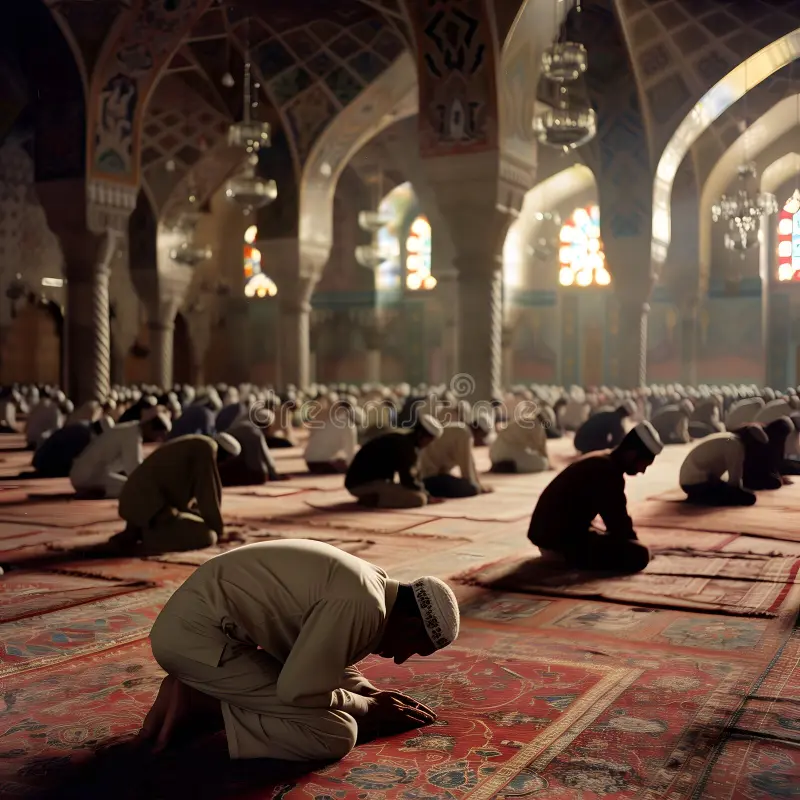
Why the Prophet’s Statecraft Still Governs the Argument
❦ ❦ ❦
I. Introduction: The Question Nobody Asks Precisely Enough
In February and again in May of 2026, the Subcommittee on the Constitution and Limited Government of the United States House Judiciary Committee convened hearings under a title that left nothing to inference: “Sharia-Free America: Why Political Islam & Sharia Law Are Incompatible with the U.S. Constitution.” The chairman opened the second hearing by declaring that America faces an existential threat. The ranking member responded that the subject “doesn’t even rank on the list of top 10 issues keeping Americans up at night,” and that the hearing was a manufactured crisis timed to a Texas primary runoff. Both statements were delivered under oath of office, in the same room, within twenty minutes of each other.
That exchange is a fair portrait of the public conversation. One side speaks of civilizational conquest; the other speaks of bigotry and distraction. Neither side, in that particular room on that particular morning, spent much time on the question that actually decides the matter, which is narrower and far less satisfying than either party would like: what, exactly, is being claimed to be incompatible with what?
This essay is an attempt to ask that question with the precision it deserves and then to answer it. The answer I will defend, and defend on the strength of the sources rather than on the strength of assertion, is this: a Sharia-based political order—that is, classical Islamic jurisprudence applied as coercive public law by a state—is genuinely and structurally incompatible with secular constitutional democracy. It is incompatible not because its adherents are uniquely violent, not because Muslims are uniquely resistant to civic life, and not because the West is uniquely virtuous. It is incompatible because the two systems answer the same foundational question—who possesses the authority to make law binding on human beings?—in ways that cannot both be true at once.
I will also defend a second claim, which cuts in a different direction and which many who share my first conclusion will find unwelcome: Sharia understood as personal religious and ethical discipline—prayer, fasting, almsgiving, dietary observance, honest dealing, filial duty—presents no such conflict, is protected by the First Amendment in precisely the way that Jewish halakhic observance and Catholic canonical observance are protected, and is practiced without incident by the overwhelming majority of the roughly four million Muslims in the United States. Conflating the two is not merely uncharitable. It is analytically fatal, because it produces an argument that cannot survive contact with the actual evidence, and it hands the defenders of the political program the easiest rhetorical victory available to them: the opportunity to answer a charge nobody serious is making.
The distinction I am drawing is not my invention. It is the organizing framework of the most rigorous scholarly treatment of the question in the Christian tradition, Professor Christine Schirrmacher’s six theses for the World Evangelical Alliance, and she states it as plainly as it can be stated:
A Sharia-based type of Islam is not compatible with Western civilization because it is not compatible with democracy, whereas a type of Islam as religion and ethical system that is not Sharia-based is compatible with democracy and Western definitions of human rights and civil liberties.
— Christine Schirrmacher, “Is Islam Compatible with Western Civilization?” World Evangelical Alliance
Schirrmacher is Professor of Islamic Studies at the Protestant University in Leuven and at the University of Bonn, and she lectures on Islam and security to the German parliament. She is not a hostile outsider throwing stones. She is a specialist who has spent a career reading the primary literature in its own language, and her judgment is that the line falls exactly where the political claims fall—not around the religion, but around the program.
What follows attempts to hold that line with discipline across nine sections of argument. I will define the terms as Muslim jurists themselves define them, because the definitional confusion is not accidental and is doing enormous work in the public debate. I will trace the historical formation of the tradition, because the Medinan precedent is the hinge on which everything turns. I will examine the sovereignty problem directly. I will look at where Muslims actually live and how they are actually governed. I will take up the specific questions of accommodation, of so-called radical Islam, of the claim that Islam has always been democratic, of the apologists and the quality of their foundations, and of the assertion—made by some Muslims, denied by others—that Islam is destined to govern the world. I will close with the American controversy of 2026, and with a caution about it that will not please everyone.
A word on method before beginning. I have tried throughout to state the strongest version of each position before assessing it, to quote defenders of Sharia in their own words rather than in summary, and to distinguish sharply between what the evidence establishes and what a partisan would like it to establish. Where the alarmist case overstates, I say so. Where the reassuring case evades, I say so. A reader who finishes this essay convinced that the author was grinding an axe will have caught me in a failure of craft, and I would rather be caught in that failure than commit it deliberately.
❦ ❦ ❦
II. The Word Itself: Why Muslims Argue About What Sharia Means
The prompt that occasioned this essay asks whether there is a genuine controversy, even among Muslim commentators, about the difference between Islamic law and Sharia. There is; it is old, and it is not a public-relations invention of the last two decades.
Begin with the etymology, because for once it is genuinely illuminating rather than decorative. The Arabic root sh-r-ʿ yields a word whose primary sense is a path, and specifically the beaten track leading through arid country to a watering place. Every serious source, hostile and friendly alike, agrees on this. The Council on Foreign Relations renders it “the correct path.” The Conversation glosses it as “originally the track leading to a waterhole in the desert.” The Council on American-Islamic Relations, testifying in effect through its Islamophobia-monitoring project, renders it “the path to water.” Amanda Tyler of the Baptist Joint Committee gave the same definition to Congress under oath in May 2026. This is not contested ground.
What that path consists of, and who is competent to describe it, is contested ground of the fiercest kind. Here the crucial technical distinction is between Sharia and fiqh. The Council on Foreign Relations states it with unusual clarity:
Sharia isn’t the same as Islamic law. Muslims believe sharia refers to the perfect, immutable values understood only by God, while Islamic laws are those based on interpretations of sharia.
— Kali Robinson, “Understanding Sharia: The Intersection of Islam and the Law,” Council on Foreign Relations
Sharia, on this account, is the divine intention itself—complete, perfect, known fully only to God. Fiqh, literally “understanding,” is the human enterprise of discerning that intention from the Qur’an and the Sunna and rendering it into workable rulings. Fiqh is jurisprudence. It is a human science with a literature, a method, a history of internal dispute, and—this is the decisive point—a demonstrated capacity for disagreement and change. Professor Khaled Abou El Fadl of UCLA, one of the most respected Muslim jurists working in the West, puts the practical consequence bluntly: “On any legal issue, there are ten different opinions.”
Five schools of jurisprudence survive as living traditions—four Sunni (Hanafi, Maliki, Shafiʿi, Hanbali) and one principal Shiʿi (Jaʿfari)—and they differ substantively, not merely in emphasis. The Hanafi school leans on reason and analogy and is the most flexible; the Hanbali school confines itself narrowly to text and produced the Wahhabi and Salafi currents; the Maliki school uniquely credits the consensus of the people of seventh-century Medina as an independent source. A Muslim in Ankara, a Muslim in Riyadh, and a Muslim in Qom are not consulting the same rulebook, and their jurists know it.
Professor Intisar Rabb of Harvard Law School pushes the point further, and her formulation is the one that most unsettles the incompatibility thesis in its crude form:
A lot of the rules that are called Islamic are often local, culturally inflected preferences that come to have an Islamic veneer.
— Intisar Rabb, Professor of Islamic Law, Harvard University, quoted in Council on Foreign Relations
Rabb offers a test case that is difficult to answer. Saudi Arabia forbade women from driving and justified the prohibition on Islamic grounds. In 2018, Saudi Arabia permitted women to drive and justified the permission on Islamic grounds. “If it’s truly Islamic,” she asks, “shouldn’t that not change? But it changed a few years ago.”
Now the counter-argument, and it is not a weak one. The Forbes essayist Jaan Islam—a Muslim researcher writing in 2016 explicitly against the reformist reading—argues that the interpretive latitude claimed by scholars like Rabb, if pressed to its conclusion, hollows out the concept of revelation itself:
However, if the Qur’an changes depending on who reads it, then Qur’an itself does not have any commandments. For any devout Muslim, believing that God does not really command anything in the Qur’an is a major problem.
— Jaan Islam, “No, Shariah Law Is Not Compatible With Western Values,” Forbes, October 6, 2016
This is a serious objection, and it deserves to be met rather than dismissed. It confuses two claims, however. Rabb is not arguing that the Qur’an means whatever a reader wants; she is arguing that a great deal of what is popularly labeled Islamic law is in fact regional custom that acquired religious authority by long association. Those are different propositions. The first is relativism. The second is a straightforward historical observation of the sort that any legal historian would make about the common law, in which a startling proportion of what is defended as ancient principle turns out on inspection to be nineteenth-century local practice.
But Jaan Islam has identified something real, and it is worth naming precisely because it constrains the reformist project in a way its friendlier advocates sometimes gloss over. There is a floor. Some rulings are so plainly stated in the Qur’an, so consistently affirmed across all five schools for fourteen centuries, and so bound up with the structure of the tradition that a jurist cannot simply reinterpret them away without a hermeneutical move that most of the tradition regards as illegitimate. The hadd punishments are on the wrong side of that floor. So is the classical law of apostasy. So is the differential legal status of Muslim and non-Muslim under an Islamic polity. These are the hard cases, and every honest treatment of the compatibility question has to reckon with them rather than route around them.
One further distinction belongs here, because it goes almost entirely unmentioned in Anglophone debate and it matters enormously. Classical Islamic political thought does not treat fiqh as coextensive with governance. It recognizes a separate category, siyasa sharʿiyya, roughly “governance in accordance with the Sharia”—the discretionary administrative authority of the ruler in matters the revealed law does not directly settle. The Ottoman qanun, a vast body of secular sultanic legislation running alongside the Sharia courts for four centuries, was justified on precisely this basis. Islamic legal history therefore contains, from within its own resources, a well-developed doctrine that not all law need be revealed law. That is a foothold for reform of enormous potential significance, and it is one that Western critics rarely acknowledge because they have generally not read far enough to know it exists.
So: is there a real controversy among Muslim commentators about the relationship between Sharia and Islamic law? Yes, and the shape of it is this. Nearly all Muslims agree that Sharia is divine and perfect. Nearly all agree that fiqh is human and fallible. They divide, sometimes violently, over how much of the received fiqh is actually load-bearing revelation and how much is human sediment that can be cleared away. That internal argument is the single most consequential intellectual struggle in the Muslim world today, and the outcome of the compatibility question depends on it far more than on anything said in a congressional hearing room.
❦ ❦ ❦
III. The Medinan Precedent: Why History Is Not a Side Issue
Christianity was born under an empire it did not control and spent its first three centuries as an illegal minority sect. Whatever one makes of the subsequent history—and the record of Christendom in power offers little ground for complacency—the founding documents of the faith were composed by men without political authority, addressed to communities without political authority, and framed accordingly. “Render unto Caesar” is a sentence that could only have been spoken from below.
Islam’s founding circumstance was structurally different, and no serious account of the compatibility question can proceed without saying so plainly. The Prophet Muhammad spent roughly thirteen years in Mecca as the leader of a persecuted minority. He then spent roughly ten years in Medina as the head of a polity: legislator, judge, treaty-maker, tax collector, military commander. He died having unified most of the Arabian Peninsula under a single religio-political authority. Roughly a third of the Qur’an’s legal material dates from the Medinan period, and it addresses inheritance, contract, criminal penalty, marriage, warfare, and the treatment of subject populations—the ordinary business of a state.
This is not a hostile characterization. It is the standard Muslim account, offered with pride rather than embarrassment. Consider how the Islamic Circle of North America’s WhyIslam project introduces the subject on its own website:
When the Prophet Muhammad, peace be upon him, first began to receive revelations from God in 610 A.D., little did he know that they were the foundational stones for the formation of a future state to be refined piecemeal over the next 23 years.
— Saulat Pervez, “Islamic Shariah,” WhyIslam (Islamic Circle of North America)
The subheading under which that sentence appears reads: “The Islamic State: A Divinely-Ordained Blueprint for Societal Balance.” This is a mainstream American daʿwa organization, writing for a non-Muslim audience, describing the revelation as the founding charter of a state. The characterization is not smuggled in by critics. It is offered freely by advocates, because within the tradition it is a strength and not a liability.
Mina Yousef, an Egyptian-born scholar of Islamic studies at Southern Baptist Theological Seminary, identifies the two assumptions that follow from this founding and that together generate the modern difficulty:
The first is that Islam is not only a religion but also a social and political order. The second is that Islam’s teachings are valid for all times and places.
— Mina Yousef, “Is Islam Compatible with Western Values?” Christ Over All, June 29, 2026
Either assumption alone is manageable. Christianity holds the second without the first; a great many political ideologies hold the first without the second. Held together, they generate a claim that a comprehensive legal-political order was divinely disclosed in seventh-century Arabia and remains binding in twenty-first-century Michigan. Yousef’s observation that “the sharp separation between religion and politics that developed in modern Western thought has no exact equivalent in classical Islamic jurisprudence or in much of Islamic history” is, so far as I can determine, simply accurate.
Schirrmacher converts this historical observation into a diagnostic criterion, and it is the most useful single test in the literature:
Whoever accepts the theocracy established by Mohammed in Medina (622–632 AD) as an authoritative role model to be imitated in the present can only see democracy as a temporary emergency solution with which one might have to conclude a temporary truce, but which must be replaced, long-term, by an Islamic social order.
— Christine Schirrmacher, World Evangelical Alliance
Note the precision of the criterion. It does not ask whether a person is Muslim. It does not ask whether a person is devout, or observant, or conservative in dress or diet. It asks one question: is the Medinan polity a normative template for political organization today, or is it a historically situated arrangement from which one draws moral and spiritual guidance without treating its constitutional form as binding? That question sorts the population in a way that actually predicts something, and it sorts it along a line that runs straight through Muslim communities rather than around them.
Yousef contributes a second historical observation of considerable explanatory power: the encounter between Islamic thought and external intellectual traditions has repeatedly followed a two-beat rhythm of openness followed by traditionalist reaction. The Abbasid translation movement under al-Maʾmun brought Greek philosophy, medicine, and mathematics into Arabic and produced what is conventionally called the Islamic Golden Age; it was followed by the eclipse of Muʿtazilite rationalism before more traditionalist theology. Napoleon’s landing at Alexandria in 1798 exposed the technological gap with Europe and triggered a modernist reform current under Muhammad ʿAli and later Muhammad ʿAbduh; it was followed by the Islamist reaction of the Muslim Brotherhood and its successors, which held that renewal lay not in accommodation but in return to the sources.
Yousef draws a consequence from this pattern that deserves attention because it runs against comfortable expectation: some Muslim immigrants to the West become more religiously rigid after arrival than they were at home, and this may function as a defensive response to perceived loss of identity rather than as evidence of prior radicalism. If that is right—and it accords with a good deal of what sociologists of migration have observed across religious traditions—then policies designed to force rapid cultural assimilation may produce precisely the entrenchment they are intended to prevent. That is an uncomfortable finding for both sides of the current American argument.
❦ ❦ ❦
IV. The Sovereignty Problem
Everything above is preliminary. Here is the argument.
Secular constitutional democracy is not primarily a set of policy outcomes. It is a procedural claim about the location of legitimate lawmaking authority. In the American formulation, that authority resides in the people, exercised through representatives, bounded by a written constitution that the people themselves may amend. In the British formulation, it resides in the Crown in Parliament. In the French, in the sovereign nation. The formulations differ; the structural feature is identical. Law is a human product, revisable by human procedure, and no other authority may override it within the territory.
Classical Islamic political theology denies this at the root. Not at the level of policy, where accommodation is easy and constant, but at the level of the underlying claim. The most illuminating statement of the difficulty comes not from a critic but from one of the twentieth century’s most sympathetic and sophisticated Muslim advocates of democracy, Muhammad Asad, in The Principles of State and Government in Islam:
Viewed from this historical perspective, ‘democracy’ as conceived in the modern West is infinitely nearer to the Islamic than to the ancient Greek concept of liberty . . . On the other hand, Islam makes it incumbent upon Muslims to subordinate their decisions to the guidance of the Divine Law revealed in the Qur’ān and exemplified by the Prophet: an obligation which imposes definite limits on the community’s right to legislate and denies to the ‘will of the people’ that attribute of sovereignty which forms so integral a part of the Western concept of democracy.
— Muhammad Asad, The Principles of State and Government in Islam
Read that passage twice. Asad is arguing for compatibility. He is a friend of the democratic idea, an Austrian-born convert who served Pakistan as a diplomat and spent his life building intellectual bridges. And in the course of making the most generous case available to him, he concedes exactly the point at issue: divine law “denies to the ‘will of the people’ that attribute of sovereignty which forms so integral a part of the Western concept of democracy.”
That is not a caricature produced by a hostile witness. It is a considered formulation by a learned advocate, and it identifies the fault line with more precision than most critics manage. The disagreement is not about whether Muslims may vote, hold office, serve on juries, or run for Congress. Of course they may, and four currently do. The disagreement is about whether a legislature’s enactments are legitimate in themselves or only insofar as they conform to a prior and higher law that no vote may amend.
Islamist writers state the consequence without Asad’s regret. Abul Aʿla Maududi, whose influence on twentieth-century political Islam is difficult to overstate, coined the term “theo-democracy” for a system he was careful to distinguish from Western democracy: the entire Muslim community, rather than a clerical caste, would administer a state whose law was fixed in advance by revelation. The scholar Youssef Choueiri’s description of what such a state would actually look like is worth quoting because it is a critique of Maududi from within Middle East studies rather than from outside it:
an ideological state in which legislators do not legislate, citizens only vote to reaffirm the permanent applicability of God’s laws, women rarely venture outside their homes lest social discipline be disrupted, and non-Muslims are tolerated as foreign elements required to express their loyalty by means of paying a financial levy.
— Youssef M. Choueiri, Islamic Fundamentalism: The Story of Islamist Movements
Legislators who do not legislate is not a rhetorical flourish. It is the logical terminus of the position, and Ayatollah Khomeini reached it explicitly in Islamic Government: Governance of the Jurist, where he denied the need for any legislative body on the ground that “no one has the right to legislate . . . except . . . the Divine Legislator.” Told during the revolution that Iranians wanted democracy, he instructed them: “Do not use this term, ‘democratic.’ That is the Western style.”
A cluster of Salafi jurists reaches the same terminus by a different road, holding that democracy is not merely mistaken but shirk—the association of partners with God—because it locates in a human assembly a legislative power belonging to God alone, and because it can in principle legalize what God has forbidden. It is worth noting, because it complicates the picture in an instructive way, that several of the same scholars who reason this way about Muslim-majority states nonetheless encourage Muslims in Western countries to vote, on grounds of choosing the lesser evil or advancing Muslim interests. Bin Baz, Ibn Uthaymeen, and the Saudi Permanent Committee for Scholarly Research and Ifta have all issued guidance along these lines. This is a real position held by real authorities, and it is neither the reassuring picture of unqualified civic embrace nor the alarming picture of monolithic subversion. It is instrumental participation within a theory that denies the system’s ultimate legitimacy.
David Goldman, writing in First Things, argues that the sovereignty divergence reaches further down than constitutional theory, into the structure of authority within the household itself. His thesis is that Islamic law devolves a fragment of sovereign coercive power to the family patriarch as “governor” of his domestic realm, whereas Western law reserves to the state a monopoly on legitimate violence and places every individual in direct relation to the sovereign:
The sovereign grants inalienable rights to every individual in Western society, of which protection from violence is foremost. Every individual stands in direct relation to the state, which wields a monopoly of violence.
— David P. Goldman, “Why Sharia Is Incompatible With Western Law,” First Things, May 24, 2010
Goldman’s central structural insight—that a legal order distributing coercive authority through a nested hierarchy of clan, tribe, and household is a different kind of thing from one channeling all coercion through a single accountable sovereign—is genuinely valuable and clarifies why the disagreement resists compromise. His essay also, I am obliged to note, contains errors that a scholarly reader should not pass over. He twice cites Surah 4:32 when he means 4:34. His claim that no Muslim religious authority of standing has repudiated the disciplinary reading of that verse was doubtful when written and is untenable now; a substantial body of contemporary jurisprudence, including work by Muslim women scholars such as Amina Wadud and Laleh Bakhtiar, reinterprets the operative verb daraba to mean separation rather than physical correction. The structural argument survives these defects. The rhetorical framing does not, and citing him without the correction would be intellectually careless.
It should also be said that Goldman’s contrast between Islamic law and halakhah, which he calls “entirely specious,” is the weakest passage in his essay. Rabbinic law also contains extensive provisions regarding domestic authority, capital punishment, and the legal disabilities of non-Jews. What renders halakhah compatible with Western law is not superior content but the fact that its practitioners have, for the better part of two millennia, operated it as a voluntary internal discipline within polities they did not control, and have developed sophisticated doctrines—dina d’malkhuta dina, the law of the kingdom is the law—for reconciling it with secular authority. That is a difference of political circumstance and juristic adaptation, not of intrinsic character, and the distinction matters, because it identifies the actual mechanism by which a comprehensive religious law becomes compatible with a secular state. The mechanism is available in principle to Islamic law. It has simply not been generalized.
❦ ❦ ❦
V. Where the Adherents Actually Live
Arguments about compatibility conducted entirely in the realm of texts have a way of floating free of the world. It is worth grounding them.
There are roughly fifty Muslim-majority countries. Most have laws referencing Sharia in some form. The Council on Foreign Relations offers the most careful available breakdown of what that actually amounts to. About half of Muslim-majority countries have some Sharia-based laws, typically governing marriage, divorce, inheritance, and child custody. Only about a dozen apply Sharia to criminal law, in part or in full. Non-Muslims are generally not expected to obey Sharia and are typically placed under separate jurisdictions.
Three broad arrangements recur. In dual systems—Malaysia and Nigeria are the standard examples—a secular judiciary operates alongside Islamic courts that Muslims may use for a defined range of family matters. In constitutional-establishment systems, the constitution designates Sharia as “a source” or “the source” of law; Pakistan, Iran, and Iraq forbid legislation contrary to Islam. In formally secular Muslim-majority states—Azerbaijan, Chad, Senegal, Tajikistan, Turkey—Islamic law has no direct legislative force, though Islamist parties compete and sometimes govern.
The Council on Foreign Relations also notes something that critics of Islamic law persistently omit, and that materially affects the picture: European-derived law shapes the legal systems of Muslim-majority countries pervasively, including in Iran and Saudi Arabia, which claim to follow Islamic law exclusively. The causes are colonial inheritance, the requirements of economic modernization, and the Western education of the elites who built the modern legal codes. The pure Sharia state, in other words, does not currently exist anywhere and arguably has not existed for well over a century. Even Iran, as one analysis dryly observes, has barely Islamized its financial system, exempts Christians from any poll tax, maintains insurance despite the theoretical prohibition on contractual uncertainty, and signs interest-bearing contracts with foreigners.
Now the harder data. The Economist Intelligence Unit’s Democracy Index and the V-Dem electoral democracy index, applied to Muslim-majority countries, produce a distribution that no honest observer can wave away. Not one Muslim-majority country is classified as a full democracy. The highest performers are flawed democracies: Malaysia, Indonesia, Albania. A large plurality are classified as authoritarian regimes, including Saudi Arabia, Iran, Afghanistan, Turkmenistan, Tajikistan, Yemen, and Chad. The states that most explicitly constitute themselves as Islamic states—Afghanistan, Iran, Saudi Arabia, Brunei—sit at or near the bottom of both indices. Saudi Arabia’s V-Dem electoral democracy score is 0.016 on a scale to 1.0.
What does this correlation establish? Less than the alarmist reading wants, and more than the reassuring reading will admit.
It does not establish simple causation, and anyone who asserts otherwise is not arguing carefully. Brian Whitaker, long the Guardian’s Middle East editor, identifies four obstacles to democracy in the region of which “militant Islam” is only one: the imperial legacy and its arbitrary borders, oil wealth, and the Arab–Israeli conflict. The rentier-state argument is particularly powerful and does not require religion at all. A government funded by hydrocarbon extraction rather than taxation faces no pressure for representation, can purchase or repress opposition indefinitely, and enjoys the protection of Western powers that need a stable supply. That mechanism operates identically in Venezuela and Equatorial Guinea, which are not Muslim countries. Any serious causal model must control for it.
And yet. Indonesia is not an oil rentier and is a flawed democracy. Bangladesh, Senegal, Malaysia, Albania, and Kosovo are not oil rentiers, and their scores cluster from mediocre to fair. Turkey has slid from flawed democracy toward a hybrid regime under a government that explicitly courts religious constituencies. The correlation between constitutionally entrenched Islamic law and democratic underperformance is not eliminated by controlling for oil. It is attenuated, which is a different thing.
The most defensible reading of the data is this: Islamic law as such does not make democracy impossible, as Indonesia and Senegal demonstrate. But the constitutional entrenchment of Islamic law as supreme and unamendable—the specific configuration that Schirrmacher identifies—has a poor record wherever it has been attempted, and its poor record is not merely a colonial artifact. That is a modest conclusion. It is also, I think, the conclusion the evidence will bear.
Two counterweights belong in the record. Polling by Pew and Gallup across Muslim-majority countries consistently finds majorities desiring neither theocracy nor Western-style secularism, but a religious democracy in which democratic institutions coexist with Islamic values. Whether that combination is coherent is exactly the question this essay is examining; that it is what most Muslims say they want is not in doubt, and it means that any account premised on Muslim populations broadly rejecting democratic governance is empirically false. Second, Indonesia—the world’s largest Muslim-majority nation—rejected the Jakarta Charter’s proposal to adopt Sharia in 2002, with even the Islamic-aligned parties voting against it, because the two largest Muslim organizations in the country, Nahdlatul Ulama and Muhammadiyah, had accepted the Pancasila settlement. Roughly one in eight of the world’s Muslims lives under a constitutional order that its own Muslim institutions deliberately chose over an Islamic state. That is not a footnote.
❦ ❦ ❦
VI. The Points of Actual Collision
Where does state-enforced classical fiqh conflict with the constitutional order of a secular democracy? Not everywhere. In four places, sharply.
Apostasy
The classical position, resting on a hadith in Bukhari—“Whoever changes his Islamic religion, kill him”—prescribes death for a Muslim who leaves Islam. Schirrmacher reports that this remains largely uncontested within established mainstream theology as taught in the major seminaries, whatever the practice of particular states. The Council on Foreign Relations notes that Nigeria and Pakistan have carried out capital punishment for blasphemy and apostasy, as did Sudan for many years.
There is no version of secular constitutional democracy compatible with this. Freedom of conscience is not a peripheral liberal preference; it is the hinge on which the entire structure of religious liberty turns. A regime in which one may enter a faith but not leave it has not granted religious freedom in any sense the word bears. This is the single hardest point for the reformist position, and it should be conceded that the most credible responses to it—that the apostasy penalty was historically a treason provision applicable to political defection in wartime, that the hadith is of contested application, that the Qur’an itself prescribes no worldly penalty—are advanced by serious Muslim scholars and are not merely apologetic evasions. But they remain minority positions in the seminaries, and honesty requires saying so.
Differential Citizenship
Classical Islamic law does not treat all persons as bearers of identical legal status. Yousef documents the point with primary citations: Sahih al-Bukhari preserves the maxim that a Muslim is not to be killed in retaliation for killing a non-Muslim, which jurists understood to exempt a Muslim from capital retaliation for the homicide of a non-Muslim. A Muslim man may marry a woman of the People of the Book; a Muslim woman may not marry a non-Muslim man, on the reasoning that a non-Muslim may not hold religious authority over a Muslim within a household.
The WhyIslam presentation confirms the structure while framing it benignly: non-Muslims under Sharia “are protected so long as they pay the annual tax, called jizya,” which it describes as nominal. Note the conditional. Protection is contingent on payment of a tax levied by reason of religious identity. Schirrmacher traces the provision to Surah 9:29 and reads it as establishing “an official second-class status as publicly subjugated for Jews and Christians.”
Reasonable people can debate whether the historical dhimma was, by the standards of its own era, comparatively humane. It very often was; medieval Europe treated its Jews considerably worse. That is beside the point at issue. Equal protection under law without regard to religion is not a standard the seventh century failed to meet by accident. It is a standard classical fiqh does not contain, and a legal order that graded rights by creed would be unconstitutional in every Western democracy.
Gender
The Qur’an affirms the spiritual equality of men and women. Classical fiqh assigns them differing legal capacities in inheritance, testimony, divorce, custody, and guardianship. Schirrmacher cites Surah 4:34 and reports that the husband’s right of chastisement “is still taught by established Islamic theology.” The Council on Foreign Relations documents Iranian and Saudi male-guardianship regimes and veiling requirements.
The apologetic response is systematic and, in parts, genuinely persuasive. WhyIslam argues that unequal inheritance is offset by the absence of any female financial obligation to the household; that the half-testimony provision of Qur’an 2:282 is confined by context to financial transactions, since 24:6–9 makes no such distinction; that women may initiate divorce; that mothers are preferred as custodians of young children. Jamal Badawi of Saint Mary’s University is cited for the testimony argument, and the argument is a real one.
What the response does not do is establish equality before the law. It establishes a scheme of complementary and differentiated obligation that its defenders regard as equitable. Those are different claims, and a constitutional order committed to equal protection cannot enforce the second while calling it the first. Whether such a scheme may be voluntarily adopted by consenting adults within a secular legal framework is a genuinely different question, and a harder one, to which I return below.
Corporal Punishment
The hudud—fixed penalties including amputation, flogging, and stoning—are the most notorious element of the tradition and, paradoxically, the one where the apologetic case is strongest on its own terms.
The evidentiary thresholds are genuinely extraordinary. WhyIslam notes that conviction for adultery required four witnesses to the physical act, each able to identify both parties without doubt; that a thief who stole from need triggered a societal obligation rather than a penalty; that failure of proof converts a hadd offense into a discretionary taʿzir matter with lesser penalties. Independent scholarship confirms this. The Council on Foreign Relations reports that the thresholds are so demanding that scholars regard the penalties as primarily deterrent rather than applied, and Professor Rabb has documented how premodern jurists used doctrines of doubt to avoid imposing them. The Council also notes, with an irony worth savoring, that stoning is never mentioned in the Qur’an and derives from Deuteronomy.
Two things follow, and they point in opposite directions. First, the popular Western image of Sharia as a machine for casual mutilation is a caricature, and repeating it is both unjust and strategically foolish. Second, none of this makes the penalties compatible with the Eighth Amendment. A punishment rarely imposed remains a punishment authorized. And the historical record of the last half-century is that where hudud have been enacted by modern states—Iran, Saudi Arabia, Sudan, northern Nigeria, Brunei, Afghanistan under the Taliban—the procedural safeguards that once constrained them have been the first thing discarded. The Council on Foreign Relations makes the same observation about extremist groups, which apply punishments “rarely used by governments in Islamic history, such as stoning, and others that traditional Islamic law expressly prohibits, such as crucifixion.” The classical scholars built a system in which severe penalties were nearly impossible to apply. Modern implementers have kept the severity and jettisoned the impossibility.
❦ ❦ ❦
VII. Must Devout Muslims Compromise to Live in the West?
This is among the sharpest questions in the prompt, and the answer is more interesting than either “yes” or “no.”
For the substantial majority of observant Muslims, the answer is: no more than any other religious traditionalist. Consider what is actually involved in Islamic practice in America. Prayer five times daily. Fasting in Ramadan. Zakat at two and a half percent. Dietary restriction. Modest dress. Honest dealing in commerce. Filial piety. Not one of these requires the slightest compromise with American law, and every one of them is constitutionally protected. The Fiqh Council of North America, the principal Sunni juridical body in the United States, resolved formally in 2011:
Like other faith communities in the US and elsewhere, we see no inherent conflict between the normative values of Islam and the US Constitution and Bill of Rights.
— Fiqh Council of North America, “On Being Faithful Muslims and Loyal Americans,” September 2011
The Conversation adds a historically grounded observation that is easy to miss and is doing real work: obedience to legitimate authority is itself a Sharia requirement. Muslims living under non-Muslim rule are not improvising; they are drawing on a jurisprudence of minority status developed over centuries of actual minority existence:
Historically, though, most Muslims have accepted compromise in practice as long as they are not required to do anything against their understanding of God’s requirements. They are accustomed to obeying the law of the land as well as the sharia, since obedience to legitimate authority is itself a sharia requirement.
— “Explainer: what is sharia law, and does it fit with Western law?” The Conversation, September 2014
So the honest answer to “must they compromise?” is that the vast majority face no compromise at all on the matters that occupy their daily religious lives. They face what an Orthodox Jew or a traditionalist Catholic faces: the routine friction of living devoutly in a permissive society. They must accept that others drink, dress as they please, blaspheme, and convert away from faith. That is a real burden of conscience. It is not a compromise of religious obligation.
For the smaller number who hold that the Medinan constitutional order is normative for the present, the answer is different, and here the reassuring framing breaks down. Such a person must accept, at minimum: that the Constitution outranks fiqh in every conflict; that apostasy carries no penalty and is a protected right; that his daughter possesses legal rights he cannot lawfully abridge; that his non-Muslim neighbor is his exact legal equal; that he may not enforce religious obligation on anyone, including his own children past majority. That is not friction. That is the surrender of a political theology.
Some make that surrender sincerely, concluding that the Medinan arrangement was contingent rather than binding. Some make it provisionally, on the classical reasoning that residence under non-Muslim rule requires it for now. Some do not make it and live in tension with the society around them. The distribution among these three is not known with any precision, and anyone who tells you the figure with confidence is either extrapolating from anecdote or selling something.
The hardest case, and the one where I think Western states have handled matters poorly, involves religious arbitration. Britain permits Islamic tribunals to render binding decisions on marriage, divorce, and inheritance where both parties consent, through the same statutory mechanism that accommodates Jewish beth din and Anglican tribunals. This looks like straightforward religious liberty and in many instances is. The difficulty is consent. When the substantive law being applied disadvantages women, and the social cost of declining arbitration is family rupture or communal ostracism, formal consent may not be meaningful consent. Yousef cites John Bowen’s Princeton study of British Islamic councils on exactly this problem. It is not a hypothetical worry, and it is not answered by pointing out that Jewish courts operate similarly—the refusal problem in Jewish divorce law is the direct analogue, and it has generated decades of litigation and remedial legislation for precisely the same reason. Reasonable people can conclude that the arbitration model is workable with strong exit guarantees and judicial review of unconscionability, or that the asymmetry is severe enough to warrant narrowing it. But the question is a real one, and it is one of the very few places where the alarm has an evidentiary basis proportionate to its volume.
❦ ❦ ❦
VIII. Is “Radical Islam” a Deviation?
The prompt asks whether so-called radical Islam represents a true departure from Muslim belief. The framing forces a binary that the evidence does not support, and the more useful answer requires distinguishing three questions that public debate routinely runs together.
Is jihadist violence a deviation in method? Overwhelmingly, yes. The Conversation is explicit that groups like al-Qaeda and the Islamic State “do not command a consensus—which, for Sunni Muslims, is an essential requirement for legitimate interpretation of the sharia.” The Council on Foreign Relations observes that leaders of such groups “often have little to no training in interpreting sharia” and quotes Rabb: “They focus on the power and not on the interpretation or on law as a sophisticated discipline.” The most substantial refutation is the 2014 Open Letter to Baghdadi, signed by more than 120 international Islamic scholars, which dismantled the Islamic State’s claims point by point on classical juristic grounds. Groups that revive crucifixion, a punishment classical law expressly prohibits, and that execute Muslims on their own authority, are operating outside the tradition’s procedural constraints, not at its rigorous edge.
Is the underlying political aspiration a deviation? Here the answer is uncomfortable, and honest analysis has to give it. The goal of a state governed by Sharia is not a jihadist invention. It is the mainstream position of classical political jurisprudence, held by scholars of unimpeachable orthodoxy across fourteen centuries. Where the jihadists deviate is in the means—in claiming authority to declare other Muslims apostate, to bypass scholarly consensus, and to wage war without the constraints classical law imposed. The aspiration is traditional. The methodology is heterodox. Confusing these produces two symmetrical errors: treating ordinary Islamists as terrorists, which is false and unjust, and treating the ideal of an Islamic state as a fringe deformation, which is historically illiterate.
Does the tradition contain resources that the violent can appropriate? Schirrmacher answers this in a sentence that should be read carefully by people inclined to say that terrorism has nothing to do with Islam:
In light of the fact that these verses are still preached by some theologians as valid for today and quoted by extremists to justify their actions, it is simply false to claim that violence and terror in the name of Islam have nothing to do with Islam.
— Christine Schirrmacher, World Evangelical Alliance
This is correct, and it is correct in a way that generalizes. Every scriptural tradition containing warrant for sanctified violence supplies material to those who want it. The herem passages in Joshua have been put to use in colonial dispossession; Christian scripture has underwritten crusade, inquisition, and pogrom. What distinguishes traditions is not the absence of such material but whether the interpretive community has built durable machinery for containing it. Judaism relegated its conquest material to a closed historical episode. Christianity, after considerable bloodshed and under considerable pressure, developed just-war constraints and eventually a doctrine of religious liberty. The question for Islam is not whether the material exists but whether the containment machinery will be built and generalized. It exists in pieces. It has not been generalized.
One point of language deserves attention. “Jihad” does not mean holy war; it means striving, and the tradition applies it to moral self-discipline and the pursuit of knowledge as well as to armed struggle. That is accurate. But the Forbes essayist Jaan Islam is also correct that in the hadith literature, the term appears overwhelmingly in military contexts, and pretending otherwise to a non-Muslim audience is a form of misdirection that damages the credibility of the people who attempt it. Both facts are true. Apologists who cite only the first and critics who cite only the second are each concealing half the evidence.
❦ ❦ ❦
IX. Can the Claim That Islam Has Always Advocated Democracy Be Refuted?
The prompt asks whether this claim can be refuted. It can—but only in the strong form, and the weak form contains genuine truth that a careful critic should not deny.
The strong form holds that Islam has always advocated democratic governance, that the Qur’an prescribes representative institutions, and that the Rashidun caliphate was a democracy. This is untenable. Three grounds suffice.
First, the Rashidun succession was not democratic in any recognizable sense. Wikipedia’s survey of the scholarship, drawing on the Encyclopedia of Islam and the Muslim World, states that the deliberations of the caliphates “were not democratic in the modern sense”; decision-making rested with a council of prominent companions and tribal representatives. Abu Bakr was acclaimed by an assembly of notables. Umar was designated by his predecessor. Uthman was chosen by a committee of six. Ali was acclaimed amid civil disorder. There was no franchise, no candidacies, no institutional mechanism for removing a ruler, and no protection for minority dissent. Three of the four were assassinated. The system was a consultative oligarchy of a type common in the ancient world; it was not democracy, and calling it democracy is an anachronism.
Second, the constitutional trajectory of the caliphate ran away from participation, not toward it. Al-Farabi, writing in the tenth century, held the ideal polity to be Medina under prophetic governance and regarded the Rashidun order as second-best; he then observed that its republican character had been replaced by dynastic monarchy under the Umayyads and Abbasids. Muhammad Iqbal made the same observation in the twentieth century, arguing that Islam contained “the gems of an economic and democratic organization of society” whose growth was stunted by Umayyad monarchism. That the tradition’s own most sympathetic interpreters describe its political history as a decline from an earlier, more consultative moment is a substantial concession about what the historical record contains.
Third, and most decisively, weighty authorities within the tradition have explicitly denied that Islam is compatible with democracy. Khomeini denied the need for a legislature. Maududi built an entire political theory around distinguishing his theo-democracy from the Western article. Salafi jurists have held democracy to be shirk. Ayatollah Khamenei, who accepts the phrase “religious democracy,” states flatly that “Islam naturally stands against liberal democracy.” One cannot maintain that the tradition has always advocated democracy while such figures occupy positions of the highest scholarly authority within it.
The weak form of the claim is a different matter and deserves respect. It holds that Islamic tradition contains authentic conceptual resources supporting consultative, accountable, non-despotic governance. It does. Shura—consultation—has Qur’anic warrant at 3:159 and 42:38. Ijma, the consensus of the community’s scholars, functions as a legitimating mechanism. Maslaha, public welfare, provides a principle of adaptation. The Bangladeshi scholar Khandaker Abdullah Jahangir develops a serious argument that popular sovereignty over state power is not anti-Islamic, distinguishing the people’s genuine ownership of political authority from any claim to alter what God has forbidden. Abdullahi Ahmed An-Naʿim has argued at length that a secular state grounded in constitutionalism and full citizenship is more consistent with Islamic history than the Islamic-state model. Al-Azhar endorsed democratic transition during the Arab Spring. Tunisia’s Ennahda has committed to democratic governance in practice and not merely in its manifesto.
Perhaps the most interesting structural argument comes from Noah Feldman, who observes that classical Islamic law operated as a genuine constraint on rulers: because law was produced by an independent scholarly class rather than by the sovereign, the caliph could not dictate legal outcomes. Sharia rulings acquired authority through scholarly consensus, and the ulama theoretically represented the community. Feldman argues that classical Islamic law functioned in many ways like constitutional law—an external, non-sovereign check on executive power. That is a real analogue to the rule of law, and it is more than most premodern political orders achieved. The Conversation makes the complementary point that Islamic law was “far from being produced by rulers or governments” and was “elaborated by scholars, often as a critique of what the rulers are doing.”
A fair verdict, then: the claim that Islam has always advocated democracy is false as stated and should be retired. The claim that Islamic tradition contains materials from which accountable constitutional governance can be constructed is true, is being acted upon by serious people, and should not be dismissed. Muslih and Browers, writing in the Oxford Encyclopedia of the Islamic World, identify three live positions—rejectionist, moderate, and liberal—and note that the rejectionist view, dominant in the 1970s and 1980s, has lost ground. That is the actual situation: a tradition in argument with itself, whose outcome is not settled.
❦ ❦ ❦
X. The Apologists: How Firm Is the Foundation?
The prompt asks how Islamic apologists explain the compatibility of Sharia with Western culture and whether they stand on firm ground. Answering fairly requires first stating their case properly, which critics rarely do.
The apologetic argument has four moves, and three of them are strong.
The first move is definitional recovery. Sharia, the apologists argue, has been reduced in the Western imagination to its criminal provisions, which is roughly as accurate as defining Judaism by the stoning provisions of Leviticus. Corey Saylor, writing for the Council on American-Islamic Relations, walks through what Sharia actually governs for an American Muslim: daily prayer, enjoining good and forbidding wrong, honest commerce, fasting, zakat, scriptural recitation, modest dress. He quotes Sherman Jackson of the University of Southern California to the effect that Sharia “includes scores of moral and ethical principles, from honoring one’s parents to helping the poor to being good to one’s neighbor,” and concludes: “That’s not a threat to America. That is America’s values.” On the descriptive question of what most Muslims mean by the word most of the time, this is simply correct.
The second move is emphasis on internal safeguards. WhyIslam’s treatment of hudud is careful and, as documented above, corroborated by independent scholarship: the evidentiary bar was set so high that jurists intended deterrence rather than application; theft from necessity indicts the society rather than the thief; forgiveness is systematically preferred to retribution. The site cites the prophetic tradition that even Muhammad’s own daughter would face the penalty for theft, presenting the law as an instrument against elite impunity rather than for it. Whatever one concludes about the penalties themselves, the account of the classical procedural framework is accurate.
The third move is parity. Jews, Christians, and Muslims may all enter private contracts, execute wills, and use private arbitration reflecting religious commitments; none may enforce agreements contrary to law or public policy. Britain accommodates Islamic tribunals through the same Arbitration Act mechanism that accommodates beth din. Islamic finance operates in Australia, Japan, Britain, and the United States without incident. Applying a special disability to Muslim religious practice while permitting the identical Jewish and Christian practice is not neutrality; it is discrimination wearing neutrality’s coat. This argument is not merely rhetorically effective. It is legally correct, and it is the reason anti-Sharia legislation has fared badly in American courts.
The fourth move is where the foundation gives way, and it gives way in an instructive place. The strong version of the apologetic claim is that there is no conflict at all between Sharia and Western constitutional order. That claim cannot survive its own defenders’ fine print. Consider, from the CAIR-affiliated presentation, the following sentence:
Muslim minorities obviously do not and cannot implement the aspects of Sharia that involve governmental action, such as criminal punishments, in a non-Muslim society.
— Corey Saylor, “Everyday Values: Most Americans are Already Familiar with Islam’s Sharia,” Islamophobia.org (a project of CAIR), October 27, 2025
That sentence is the whole argument of this essay, stated by the other side, in a document written to allay concern.
Read it closely. It concedes that Sharia has aspects involving governmental action. It concedes that these include criminal punishments. It concedes that these cannot be implemented in a non-Muslim society. What it does not say—and the omission is the entire question—is that those aspects are abrogated, superseded, or no longer part of the divine law. The word chosen is “cannot,” which describes a circumstance, not “must not,” which would describe a principle.
I want to be scrupulously fair here, because it would be easy to over-read this. Saylor is a civil-rights advocate writing a short public-education piece, not a jurist drafting a legal opinion, and it is entirely possible he intended nothing beyond a plain statement that American Muslims are not running criminal courts. The Fiqh Council resolution he cites goes further and speaks of no inherent conflict with the Constitution. Many American Muslims would say without hesitation that the hudud belong to a historical political order and have no claim on the present.
But the sentence as written concedes the structural point, and it concedes it in the same way that the tradition’s most sophisticated advocates concede it. Asad conceded that divine law denies sovereignty to the will of the people. Saylor concedes that Sharia contains governmental provisions that a minority cannot implement. Neither is dissembling. Both are describing a system that, on its own account, contains a public-law dimension currently held in abeyance by circumstance.
So: is the apologetic foundation firm? On the descriptive question—what Sharia means to ordinary Muslims in America, and whether their practice threatens the Republic—it is firm, and the critics are wrong. On the analytical question—whether classical Sharia contains a public-law program in structural tension with constitutional democracy—it is not firm, and the apologists have not so much refuted the claim as declined to engage it, sometimes while conceding it in a subordinate clause.
The honest position, which a few Muslim thinkers hold and more should, is the one An-Naʿim states: the public-law dimension of classical fiqh should be affirmatively renounced as a matter of Islamic principle, not merely deferred as a matter of demographic arithmetic. That is a theologically serious position with a real constituency. It is also, notably, not the position the largest American Muslim advocacy organizations have taken. They have instead argued that the question does not arise. It does arise, and the difference between “does not apply here” and “is no longer binding anywhere” is the difference the entire debate turns on.
❦ ❦ ❦
XI. “Islam Will Rule the World”: Outliers or Mainstream?
The prompt asks whether Muslim voices claiming that Islam will take over the world are outliers or whether the thought is becoming mainstream. The question contains an ambiguity that must be resolved before it can be answered, because two very different claims travel under the same words.
The first is eschatological: a belief that Islam will ultimately prevail as a matter of divine promise, in God’s time and by God’s means. This belief is not fringe. It is textually grounded and traditionally mainstream. Consider this exchange from a Muslim question-and-answer site, presented as ordinary catechesis rather than as militancy:
Allah has promised to those amongst you who believe and do righteous actions that He will certainly grant them khilafah (succession) on the earth, as He granted it to those before them; and that He will grant them authority to practice their deen, the one that He has chosen for them; and He will change their state from one of fear in which they lived to one of peace and security.
— Qur’an 24:55, as cited on Islamiqate, “Does Allah promise Islam will rule the world?”
The classical exegete Ibn Kathir glosses the verse as a promise that the Prophet’s community will become “the leaders and rulers over mankind, by which nations will be corrected and to whom mankind will submit.” Supporting hadith are adduced: that the faith will reach every place touched by night and day, and that the dominion of the Prophet’s community will extend to the horizons God showed him.
A Christian reader should feel a shock of recognition rather than of horror. Christianity holds that every knee shall bow and every tongue confess; that the kingdoms of this world shall become the kingdom of our Lord; that Christ shall reign forever. Islamic eschatological confidence about ultimate universal prevalence is structurally identical to Christian eschatological confidence, and it is no more sinister. Universal religions make universal claims. That is what makes them universal religions.
The second claim is political: that Muslims should work in the present to bring existing states under Islamic governance, whether by violence, by demographic change, or by institutional capture. Here the picture is genuinely different, and warrants concern proportional to evidence.
That such a program exists is not in dispute. Maududi wrote of an Islamic state that would eventually “rule the earth” and stated in Political Theory of Islam that “the power to rule over the earth has been promised to the whole community of believers.” Hizb ut-Tahrir campaigns openly for a restored caliphate and is banned in Indonesia for that reason. Qutb’s Milestones is a manual for exactly this project. These are not obscure texts; they are among the most widely circulated works of twentieth-century Islamic political thought.
Is it becoming mainstream? On the available evidence, no, and in several respects it is losing ground. Muslih and Browers report that the rejectionist current associated with Qutb and Maududi “was widespread in the 1970s and 1980s” but that “its popularity has diminished in recent years.” Indonesia banned Hizb ut-Tahrir’s local branch. Indonesia’s legislature, including its Islamic parties, rejected constitutional Sharia in 2002. Pew and Gallup find that Muslim majorities want democratic institutions coexisting with Islamic values, which is precisely not the caliphal program. The Arab Spring produced mass mobilizations demanding accountable government, not the restoration of the caliphate.
There are countervailing currents. Turkey has moved toward religiously inflected authoritarianism under the AKP. The Taliban returned to power and reimposed hudud. Salafi networks with substantial Gulf funding operate globally, and Schirrmacher argues forcefully that in Europe, Sharia-oriented Islam imported from the Middle East through funded institutional channels is actively suppressing the emergence of a reform-minded European Islam:
A freedom-oriented Islam simply cannot be expected to arise from the Middle East in our days, for such an interpretation of Islam is not taught at a single mosque or university there.
— Christine Schirrmacher, World Evangelical Alliance
This is her most consequential empirical claim and, if accurate, her most alarming. It relocates the problem from Muslim populations to the institutional supply chain of religious authority: which seminaries train the imams, who funds the mosques, whose texts are taught. That is a tractable policy question rather than a civilizational verdict, and it is where the serious analytical energy ought to go. Her related observation—that Muslim reformers who challenge political Islam face intimidation and death threats and deserve public solidarity rather than abandonment—is a moral obligation the West has discharged badly.
The reasonable conclusion is that global-domination advocacy is a real, funded, organized minority position with disproportionate institutional reach and diminishing popular appeal. Treating it as fringe is complacent. Treating it as mainstream is empirically false and, in practical terms, self-defeating: it insults the majority whose cooperation any effective response would require.
❦ ❦ ❦
XII. The American Argument of 2026
The abstract question has become an American political controversy, and the controversy deserves examination on its own terms because it illustrates how badly the analysis above can go wrong in practice.
In November 2025, the governor of Texas directed law enforcement in Dallas and Collin Counties to investigate what he described as Sharia courts. A Sharia-Free America Caucus was formed. The House Judiciary Subcommittee on the Constitution and Limited Government held hearings in February and May 2026. Legislation was introduced that would deny immigration status to anyone who “adheres to sharia law.”
The majority’s case, as presented at the May hearing, rested on several distinct kinds of claim, and they are not of equal quality. Some are straightforwardly true and constitutionally significant: that no parallel adjudicatory system may claim authority superior to the Constitution; that religious liberty protects belief and worship but confers no immunity from generally applicable criminal law; that coerced participation in religious arbitration raises genuine due-process concerns. The witness Ammon Blair of the Texas Public Policy Foundation put the constitutional principle in terms that even the ranking Democrat said he largely agreed with: a crime remains a crime regardless of religion, and no system may exercise coercive civil authority independent of the Constitution while claiming immunity from constitutional accountability. That is correct and is the strongest ground the majority occupied.
Other claims advanced at the hearing were of markedly lower evidentiary quality, and a scholar who cites the hearing without saying so is not doing scholarship. A quotation attributed to Robert H. Jackson was presented as a Supreme Court justice’s constitutional judgment; it is in fact from a foreword Jackson wrote to a 1955 comparative-law volume and carries no juridical weight. A widely circulated quotation attributed to CAIR co-founder Omar Ahmad has been denied by Ahmad for a quarter century and rests on a single unrecorded newspaper account. The Muslim Brotherhood’s Explanatory Memorandum was dated variously to 1981 and 1991 by different witnesses; it is 1991, and its evidentiary status—a single document by one individual, entered in a terrorism-financing prosecution, never adopted as organizational policy—is considerably more contested than its invocation suggests. A poll finding that forty-four percent of French Muslims prioritize religious over civil law was cited without its source, methodology, or the substantial critical literature surrounding it. One witness told the subcommittee that Islam “offers three choices: Convert, submit, or die,” and that mosque expansion in Texas constitutes a conquest strategy. These are not findings. They are assertions, and several are contradicted by the record: the Department of Justice, under the current administration, closed its investigation into the Dallas-area development at the center of the controversy without finding any fair-housing violation.
The minority made two arguments of real force and one of real weakness. Representative Raskin’s challenge—name one thing an anti-Sharia law would accomplish that the First Amendment does not already accomplish—went unanswered, and it is a serious challenge. Honor killing is murder; forced marriage is coercion; female genital mutilation is a federal crime; no religious tribunal may enforce an unconscionable judgment. Under questioning, the majority’s own witness agreed that existing law suffices. Amanda Tyler of the Baptist Joint Committee grounded the point in Baptist history rather than in modern liberalism, citing Thomas Helwys, who wrote to King James I in 1612 that whether men “be heretics, Turks, Jews, or whatsoever, it appertains not to the earthly power to punish them in the least measure.” That is the deepest well in the American religious-liberty tradition, and it was dug by dissenting Protestants who expected to be persecuted, not by secularists.
The minority’s weakness was the reflexive assertion that Sharia is merely personal observance and nothing more. Representative Jayapal elicited testimony that Sharia “refers to the religious principles that guide Muslims in their beliefs and actions—a set of rules on how to pray and dress and fast.” That is true of what most American Muslims practice. It is not a complete account of what classical Sharia is, as this essay has documented at length from Muslim sources, and treating the political dimension as a fiction invented by bigots is not a defensible scholarly position. It also has the practical effect of leaving the reformers unsupported: if there is nothing in the tradition requiring reform, the Muslim scholars risking their safety to argue for it are working on a problem that does not exist.
Two further observations about the hearing bear recording. The minority noted that across two hearings the majority produced no Muslim witness and no academic specialist in Islamic law. On a question of this difficulty, that is a serious methodological defect, and it is the reason the hearing generated heat and very little usable analysis. And the human cost is not abstract: the Institute for Social Policy and Understanding reported a sharp rise in endorsement of anti-Muslim stereotypes at the end of 2025, and found that nearly half of Muslim families with children in K–12 schools reported religious bullying, at roughly twice the rate of the general public, with about half of that bullying coming from adults. Whatever one concludes about the underlying legal question, a public argument conducted at this level of precision imposes costs on children who have no part in it.
❦ ❦ ❦
XIII. Conclusion: What the Evidence Will Bear
Let me state the findings plainly, including the ones that cut against the argument I set out to make.
Sharia as state-enforced public law is incompatible with secular constitutional democracy. This is not a matter of interpretation but of structure. Classical fiqh locates ultimate legislative authority in revelation rather than in the people; grades legal status by religion and by sex; prescribes death for apostasy; and authorizes corporal penalties that no Western constitution permits. Muhammad Asad conceded the sovereignty point while arguing for compatibility. Christine Schirrmacher, who reads the primary sources in Arabic, states the conclusion without qualification. Mina Yousef, trained in Islamic studies and born in Egypt, reaches it independently. This finding does not depend on hostile sources and is not seriously contested by anyone who engages the classical material directly.
Sharia as personal religious discipline is fully compatible with Western constitutional order and is constitutionally protected. Prayer, fasting, almsgiving, dietary observance, modest dress, and honest dealing conflict with nothing in American law. The Fiqh Council of North America’s 2011 resolution is accurate as to the practice of American Muslims. Anti-Sharia legislation targeting these practices is unconstitutional, and courts have said so.
The distinction between these two is the whole of the matter, and almost nobody in public life maintains it. Critics collapse it to reach a stronger conclusion than the evidence supports. Defenders collapse it to avoid a weaker one. The collapse is convenient for both and destructive of understanding, and it is why the argument has run in circles for twenty years.
The Medinan precedent is the operative variable, not Islam as such. Schirrmacher’s criterion is the right one: whoever treats the Medinan polity as a normative constitutional template will, at best, regard democracy as a temporary accommodation. Whoever does not will not. That line runs through Muslim communities, not around them, and the argument on either side of it is being conducted by Muslims, in Arabic and Urdu and Indonesian, with real stakes and real risk.
In the West, the practical risk is narrow and specific. It is not conquest, and the demographic and institutional claims made to that effect do not survive scrutiny. It is the possibility that parallel arbitration bodies applying substantively unequal law will bind vulnerable parties whose consent is nominal, and the possibility that the transnational institutional supply of religious authority will crowd out indigenous reform. Both are addressable by ordinary legal and policy means: enforce existing law without exception, require genuine and revocable consent with meaningful exit and judicial review of unconscionability, attend to who funds and staffs religious institutions, and extend real support to Muslim reformers who are currently exposed and largely alone.
Whether the reform succeeds is not a question the West can answer, and the more forcefully it presses, the more it strengthens the reactionary current that Yousef traces across two centuries. What the West can do is refuse to guarantee failure: by not conflating the faith with the political program, by not treating four million fellow citizens as a fifth column on the evidence of a memorandum and a disputed quotation, and by being clear—entirely clear, without apology or hedge—that the Constitution admits no rival sovereign and that this rule applies without exception to every religion, including the ones that founded the country.
That last point is where the honest critic and the honest defender ought to be able to meet. The Ten Commandments have no more claim to statutory force than the hudud. Thomas Helwys understood this in 1612 and said so to a king who could have killed him for it, which is in fact what happened. He died in Newgate prison. The principle he articulated—that earthly power has no jurisdiction over the conscience of heretics, Turks, or Jews—is the one thing in this entire argument that everyone claiming the Western inheritance is obliged to defend, and it is the reason the answer to state-enforced Sharia is not state-enforced anything else.
The path to the water hole is a good image for a religious law. It is a terrible image for a constitution, because a constitution is not a path to anywhere. It is the agreement about who gets to say where the path goes. On that question, the West has an answer, arrived at across four centuries and a great deal of blood, and it is not negotiable: the people say, under law, they can change, and no one may overrule them in the name of heaven.
❦ ❦ ❦
If you’ve made it this far and concluded that the discussion is way too complicated, check out this 40-page step-by-step instructional guide for performing the Salah, the formal prayer of Islam.
Loading Viewer...
SOURCES CONSULTED
Primary and secondary sources were fetched and used in the preparation of this essay. Where a source is advocacy rather than scholarship, it has been cited as evidence of a position held rather than as an authority on Islamic law.
Scholarly and Reference
Robinson, Kali. “Understanding Sharia: The Intersection of Islam and the Law.” Council on Foreign Relations, updated December 17, 2021.
https://www.cfr.org/backgrounders/understanding-sharia-intersection-islam-and-law
“Explainer: what is sharia law, and does it fit with Western law?” The Conversation, September 2014.
https://theconversation.com/explainer-what-is-sharia-law-and-does-it-fit-with-western-law-31972
“Islam and democracy.” Wikipedia. Consulted for its survey of Muslih & Browers, Esposito & DeLong-Bas, Feldman, Asad, Maududi, Choueiri, Khomeini, Al-Farabi, and the Democracy Index / V-Dem data tables.
https://en.wikipedia.org/wiki/Islam_and_democracy
“Criticism of Islam.” Wikipedia.
https://en.wikipedia.org/wiki/Criticism_of_Islam
The Incompatibility Case
Schirrmacher, Christine. “Is Islam Compatible with Western Civilization?” World Evangelical Alliance, July 6, 2017.
Yousef, Mina. “Is Islam Compatible with Western Values?” Christ Over All, June 29, 2026.
Goldman, David P. “Why Sharia Is Incompatible With Western Law.” First Things, May 24, 2010.
https://firstthings.com/why-sharia-is-incompatible-with-western-law/
Islam, Jaan. “No, Shariah Law Is Not Compatible With Western Values.” Forbes, October 6, 2016.
https://www.forbes.com/sites/realspin/2016/10/06/no-shariah-law-is-not-compatible-with-western-values/
Muslim and Apologetic Sources
Pervez, Saulat. “Islamic Shariah.” WhyIslam (Islamic Circle of North America).
Saylor, Corey. “Everyday Values: Most Americans are Already Familiar with Islam’s Sharia.” Islamophobia.org, a project of the Council on American-Islamic Relations, October 27, 2025.
Everyday Values: Most Americans are Already Familiar with Islam’s Sharia
“Does Allah promise Islam will rule the world?” Islamiqate, September 18, 2021. Cited for Qur’an 24:55 and the commentary of Ibn Kathir.
https://www.islamiqate.com/4471/does-allah-promise-islam-will-rule-the-world
Fiqh Council of North America. “On Being Faithful Muslims and Loyal Americans.” September 2011.
The United States Congressional Record
“Sharia-Free America: Why Political Islam & Sharia Law Are Incompatible with the U.S. Constitution: Part II.” Hearing before the Subcommittee on the Constitution and Limited Government, Committee on the Judiciary, U.S. House of Representatives, 119th Congress, 2nd Session, May 13, 2026. Serial No. 119-67.
https://www.govinfo.gov/content/pkg/CHRG-119hhrg63735/html/CHRG-119hhrg63735.htm
Committee document repository for the May 13, 2026 hearing, including statements submitted by CAIR, MPAC, USCMO, Interfaith Alliance, and the Muslim American Members of Congress.
https://www.congress.gov/event/119th-congress/house-event/119267
Consulted and Set Aside
The following were reviewed but are not cited as authorities, for the reasons given. Reddit discussion threads at r/changemyview and r/SocialDemocracy are user-generated opinion and carry no evidentiary weight on questions of Islamic law, though they are a fair index of how the argument runs among educated non-specialists. WikiIslam is a polemical wiki with an explicit adversarial mission and no scholarly editorial process. The Medium post “Myth 7” is an anonymous polemic. Center for Inquiry and The Independent were inaccessible to automated retrieval. Sites including CARM, GotQuestions, NCCS, TruthAboutIslam, America Renewing, ICGS, Christian Concern, and the Hoover Institution offer advocacy or policy argument rather than primary research on Islamic jurisprudence; where their substantive claims appear in this essay, they have been sourced to the underlying scholarship instead.
❦ ❦ ❦
A NOTE ON METHOD
This essay was researched and drafted with AI assistance under the author’s direction and editorial control. Every source cited above was retrieved and read in full during preparation; no quotation appears here that was not verified against the retrieved text. Two errors in a cited source—a repeated misnumbering of a Qur’anic verse and an overstated claim about the absence of contrary Muslim scholarship—are identified in the body of the essay rather than silently reproduced. Claims made in congressional testimony have been distinguished from established findings throughout. The author retains full responsibility for the argument, the judgments, and any errors that remain.