
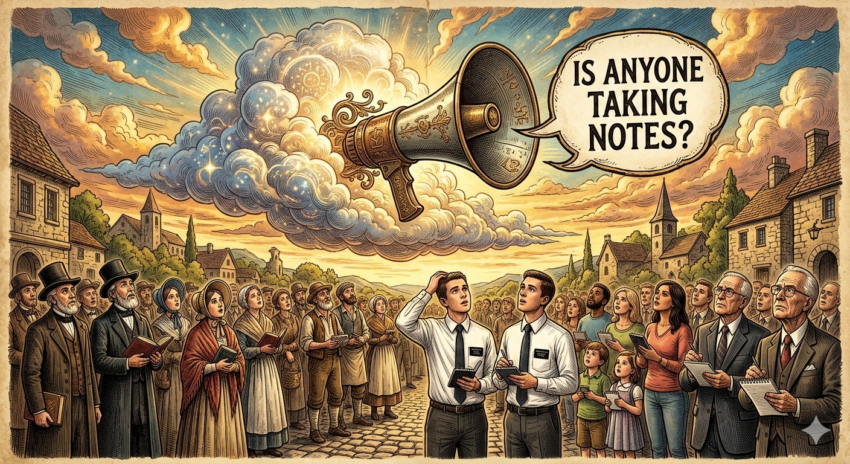
God’s Changing Mind? Continuing Revelation and the LDS Doctrine That Rewrites Itself
Introduction: The Announcement That Asks a Deeper Question
On March 18, 2026, the Deseret News published a story with a headline that most Latter-day Saints would receive as welcome news: women would now be permitted to serve as Sunday School presidents in LDS ward and branch congregations. The First Presidency of The Church of Jesus Christ of Latter-day Saints announced the change in a letter to general authorities and local leaders, noting that, effective immediately, a bishop could call either a man or a woman to serve as ward Sunday School president—a departure from a longstanding practice of exclusively male leadership in that role.
To those outside Mormonism, the announcement might appear unremarkable, even progressive—a church finally catching up to cultural expectations about women in leadership. But embedded in the Deseret News article is a comment from a church-affiliated scholar, Jennifer Erickson, that opens a far more consequential theological door:
“I imagine that how the reality of that unchanging doctrine is expressed in the church will continue to change as the cultural context changes.” — Jennifer Erickson, quoted in Deseret News, March 18, 2026
In eleven words—“unchanging doctrine expressed in ways that continue to change”—Erickson has, perhaps unintentionally, articulated the central paradox of LDS ecclesiology: a God who is immutable, yet a church whose policies, ordinances, and doctrines shift with cultural pressure. It is a claim that any serious theologian must interrogate.
This essay undertakes precisely that interrogation. Beginning with the Deseret News story as its point of departure, it examines the LDS doctrine of continuing revelation—what it claims, what it requires, what it contradicts, and what it reveals about the LDS conception of God and Scripture. Along the way, it engages the arguments of LDS apologists and sympathetic scholars, presents the evangelical Christian rebuttal rooted in the sufficiency of Scripture, and examines the historical record that judges continuing revelation not as the living voice of God, but as an unstable theological apparatus constructed to justify institutional change.
This is not an exercise in mockery. The Latter-day Saint tradition has produced sincere, intelligent, and devout people who deserve to have their claims engaged seriously. But seriousness demands honesty. And honesty requires us to ask the question that the March 18 announcement places squarely before us: if God’s doctrine is unchanging, why does its expression keep changing—and who, precisely, has the authority to say so?
The Great Apostasy—The Foundation That Must Hold Everything
Why the Great Apostasy Is Load-Bearing
To understand why continuing revelation is so theologically vital to Latter-day Saints, one must first understand the claim upon which the entire Restoration narrative rests: the Great Apostasy. According to official LDS teaching, the original Church established by Jesus Christ did not survive the first centuries of Christian history. The apostles were killed, priesthood authority was removed from the earth, doctrines were corrupted by pagan philosophy, and the organization Christ Himself founded ceased to exist.
The LDS Gospel Principles manual states the matter plainly:
“One by one, the Apostles were killed or otherwise taken from the earth. Because of wickedness and apostasy, the apostolic authority and priesthood keys were also taken from the earth. The organization that Jesus Christ had established no longer existed, and confusion resulted. More and more error crept into Church doctrine, and soon the dissolution of the Church was complete. The period of time when the true Church no longer existed on earth is called the Great Apostasy.” — Gospel Principles (2009), p. 92, cited at Mormon Research Ministry
This is not a secondary teaching—it is the indispensable premise of Mormonism. If the Great Apostasy did not happen, the entire Restoration enterprise collapses. Joseph Smith’s First Vision becomes unnecessary, the Book of Mormon becomes redundant, and the prophetic succession of LDS presidents becomes a fiction. Eric Johnson of the Mormonism Research Ministry (MRM) has observed:
“If the Great Apostasy did not take place, then The Church of Jesus Christ of Latter-day Saints is false and it should be pointed out as being wrong.” — Eric Johnson, “Examining 10 Claims of the Great Apostasy,” Mormonism Research Ministry, July 9, 2021
Here is the structural problem: continuing revelation is the living corollary to the Great Apostasy. If the apostasy severed heaven’s communication with earth, then the Restoration reopened it—and that channel, according to LDS theology, must remain perpetually open. A church that claims to be the sole custodian of divine authority on earth cannot afford to fall silent. Continuing revelation is, therefore, not merely a blessing; it is an institutional necessity.
The Biblical Case Against the Great Apostasy
The traditional Christian response to the Great Apostasy doctrine begins with one of the most unambiguous promises in the New Testament. In Matthew 16:18, Jesus declares to Peter: “And I tell you, you are Peter, and on this rock I will build my church, and the gates of hell shall not prevail against it.”
This is a promissory statement. It is not conditional upon apostolic survival, institutional continuity, or the faithfulness of second-generation Christians. It is an unconditional pledge by Christ Himself that the powers of death and corruption would not overcome His Church. If the Great Apostasy occurred as Mormonism requires—a total organizational extinction spanning centuries—then either Jesus was wrong, or the promise must be reinterpreted in ways the text simply will not support.
The essay at The Righteous Cause, “The Gates Did Not Prevail: A Biblical and Historical Case Against the LDS Great Apostasy Doctrine,” addresses this at length, noting that the historical record of Christian continuity from the first century through the Reformation presents an insuperable problem for LDS claims. The Church did not vanish. It fractured, fought heresies, debated councils, and sometimes embarrassed itself—but it never ceased to exist, and the proclamation of the gospel never fell silent.
The Apostle Paul’s letter to the Ephesians describes God’s plan as one to bring “unity to all things in heaven and on earth under Christ” (Ephesians 1:10), and in Ephesians 3:21 he declares: “to him be glory in the church and in Christ Jesus throughout all generations, for ever and ever.” Throughout all generations. The grammar does not allow for a multi-century vacancy.
The MRM article enumerates ten specific claims of the Great Apostasy and finds each wanting against both Scripture and history—from the claim that all Christian churches are wrong (a position implying that no genuine Christian existed between the second century and Joseph Smith’s 1820 vision) to the assertion that priesthood authority was entirely removed from the earth, a claim with no apostolic or patristic precedent. The conclusion is unavoidable: the Great Apostasy is a theological construct required by Mormonism’s claims to exclusive authority, not a verdict rendered by the historical or biblical evidence.
The Architecture of Continuing Revelation in LDS Theology
What Latter-day Saints Mean by Continuing Revelation
Once the Great Apostasy is accepted as a historical fact, continuing revelation becomes both possible and necessary. The LDS Church teaches that revelation did not cease with the biblical canon—indeed, that the canon’s closing was itself a symptom of apostasy, a human imposition of silence upon a speaking God. The Ninth Article of Faith, attributed to Joseph Smith, states:
“We believe all that God has revealed, all that He does now reveal, and we believe that He will yet reveal many great and important things pertaining to the Kingdom of God.” — Joseph Smith, Articles of Faith, No. 9 | The Church of Jesus Christ of Latter-day Saints
This is a striking and comprehensive claim. It does not merely affirm that God guided the early Church; it asserts that divine revelation is an ongoing, present-tense phenomenon available to the LDS Church today. President Dieter F. Uchtdorf drew directly on this article to describe the Restoration as a process rather than an event:
“Sometimes we think of the Restoration of the gospel as something that is complete, already behind us—Joseph Smith translated the Book of Mormon, he received priesthood keys, the Church was organized. In reality, the Restoration is an ongoing process; we are living in it right now.” — President Dieter F. Uchtdorf, General Priesthood Session, cited in Chad Nielsen, Times and Seasons, December 12, 2021
The LDS Living curriculum guide for Doctrine and Covenants Lesson 42 affirms this position through President James E. Faust:
“For many years, I have watched the process of continuous revelation which emanates from God through the keys, authority, and under direction of the President of the Church. I testify that this revelatory power is real.” — President James E. Faust, cited in Ted L. Gibbons, LDS Living, October 18, 2013
The official Church curriculum makes clear that continuing revelation is not peripheral—it is constitutive. Joseph F. Smith, sixth president of the LDS Church, taught in terms that could hardly be stronger:
“The principle of continuous revelation is a divine principle, and it is inseparably connected with the order and government of the Church of Jesus Christ of Latter-day Saints.” — Joseph F. Smith, Teachings of Presidents of the Church: Joseph F. Smith, Chapter 41
The Hierarchy of Revelation in LDS Practice
LDS theology distinguishes carefully between the types of revelation available at different levels of the institutional hierarchy. Truth in Love Ministry summarizes the LDS architecture:
“Latter-day Saints believe that God communicates His will to people in a hierarchical way—to the prophet for the Church as a whole, to apostles for their stewardships, to bishops for their wards, and to individuals for their personal lives.” — Truth in Love Ministry, “Continuing Revelation.”
At the apex sits the President of the Church, who alone holds all the keys of the priesthood and may receive revelation for the entire institution. Below him, members of the Quorum of the Twelve Apostles receive revelation for their assigned stewardships—areas like temple construction, missionary work, or curriculum development. Local leaders—stake presidents, bishops, branch presidents—receive revelation for their congregations, such as calling teachers or adjusting meeting schedules. And ordinary members may receive personal revelation for decisions within their own lives and families, from career choices to child-rearing.
The problem, as we shall see, is that this elegant hierarchy breaks down at multiple points—both in theory and in practice. The March 18, 2026, policy change illustrates this breakdown starkly: a seemingly minor modification to who may lead a Sunday School presidency—allowing women to serve as presidents without a counselor—is presented as the result of revelatory guidance from the First Presidency and Quorum of the Twelve. Yet it arrives with no “Thus saith the Lord,” no formal canonization into scripture, no prophetic vision shared in General Conference, and no explanation beyond a terse administrative letter citing “institutional determination” and administrative efficiency. This is revelation reduced to memo—lacking the divine weight, transparency, or binding authority that should distinguish it from mere corporate policy tweaks. If the topmost keys produce such opaque, incremental adjustments, how does one distinguish heavenly direction from human pragmatism at any level?
The LDS apologist website Public Square Magazine captures the internal tension well:
“Because they believe in a God who knows them individually, Latter-day Saints are encouraged to develop a personal relationship with Him. Part of coming to know God is in knowing His plan for our lives.” — Brianna Holmes, “Divine Dissonance: Navigating Revelation Personal and Prophetic,” Public Square Magazine, February 9, 2024
Holmes goes on to acknowledge the tension directly: personal revelation must stay within the “parameters” of institutional revelation, which means that if a member receives a “revelation” that conflicts with a policy from Salt Lake City, the member is expected to defer. The divine pipeline, in practice, flows in one direction only.
The Problem of an Immutable God Who Keeps Changing His Mind
Mormon 9:9 and the Self-Contradiction Within LDS Scripture
The most devastating critique of LDS continuing revelation is not an external one—it comes from the Latter-day Saints’ own canon. In Mormon 9:9, the prophet Moroni declares:
“For do we not read that God is the same yesterday, today, and forever, and in him there is no variableness neither shadow of changing?” — Mormon 9:9, Book of Mormon | The Church of Jesus Christ of Latter-day Saints
This verse is essentially a paraphrase of James 1:17 and Hebrews 13:8—the same biblical foundations on which orthodox Christianity grounds the doctrine of divine immutability. The God of the Book of Mormon, according to Moroni, does not change. And yet the revelatory history of the LDS Church presents a God who has issued commandments with the force of divine law, only to retract, revise, or reverse them when cultural or political pressures became sufficient.
The examples are not peripheral. They are among the most consequential revelatory acts in LDS history:
Polygamy: The Eternal Principle That Was Not
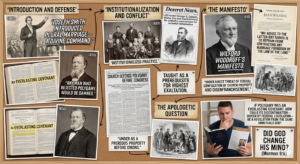
Joseph Smith introduced plural marriage as a divinely commanded and eternally necessary practice, reportedly receiving revelation on it as early as 1831 though recorded in 1843. Doctrine and Covenants Section 132, still in the LDS canon, presents it as an “everlasting covenant” essential for exaltation in the highest degree of the celestial kingdom, warning that rejection leads to damnation. Brigham Young declared that any man who rejected polygamy would be damned, stating in 1855: “Now if any of you will deny the plurality of wives, and continue to do so, I promise that you will be damned.”
The practice was institutionalized through temple sealings, defended before Congress amid anti-polygamy laws like the Morrill Act (1862), Edmunds Act (1882), and Edmunds-Tucker Act (1887), and taught as a prerequisite for the highest degree of exaltation. These federal measures disincorporated the church, escheated its assets, and imprisoned leaders, blocking Utah statehood. Then, in 1890, under the direct threat of federal confiscation of church property and the disenfranchisement of Utah statehood, LDS President Wilford Woodruff issued the Manifesto on September 25, declaring intent to obey anti-polygamy laws while a vision warned of temple losses if continued.
LDS official sources frame the Manifesto as itself a revelation. But the question is inescapable: if polygamy was an everlasting covenant commanded by God, how could its discontinuation—driven by federal legislation—also be a revelation from the same immutable God? Did God change His mind? And if He did, what does that do to Mormon 9:9?
The 1978 Priesthood Revelation: Race and the Reversible God
From the earliest days of the LDS Church, Black men like Elijah Abel held the priesthood under Joseph Smith, but in 1852, Brigham Young publicly announced a ban barring men of Black African descent from ordination. This restriction, extended to temple endowments and sealings by subsequent leaders, persisted until June 8, 1978—not merely a policy, but taught as divinely ordained by Brigham Young and prophets like John Taylor and Joseph F. Smith. For instance, Joseph Fielding Smith wrote in Answers to Gospel Questions (1958) that the denial stemmed from premortal valiance, a theory popularized despite lacking explicit revelation and later disavowed by the Church.
Then, Official Declaration 2 reversed it after President Spencer W. Kimball’s earnest prayers, culminating in a June 1, 1978, temple prayer circle where the First Presidency and Quorum of the Twelve unanimously received confirmation to extend the priesthood to “all worthy male members,” amid growing international growth pressures like in Brazil and Africa. The revelation is real and welcome in its result. But the theological wreckage it leaves behind is significant: generations of Black members—and non-members considering the Church—were told their exclusion was God’s will, with theories like Cain’s curse or premortal choices invoked to justify it.
Either it was divine, or it wasn’t—both cannot be simultaneously true if God is immutable (Malachi 3:6; Mormon 9:9). This 2013 essay now attributes the ban to Young’s era racism rather than revelation, condemning past theories while affirming no current doctrinal basis. This shift raises questions about prophetic authority: if prior leaders erred on race, what else might be cultural accommodation branded as revelation?
The 2015 LGBT Policy and Its 2019 Reversal
In November 2015, the LDS Church issued what became known as “the exclusion policy” (or “POX”)—a leaked Handbook 1 revision classifying members in same-sex marriages as apostates subject to church discipline, and barring their natural or adopted children from baby blessings, baptism (until age 18), priesthood ordination, or missions unless they disavowed same-sex relationships and moved out. LDS apostle (now President) Russell M. Nelson publicly declared in a January 2016 BYU devotional that the policy emerged after leaders prayerfully addressed a “thorny problem,” with unanimous approval from the First Presidency and Quorum of the Twelve—describing it as revelation, and noting he had “wept” in the process.
Just over three years later, on April 4, 2019—during General Conference—the policy was reversed: children of same-sex couples could now receive blessings and baptisms at local leaders’ discretion without needing to disavow parents or relocate, while same-sex marriage remained a “serious transgression” but no longer automatic apostasy. Religion News Service observed the theological question this raised plainly: “Mormon leaders reverse LGBT policy, raising the question: what is revelation?” Religion News Service:
“Mormon leaders reverse LGBT policy, raising the question: what is revelation?” — Religion News Service, April 4, 2019
It is a question the LDS institutional response has never satisfactorily answered. Church statements framed the reversal as “policy changes” motivated by love, after “extended… prayer,” but Nelson’s prior insistence on the original as revelation left ambiguity. If the 2015 policy was revelation—and a sitting apostle affirmed as much, on camera—then what was the 2019 reversal? A correction? An update? Was “extended prayer” part of the original revelation? A new revelation superseding the prior one? And if LDS revelation is subject to reversal within 40 months, what is it worth as a guide for the life of faith?
The Apologist Response: God Is Nurturing, Not Changing
LDS apologists have developed a sophisticated rejoinder to this critique, and fairness requires engaging it directly. The most common formulation appears in comments and essays across the LDS internet, including this representative post from the Mormon Matters forum:
“Thus the need for continuing revelation isn’t that God is changing his mind, but rather is continually nurturing and growing his children.” — Forum commenter, Mormon Matters.
This is a rhetorically appealing response. It frames policy changes not as divine vacillation but as divine pedagogy—a heavenly Parent adjusting the curriculum for the maturity level of His children. Scripture Central scholar Ryan Dahle deploys a similar argument:
“Sometimes God’s commandments—although they are perfectly in harmony with eternal laws—can vary based on temporal circumstances. God commanded Lehi and his family, for instance, to flee from Jerusalem. Then… He commanded Lehi’s sons to make a nearly 500-mile round trip back to Jerusalem to retrieve the Brass Plates.” — Ryan Dahle, “Does God Ever Change His Mind?” Scripture Central, April 5, 2019
The analogy is instructive but ultimately unpersuasive. There is a categorical difference between God giving situational directives to an individual on a journey and God issuing institutional commandments that are taught as eternal, sealed with prophetic authority, and enforced under threat of damnation—only to reverse them under social pressure. Nephi’s mission to retrieve the Brass Plates was never presented as an “everlasting covenant.” Polygamy was.
Moreover, the “nurturing” argument proves too much. If God is simply adjusting His instruction to meet His children’s developmental needs, then no LDS revelation can be said to be finally authoritative—because any of them might be revised as the institutional “maturity level” changes. This doesn’t produce a stable theology; it produces a wax nose that can be shaped by the next prophetic administration.
LDS scholar Chad Nielsen, writing in Times and Seasons, acknowledged this structural tension candidly:
“A change in ordinance seems to contradict Joseph Smith’s statement that the Lord ‘set the ordinances to be the same for Ever and ever.’ I.e., if there is one perfect state that must be restored, a change indicates that either the old way of doing things was wrong or the new way is a mistake.” — Chad Nielsen, Times and Seasons, December 12, 2021
Nielsen was writing as a sympathetic insider—and even he could not escape the logical fork. Either the earlier revelation was wrong, or the later one is. A God who is genuinely immutable cannot preside over both.
The Quora Consensus: Even LDS Members Notice the Contradiction
On Quora, a thread examining how changing LDS leadership positions align with the belief in unchanging revelation from God produced a range of responses that reveal the spectrum of LDS reasoning on the matter. Some respondents defended the “nurturing” framework. Others argued that only “doctrines” are immutable while “policies” may change freely—a distinction the Church itself has never formally codified. Still others acknowledged, with varying degrees of discomfort, that the frequency of institutional reversals strains credibility.
The doctrine-versus-policy distinction deserves scrutiny. When Apostle Nelson declared the 2015 exclusion policy a revelation and wept over it, was he weeping over a mere administrative policy—or over a doctrine? When Brigham Young declared that any man who rejected polygamy would be damned, was he speaking of a policy or an eternal principle? The LDS Church’s retrospective application of the doctrine/policy label to embarrassing reversals functions as an escape hatch, not a principled theological distinction.
Keith Burns, writing in the Salt Lake Tribune, posed the essential question directly:
“If the Church has continuing revelation, why has so much of what was once declared as revealed truth needed to be changed? And if change is itself revelatory, how would a member know when any current teaching is final?” — Keith Burns, “Continuing Revelation or Change in LDS Church?” Salt Lake Tribune, October 9, 2022
It is a question the LDS institutional response has never satisfactorily answered.
The Arbitrary Revelation—What Separates a Pew Member from an Apostle?
The Problem of Epistemic Parity
One of the most theologically arresting aspects of LDS revelatory culture is the claim that every member—not merely prophets and apostles, but the woman in the fourth pew from the left on a Sunday morning—may receive personal revelation from God. LDS President Russell M. Nelson made this explicit:
“The privilege of receiving revelation is one of the greatest gifts of God to His children… it will not be possible to survive spiritually without the guiding, directing, comforting and constant influence of the Holy Ghost.” — President Russell M. Nelson, General Conference, April 2018, cited at Public Square Magazine.
This is democratized revelation—a concept that carries significant pastoral appeal. Who would not want to believe that the God of the universe is personally guiding their career decisions, their marriage choices, their family planning? But the theological question is severe: on what basis does LDS theology distinguish a “confirmation” received by an ordinary member from a “revelation” delivered through the President of the Church?
The short answer the LDS framework offers is: jurisdictional scope. A member’s revelation applies only to their personal domain. An apostle’s applies to their stewardship. The prophet’s applies to the whole Church. But this structural answer does nothing to address the epistemological problem: the subjective mechanism—a burning in the bosom, a feeling of peace, an impression—is identical at every level of the hierarchy.
The Deseret News story that prompted this essay illustrates the problem vividly. Scholar Jennifer Erickson explains the policy change as part of “a dynamic and ongoing restoration of truths.” But the Latter-day Saint sitting in the pew of a Gilbert, Arizona ward on Sunday morning who prays and receives what she believes is divine confirmation that she should lead her ward’s Sunday School—how different is her experience from the apostolic process that produced the First Presidency letter? The mechanism is the same. Only the institutional status differs.
The Righteous Cause on Subjective Revelation
This author, writing at The Righteous Cause, has addressed this epistemological problem in two essays that are particularly relevant to the present discussion. In “God Told Me—Did He Really?” (February 2026), he examines the pervasive Christian tendency—not exclusive to Mormonism—to baptize personal desires with divine language:
“How easily ‘God told me’ becomes a convenient license for ambitions, relationships, or decisions that may not align with God’s will at all. We baptize our preferences with spiritual language, mistaking strong feelings for divine direction. The heart, Jeremiah warns us, ‘is deceitful above all things, and desperately sick; who can understand it?’ (Jeremiah 17:9).” — “God Told Me—Did He Really?” The Righteous Cause, February 11, 2026
This concern, grounded in the sufficiency of Scripture, applies with particular force to the LDS revelatory framework. When an ordinary member receives a “confirmation” about a career decision, they rely on the same internal witness that LDS prophets cite when announcing institutional changes. But the Bible offers a robust external standard—the written Word of God—against which all claimed revelations must be tested. The LDS system provides no equivalent filter, because it cannot: if the Bible alone were sufficient, the entire apparatus of continuing revelation would be unnecessary.
The essay in “Refuting Subjective Revelations” (September 2025) at The Righteous Cause reinforces this concern, noting that the LDS criteria for validating personal revelation—peace, a burning feeling, consistency with prior teaching—are circular when the “prior teaching” is itself subject to revision by the next prophetic announcement. The essay even critiques modern misunderstandings within the Christian community about personal subjective experience over biblical authority:
In an age where information abounds and Christian-themed literature floods bookshelves and digital platforms, believers must exercise discernment in selecting their reading materials. Not every publication bearing a Christian label aligns with the truth of Scripture, and even well-intentioned works can lead astray if they prioritize subjective experience over biblical authority. The apostle Paul warned of false teachings that appeal to itching ears (2 Timothy 4:3-4),1 underscoring the need for vigilance. As stewards of God’s truth, Christians are called to test all things against the unchanging standard of His Word (1 Thessalonians 5:21),2 ensuring that what they consume edifies their faith rather than distorts it. This caution is not mere skepticism but a biblical imperative to guard the heart and mind in pursuit of godliness.
The document in question, titled “5 Ways to Know a Revelation is From God,” presents an earnest but deeply flawed guide to discerning divine communication. While its author seeks to encourage believers in pursuing intimacy with God—a noble goal—the piece veers into dangerous territory by promoting a highly subjective, experiential model of revelation that undermines the authority and sufficiency of Scripture. In this article, I will systematically refute the majority of its claims, drawing on biblical exegesis, historical theology, and apologetic principles. My contention is not that God is silent today but that His primary mode of speaking is through the inspired, inerrant Word of God, as affirmed in 2 Timothy 3:16-17.3 Any purported “revelation” must be rigorously tested against this standard, lest we fall prey to self-deception, cultural influences, or even demonic counterfeits.
The Orthodox Christian Alternative
Traditional Christianity offers a markedly different account of divine guidance. The Holy Spirit does guide believers—but through the illumination of Scripture, the confirmation of the community of believers, and the shaping of providential circumstances, not through a subjective, unverifiable inner witness that bypasses the written Word.
The MacArthur New Testament commentary on John 16:13 is instructive: the Spirit’s role is to “guide you into all the truth”—but that truth is the apostolic witness already deposited in Scripture, not a perpetual stream of new disclosure. The Spirit does not generate new revelation; He illuminates existing revelation. This is the orthodox Protestant position, grounded in the sufficiency and finality of the biblical canon.
Grace to You Ministries, citing John MacArthur’s extensive preaching on this topic, argues that the canon closed with the apostolic era not because God chose to be silent, but because the full revelation of Christ—the fullness of God’s disclosure in His Son (Hebrews 1:1-2)—had been committed to writing and transmitted to the Church. The Spirit’s work is not to add to that revelation but to apply it with transforming power.
The New Calvary Baptist Church paper on the sufficiency of Scripture states the evangelical position with precision:
“Scripture is not merely sufficient for salvation; it is sufficient for all matters of faith, life, and practice. The claim of ongoing revelation not only adds to what God has spoken; it implicitly declares that what He has already spoken is insufficient.” — “The Sufficiency of Scripture and the Continuing Revelation of God“.
The distinction is vital. In orthodox Christianity, God guides a believer’s life through prayerful engagement with Scripture, the counsel of mature believers, and the disposition of circumstances—a process that is Spirit-empowered but Word-anchored. The LDS framework, by contrast, trains its members to seek a subjective internal witness that the Church itself admits has been mistaken at the institutional level. If prophets and apostles have been wrong about polygamy, priesthood restriction, and the exclusion of children of same-sex parents—all presented as revelations—what confidence can an ordinary member have in their own similar experiences?
Truth as a Moving Target—The Cultural Accommodation of LDS Revelation
When Doctrine Tracks Culture
The Christian Research Institute’s analysis of Mormonism and the Question of Truth, authored by former Latter-day Saint Latayne C. Scott, identified as early as 1992 what has become increasingly apparent in subsequent decades:
“As a faithful Mormon, I was confident that, because of continuing revelation from God to the prophet of the church, whatever my leaders told me took into account new developments in human history. I reasoned, for example, that since the birth control pill hadn’t been invented until the twentieth century, it was useless to look for clues about its rightness or wrongness in a flawed, 2,000-year-old book.” — Latayne C. Scott, “Mormonism and the Question of Truth,” Christian Research Journal, vol. 15, no. 1, Summer 1992
Scott’s observation captures the cultural logic of continuing revelation: it provides an infinitely flexible justification for institutional change by attributing every change to divine instruction rather than social pressure. This is, from a sociological standpoint, an extraordinarily useful apparatus. It preserves prophetic authority even as the content of prophetic pronouncements shifts to accommodate contemporary expectations.
But there is a pattern that is difficult to dismiss. The 1890 Manifesto on polygamy came when the U.S. government threatened to dissolve the LDS Church entirely. The 1978 priesthood revelation came after decades of mounting civil rights pressure and at a moment when LDS missionary work in Africa and Brazil was severely constrained by the race-based exclusion. The 2019 reversal of the LGBT children policy came after the 2015 version had triggered the largest wave of member resignations in a single week in the Church’s modern history.
This is not necessarily to assert that the LDS leadership acted in bad faith. It is to observe that the pattern of “continuing revelation” correlates with social and institutional pressure in ways that are difficult to explain if the revelations are genuinely independent of cultural circumstance. Jennifer Erickson’s comment in the Deseret News—“the reality of that unchanging doctrine is expressed in the church will continue to change as the cultural context changes”—inadvertently makes the correlation explicit.
Rational Faiths on the Paradox of Revelation as Control
The LDS progressive blogging community at Rational Faiths has explored a counterintuitive dimension of this problem: continuing revelation, rather than enabling genuine change, often functions as a brake on reform. Because every institutional change must be framed as a prophetic revelation, members who advocate for changes are implicitly challenging prophetic authority, which makes bottom-up reform structurally impossible. Change can only come from the top, legitimized as revelation, even when it tracks what the membership (or the outside culture) has been requesting for years.
This is a penetrating insight from within the LDS tradition. The Sunday School presidency announcement is a case in point. LDS women have sought expanded leadership roles for decades. The change announced March 18, 2026, is not the product of grassroots advocacy being heard—it is the product of institutional authority deciding when and how to extend a concession, framed as divine direction. The members who asked are not credited; the prophet who announced is.
The Honoring of Scripture, Mormon Style
Sharon Lindbloom of the Mormonism Research Ministry has observed that LDS theology’s relationship to biblical authority is structurally compromised by the continuing revelation apparatus. Citing LDS scholar Wallace Goddard’s argument that the Bible is an honored but insufficient guide:
“The testimony of the Bible is joined by the testimony of other witnesses: the Book of Mormon, the witnesses of Moses, Adam, Enoch, Abraham, Matthew, and Joseph Smith gathered in the Pearl of Great Price, the Doctrine and Covenants, the Proclamations, and the abundant teachings of prophets in our own time.” — Wallace Goddard, cited in Sharon Lindbloom, “Honoring the Bible, Mormon Style,” Mormonism Research Ministry, May 11, 2020
Lindbloom notes that this is not “honoring” the Bible in any meaningful evangelical sense. It is subordinating the Bible to an ever-expanding body of prophetic pronouncements, some of which have been reversed, revised, or quietly retired. The result is a canon that has no edges—and therefore no real authority—because any given text can be superseded by the next letter from the First Presidency.
The evangelical doctrine of sola scriptura is not an arbitrary rule invented to protect the status quo; it is a theological conclusion drawn from the nature of biblical inspiration, the finality of the apostolic witness, and the sufficiency of Christ as God’s ultimate revelation. As Hebrews 1:1-2 declares: “Long ago, at many times and in many ways, God spoke to our fathers by the prophets, but in these last days he has spoken to us by his Son.” The Son is not a chapter in an ongoing story; He is the final Word.
The Quorum of the Twelve, the Pew, and the Problem of Verification
What Makes a Prophet’s Revelation Different?
Ben Spackman, a thoughtful LDS historian and educator, has written about the meaning of D&C 1:30’s designation of the LDS Church as “the only true and living church.” The word “living” is, for Spackman and many LDS thinkers, the operative term—indicating a dynamic, revelatory community rather than a static one. This language implicitly contrasts “living” revelation with the “dead” letter of a closed canon.
The rhetorical force of this framing is considerable. Who would choose a dead, silent God over a living, speaking one? But the framing papers over the central epistemological problem: how does one verify that the living church is speaking for the living God, rather than for the living institution? The mechanisms for verification—praying, seeking a spiritual witness, accepting the prophet’s authority—are entirely internal to the system. There is no external standard.
LDS Church News, in a 2008 article titled “God Still Speaks: Enhancing Scriptures,” presented the revelatory heritage of the LDS Church as an unbroken stream of divine communication from Joseph Smith to the present:
“God does not leave us to ourselves. He speaks to us through His servants the prophets, who bear witness of His will and communicate His commandments to His children on earth.” — Church News, April 12, 2008
This is a beautiful claim—but “beautiful” and “verifiable” are not synonyms. The historical record of LDS prophetic pronouncements includes statements that were presented as divine communication and subsequently abandoned. The gap between the claim of prophetic authority and the record of prophetic accuracy is not one that continuing revelation can close; it is one that continuing revelation creates.
The Grassroots Member: Revelation Without Accountability
For the ordinary Latter-day Saint—the ward member referenced in the Deseret News story—the landscape of personal revelation is even more treacherous. LDS culture teaches members to seek divine guidance for decisions ranging from which college to attend to which neighborhood to move into. The epistemological tools offered are the same at every level: prayer, fasting, scripture study, and attending to internal impressions.
But as noted in The Righteous Cause essay, “God Told Me—Did He Really?” the subjective impression is an unreliable guide precisely because the human heart is prone to self-deception. A.W. Tozer’s warning—cited in that essay—that the Bible must remain the anchor against the drift of feeling is not a counsel of spiritual impoverishment; it is a counsel of spiritual safety.
The Public Square Magazine article by Brianna Holmes, writing from within an LDS framework, acknowledges that personal revelation has its own internal checks: members should not expect revelation outside their proper jurisdiction, and feelings that contradict prior teaching or encourage sin should be rejected. But she also acknowledges what may be the most honest admission in LDS revelatory literature:
“For example, if a person prays to God about proceeding forward with an extramarital affair and feels ‘good’ about it, that is not a true revelation from God.” — Brianna Holmes, “Divine Dissonance: Navigating Revelation Personal and Prophetic,” Public Square Magazine, February 9, 2024
This is correct—but what is the basis for that verdict? It is the prior moral teaching of the Church. In other words, personal revelation is valid only when it confirms what the Church already teaches. Revelation that contradicts official teaching is, by definition, invalid. This means personal revelation is not an independent channel of divine communication; it is a system for ratifying institutional orthodoxy through subjective experience. That is not a continuing revelation. That is confirmation bias elevated to sacramental status.
The Biblical God Who Does Not Change His Mind— And Why That Matters
Immutability as a Perfection, Not a Limitation
Orthodox Christianity’s insistence on divine immutability is sometimes caricatured as a cold, static conception of God—a frozen first cause indifferent to human need. This is a misrepresentation. The biblical doctrine of immutability does not mean God is incapable of action or unresponsive to prayer; it means that God’s character, purposes, and moral requirements do not shift with cultural trends or political exigencies.
The Westminster Confession of Faith describes God as “most holy, most free, most absolute; working all things according to the counsel of His own immutable and most righteous will, for His own glory.” Immutability, in this framing, is a perfection—it is what distinguishes the living God from the pagan deities who could be manipulated, bribed, or circumvented. A God who changes His moral requirements in response to cultural pressure is not the God of Abraham, Isaac, and Jacob; He is a projection of human institutional management onto a divine canvas.
Malachi 3:6 states the principle plainly: “I the Lord do not change; therefore you, O children of Jacob, are not consumed.” The immutability of God is not merely a philosophical attribute; it is the ground of Israel’s—and the Church’s—security. If God changed, the covenant would be impossible. The promise would be conditional. Salvation would be precarious.
Numbers 23:19 is equally explicit: “God is not a man, that he should lie, or a son of man, that he should change his mind. Has he said, and will he not do it? Or has he spoken, and will he not fulfill it?” The rhetorical questions assume the answer: God does not revise His commitments. He does not issue eternal covenants and then revoke them under federal pressure.
The Irony of Mormon 9:9
Here is the theological irony that the LDS tradition has never fully resolved: the Book of Mormon itself affirms divine immutability in language nearly identical to the biblical witness. Mormon 9:9 echoes James 1:17. Moroni 8:18 declares that God is “unchangeable from all eternity to all eternity.” If these statements are true, then the LDS narrative of a God who reveals polygamy as eternal, then retracts it; who decrees priesthood restriction by race, then reverses it; who inspires a policy excluding children of same-sex couples, then abandons it within forty months—that narrative describes a God fundamentally unlike the one the Book of Mormon itself portrays.
The apologist may respond that God’s character is unchanged even when His instructions vary. But this response cannot survive the cases cited above. The issue is not that God gave different instructions to different individuals (the Lehi narrative). The issue is that God gave institutional commandments framed as eternal, and then changed them. The character of the command, not merely its content, is what is at stake.
The Women in Sunday School and the Larger Question
Reading the Policy Change Theologically
Returning to the Deseret News announcement of March 18, 2026: the decision to allow women to serve as Sunday School presidents is, in isolation, a positive organizational development. Women have been teaching in LDS congregations for the better part of two centuries, and expanding their formal leadership roles seems consonant with recognizing their existing contributions. President Henry B. Eyring’s observation—cited in the article—that women have served as “the primary gospel instructors, beginning with Eve” acknowledges a theological reality that the institutional structure has been slow to formalize.
But the theological question the announcement raises is not about women’s capabilities. It is about the process by which the Church decides what is or is not authorized. Is this a revelation? A policy? An administrative update? The First Presidency letter—not a thus-saith-the-Lord canonized in Doctrine and Covenants, but a letter—announces it as a determination of the First Presidency and Quorum of the Twelve. The Deseret News scholar frames it as part of “a dynamic and ongoing restoration.”
The Deseret News scholar frames it as part of “a dynamic and ongoing restoration.” If this is a revelation, the question is: why now? LDS women have been seeking expanded roles for decades. If God’s timing is sovereign and His communication to His prophet is direct, why did the revelation arrive in March 2026 rather than in 1886, or 1956, or 1996? And if the answer is “the cultural context was not ready”—as Erickson implies—then we are back to the central problem: a revelatory framework whose content is determined by cultural timing is not revelation from an immutable God; it is institutional adaptation with theological branding. Indeed, cultural context has never really been “ready” for God’s commandments—from the rejection of Noah’s ark to the crucifixion of Christ—yet divine revelation proceeded undeterred by societal unreadiness. This pattern underscores that true revelation transcends culture, rather than conforming to it.
What the Evangelical Christian Perspective Offers
Traditional Christianity does not claim a living prophet who receives new directives from God about organizational structure. It claims something far more stable: a completed canon, a present-tense Holy Spirit who illuminates that canon, and a community of believers who govern themselves by the whole counsel of Scripture. The New Testament’s teaching on the gifts and leadership roles of women is not simple—evangelical Christians debate it sincerely—but those debates are conducted against the fixed reference point of a completed text.
The evangelical church that decides, after prayerful study of Galatians 3:28 and 1 Timothy 2:12 and the whole of redemptive history, to expand or to maintain gender-differentiated roles is not claiming a new revelation. It is doing theology—the slow, communal, Scripture-anchored work of discerning what the unchanging Word of God means for its particular time and context. It is not exempt from error, but it is accountable to an external standard.
The LDS model offers the opposite: an internal standard (prophetic authority) that claims external divine validation (revelation) but cannot be tested by any criterion outside the institutional system itself. When the standard produces polygamy, it is revelation. When it retracts polygamy, it is also a revelation. When it bars Black members from the priesthood, it is a revelation. When it extends the priesthood to Black members, it is also a revelation. When it excludes children of gay parents, it is a revelation. When it welcomes them back, it is also a revelation.
At what point does a framework that validates contradictory conclusions cease to be a theological system and become merely an institutional rationale?
The God Who Speaks Once and Forever
The Deseret News announcement of March 18, 2026, is, in its surface content, a modest institutional update. Women may now lead Sunday School presidencies in LDS congregations. Thousands of qualified women will take on new responsibilities, and many congregations will likely benefit.
But embedded in the commentary surrounding the announcement is a theological claim of staggering proportions: that the God of the universe is continuously issuing new directives to His authorized prophets, who then translate those directives into institutional policy—a process that tracks cultural context closely enough that a scholar can say, without apparent irony, that “unchanging doctrine will continue to change as the cultural context changes.”
This is not the God of Scripture. The God of Scripture is not continuously revising His institutional policies in response to social pressure. He has spoken, finally and fully, in His Son (Hebrews 1:1-2). He has committed that revelation to a written canon that is “breathed out by God and profitable for teaching, for reproof, for correction, and for training in righteousness, that the man of God may be complete, equipped for every good work” (2 Timothy 3:16-17). The word “complete”—artios in Greek—means thoroughly furnished, lacking nothing. If the believer is complete through Scripture, what does continuing revelation supply that Scripture lacks?
The answer, in the LDS system, is institutional authority—the ongoing validation of the Church’s claim to be the only authorized representative of God on earth. Continuing revelation is not primarily about new truth; it is about perpetuating prophetic credibility in the face of a historical record that repeatedly disconfirms it.
The Christian answer to the Latter-day Saint is not triumphalism. It is an invitation to the immovable. The God who does not change (Malachi 3:6), who does not lie (Numbers 23:19), who has spoken His final word in His Son (Hebrews 1:1-2)—that God offers a security that no system of continuing revelation can provide. Because in a system where God keeps updating His instructions, no instruction can be trusted as final. But in the God of Scripture, every promise is “Yes” and “Amen” in Christ (2 Corinthians 1:20)—not until the next letter from the First Presidency, but forever.
That is the God worth trusting. That is the revelation worth building a life on.
Primary Sources Referenced
• Deseret News, “Women to Serve in Ward Sunday School Presidencies,” March 18, 2026 | https://www.deseret.com/faith/2026/03/18/women-lead-latter-day-saint-sunday-school-presidencies/
• Eric Johnson, “Examining 10 Claims of the Great Apostasy,” Mormonism Research Ministry, July 9, 2021 | https://mrm.org/deny-great-apostasy
• “The Gates Did Not Prevail,” The Righteous Cause, February 24, 2026 | https://novus2.com/righteouscause/2026/02/24/the-gates-did-not-prevail-a-biblical-and-historical-case-against-the-lds-great-apostasy-doctrine/
• Chad Nielsen, Times and Seasons, December 12, 2021 | https://archive.timesandseasons.org/2021/12/all-that-god-has-revealed-all-that-he-does-now-reveal-and-that-he-will-yet-reveal/index.html
• Keith Burns, Salt Lake Tribune, October 9, 2022 | https://www.sltrib.com/opinion/commentary/2022/10/09/keith-burns-continuing/
• Ryan Dahle, “Does God Ever Change His Mind?” Scripture Central, April 5, 2019 | https://scripturecentral.org/blog/does-god-ever-change-his-mind
• Latayne C. Scott, “Mormonism and the Question of Truth,” Christian Research Journal, 1992 | https://www.equip.org/articles/mormonism-and-the-quest-for-truth/
• Mormon Matters Forum Comment | https://www.mormonmatters.org/podcast-item/222-223-becoming-like-god/
• Ben Spackman, “Quick Thoughts on D&C 1:30,” January 2017 | https://benspackman.com/2017/01/quick-thoughts-dc-130-true-living-church/
• Quora Thread | https://www.quora.com/How-do-the-changing-positions-of-LDS-leaders-align-with-their-belief-in-unchanging-revelation-from-God
• Truth in Love Ministry, “Continuing Revelation” | https://tilm.org/are-mormons-christian/continuing-revelation/
• Teachings of Presidents: Joseph F. Smith, Chapter 41 | https://www.churchofjesuschrist.org/study/manual/teachings-joseph-f-smith/chapter-41?lang=eng
• Church News, “God Still Speaks,” April 12, 2008 | https://www.thechurchnews.com/2008/4/12/23231839/god-still-speaks-enhancing-scriptures/
• “God Told Me—Did He Really?” The Righteous Cause, February 11, 2026 | https://novus2.com/righteouscause/2026/02/11/god-told-me-did-he-really/
• “Refuting Subjective Revelations,” The Righteous Cause, September 29, 2025 | https://novus2.com/righteouscause/2025/09/29/refuting-subjective-revelations-a-biblical-critique-of-5-ways-to-know-a-revelation-is-from-god/
• Religion News Service, “Mormon Leaders Reverse LGBT Policy,” April 4, 2019 | https://religionnews.com/2019/04/04/mormon-leaders-reverse-lgbt-policy-raising-the-question-what-is-revelation/
• Grace to You / John MacArthur, “Does God Still Give Revelation?” | https://www.gty.org/sermons/90-53/does-god-still-give-revelation
• New Calvary Baptist Church, “Sufficiency of Scripture and Continuing Revelation” | https://myncbc.org/wp-content/uploads/2022/03/12-01-The-Sufficiency-of-Scripture-and-the-Continuing-Revelation-of-God.pdf
• Ted L. Gibbons, LDS Living, October 18, 2013 | https://www.ldsliving.com/d-c-lesson-42-continuing-revelation-to-latter-day-prophets/s/74002
• Rational Faiths, “How Continuing Revelation Prevents Change” | https://rationalfaiths.com/continuing-revelation-prevents-change-mormonism/
• Sharon Lindbloom, “Honoring the Bible, Mormon Style,” Mormonism Research Ministry | https://mrm.org/honoring-the-bible-mormon-style
• Brianna Holmes, “Divine Dissonance,” Public Square Magazine, February 9, 2024 | https://publicsquaremag.org/faith/gospel-fare/divine-dissonance-navigating-revelation-personal-and-prophetic/
A Note on Research Methods and Accuracy
This work represents a collaboration between the author’s own theological research, primary source documentation, and the emerging capabilities of artificial intelligence research tools. AI assistance was employed throughout the investigative process — not as a ghostwriter or a substitute for scholarship, but as a rigorous research partner: surfacing sources, cross-referencing claims, identifying scholarly consensus, and flagging potential errors before they could reach the page.
Every factual claim in this work has been subjected to active verification. Where AI-generated content was used as a starting point, it was tested against primary sources, peer-reviewed scholarship, official LDS documentation, and established historical records. Where discrepancies were found — and they were found — corrections were made. The author has made every reasonable effort to ensure that quotations are accurately attributed, historical details are precisely rendered, and theological claims fairly represent the positions they describe or critique.
That said, no work of this scope is immune to error, and the author has no interest in perpetuating inaccuracies in the service of an argument. If you are a reader — whether sympathetic, skeptical, or hostile to the conclusions drawn here — and you identify a factual error, a misattributed source, a misrepresented doctrine, or a claim that cannot be substantiated, you are warmly and genuinely invited to say so. Reach out. The goal of this work is not to win a debate but to get the history right. Corrections offered in good faith will be received in the same spirit, and verified corrections will be incorporated into future editions without hesitation.
Truth, after all, has nothing to fear from scrutiny — and neither does this work.
The statement that the (scriptural) truth is a moving target in the Mormons’ belief system is accurate.