
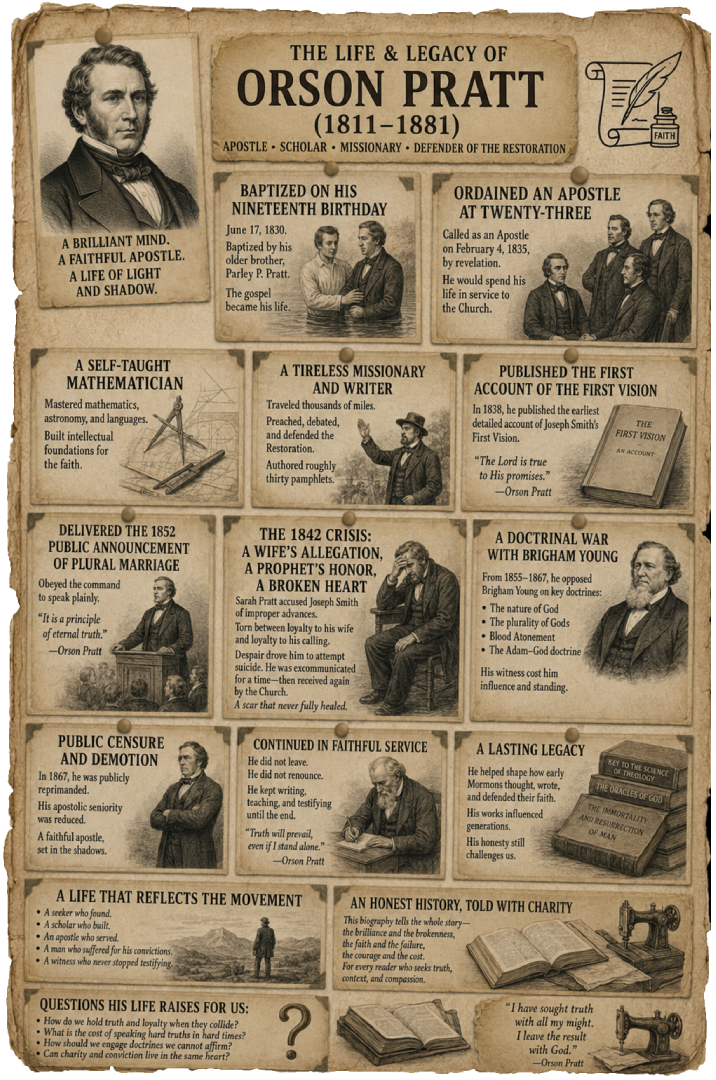
Eighth post in the Early Mormon Personalities Series
Orson Pratt and the Logical Architecture of Early Mormonism
1811 ~ 1881
I. A Man on a Bridge at Midnight
In late August of 1842, on a sticky Illinois night thick with the smell of river mud and prairie smoke, a slender man of thirty walked alone toward the Mississippi. He wore the dark frock of a preacher, but his face, hollowed by sleeplessness, belonged to a man who had stopped believing in his own reflection. He had come to Nauvoo six years earlier as a rising apostle of a new American faith, a brilliant young mathematician who could disassemble an opponent’s argument as cleanly as he factored a polynomial. Now he wandered the riverbank for five days, sleeping in the grass, his shirt unchanged, his Bible unread. Search parties combed the slough. A note was rumored. His wife wept in their cottage. Somewhere above the high bluff, the Prophet Joseph Smith preached on, and the Twelve Apostles met without him.
When Orson Pratt was finally found, exhausted and incoherent, he is said to have written, in a hand that trembled like a leaf in November, six words that would echo through the rest of his long, complicated life: “My sorrows are greater than I can bear.” Those words, faintly biblical in cadence, faintly Davidic, were not the cry of a skeptic. They were the cry of a believer who could not get his own faith to reconcile with itself. He had defended Joseph Smith on three continents; he had stood before British miners in damp rented halls and made the Restoration sound as airtight as Euclid; and now, in his thirty-first year, he could no longer trust either his prophet or his wife, and was therefore in danger of losing his soul.
This is the story of that man. It is the story of how a hungry New York farm boy with a borrowed Bible became the most logical mind of the early Mormon movement, baptized at nineteen by his older brother, ordained an apostle at twenty-three, and entrusted in 1852 with the most explosive announcement in nineteenth-century American religion: that the Latter-day Saints practiced plural marriage and would not apologize for it. It is also the story of how that same logical mind, when pressed against the speculative theology of Brigham Young, refused to bend, and was demoted, censured, and ultimately silenced into uneasy obedience. And it is the story of how the church Orson Pratt loved and served has, in our own century, quietly rearranged his memory — keeping his pamphlets, polishing his portrait, and gently editing the parts of his life that no longer fit the brochure.
Walter Bagehot once observed that the great difficulty in writing history is that the dead do not stay still. Orson Pratt is a case in point. He has been called the Paul of Mormonism, the gauge of philosophy, the apostle of polygamy, and a stubborn mule. He was all of them at different hours of the same long day.
✦ ✦ ✦
II. Origins: A Boy of the Burned-Over District
Orson Pratt was born on September 19, 1811, in the village of Hartford, Washington County, in the rolling country east of the Adirondacks. His parents, Jared Pratt and Charity Dickenson, were the kind of plain, struggling Americans who turn up in nineteenth-century county records and almost nowhere else. Jared was a man of more dignity than means; Charity could read her Bible but had little spare time to teach it. They were, as Orson would later write with the carefulness of a man who had escaped poverty by an act of will, “numbered among the poor of this world,” and “a succession of misfortunes kept them down in the low vales of poverty.”
The Pratts moved about as poor families do, settling in New Lebanon, then drifting through Columbia County. They did not regularly attend any church. Orson, the fifth of six children, later admitted he could not remember being inside a meeting house more than a few times. Yet he read the King James Bible, the only book most farmhouses possessed, and read it with the urgency of a boy who suspected it contained the keys to everything that mattered. At the age of eleven, the family economy demanded that he be sent out as a hired hand. For nearly nine years, he ploughed and reaped on other men’s farms from Ohio to Long Island, sleeping in haylofts and in cold corners, a Bible in his pack and an ache in his chest he could not name.
He came of age in the Burned-Over District of upstate New York, that strip of land between Albany and Buffalo so often swept by religious revival in the 1820s and 1830s that one observer compared it to a forest scorched again and again by the same lightning. Methodists shouted; Presbyterians thundered; Baptists immersed; Universalists soothed; Shakers danced; Millerites calculated the date of the Second Coming. Joseph Smith, four years older than Orson, was experiencing his own visionary disturbances thirty miles away. The American religious imagination was, in those years, a frontier as wild as the timberlands of Michigan. A serious-minded boy who took the Bible at its word and disliked the contradictions of the competing sects had two choices: he could become a skeptic, like the young Abraham Lincoln, or he could become a seeker, like the young Joseph Smith.
Orson Pratt became a seeker. In the autumn of 1829, he retreated nightly to the lonely fields near his current employer’s farm, knelt on the cold ground, and prayed for direction. The narrative he later left of this period has an almost Augustinian quality, the precise interior recording of a soul under siege:
In the silent shades of night, while others were slumbering upon their pillows, I often retired to some secret place in the lonely fields or solitary wilderness, and bowed to the Lord, and prayed for hours with a broken heart and contrite spirit; this was for the Lord to manifest His will concerning me.
— Orson Pratt, autobiographical sketch, Latter-day Saints’ Millennial Star, January 1865
It is a passage worth lingering over. The young Pratt is praying not for a vocation, not for prosperity, not even for forgiveness of any specific sin. He is praying to know what he is for. He is a Protestant boy, alone in the dark, looking for a sign. He had nothing in him of the wild visionary; he was, even at eighteen, a man whose temperament tilted toward mathematics, ledger books, and the calm certainty of a balanced equation. Yet what would shortly find him was not a syllogism but a man on horseback — his own elder brother.
✦ ✦ ✦
III. The Brother on Horseback: Conversion to Mormonism
In September 1830, Parley P. Pratt rode into Canaan, New York, where Orson was working out his contract. Parley was twenty-three; he had been baptized only a few weeks earlier into the newly organized Church of Christ, the small Restorationist body that Joseph Smith had founded in Fayette on April 6 of that year. He brought with him a copy of the Book of Mormon, fresh from E. B. Grandin’s press in Palmyra, and the kind of contagious zeal that older brothers sometimes use to convert younger ones. Parley would later write, with a brother’s understandable hyperbole, that Orson “received it with all his heart.”
On his nineteenth birthday — September 19, 1830 — Orson was baptized in a cold New York creek. The choice of date was no accident; it carried the freight of a young man marking a deliberate threshold. Within weeks, he had traveled the two hundred miles to Fayette and entered the upper chamber of Peter Whitmer’s house, where Joseph Smith dictated a personal revelation to him through a seer stone in a hat. The revelation, later canonized as Section 34 of the Doctrine and Covenants, named him an elder and sent him on his first preaching mission to Colesville. Orson, then “young and timid,” as he later wrote, asked John Whitmer to scribe in his place. He had come for instructions and received a commission.
It is worth pausing here on the mechanism of his conversion, because it sets the pattern for everything that follows. Orson Pratt did not become a Mormon because of an ecstatic vision. He did not have a Damascus Road. What persuaded him, by his own later account, was the apparent coherence of the new doctrine with the New Testament, the “ancient gospel” restored in its “beauty and simplicity.” He was, in other words, intellectually persuaded before he was experientially overwhelmed. He came in by argument, and he would stay in by argument, even when the arguments themselves began, decades later, to tighten around his throat.
Familial influence cannot be discounted. At nineteen, a young man without a settled trade is unusually open to the voice of an admired older brother — especially when that brother arrives with what appears to be a key to the cosmos. Parley P. Pratt would write Mormonism’s most popular early apologetic, “A Voice of Warning,” in 1837. Orson would expand, systematize, and defend nearly every doctrine Parley introduced. The Pratt brothers form one of the great evangelistic partnerships of the nineteenth century, and one cannot tell the story of either without the other. From a Christian theological standpoint, the pattern is achingly familiar: the apostles of every restorationist movement tend to come in pairs, in families, in clusters, drawn together less by argument than by affection, and only afterward articulating the affections as argument.
The biblical Christian asks here a question that the Mormon biographer does not always ask: by what test did young Orson decide that Parley’s message was true? In Deuteronomy 13 and Deuteronomy 18, the Lord, through Moses, gave Israel two clear tests for a prophet — whether his predictions came to pass, and whether his teaching led the people toward or away from the God of Scripture. Paul reminded the Galatians that even if an angel from heaven preached another gospel, that gospel was to be rejected (Galatians 1:8). Young Orson, working alone with his Bible and his loneliness, applied no such filter. He applied a kind of internal aesthetic test — the new message felt biblical to him — and on the strength of that intuition, he gave his entire adult life to a movement that would, within a single generation, articulate doctrines profoundly at variance with the historic Christian creeds. That is not a unique tragedy. It is a representative one. The history of the Burned-Over District is littered with serious, sincere, Bible-loving young people who reached for a restoration and found a redefinition.
✦ ✦ ✦
IV. The Apostle on Horseback: Service, Mission, and the British Tract
From his ordination as an elder in December 1830, Orson Pratt traveled almost without pause. He preached in New York, Pennsylvania, New Jersey, Vermont, New Hampshire, Connecticut, and Massachusetts. He was ordained a high priest by Sidney Rigdon in 1832. He marched with Zion’s Camp in 1834. He sat in the School of the Prophets in Kirtland. He studied Hebrew so seriously that he once argued with Joseph Smith over the pronunciation of a single letter — an incident that Joseph recorded with the kind of bemused exasperation older brothers reserve for talented younger ones. By the time he was ordained one of the original Twelve Apostles on April 26, 1835, he had walked or ridden thousands of miles. He was twenty-three years old.
The story of his call to the Twelve has the air of frontier legend. Weakened by fever, he had wandered into Columbus, Ohio, looking for shelter. He felt prompted to speak to a stranger, who turned out to be the only Latter-day Saint in town. While lodging in the man’s house, Orson picked up a copy of the church newspaper, the Messenger and Advocate, and read that he had been called to the apostleship and was expected in Kirtland by a specific day. He left immediately, traveled by stagecoach, and arrived at the meeting of the Twelve at ten in the morning of the appointed day. The brethren, who had prayed for his arrival, marveled at the timing. He was ordained that afternoon. The episode is the kind of story the LDS Church properly cherishes, and a Christian observer can readily acknowledge that the young man’s diligence and courage were real.
The defining mission of Pratt’s early life, however, came in 1839–1841, when he and the rest of the Twelve sailed for the British Isles. Penniless, exhausted, and homesick, they baptized roughly eight thousand people in twelve months — a figure that single-handedly explains why nineteenth-century Mormonism took on a transatlantic character. Pratt himself was assigned to Scotland, where in nine months he gathered a branch of two hundred members in Edinburgh. There, in 1840, he printed at his own labor and expense a thirty-one-page tract titled “An Interesting Account of Several Remarkable Visions and the Late Discovery of Ancient American Records.”
The little pamphlet matters far out of proportion to its size. It contains the earliest published account of Joseph Smith’s First Vision — the foundation story of the Restoration, but one that, remarkably, had not appeared in print during the church’s first decade. It contains, in fifteen articles, a kind of early creed that anticipates and shapes the “Articles of Faith” Joseph Smith would publish under his own name two years later. Historians of Mormonism, such as Peter Crawley and David Whittaker, have noted that many of the foundational ideas of the Latter-day Saint movement first surfaced in print in tracts like Pratt’s during this same window of 1839–1840. Joseph Smith himself would complain in April 1842 that several of his followers — including the Pratt brothers — had begun publishing his ideas as their own.
From a Christian theological perspective, this fact is worth noting. The First Vision, presented to modern Latter-day Saints as the founding miracle that authenticates the entire Restoration, did not enter the public consciousness of the movement until 1840, twenty years after the alleged event. The earliest converts — the Whitmers, the Knights, the Smiths themselves, and indeed the Pratts — came to Mormonism without ever having heard of it. The structure of authentication that contemporary missionaries place at the heart of every doorstep conversation was, in the original chronology, a later addition. That is not a small detail. It is the kind of fact that an honest history must keep in view.
Pratt returned to Nauvoo in 1841 a celebrated missionary, with a wife (Sarah Marinda Bates, whom he had married in 1836), a son, and the confidence that he was rising in a movement of cosmic significance. He had no idea that the deepest crisis of his life was waiting for him in his own home.
✦ ✦ ✦
V. The Bennett Affair: A Marriage, a Prophet, and a River
What happened to Orson Pratt in the summer of 1842 is the most painful chapter in his biography, and also the one most carefully airbrushed by official LDS sources. To understand it requires three actors and a doctrine.
The doctrine was plural marriage. Joseph Smith had begun teaching it privately to selected followers, taking plural wives himself while publicly denying that the church practiced any such thing. The full revelation, later recorded as Section 132 of the Doctrine and Covenants, would not be published until 1852, ten years after his death. In Nauvoo in 1842, the doctrine was thus an open secret — known to intimates, denied to outsiders, dangerous to everyone in between.
The first actor was John C. Bennett, a brilliant and unscrupulous physician who had risen rapidly in the Nauvoo hierarchy to become mayor of the city and Assistant President of the Church. Bennett was, by every contemporary account, a thoroughly bad character; he had abandoned a wife in Ohio, practiced abortion in Nauvoo, and seduced or attempted to seduce several women under the pretext of a doctrine he called “spiritual wifery.” When his misconduct was finally exposed in the spring of 1842, Bennett was excommunicated and turned, predictably, into the church’s most venomous outside critic. He published in Springfield, Illinois, a series of inflammatory letters that became a book, “The History of the Saints” (1842), which combined genuine inside knowledge with malicious distortion.
The second actor was Sarah Marinda Bates Pratt, Orson’s wife, who had remained in Nauvoo while he preached in England. Sarah claimed — then, and for the rest of her long life — that during her husband’s absence Joseph Smith had attempted to recruit her as one of his spiritual wives. According to her own later account, when Smith proposed to her, she refused, declaring that she would not break her marriage covenant with Orson and did not believe Smith’s revelation on plural marriage was of God. She told him, in language a Victorian woman could only have written with reluctance, that if he attempted any such thing again, she would tell her husband upon his return.
The third actor was Joseph Smith himself, who, when Orson returned and learned of his wife’s allegation, denied it categorically. Smith told Orson that Sarah was lying, that she had in fact been Bennett’s lover, and presented affidavits — some sworn by men of dubious character — to that effect. The official LDS narrative has since maintained, with a remarkable lack of evidentiary self-doubt, that Sarah was the deceiver and Bennett her seducer. The BYU Religious Studies Center, in its standard biographical entry, phrases it this way:
Unfortunately, in Nauvoo Elder Pratt and his wife Sarah were deceived by the slanderous lies fostered by the apostate John C. Bennett, and in 1842 they were excommunicated from the Church for rebellion.
— Lawrence R. Flake, Prophets and Apostles of the Last Dispensation
Compare that tidy summary with what serious historians both inside and outside the LDS tradition have documented. Richard Van Wagoner’s careful 1986 essay in Dialogue, “Sarah Pratt: The Shaping of an Apostate,” shows that Sarah’s account was consistent across decades, that the affidavits against her were produced under pressure during a Nauvoo damage-control campaign, and that several of them were almost certainly perjured. Gary Bergera’s 2002 study “Conflict in the Quorum” treats the question with similar candor. Even Richard Bushman, the most respected modern LDS biographer of Joseph Smith, concedes in “Rough Stone Rolling” (2005) that Smith “suggested he divorce Sarah and start a new family,” and that Pratt’s grief was so total that he came briefly to the edge of self-destruction.
Orson Pratt was caught between his prophet and his wife. He chose his wife, at least for a moment. He stood up in a public meeting and declined to support a resolution affirming Joseph Smith’s character. When Smith asked whether Orson personally knew of any immoral act on his part, Orson, with painful honesty, answered no — he did not personally know — but he could not bring himself to vote his confidence either. For five days, he wandered the Mississippi bottoms. He attempted suicide. His friend and fellow apostle Wilford Woodruff would write that summer, with a kind of stunned candor:
Dr. John Cook Bennett was the ruin of Orson Pratt.
— Wilford Woodruff, Journal, 1842 (cited in Watson, The Orson Pratt Journals, p. 180)
The phrase has been quoted ten thousand times in LDS literature, always to redirect blame to the safely demonized Bennett. It is, of course, a half-truth. Bennett was a scoundrel; Bennett did spread inflammatory accounts. But the deeper cause of Orson Pratt’s despair was not Bennett at all. It was the collision between his belief in Joseph Smith and his belief in Sarah Pratt, and behind that, his collision with a doctrine — plural marriage — that he could not at that moment reconcile with the Bible he had memorized. On August 20, 1842, Brigham Young, Heber C. Kimball, and George A. Smith spent days reasoning with him. When he would not yield, they excommunicated him. Sarah was not, at that point, excommunicated with him — a fact whose significance the official accounts often pass over in silence.
Five months later, in January 1843, Orson was rebaptized by Joseph Smith himself and restored to the Quorum of the Twelve Apostles. What changed between August and January is among the most contested questions in early Mormon history. Some sources suggest he came to believe Sarah had lied to him after all. Others suggest he simply could not bear the alternative — to walk away from the apostleship, the brotherhood, and the only theological universe he understood. He did not, however, divorce Sarah. He carried her, and she carried her grievances, for the rest of their long marriage, until they finally separated decades later. She would die outside the church she once shared with him. So, eventually, would two of their sons.
A Christian observer cannot read this story without grief. From a biblical standpoint, the situation is plain enough to be tragic: a faithful wife resisted what she understood to be an immoral overture; her husband, who had every reason to trust her, was placed under enormous institutional pressure to disbelieve her; and the long unraveling that followed was the slow-moving consequence of a doctrine that Scripture itself forbids. Paul wrote that a bishop must be the husband of one wife (1 Timothy 3:2). The biblical pattern of marriage, restated by Jesus Himself in Matthew 19, is one man and one woman in lifelong fidelity. Plural marriage was not a Restoration of the New Testament gospel; it was a departure from it. Pratt’s sorrows in 1842 were the first wave of a tide the church would not stop trying to navigate for fifty more years.
✦ ✦ ✦
VI. The Paul of Mormonism: Pamphleteer, Systematizer, Defender
The astonishing thing about Orson Pratt is that the 1842 crisis did not destroy him; it forged him. Within a year of his rebaptism, he was preaching again. Within five years, he was on his way west with the Vanguard Company, the small advance party Brigham Young sent to scout the Salt Lake Valley. On July 21, 1847 — three days ahead of the main body — Orson Pratt and Erastus Snow rode into the valley and saw the sagebrush sea that would become Mormon Zion. Pratt, the mathematician, designed alongside William Clayton the “roadometer” — a wooden gear assembly attached to a wagon wheel that counted revolutions and measured the journey. He recorded latitudes, longitudes, and barometric pressures all the way west. Modern Mormon historians sometimes call him the company’s scientific officer; the description fits.
From 1848 through the 1860s, Pratt’s principal occupation was apologetics. He presided three times over the British Mission; he edited the Millennial Star; he wrote, by his own count, more than thirty pamphlets. His tracts on baptism, on the Holy Spirit, on miracles, on the gathering of Israel, on the divine authority of Joseph Smith, and on the divine authenticity of the Book of Mormon went through edition after edition and were carried in the satchels of missionaries from Liverpool to Lyon. T. B. H. Stenhouse, a former Mormon, would credit Pratt with producing “the first logical arguments in favour of Mormonism.” W. W. Phelps called him the “Gauge of Philosophy.” Edward Tullidge would call him the “Paul of Mormonism.” John Henry Evans, writing for the church’s 1930 centennial, declared that no figure of intellectual stature in the first century of Mormonism approached him.
In Pratt’s hands, the inchoate revelations and oral teachings of Joseph Smith became something resembling a system. The Mormon doctrine of God, the pre-existence of spirits, the eternal nature of matter, the materiality of the divine, the gathering of Israel, the theological basis for plural marriage — all of these were given their first rigorous, formally argued expression in Pratt’s pamphlets. T. Edgar Lyon, who completed the first scholarly biography of Pratt in 1932, concluded that no person in the church except Joseph Smith himself did more than Pratt to shape what Mormons believed and how they argued for it. Gary Bergera, writing in Dialogue, summarized the scholarly consensus succinctly: Pratt was the church’s premier popularizer and systematizer. He took Joseph’s scattered utterances and arranged them into something that could survive contact with a skeptical Scottish miner or a Boston Unitarian minister.
The most famous moment of his public career came on August 29, 1852, in a special conference in Salt Lake City. Brigham Young had decided the time had come to publicly acknowledge what the church had been quietly practicing for over a decade. He chose Orson Pratt — the rational apostle, the pamphleteer, the man with the cleanest reputation for honest argument — to deliver the announcement. Pratt rose and, in a sermon scholars have shown was prepared over weeks rather than improvised, defended plural marriage as a restoration of patriarchal practice, supported by the example of Abraham, Jacob, David, and Solomon. He would spend the next year in Washington, D.C., publishing a monthly periodical called The Seer in defense of the doctrine. To this day, his Seer essays remain the most thorough nineteenth-century Mormon attempt to make the biblical case for polygamy. He acquired, deservedly or not, the nickname “the apostle of polygamy.”
From a biblical standpoint, the Seer essays are a fascinating but ultimately unconvincing performance. Pratt assembled every Old Testament patriarch, every recorded plural marriage, every ambiguity in the Mosaic law, and arrayed them in a logical structure designed to make polygamy not merely permissible but obligatory in certain dispensations. He could not, however, do what Scripture itself does not allow: he could not produce a single New Testament endorsement. He could not get past Jesus’s appeal in Matthew 19 to the Edenic pattern of one man and one woman. He could not get past Paul’s instructions in 1 Timothy 3 and Titus 1. And he could not get past the simple fact that in the centuries between Malachi and Matthew, the people of God had themselves moved away from the practice. Even more strikingly, the Book of Mormon itself, in Jacob 2:24, calls David and Solomon’s plural marriages “abominable before me, saith the Lord.” Pratt’s sermon, brilliant as it was, was a defense of something the Mormon canon itself had once condemned.
And yet — and this is essential to the human portrait — he believed it. Whatever private griefs the doctrine had cost him in 1842, by 1852, Orson Pratt was a thoroughgoing defender of plural marriage. He would eventually marry, by his first wife Sarah’s count, ten women, fathering some forty-five children, and at age fifty-seven he would marry a sixteen-year-old girl named Margaret Graham. The household, by every account, lived on the edge of poverty, sustained by Pratt’s pamphlet royalties and his wives’ sales of fabric and millinery. It is not an edifying story. But it is the story, and any biographer who pretends otherwise is writing fiction.
✦ ✦ ✦
VII. The Long Argument with Brigham: Doctrine, Authority, and the Limits of Reason
If the 1842 Bennett crisis was the first great trial of Orson Pratt’s life, the longer trial — stretched across more than two decades — was his theological conflict with Brigham Young. To understand it is to understand why a man so brilliant never became president of the church he had helped to build, and why his most influential ideas had to wait until after his death and Young’s to find their full reception.
The conflict began in 1853 over The Seer. Brigham Young, reading from Salt Lake, found in Pratt’s Washington essays a doctrine of God he could not accept. Pratt had argued that God is not merely an exalted being but the totality of certain divine attributes — truth, light, love, wisdom, knowledge — distributed across countless persons in countless worlds. The “one God” of the Bible, in Pratt’s reading, was the unity of these attributes, not the singular personhood of a particular exalted Father. He further argued that God already possessed a fullness of knowledge and could not, therefore, progress in wisdom forever. He insisted, in defending these positions, that doctrine must satisfy reason, and that reasonable people would reject anything that did not.
Young, by contrast, was developing a far more speculative theology. He taught that Adam was both the spiritual and the physical father of humanity, that Adam had come to this earth from another exalted world bringing Eve with him, and that this same Adam was the God whom the Saints worshiped. This is the doctrine known to Mormon historians as Adam-God; it is the most controversial single teaching Brigham Young ever delivered, and modern LDS leaders have spent more than a century trying to bury it. Young also taught that God was still progressing in knowledge, that intelligent beings would learn eternally, and that the kind of finished, omniscient God Pratt described was a philosophical idol.
The two men were too important to ignore each other. Their dispute therefore played out, between 1853 and 1868, in private letters, in tense quorum meetings, in public sermons from the Tabernacle, and finally in two formal censures issued by the First Presidency and the Twelve. Brigham Young, who genuinely admired Pratt, repeatedly tried to bring him to heel. He sent him on long missions to keep his speculations at a distance. He chose, deliberately, to publicly condemn the doctrine and not the man:
With all the knowledge and wisdom that are combined in the person of brother Orson Pratt, still he does not yet know enough to keep his foot out of it, but drowns himself in his own philosophy, every time he undertakes to treat upon principles that he does not understand.
— Brigham Young, March 8, 1857, Journal of Discourses 4:267
Young’s affection for Pratt’s integrity was sincere. He once remarked, in a phrase Mormons still quote, that if Brother Orson were chopped into inch pieces, each piece would cry out that Mormonism was true. But he could not tolerate a public competitor for the magisterium of doctrine. In a six-hour meeting on January 27, 1860, recorded in agonizing detail by Wilford Woodruff, Pratt was confronted by virtually the entire senior leadership of the church. He refused, at first, to back down. “I will not act the Hypocrite,” he told them. “I will be a free man.” Young, in turn, declared that Pratt had taken a stubborn course “like a mad stubborn mule.” Both men, by their lights, were defending something necessary — Young the unity of the church, Pratt the integrity of his own conscience.
Two days later, on January 29, 1860, Pratt stood in the Old Tabernacle and made the most painful public confession of his life. He acknowledged that he had advanced doctrines in conflict with the President. He affirmed that when one’s beliefs collide with those of the church president, one must yield to that higher authority. He admitted, with sad self-knowledge, that he might not be able to live up to that standard. The sermon, after further negotiation, was edited by the Twelve and published in the Deseret News with a First Presidency preamble. The relevant material from The Seer and from his pamphlet “Great First Cause” was repudiated as not the doctrine of the church. Five years later, in 1865, the censure was renewed and broadened, with similar treatment given to his “Holy Spirit” tract and to Lucy Mack Smith’s biography of her son Joseph, which Pratt had edited in London without prior approval.
The episode was institutionally devastating but spiritually clarifying. Pratt would, with mixed success, restrain his speculative pen for the rest of Brigham Young’s life. But the deeper question never went away. Was the church’s truth determined by the living president or by the written canon? Pratt’s instinct, which never fully changed, was that the canon was paramount and that any new teaching must be tested against it. Young’s instinct, equally consistent, was that the living oracle outranked the written one. “I just know it,” Young said at one point, “my path is like the noon day sun.” Pratt, with the politeness of a man under discipline, never quite agreed.
In April 1875, Young settled the question of succession by reordering the seniority of the Quorum of the Twelve. Pratt’s 1842 excommunication, however briefly it had lasted, was now used as a technical ground to drop him in seniority, not from his original ordination date of April 1835 but from his reordination date of January 1843. Orson Hyde, whose case was parallel, was similarly demoted. The effect was to ensure that neither man would ever become president of the church. John Taylor would succeed Young in 1880. Pratt would die a year later, in October 1881, the last surviving member of the original Quorum of the Twelve, on a couch in his Salt Lake home, of complications from diabetes.
✦ ✦ ✦
VIII. Theological Departure: Where Pratt Left Historic Christianity
Any honest Christian appraisal of Orson Pratt must reckon not only with the man but with the doctrines he formulated, defended, and bequeathed to a movement that now numbers in the millions. Five departures from historic Christian teaching are particularly worth naming.
1. The Plurality and Materiality of God
Pratt taught, in extended pamphlets and Seer essays, that God is material rather than spirit, that the divine attributes are distributed across many exalted beings, and that any human being who lives faithfully through the Mormon system may himself attain to godhood. This last doctrine, known in Mormon parlance as exaltation or eternal progression, was famously summarized by Pratt’s contemporary Lorenzo Snow: “As man now is, God once was; as God now is, man may be.” Pratt’s elaborations were less catchy but more rigorous. Yet they collide directly with the witness of Scripture. “I am God, and there is none else,” says the Lord in Isaiah 45:22. “God is spirit,” Jesus says in John 4:24, “and they that worship him must worship in spirit and in truth.” The biblical doctrine of God is monotheistic in the strongest sense; the persons of the Trinity are not three exalted men but one eternal God, uncreated, infinite, and incomparable. Pratt’s plural and material deity is not a clarification of biblical monotheism; it is its quiet undoing.
2. The Sufficiency and Finality of Scripture
Pratt’s apologetic, especially in his “Divine Authority” pamphlet of 1848, made continuing modern revelation indispensable to genuine Christianity. He argued that without an open canon and a living prophet, nobody could legitimately claim to be the church of Christ. The biblical position is precisely the opposite. Jude exhorts believers to contend earnestly for the faith “once for all delivered unto the saints” (Jude 3). Paul warns Timothy that the inspired Scriptures “are able to make thee wise unto salvation” and are sufficient “that the man of God may be perfect, throughly furnished unto all good works” (2 Timothy 3:15–17). Revelation 22:18–19 closes with a stern warning against adding to or subtracting from the prophetic word. Pratt’s view turned the Bible into a starting point; the biblical view treats it as the standard against which all further claims must be measured. This is not a minor disagreement. It is the foundational divide between the Reformation principle of sola Scriptura and every restorationist innovation since.
3. The Authenticity of the Book of Mormon as Scripture
Pratt’s most enduring contribution to Mormon apologetics was his unflinching either/or framing of the Book of Mormon’s truth claims. In his 1850 pamphlet, “Divine Authenticity of the Book of Mormon,” he wrote:
If false, [the Book of Mormon] is one of the most cunning, wicked, bold, deep-laid impositions ever palmed upon the world, calculated to deceive and ruin millions who will sincerely receive it as the word of God, and will suppose themselves securely built upon the rock of truth until they are with their families plunged into hopeless despair.
— Orson Pratt, Divine Authenticity of the Book of Mormon (Liverpool, 1850)
Pratt urged his readers to examine the evidence and, if they found it wanting, to publish the imposture extensively and silence its propagators. He was, in this passage, sublimely confident that no honest examiner could ever find against him. A century and a half of textual, archaeological, linguistic, and DNA evidence has nevertheless found against him. The Book of Mormon contains horses, chariots, steel, wheat, and barley in pre-Columbian America — elements no archaeologist has ever documented in the relevant period. Its narrative populations, if real, should appear in the Native American genome and do not. Its language echoes the King James Bible in passages that quote the New Testament centuries before the New Testament was written. Pratt’s own challenge, taken seriously, has produced the conclusion he insisted his honest readers must accept if the evidence failed: the book is not ancient American history. The Christian biographer says this not in triumph but in sorrow, knowing how many sincere souls have rested their salvation upon it.
4. Salvation by Grace Through Faith
Throughout his pamphlets, Pratt presented salvation as a matter of submission to a particular institutional order: baptism by an authorized priesthood holder, laying on of hands by the same, ordinances administered in the temple, and a lifelong faithfulness to a hierarchy of living oracles. Faith is present in his system, but it is faith in a chain of authority rather than faith in the finished work of Christ. The contrast with the apostle Paul is stark. “For by grace are ye saved through faith,” Paul writes to the Ephesians; “and that not of yourselves: it is the gift of God: Not of works, lest any man should boast” (Ephesians 2:8–9). The crucified and risen Christ is, in the biblical gospel, sufficient. The ordinances are signs of grace, not its source. Pratt’s brilliance was in some ways his snare: a temperament so committed to ordered, demonstrable steps that the unmerited gift of the gospel kept slipping through his geometry.
5. The Test of a Prophet
Finally, Pratt’s lifelong defense of Joseph Smith as a prophet collides with the biblical tests of prophecy. Deuteronomy 18:21–22 instructs Israel to evaluate a prophet by whether his predictions come to pass. Joseph Smith predicted that the Second Coming would occur within the lifetime of those then alive (D&C 130:14–17 records his musing on the date 1890); he prophesied that a temple would be built in Independence, Missouri, in his generation (D&C 84:4–5); he prophesied that the Civil War would consume all nations (D&C 87). None of these came to pass as stated. Pratt himself, in his eagerness to defend the prophet, never seems to have applied the Mosaic test to Joseph that he so freely applied to other religious teachers. The Christian reader, applying Scripture to Scripture, cannot in good conscience set the test aside.
✦ ✦ ✦
IX. A Character Study: The Man Behind the Mind
It would be easy, having catalogued his theological departures, to dismiss Orson Pratt as either a fraud or a fool. He was neither. He was, by every honest reckoning, a man of extraordinary diligence, courage, integrity, and intellectual seriousness. Sterner judgments belong to God.
His diligence was almost monastic. He taught himself algebra, geometry, trigonometry, conic sections, calculus, and astronomy without a teacher. He published, in 1866, “A New and Easy Method of Solution of the Cubic and Biquadratic Equations” — a work that, while overstated by Mormon hagiographers as a universally adopted textbook, was nonetheless competent original mathematics from a man who had begun life as a hired hand. He crossed the Atlantic more than a dozen times. He preached, by his own count, in nearly every state east of the Mississippi and in much of Europe. Wilford Woodruff said of him near the end of his life that he had never seen a man waste fewer moments. Even in a storm at sea, with waves breaking over the bow, Pratt would be found reading a book.
His courage was real. He stood his ground against Brigham Young at a moment when standing one’s ground could cost a man not only his apostleship but his community, his livelihood, and the affection of every neighbor on every block. He refused, in 1860, to confess error he did not believe. He refused, in 1865, to fall silent on doctrines he thought biblical. He yielded only when yielding seemed to him a smaller violation than schism, and even then, he yielded in the language of conscience, not capitulation.
His integrity was, however, also his blind spot. Pratt could not see that the foundation he was defending so logically was itself unstable. He treated Joseph Smith’s revelations as fixed points in space and reasoned outward from them with mathematical precision. When Brigham Young moved one of the fixed points — by teaching Adam-God, by repudiating Lucy Mack Smith’s biography, by reorganizing the seniority of the Twelve — Pratt did not perceive the deeper problem. The deeper problem was that any system built on an open canon is permanently vulnerable to revision by the current revelator. Pratt thought he could defend a fixed Mormonism with the tools of geometry. The geometry was good. The fix was not.
And he had contradictions of his own. The man who once stood by his wife against the prophet eventually came to live in a household that the prophet’s doctrine had constructed. The man who said “I will be a free man” in 1860 wrote in 1868, with weary tenderness, a letter to Brigham Young apologizing for having tried to justify himself in earlier disagreements. The man whose either/or challenge on the Book of Mormon dared his readers to follow the evidence wherever it led never quite turned that same challenge upon himself.
These are not the failures of a wicked man. They are the failures of an honest one, working with the wrong materials. The biblical writer who comes closest to capturing him is Paul, who wrote in 1 Corinthians 8:2 that “if any man think that he knoweth any thing, he knoweth nothing yet as he ought to know.” Orson Pratt thought he had reasoned his way to the truth. He had reasoned his way only to a system that demanded he stop reasoning when the present prophet so directed.
✦ ✦ ✦
X. Legacy and the Tidying of Memory
Orson Pratt’s legacy within Mormonism is, paradoxically, larger than his official standing suggests. His pamphlets shaped two generations of missionaries. His verse divisions of the Book of Mormon and the Doctrine and Covenants — he was assigned, after Brigham Young’s death, to prepare new editions of both — are still in use today. His conception of God, repudiated in his lifetime, has been quietly reabsorbed by such twentieth-century LDS theologians as Joseph Fielding Smith and Bruce R. McConkie. Adam-God, which Brigham Young preached, and Pratt opposed, has been so thoroughly buried that contemporary Latter-day Saints who teach it are subject to church discipline. In the long argument, Pratt mostly won. He just did not live to see it.
What he also did not live to see was the way his life would be edited. Modern LDS biographical material on Orson Pratt — from the Doctrine and Covenants Central biographical entry, to the BYU Religious Studies Center, to the church’s own Liahona magazine — follows a remarkably consistent template. The 1842 crisis is reduced to a sentence or two in which the scoundrel Bennett deceived both Orson and Sarah, both were excommunicated for “rebellion,” and the merciful prophet personally rebaptized them. The years of conflict with Brigham Young became a gentle footnote about “differences of doctrine” resolved by the apostle’s loyal submission. The 1875 demotion in seniority is presented as a technical matter of “seniority in service.” Sarah Pratt’s apostasy and the alienation of two sons are barely mentioned. The attempted suicide, when mentioned at all, is folded into Bennett’s villainy.
There is a particular phrase that recurs across these official accounts:
Unfortunately, in Nauvoo Elder Pratt and his wife Sarah were deceived by the slanderous lies fostered by the apostate John C. Bennett.
— Lawrence R. Flake, Prophets and Apostles of the Last Dispensation
Notice the rhetorical work the sentence does. The agency is Bennett’s. Sarah is folded in with Orson as a passive recipient of deception. The actual content of her allegation — that Joseph Smith propositioned her — disappears entirely. The reader who knows nothing else of the affair would conclude that Sarah was a simpleton misled by a swindler. The reader who has actually read Sarah’s own carefully consistent accounts across forty years, or Richard Van Wagoner’s careful scholarship in Dialogue, or Gary Bergera’s documentary work, knows that the woman in question was anything but simple. She refused, until her dying day, to recant her version of events. She paid for that refusal with her marriage, her social standing, and ultimately her place in the Mormon community.
A historian who works in the tradition of Barbara Tuchman or Ian Kershaw — who treats human beings as complicated agents shaped by their circumstances rather than as types to be celebrated or villainized — cannot accept the sanitized version. Sarah Pratt deserves the dignity of being heard. Orson Pratt deserves the dignity of being seen, not as a stained-glass figure, but as a brilliant and tormented man who loved his wife, loved his prophet, and could not in the end serve both. The 1842 crisis was not a regrettable detour. It was the central wound of his life, and his ministry afterward must be read in its light, not in its absence.
There is a further pattern of tidying worth naming. Modern LDS material on Pratt’s controversies with Brigham Young consistently presents Pratt as the one who needed correction and Young as the calm, patient shepherd. The actual documentary record — published in Dialogue, in Bergera’s 2002 study, in Breck England’s 1985 biography, and in the Wilford Woodruff journals — shows a much messier picture. It shows Young preaching Adam-God from the Tabernacle pulpit, demanding Pratt’s silence on the omniscience of God, sending Pratt on years of missions partly to keep him at a distance, and reorganizing the Twelve to ensure that Pratt could not succeed. It shows a church wrestling with whether revelation could be tested or only obeyed, and it shows that question being answered institutionally in favor of obedience. The Christian reader who knows the Berean injunction in Acts 17:11 — to search the Scriptures daily, to see whether things preached were so — cannot help noticing which side of that question Pratt’s instinct lay on, and which side prevailed.
✦ ✦ ✦
XI. The Last Word: Sleep Will Be But a Moment
On September 18, 1881, two weeks short of his seventieth birthday, weakened by diabetes and barely able to leave his room, Orson Pratt rose for one last sermon in the Salt Lake Tabernacle. He told the congregation that if he lived another day, he would be seventy, which was the years appointed unto man. He spoke, as he had spoken for half a century, of the plan of salvation as he understood it. Fifteen days later, on October 3, he died on his couch at home, surrounded by family. He had dictated, before the end, the epitaph he wanted on his stone:
My body sleeps for a moment, but my testimony lives and shall endure forever.
— Orson Pratt, dying words, October 1881
It is a sentence worth weighing. The body’s sleep is biblical — Daniel speaks of the dead awaking, and Paul speaks of those who have fallen asleep in Christ. The promise that the testimony endures forever is the universal testimony of every believer who has ever loved his Lord and trusted his hope of resurrection. The Christian who reads Pratt’s epitaph cannot help admiring the courage and finality of it. The question — the only question that finally matters — is whether the testimony was true.
Orson Pratt staked his life and his eternal hope on a Restoration that he believed restored the New Testament gospel in its original purity. The evidence of Scripture, in the matters detailed above — the nature of God, the sufficiency of revelation, the gospel of grace, the test of a prophet, the canon of Scripture itself — suggests that what was restored was not the New Testament gospel but a sophisticated nineteenth-century alternative to it. That is not an indictment of Pratt’s sincerity. It is an observation about the structure of the building he gave his life to. Sincere men have built, throughout church history, on foundations Scripture does not finally support. Pratt was one of them, and his sincerity was real.
There is no joy, for a Christian historian, in recording the misdirection of a brilliant and well-intentioned life. The apostle Peter, in 1 Peter 3:15, instructs believers to be ready always to give a defense for the hope that is in them, but to do so with meekness and fear. Orson Pratt deserves meekness; the Latter-day Saints who continue to read his pamphlets and venerate his memory deserve respect; the doctrines themselves deserve careful examination against the unchanging word of Scripture. To that examination, generation after generation, the church of Christ must always return. “To the law and to the testimony,” Isaiah wrote, “if they speak not according to this word, it is because there is no light in them” (Isaiah 8:20).
Of Orson Pratt, the man, we can say what the historian Tuchman might have said of one of her own subjects: he gave more of himself than most men give, he saw more clearly than most men see, and in the end, the structure he loved could not bear all the weight he placed upon it. He died with his epitaph on his lips and his apostleship intact. The God he served, in ways he could not have known, will judge the heart. Of that judgment, no Christian biographer is the master. But the historian’s task is to tell the truth as he finds it, and the truth about Orson Pratt is not that he was a deceiver, nor that he was a saint, but that he was a brilliant and lonely man in the long noon of the Burned-Over District, drawn into a Restoration whose claims his own honest mind could not, at last, fully verify. He believed against the evidence. He suffered for it. He served anyway. And he sleeps, as he hoped, awaiting an awakening whose nature only the true God will, in the end, define.
Primary Sources Consulted
The following sources informed the historical, biographical, and theological analysis presented in this essay. All URLs are presented as consulted during the research process:
• Wikipedia, “Orson Pratt” (general biographical overview): https://en.wikipedia.org/wiki/Orson_Pratt
• Lawrence R. Flake, BYU Religious Studies Center, Prophets and Apostles of the Last Dispensation: https://rsc.byu.edu/prophets-apostles-last-dispensation/orson-pratt
• Gary James Bergera, “Orson Pratt: Prolific Pamphleteer,” Dialogue Journal: https://www.dialoguejournal.com/articles/orson-pratt-prolific-pamphleteer/
• Gary James Bergera, “The Orson Pratt–Brigham Young Controversies,” Dialogue Journal: https://www.dialoguejournal.com/articles/the-orson-pratt-brigham-young-controversies-conflict-within-the-quorums-1853-to-1868/
• Matthew McBride, “Orson Pratt’s Call to Serve,” Revelations in Context (LDS Church): https://www.churchofjesuschrist.org/study/manual/revelations-in-context/orson-pratts-call-to-serve?lang=eng
• Susan Easton Black, “Orson Pratt,” Doctrine and Covenants Central: https://doctrineandcovenantscentral.org/people-of-the-dc/orson-pratt/
• Pratt Family Association, biographical and family materials: https://jared.pratt-family.org/orson-pratt-overview.html
• Pratt Family Association, “Life and Labors of Orson Pratt” (detailed biography): https://jared.pratt-family.org/orson_histories/orson-biography-life-labors-2.html
• Chad Lawrence Nielsen, “Orson Pratt: The Gage of Philosophy”: https://chadlawrencenielsen.wordpress.com/2012/11/18/orson-pratt-the-gage-of-philosophy/
• Liahona, October 2023, “Orson Pratt and Emmeline Wells”: https://www.churchofjesuschrist.org/study/liahona/2023/10/united-states-and-canada-section/03-orson-pratt-and-emmeline-wells-examples-of-intellect-and-faith?lang=eng
• Quora discussion on Orson Pratt’s excommunication: https://www.quora.com/Why-was-Orson-Pratt-excommunicated-from-the-LDS-Church
• Dialogue Journal, “Orson Pratt Jr.: Gifted Son of an Apostle and an Apostate”: https://www.dialoguejournal.com/articles/orson-pratt-jr-gifted-son-of-an-apostle-and-an-apostate/
• Reddit r/exmormon discussion of Sarah Pratt and Orson Pratt Jr.: https://www.reddit.com/r/exmormon/comments/20etgu/sarah_pratt_and_orson_pratt_jr_the_integrity_of/
• Reddit r/exmormon discussion of Pratt’s return to the church: https://www.reddit.com/r/exmormon/comments/1199y6/why_did_orson_pratt_return_to_the_fold/
• Journal of Discourses 19:20 (Orson Pratt sermon): https://journalofdiscourses.com/19/20
• Journal of Discourses 18:28 (Orson Pratt sermon): https://journalofdiscourses.com/18/28
• Journal of Discourses 1:47 (Orson Pratt sermon): https://journalofdiscourses.com/1/47
• Journal of Discourses 2:50 (Orson Pratt sermon): https://journalofdiscourses.com/2/50
• Journal of Discourses 3:43 (Orson Pratt sermon): https://journalofdiscourses.com/3/43
• Aaron Brown, biographical sketch on Orson Pratt Brown family site: http://orsonprattbrown.net/Angela/AaronBrown/orson-pratt.html
• Dialogue Journal, “Early Mormon Intellectuals: Parley P. and Orson Pratt”: https://www.dialoguejournal.com/articles/early-mormon-intellectuals-parley-p-and-orson-pratt-a-response/
• wasmormon.org, “Orson Pratt Wouldn’t Leave the Mormon Church Alone”: https://wasmormon.org/orson-pratt-wouldnt-leave-the-mormon-church-alone/
A Note on Content
This essay is part of the ongoing “Early Mormon Personalities” series at The Righteous Cause. It is written from an evangelical Protestant perspective in the spirit of 1 Peter 3:15, with a deliberate commitment to charity toward Latter-day Saints as individuals while engaging Latter-day Saint doctrines and historical claims with the seriousness they deserve. Research was conducted with the assistance of an AI research collaborator (Anthropic’s Claude), as disclosed in the standard colophon of this series; all editorial judgments, theological framing, and final interpretive choices are the author’s own.
A Note on Research Methods and Accuracy
In recent years, some have voiced concern that artificial intelligence may distort facts or introduce inaccuracies into serious research. That criticism deserves acknowledgment. However, AI has now evolved into the most powerful research instrument available to any dedicated scholar—capable of analyzing vast datasets, cross‑referencing historical records, and surfacing overlooked connections across sources. This work represents a collaboration between the author’s investigative inquiry, verified primary documentation, and the advanced analytic capabilities of AI research tools. Here, AI was not used as a ghostwriter or a shortcut for scholarship, but as a disciplined research partner devoted to rigor, accuracy, and transparency.
Every factual claim in this work has been subjected to active verification. Where AI‑generated content was used as a starting point, it was tested against primary sources, peer‑reviewed scholarship, official institutional documentation, and established historical records. Where discrepancies were found—and they were found—corrections were made. The author has made every reasonable effort to ensure that quotations are accurately attributed, historical details are precisely rendered, and theological claims fairly represent the positions they describe or critique.
That said, no work of this scope is immune to error, and the author has no interest in perpetuating inaccuracies in the service of an argument. If you are a reader—whether sympathetic, skeptical, or hostile to the conclusions drawn here—and you identify a factual error, a misattributed source, a misrepresented teaching, or a claim that cannot be substantiated, you are warmly and genuinely invited to say so. Reach out. The goal of this work is not to win a debate but to get the history right. Corrections offered in good faith will be received in the same spirit, and verified corrections will be incorporated into future editions without hesitation.
Truth, after all, has nothing to fear from scrutiny—and neither does this work.