
The Governing Principle: Sufficiency, Not Mere Necessity
A summary and theological reflection
Wesley “Wes” Huff is a Christian apologist, speaker, and scholar shaped by a global upbringing spanning Pakistan, the Middle East, and Canada. After overcoming a life-altering neurological condition at age eleven that left him temporarily paralyzed, he developed a perspective that deeply informs both his faith and academic work. Now a PhD candidate in New Testament studies at the University of Toronto, Wes is known for making historical scholarship clear and accessible through debates, lectures, podcasts, and his work with Apologetics Canada. His passion for ancient manuscripts, early Christian history, and biblical textual criticism aligns naturally with the mission of The Manuscript Collection, making this collaboration a compelling intersection of rigorous scholarship and the preservation of scriptural heritage.
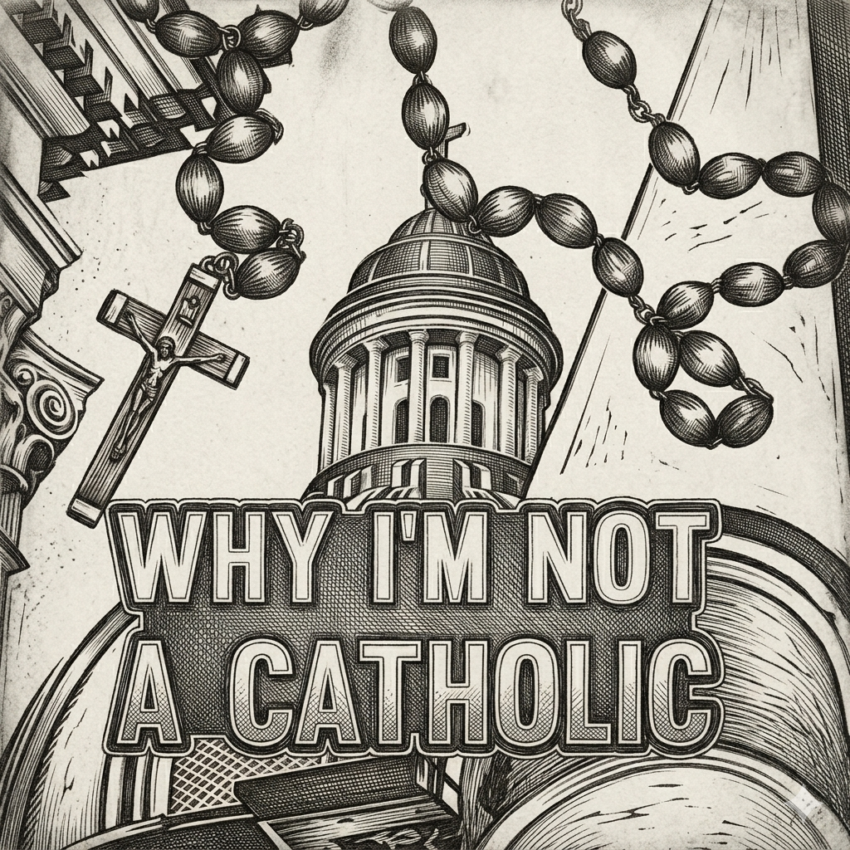
Few questions seem to baffle the online faithful more than the one Wes Huff, the Canadian biblical scholar and apologist with Apologetics Canada, says he hears almost daily: How can someone who has studied Scripture and church history as deeply as you have still remain a Protestant? In a long, deliberately gentle address, Huff turns that incredulity on its head. His short answer is that it is because he studies Scripture and church history—not despite it—that he is a convictional Protestant. The rest is the careful unfolding of why.
Huff is at pains to begin in charity. He names Roman Catholic voices he genuinely admires—Trent Horn, Michael Knowles—and insists he has never produced focused anti-Catholic content; the clips circulating online are off-the-cuff answers, not his considered case. What follows, he says, is clarification rather than combat, offered to people he loves and wants only the best for. With that posture established, he lays out a structured argument: three sufficiencies that anchor the Protestant conviction, four doctrinal commitments of Rome that he cannot accept, and the question that finally decides the matter—justification.
Here is the full transcript of this video [Click HERE to close]
–
I get a lot of engagement on my content with Roman Catholics, and some of it I really appreciate. There are quite a few Roman Catholic voices out there online that I genuinely see as good and articulate and clear when it comes to a host of issues, despite the theological differences that I might hold as a Protestant and they would hold as a Roman Catholic. Trent Horn, for example, comes to mind. I’ve watched quite a bit of his content. I really like Trent. I like his demeanor. I appreciate the stuff he puts out online. I’ve been on Michael Knowles’ show. I enjoyed our interaction and he’s been very supportive and encouraging towards me since. And so despite what some of you may have seen on like Roman Catholic Twitter or YouTube or whatever, I actually have never made a video solely focused on Protestant versus Roman Catholic distinctives. There are videos floating around out there on the internet of maybe me being asked about the subject in like a Q&A at a talk that I’ve given, but they’re aren’t actually any on my channel. So it’s those ones that are floating around online, they’re me giving an off the cuff answer as opposed to focused and specific content like that you would find here on my personal platform. The closest I’ve ever come is discussing the topic of the canon of Scripture, where there is, there’s a difference when it comes to the Old Testament in a Roman Catholic Bible and in a Protestant Bible. But that’s been an attempt to discuss and clarify the issue rather than like pitting the Protestant position over and above the Roman Catholic one.
But I wanted to take the time and stipulate why I’m a Protestant, why I am not a Roman Catholic in particular, because I get a lot of comments that say things like, Wes, I can’t believe with all of your study of scripture and church history, you still remain Protestant. And so I wanted to lay out the reasons why that is. The short answer is, is that it’s because of my study of scripture and church history that I am a convictional Protestant. But there’s obviously things that need to be teased out there. And so I want to go through some of these things with you to clarify, okay, what are the reasons that I hold to a modern Protestant position rather than a modern Roman Catholic one. And the first one right off the bat is the issue of sufficiency. So first, sufficient meaning that in what they are and in what they do, they meet the needs entirely of their proposed intent. So if we’re talking about the sufficiency of scripture, in other words, and I’ve said this elsewhere, scripture is ontologically unique. So though it contains both divine and human authorship, scripture remains the speech of God. Nothing else matters.
We possess as a rule is akin to scripture. Likewise, scripture functions unrivaled in its authority. Nothing we possess as a rule does that. But both in what it does and in what it is, scripture is unique. And that uniqueness provides the basis for its sufficiency. Scripture intends to communicate to the body of Christ both the primary and infallible means for faith and practice. So what scripture intends to communicate when properly understood contextually and exegetically, it does. And this doesn’t preclude misunderstanding or misinterpretation. Even when God spoke directly via the prophets to people in Israel or the surrounding nations around Israel, it didn’t mean that they wouldn’t misunderstand, twist, or misapply those prophetic words despite them being near divine dictation, right? God is speaking directly to the prophet, and there’s a divine communication there that is… It is infallible, right? God is, he’s communicating those words.
And that doesn’t mean that everyone who’s hearing them is going to apply them perfectly. Scripture being sufficient and is sufficient due to its divine origin. And that doesn’t mean then that you won’t have individuals who disagree with what it means or how it should be understood. That is why the discipline of interpretation and the study of the original languages has been a core emphasis by so many throughout Christian history. Our goal is, as Al Anselm of Canterbury said, is faith-seeking understanding because we are fallible and God is not. And it is not God’s fault that we fallibly understand or misunderstand his infallible words. And likewise, does not negate that due to the origin being divine, scripture is therefore insufficient to communicate properly without an infallible interpreter. While Luther and the Reformers taught that the Bible alone is the authority for Christian faith and practice, the Roman Catholic Church responded at the Council of Trent by affirming that truth and salvation’s rule exist in both written scripture and in unwritten traditions received from the apostles.
So Roman Catholics… Therefore operate with a two source of authority, scripture and tradition. Importantly, the Protestant principle of sola scriptura does not eliminate all authority. Churches acknowledge church tradition as possessing a ministerial or serving rather than a magisterial or leading authority. That’s important to take note of. That the authority, right, is the church possessing a ministerial or serving rather than a magisterial or leading authority. So seemingly valued when grounded in Scripture and cherished historically, but ultimately subordinate to Scripture. Tradition for Protestants has a vote and it has a voice. Scripture simply has the veto. This distinction between Scripture’s ultimate authority and tradition’s secondary role marks the Protestant position’s essential contrast with Rome’s dual source framework. I believe Scripture to be sufficient to effectively communicate. Neither tradition nor personal experience have the same divine authority. So Scripture in that way is sufficient.
Secondly, I believe in the sufficiency of faith. The Protestant emphasis on salvation is that it comes through faith alone. That justification, which is going to be a further point that I’m going to elaborate on a little bit later, is a definitive moment when God declares a person righteous and they enter the Christian life. This represents a judicial understanding. God pronounces the believer righteous based on faith in Christ. This standing with God excludes all human works, including religious rituals performed through a church. The Catholic perspective differs fundamentally. Rather than viewing justification as a single point in time, the Roman Catholic position understands it as an ongoing process dependent on grace itself.
Received through participation in the church as a repository of saving grace. Grace functions almost as a substance that can be dispensed through various channels. The church’s leadership, prescribed rights, the mass, Eucharist, baptism, and sacraments, all of which serve as a means of saving grace that progressively improve and perfect the believer towards salvation. So justification then in Roman Catholicism is understood as a continuing process in which God makes believers righteous through faith expressed in works of love, including participation in the sacrament that convey grace with justification initially conferred in baptism and involving sanctification of the whole person.
It’s important to note that Catholic doctrine does not advocate works-based salvation. Rather, both traditions, Protestantism and Roman Catholicism, affirm salvation by grace. The crucial difference lies in how grace is received and what it accomplishes, whether justification is sufficient as a one-time entrance into Christian life or a constant movement towards salvation. Roman Catholicism joins justification with sanctification and regeneration, tying it to baptism and the sacrament through which grace is infused, making justification a cooperative effort between God’s grace and human effort, where believers merit eternal life through Christ’s involvement and good deeds. This represents the watershed separation, I think, of these two theological traditions on the nature and sufficiency of faith in salvation.
The Protestant position is that humans possess no inherent capacity to contribute meaningfully to their own salvation, having lost the freedom to accomplish anything pleasing to God. So we see that in places like Hebrews 11, verse 6, or Romans 8, 8, meaning salvation must originate entirely from Christ rather than from human effort. So this recognition of human inability, paedophilia, paired with Christ’s sufficiency, becomes the foundation of faith itself. Melanchthon, in his letter to Brentius in 1531, articulated this position by clarifying that faith justifies not because it represents some perfect perfection within us, but because it, quote, lays hold of Christ, the basis for our acceptance before God. And we also see Zwingli, the other reformer, similarly holding that faith understood as humanity’s appropriation of Christ’s redemptive work through grace, and that it functions as the sole instrument of salvation. These are the historical Protestant positions.
For Calvin, genuine faith involves not ignorance, but knowledge of God and Christ. Not submission to an ecclesiastical authority, but firm persuasion that God acts as a benevolent father and confident expectation of salvation. Luther also employed the metaphor of a bride united with her bridegroom. Faith unites the soul with Christ in such a way that Christ assumes the believer’s sin and death and damnation while bestowing his grace life and salvation upon the soul luther and the other reformers insisted that justification by faith alone represented salvation as entirely god’s work accomplished through grace alone because of Christ alone. The Reformers distinguished their position from Rome’s claim that faith constitutes merely one component of justification alongside things like works and sacraments and post-mortem purgation. This emphasis on faith’s sufficiency, therefore, simultaneously rejected both human merit and and institutional mediation as necessary components of justification. I believe that what Jesus accomplished, he did so sufficiently. His act of justifying the believer was once for all. There is no condemnation for those who are in Christ Jesus. It says in Romans chapter eight, verse one, and I can hold that sufficient work in my life confidently.
The next one would be sufficiency of grace. So the fundamental divide in these kind of definitional differences, which I think are important and which are key to why I am Protestant and not Roman Catholic is that the divide concerns whether grace accomplishes salvation by itself or or requires human cooperation. The Reformation debate centered not on grace’s necessity, but on its sufficiency. Rome maintains that grace enables, but does not compel salvation, since grace cannot… Initiate or sustain or complete salvation without human assent and cooperation. This disagreement reflects competing understandings of grace and nature itself. Roman Catholicism treats grace almost as a substance dispensed through meritorious channels. Like I said before, you have the magisterium, you have prescribed rights, you have the mass, Eucharist, baptism, and the sacraments, all of these as a means of grace that improve and perfect the believer towards salvation. Protestants, though, in contrast, understand grace as God’s sovereign, transformative power that operates independently of human merit or institutional mediation.
So Romans 11.6 establishes that if salvation is by grace, it cannot simultaneously rest on works, since grace would otherwise cease being grace. Paul declares that in 2 Corinthians 12, 9, that my grace is sufficient for you. And I think that underscores grace’s completeness. While in 2 Timothy 1, 9, attributes salvation to God’s purpose and grace given before the ages. And not because of our cooperation or in cooperation with human works for its origins. The sufficiency question is a very important one. I don’t negate that Roman Catholicism says that those things are necessary. Scripture is necessary. Grace is necessary. Faith is necessary. But I ultimately think that what we see in Scripture is not that these things are necessary, but they are sufficient. They are sufficient to actually accomplish God in his communication and in the salvific work that he operates.
My next reason that I’m not Roman Catholic is the papacy. I simply do not see Matthew 16, 18 being a statement about Petrine supremacy. So let me read this for you. It says, and I tell you, You are Peter, and on this rock I will build my church, and the gates of hell shall not prevail against it. So the way that Rome today has understood this is that Peter is the rock, and that through Peter there is a line of successors, which are the bishops of Rome and that this specific bishop is is the vicar of Christ on earth. I think this is a misreading. And I would go as far as saying that what Augustine states in this passage, when he talks about it in his homilies on the gospel of John is correct. He articulates that the rock in Matthew 16, 18 is Christ himself, not Peter. And he clarifies that Peter derived his name from rock, right? So Petra in Greek, right? That’s rock. And that it’s not the reverse.
So his actual argument is just as Christian comes from Christ, not the other way around. So we have the statement on this rock, I’ll build my church, and then calling Peter the rock. Augustine argues it’s the same way we view the term Christian, that we get our Our title as Christian from Christ, not the other way around. And so Augustine is pretty specific on this, that when Christ said, upon this rock, I will build my church, that we ought to interpret that as referring to the confession of Peter that he had, that he just made in context rather than the person of Peter. And Augustine doesn’t argue grammatically from the Greek. I think that, you know, he’s very candid in saying he doesn’t understand the Greek, but I think that is what we see in the Greek. Jesus says this. So let me read it for you. I’ll put it up on the screen and you can follow along even if you can’t read Greek. He says, “On this rock, I will build my church.” He doesn’t say, “On you,” that being Peter, “I will build my church.” He says, “On this rock, I will build my church.” So I don’t think there’s an exegetical argument there for papal authority. I think Augustine is correct.
That it’s Peter’s confession of Christ’s identity, not Peter himself on which the church stands. Now, anticipating pushback, I can already hear people typing in the comments section about other things Augustine said about the authority of the bishop of Rome that I, as a Protestant, clearly don’t adhere to. And I totally grant that. I neither believe or am obligated nor even need to agree with Augustine on everything he says about the position, authority, or posturing of the Bishop of Rome. I can, however, agree with him here. Where I might disagree with him elsewhere, I agree with Augustine when he correctly looks at Matthew 16:18 and properly reads the context of the passage, as I believe it is meant to be read. But even, even if we grant that Peter is the rock, right? That the rock that Jesus is talking about is Peter, I still don’t see this as meaning that Peter’s successors are the heads of the church.
I also think the historical record format, at least the century following the time of Jesus, indicates there being a single bishop in Rome. So this like 100 year period after Jesus, as the office of bishops developed into a role distinct from pastors hierarchically, it does not appear that there was a single ruling bishop, say in the late first or early second century during Ignatius’ time. Rather than addressing a bishop of Rome or a college of presbyters, Ignatius never mentions any presiding or noteworthy supremacy authority for the Roman Catholic Church. And this isn’t a fallacious argument from silence. Ignatius held extraordinarily strong convictions about hierarchical church structure and the necessity of obedience to bishops. No writer in the early church asserted the Episcopal authority in more emphatic terms than Ignatius. And so his complete silence on papal primacy is an elephant in the room. The Shepherd of Hermas from the early second century mentions, quote, the elders who preside over the church. So rather than a single bishop, he refers to it as in the plural.
And Clement, traditionally listed as an early Roman bishop, should probably be understood as one of several collegiate presiding elders rather than the sole bishop. While Stephen of Rome is the first one to initiate Petrine-based claims in 256 AD and earlier bishops exercised authority, Bishop Sylvester, the bishop of Rome during the time of the Council of Nicaea, he doesn’t even show up. To the Council of Nicaea. And no one appears to think that this is some serious issue. While he does send delegates on his behalf, neither him nor his delegates are given any special privileges or seen as exercising any more or less authority than any other church leader. Explicit assertion of Rome’s unique overarching supremacy doesn’t realistically crystallize until, I would argue, the late 4th and 5th centuries, particularly through Damasus, Leo the Great, and Galatius. So I don’t see the papacy holding any kind of unique office in that way. I don’t see that biblically, and I don’t see that in this very early kind of infancy church period.
The next reason why I don’t buy Roman Catholicism is prayer to the saints. I believe prayer to the saints to be a serious issue. I have less of a problem with the acknowledgement of particularly exemplary figures throughout church history. I’m a big fan of highlighting heroes of the faith that we can recognize within the communion of saints. This is somewhat aside from the fact that scripture consistently refers to all Christians as saints. Paul addressing the believers in Rome as called to be saints. That’s Romans chapter 1 verse 7. And he similarly designates the Corinthian church as those sanctified in Christ Jesus called to be saints together with all those who in every place call upon the name of the Lord Jesus Christ. That’s 1 Corinthians chapter 1 verse 2. I also grant that the Roman Catholic position in regard to prayer to the saints is not a worship of the saints, but speaking to deceased saints, signaling the distinction of dulia service and latria worship.
That the Roman Catholic would articulate that in the same way that we would ask saints here on earth to pray for us, the saints in glory are closer to God himself, and so we ask them to pray for us in a similar way, and specifically due to their proximity to the divine, due to their glorified state. Theologically, I can understand this, but the practical reality of piety is I do think problematically collapses the dulia and latria distinction in an unhelpful way. So prayer is only ever addressed to God within scripture. It is a fundamentally worshipful act in its nature and its function. Even in instances of biblical prayer that encompasses complaints or negotiation or self-defense or maybe even like raw emotional expression, every instance of prayer within scripture is only ever addressed a genuine dialogue with the divine. So the divide of a prayer to a saint, which is understood as non-worshipful, and a prayer to God that is understood as worshipful, I think actually breaks down under the scrutiny of scripture.
And I mean this with a great deal of respect to my Roman Catholic friends. But when you look at the practice of prayer to the saints throughout church history, it far too often develops into superstition and supplication to saints in contrast or even instead of God himself. There are countless examples of that where you see individuals throughout church history who have taken on this practice and they pray to saints first. For help or for aid in derogation of actually praying to God. And I even see prayers for the saints as an early developing practice. I grant that, you know, that goes within antiquity, origin in the late second century. And early third century. He defended it by appealing to the communion of saints. But it’s really in the fourth and fifth centuries that you see the practice start to crystallize with its advocacy by individuals like Cyril of Jerusalem and Chrysostom and Gregory Nazianzen. So I don’t think we start to see a shift from praying for the dead to praying to them until a little bit later. I think the evidence shows more that for the first three centuries, veneration of martyrs restricted itself to remembrance of their virtues and celebration of their death as their heavenly birth. That’s kind of the language that’s used in some of these early writings.
But in the Nicene age, it starts to advance and it advanced to formal invocation of saints as patrons and intercessors. And biblically, I have an extremely hard time justifying either prayer to or for saints. I just do not see it. And though I understand that Roman Catholics have a different understanding of prayer and and how it operates in being offered to saints without being confused or conflated with worship, I don’t think it’s biblically warranted. And more often than not, I think it’s what, from a scriptural lens, can actually be tantamount to idolatry.
My next problem and reason why I’m not Roman Catholic is because of the mass. Now I hope if you’re a Roman Catholic and you’re this far into the video, you hear me pause to say that the whole reason I’m making this is not to be inflammatory. It’s not to be mean-spirited or capitalize on being a Protestant who’s more concerned with being right than being loving. I care for my Roman Catholic friends, and I want only what is best for them. I’m saying these things. Because I think that these things are important. I’m a convictional Protestant. I genuinely believe that the effort of the Reformation was good and was needed and was a true pursuit. And so my desire is that you keep that in mind with what I have said and with what I’m about to say particularly, because I’m about to talk pretty candidly about the Mass. The Mass is as is understood in formal Roman Catholic doctrine and dogma, is at minimum theologically problematic from a biblical standpoint, and at most what I believe to be a denial of the work communicated within the gospel message. Now that’s a bold statement, and I don’t say it lightly, but I think it’s true.
Here’s why I say it though. The notion that the Mass, in formal Roman Catholic theology, is an unbloody sacrifice where the priest offers up Christ to God the Father. That the mass constitutes an actual sacrifice that does not differ in essence from Christ’s sacrifice on the cross. So the former being bloody while the latter is bloodless. Now, my own theology as a historic Baptist would say that the Lord’s Table contains the idea of real presence, that Jesus is present in the matter of what we are doing whenever we meet together in remembrance of him. And I would even go as far as saying that I think there’s a sacrificial component to to this in so far as this is a sacrifice of praise and of thanksgiving that we offer in worship, but is not a propitiatory sacrifice. So propitiation is a theological term referring to appeasing divine wrath through prayer or sacrifice. When sin has been committed during the mass, the mechanism involves the priest’s consecration of the bread and the wine, and then the consecrated hosting cup represent the slain lamb through the action of consecration and the production of the body and then separately of the blood. By the words of consecration.
Luther distinguishes between a sacrament and a sacrifice, and I think that’s helpful. The sacrament is the means of the grace by which God gifts us participation in this event by him saying, this is my body given to you. And the posture is God to us. The Mass has the priest offering Christ to the Father, and the directionality of the posture then is not heavenly downward for the Church, which I would argue is what is happening in the means of grace that takes place at the Lord’s table, but earthly upwards on behalf of the Church to God. So in Roman Catholicism, it’s earthly upwards. In Protestantism, I would argue in the kind of proper biblical understanding of what’s going on at the Last Supper, at the Lord’s Table, it’s heavenly downwards. What I believe is happening at the Lord’s Table is an action where we participate in praise and thanksgiving in remembrance of a one God.
Time event. We’re not offering Christ up as a sacrifice to appease the Father’s wrath for the forgiveness of our sins. I totally understand that this is representation rather than re-sacrifice. I don’t want to be accused of misrepresenting the Roman position on this. I think we just disagree fundamentally. And I recognize the nuance. I simply deny the whole premise. My position as a historic Protestant is that the Roman Catholic understanding of what takes place on the Mass is not compatible with what we see in places like Hebrews 9-10, where the Mass as a sacrifice is a direct conflict with the juxtaposition of the sacrifices in the Old Testament in the Old Covenant system being compared with the once-for-all sacrifice of Jesus in the New. A representation of an unbloody sacrifice that needs to be done over and over in order for the remission of sins is contrary to, I think, what the author of Hebrews describes in what takes place on the cross. And I think that that’s a problem.
My next point is the idea of the changing in the quote, unchanged church. Last spring, I traveled to Trento, Italy, where our film team at Apologetics Canada went there specifically to produce episode four of our Can I Trust the Bible video series. And the purpose of us being at Trent is was to discuss its impact on the official pronouncement of the canon of scripture that took place on April 8th, 1546. So for that project, I was reading a ton of stuff that was going on at Trent in the 16th century and the conversations and disagreements that happened during the counter-reformational movement. And I have to be honest, my experience of that investigation solidified for me that the religion of Rome being argued for at Trent, at the Council of Trent, is quite different in places to the religion of Vatican II following 1965. The theology of Rome has changed. The historical consistency often claimed within Roman Catholicism is simply not there when actually compared with what the church has in the past declared about its beliefs.
The polemics that took place during the Reformation taught that Roman Catholic teaching as it was at Trent, was the universal teaching of the whole church. And that’s simply false. So when you have Cardinal Henry Newman writing an essay on the development of Christian doctrine in 1848, he’s outlining the parameters of why the claim of unchanged continuity isn’t true. The development hypothesis undermines a unified, constant, and uniform teaching from the Apostles to today, what Newman outlines is simply not the thinking of those at Trent. It isn’t. They would not have agreed with Cardinal Henry Newman’s thesis. On paper, the claim of continuance and unchanged succession sounds great, but at a deeper inspection, It’s just simply not true. And a simple example of this is that the medieval church taught that submission to the Bishop of Rome, the Pope, was a matter of salvation. It was salvific. The papal bull Unum Sanctum issued by Pope Boniface in 1303 stated, quote, we declare, affirm, define, and pronounce that it is absolutely necessary to salvation that every human creature should be subject to salvation.
To the Roman pontiff. A modern Roman Catholic teaching acknowledges that those suffering from invincible ignorance of the true religion can achieve salvation through moral readiness and faithfully fulfilling God’s will through the precise mechanisms that remain unexplained. And this includes, according to the Catholic Catechism, Muslims and Jews being able to be saved even if they are outside the church. Let me read for you paragraph 841, 841 of the Catechism. It says this, quote, In the first place, amongst whom are the Muslims. These profess to hold the faith of Abraham, and together with us they adore the one merciful God, mankind’s judge on the last day. I’m sorry, but this is not the teaching that you find in the very clear medieval Catholic theology of extra ecclesiam nulla salus. Outside of the church, there is no salvation. It’s just not the same. There’s a clear change.
You read the writings of the medieval church and it has sometimes even stark differences like this. A clear growth. And so I don’t think that that validates that this is the one true church, that it has gone unchanged. And when you read individuals like Cardinal Henry Newman, he is working a thesis to explain exactly how change does happen. Okay, justification. I touched on this a little bit before when I talked about sufficiency, but when I use the word justification, what I’m asking is the question, how am I made right with God? How is God’s work in moving a person from sin to a state of grace accomplished? The fact is I have a problem. I have a problem because I’m a sinner. And so as a sinner, I am confronted with a holy and righteous God who due to his holiness and his righteousness, if I am to ever be in relationship with him, my sin must be accounted for. And so justification is the act by which God declares a sinner like me righteous.
And one of the main reasons, if not the main reason I am not Roman Catholic is due to the answer to that question on justification. When I read scripture, when I look at passages specifically addressing the topic throughout the book of Galatians and Romans, Ephesians, Titus, first Corinthians and James, I see the clarity of the Protestant position compared to the discontinuity of that of the gospel that Rome articulates. But the divide between the Protestant and Roman Catholic perspective here hinges on a crucial semantic and theological distinction about what the term itself means. The Roman Catholic Church maintains that God will not declare a person just until that person actually is just. Requiring the person to be just by definition, so that when God examines and defines that person, he finds genuine righteousness present. In contrast, Protestants argue that a person can be justified only when something is added to them, namely the righteousness of Christ, and that one must be covered by his righteousness in order to be justified.
With acceptance by God resting solely on this basis. This disagreement stems from competing interpretations of the word justification itself. Historic Protestants, thinkers like the Lutheran and Reformed camps, recognized that the verb to justify was forensic, meaning to declare or pronounce to be righteous, not to make justifications. So for Protestants, justification refers to God’s external ruling that the sinner is regarded as righteous before him, before God, marking the beginning of the Christian life. Roman Catholicism, on the other hand, understands justification to mean both the initiation and the ongoing process of regeneration. In other words, when we use the term justification, we could just as easily use the word vindication. So for the Protestant position, I go to places like Romans 4:4-5, which uses Abraham as the model, showing that faith, not labor, is counted as righteousness when directed toward God who justified the ungodly.
Romans 4:25 and 5:1 connects Christ’s resurrection to our justification and the resulting peace with God through faith. Romans 8:33 identifies God as the one who justifies. Romans 4:9 connects justification through Christ’s blood with future salvation from God’s wrath. And then 1 Corinthians 6:11 places justification alongside sanctification as part of transformation in Christ. Galatians 2:16, it establishes that a person is not justified by works of the law, but through faith in Jesus Christ. And then Romans chapter 3 verses 20 to 24 explains that no one achieves righteousness through law keeping, yet all who believe are justified by God’s grace through Christ’s redemption. And then we see that. We see that just a little bit later in chapter 3 verse 28 where it affirms the justification.
Comes by faith apart from works of the law. So it’s not that I contribute toward the act and then get something out of it. Instead, the one who does not work, but trusts in God who justifies, then our faith is credited to us as righteousness. Luther argued that justification occurs through legal imputation of Christ’s righteousness to the sinner apart from the sinner’s own righteousness. With moral transformation being the effect rather than the cause of justification. It’s not like you can just be pronounced righteous and now you can do whatever you want because God has washed you clean. No, the cause has an effect. And so the Protestant position is that justification is acquired by faith alone not by faith plus ritual obedience or personal holiness. It’s entirely received and not achieved.
So as I conclude, do I think Roman Catholics can be true Christians? I’ve highlighted all these things. I think there are real issues, there are real differences, divides with things like sufficiency, talking about scripture, talking about faith, I, you know, look at what the doctrine of the mass is according to Roman Catholicism and I reject that. I look at the papacy and its historic understanding. I reject that. I look at this idea that the Roman Catholic Church is the true unchanged 2000 year old church. And I simply look at the evidence for that and I don’t see it. I see clear developmental change. So in light of that, do I think that Roman Catholics Can be genuine born again believers? And the answer to this, and I’ve maintained this publicly many times, is yes. Luther himself addressed this question in 1528.
When asked about whether those coming out of the Church of Rome should be rebaptized due to their now realization of the falsehoods taught under the papacy and their movement towards Protestantism, you know, do they need to be rebaptized? He addresses it by saying, quote, “…we on our part confess that there is much that is Christian and good under the papacy.” Indeed, everything that is Christian and good is to be found there and has come to us from this source. For instance, we confess that in the papal church there are the true holy scriptures, true baptism and true sacrament of the altar, the true keys of the forgiveness of sins, the true office of the ministry, the true catechism in the form of the Lord’s Prayer, the Ten Commandments, and the Articles of the Creed. I speak of what the Pope and we have in common. I contend that in the papacy there is true Christianity, even the right kind of Christianity. And I contend that in the papacy there is true Christianity, even the right kind of Christianity, and many great and devoted saints. This is Martin Luther, right? Wrote some of the strongest criticisms of the Catholic Church, right? He is saying, yes, you can be Christian and be within the papal system.
John Calvin in the Institutes of the Christian Religion wrote, He states this, he says, piety exterminated, and the worship of God almost abolished. I affirm, then, that they are churches inasmuch as God has woefully preserved among them a remnant of his people, though miserably dispersed and dejected. Luther’s perspective was never some idea that he was the head of a new church. And those under Protestantism were now new believers. The reformers recognized the continuity of the church and their inheritance over the 1500 years prior to them going right back to Jesus. The caricature that Protestants believe that the church ceased to exist from the apostles to Luther is a complete straw man. Luther does not believe that. What Joseph Smith did about a great apostasy and a restoration. The desire of the Reformation was for unity under the banner of truth. Luther longed that Rome would come to its senses and abandon the incremental traditions at the time that it developed and that were either unbiblical or anti-biblical.
Luther’s desire was for a conversation at the table to reorient the church, not to split from it. It was Rome that said no and excommunicated him. He didn’t leave, he was removed. And I think that’s important to remind. Luther didn’t leave and start his own church. He was trying to work within the system and was eventually excommunicated from that system for pointing out the theological inconsistency and the corruption. It’s not that there is no good within the Church of Rome or no true believer trusting in Jesus within Roman Catholicism. I think there are. I know people who I believe to be saved within the Roman Catholic Church. However, I believe them to be saved in spite of the teaching of Rome, not because of it. In Luther’s Against the Roman Papacy, he says this, quote, Once again, I hope you hear my heart here. What I’m about to say, I don’t say out of malice or bitterness because I genuinely care for and love those within the Church of Rome. Being a biblically-based faithful Christian will make you a bad Roman Catholic and vice versa.
There will come a time for the mature believer to have to leave Rome as they realize that the incongruity within its doctrines and dogmas with that of the true faith of biblical Christianity. I say that with love, I say that with care, I don’t say that lightly, but I think that is true. I am a Protestant out of conviction, not out of convenience. And this is probably one of my longer videos, but I think it’s a video where I’ve tried to outline some of these things. I think sufficiency is important. I think it’s more than simple necessity. I think it’s sufficiency. God is able to communicate the sufficiency of faith, the sufficiency of Christ in that act. That’s why the later solas were developed. You know, scripture alone, Christ alone, faith alone, grace alone, to the glory of God alone. Roman Catholics don’t differ with Protestants in saying that these things are necessary. We differ when we say that these things are sufficient. So I look at that. I think that’s a serious issue. I think like the reformers, the justification is probably the most important issue, but I also look at the papacy. I just don’t see justification for that. I look at the claim of the unchanged church. I don’t see a justification for that. All these things. And ultimately, via my reading of scripture, via my study of church history is why I’m I remain and am convictionally Protestant and believe that to be true.
The Governing Principle: Sufficiency, Not Mere Necessity
The thread that ties Huff’s whole case together is a single, easily missed word: sufficiency. He grants from the outset that Rome affirms the necessity of Scripture, of grace, and of faith. The Reformers did not deny those necessities either. The dividing line falls elsewhere—on whether these realities are sufficient, whether they actually accomplish what God intends without the supplement of human cooperation, sacramental machinery, and institutional mediation. That is the lens through which his first three reasons come into focus, and he argues that it is why the Reformation eventually distilled itself into the five solas.
Roman Catholics don’t differ with Protestants in saying that these things are necessary. We differ when we say that these things are sufficient.
— Wes Huff
The Three Sufficiencies
1. The Sufficiency of Scripture
Huff grounds sola scriptura in what he calls the ontological uniqueness of the Bible. Though it carries both divine and human authorship, Scripture remains the speech of God; nothing else we possess is akin to it in what it is or in what it does. Because its origin is divine, it is sufficient—read contextually and exegetically—to communicate the primary and infallible rule for faith and practice.
He anticipates the standard objection: fallible readers misread Scripture, so an infallible interpreter is required. Huff answers that even direct prophetic revelation was misunderstood and twisted; the fallibility lay in the hearer, not in the Word. Echoing Anselm of Canterbury’s faith seeking understanding, he argues that the disciplines of interpretation and the study of the biblical languages exist precisely because we are fallible and God is not, and that human misunderstanding never renders the Word itself insufficient.
Crucially, Huff stresses that sola scriptura does not abolish every other authority. Tradition retains a ministerial (serving) authority, not a magisterial (ruling) one. He sets this against the Council of Trent, which located saving truth in both written Scripture and unwritten apostolic traditions—Rome’s familiar two-source framework. His formulation has become something of a maxim:
Tradition has a vote and it has a voice. Scripture simply has the veto.
— Wes Huff
This is the classic Reformational instinct, codified a century later by the Westminster divines, who confessed Scripture’s comprehensive adequacy for everything God requires of His people:
The whole counsel of God concerning all things necessary for His own glory, man’s salvation, faith, and life, is either expressly set down in Scripture, or by good and necessary consequence may be deduced from Scripture; unto which nothing at any time is to be added.
— Westminster Confession of Faith, 1.6
All Scripture is breathed out by God and profitable for teaching, for reproof, for correction, and for training in righteousness, that the man of God may be complete, equipped for every good work.
— 2 Timothy 3:16–17 (ESV)
2. The Sufficiency of Faith
Turning to salvation, Huff frames the Protestant claim judicially: justification is a definitive moment in which God declares the sinner righteous based on faith in Christ, excluding all human works and ritual mediation. Rome, by contrast, treats justification as an ongoing process sustained by grace received through the church’s sacramental system—a process that fuses justification with regeneration and sanctification, begun at baptism and increased through the Mass, Eucharist, and the other sacraments.
He is scrupulously fair here. Catholic doctrine is not, he insists, a doctrine of works-salvation; both communions affirm salvation by grace. The watershed is how grace is received and what justification accomplishes—whether a once-for-all entrance into the Christian life, or a lifelong movement toward salvation in which the believer cooperates and, in some sense, merits eternal life through grace-empowered works.
To anchor the Protestant reading, Huff marshals the Reformers themselves. Philip Melanchthon insisted that faith justifies not because of any perfection in us but because it lays hold of Christ. Huldrych Zwingli treated faith as the sole instrument by which we appropriate Christ’s redemptive work. John Calvin defined genuine faith not as submission to ecclesiastical authority but as the knowledge of God and a firm persuasion of His fatherly benevolence. And Martin Luther reached for his famous bridal metaphor: faith so unites the soul to Christ that He assumes its sin, death, and damnation while bestowing His grace, life, and salvation. Justification, on this account, is entirely God’s work—accomplished by grace alone, through faith alone, because of Christ alone.
Later Protestant theologians would call this the article on which the church stands or falls, and R. C. Sproul would name it the material cause of the entire Reformation. Huff’s own confession is simpler and warmer: what Jesus accomplished, He accomplished sufficiently, and that finished work can be rested in with confidence.
There is therefore now no condemnation for those who are in Christ Jesus.
— Romans 8:1 (ESV)
3. The Sufficiency of Grace
The third sufficiency concerns grace itself. Rome, Huff argues, tends to treat grace almost as a substance dispensed through meritorious channels—the magisterium, prescribed rites, the Mass, baptism, and the sacraments—that progressively perfect the believer toward salvation. The Reformation debate, he clarifies, was never about grace’s necessity but about its sufficiency: does grace accomplish salvation by itself, or does it merely enable a salvation that still requires human assent and cooperation to begin, sustain, and complete?
His answer is Pauline. Romans 11:6 establishes that if salvation is by grace, it cannot simultaneously rest on works, or grace would cease to be grace. Second Corinthians 12:9 underscores grace’s completeness. Second Timothy 1:9 attributes salvation to God’s own purpose and grace, given before the ages and not based on our cooperation. For Protestants, grace is God’s sovereign, transformative power, operating independently of human merit or institutional mediation.
But if it is by grace, it is no longer on the basis of works; otherwise grace would no longer be grace.
— Romans 11:6 (ESV)
My grace is sufficient for you, for my power is made perfect in weakness.
— 2 Corinthians 12:9 (ESV)
✦ ✦ ✦
Four Doctrines of Rome He Cannot Accept
The Papacy
Huff denies that Matthew 16:18 teaches Petrine supremacy. Following Augustine’s Homilies on the Gospel of John, he reads the rock not as the person of Peter but as Christ Himself—or, more precisely, as Peter’s confession of Christ’s identity. Augustine observed that Peter (Petros) takes his name from the rock (petra), not the reverse—just as a Christian is named for Christ, and not Christ for the Christian. Augustine candidly admitted he had no Greek, yet Huff contends the grammar bears his reading out: Jesus says on this rock, not on you, I will build my church.
And I tell you, you are Peter, and on this rock I will build my church, and the gates of hell shall not prevail against it.
— Matthew 16:18 (ESV)
Anticipating the objection that Augustine elsewhere exalted the bishop of Rome, Huff grants the point freely: he need not agree with Augustine on everything to agree with him here. And even if Peter were the rock, that would not make his successors heads of the church. The historical record, he argues, tells against Roman primacy for the better part of the first century after Christ. Ignatius of Antioch—the early church’s most emphatic champion of monepiscopal authority and obedience to bishops—never mentions any Roman supremacy, a silence Huff calls not a mere argument from silence but “the elephant in the room.” The Shepherd of Hermas speaks of the elders (plural) who preside; Clement is best understood as one of several collegial presbyters. Stephen of Rome first advances Petrine claims around 256; Sylvester does not even attend the Council of Nicaea, and neither he nor his delegates wield special authority. Explicit assertion of Rome’s overarching supremacy, Huff argues, does not crystallize until the late fourth and fifth centuries, through Damasus, Leo the Great, and Gelasius.
This developmental picture is not a Protestant invention. Catholic historians such as Eamon Duffy and reference works like J. N. D. Kelly’s Oxford Dictionary of Popes likewise describe the monarchical Roman episcopate as a gradual emergence rather than an apostolic given.
Prayer to the Saints
Huff distinguishes honoring exemplary believers—which he warmly endorses—from praying to them, which he rejects. He notes first that Scripture calls all Christians saints (Romans 1:7; 1 Corinthians 1:2). He grants Rome’s distinction between dulia (veneration) and latria (worship), and even concedes the theological logic: the glorified saints are near to God, so the faithful ask their intercession much as they might ask a living believer to pray. Theologically, he can follow the argument; in practice, he says, popular piety collapses the dulia–latria distinction in unhelpful ways.
To those sanctified in Christ Jesus, called to be saints together with all those who in every place call upon the name of our Lord Jesus Christ.
— 1 Corinthians 1:2 (ESV)
His deeper objection is that in Scripture, prayer is only ever addressed to God and is by nature a worshipful act—even when it takes the form of complaint, negotiation, or raw lament. The proposed category of a non-worshipful prayer directed to a saint, he contends, breaks down under scrutiny. Historically, the first three centuries restricted the veneration of martyrs to remembrance of their virtues and celebration of their death as a heavenly birth; the formal invocation of saints as patrons and intercessors advances only in the Nicene age, with figures like Cyril of Jerusalem, Chrysostom, and Gregory Nazianzen. Finding neither prayer to nor for the dead biblically warranted, Huff judges the practice to drift, far too often, into something “tantamount to idolatry.” The point coheres with Paul’s insistence on a single mediator:
For there is one God, and there is one mediator between God and men, the man Christ Jesus.
— 1 Timothy 2:5 (ESV)
The Mass
Pausing again to reaffirm his charity, Huff speaks candidly: the Mass, as defined in formal Roman dogma, is at minimum theologically problematic and at most a denial of the gospel itself. His objection targets the doctrine that the Mass is an unbloody, propitiatory sacrifice in which the priest offers Christ to the Father—a sacrifice not differing in essence from Calvary, only in mode. Borrowing Luther’s distinction between a sacrament and a sacrifice, Huff highlights the directionality of the act. In the biblical Lord’s Supper, the movement is heavenly-downward: God gifts His people through the words this is my body, given for you. In the Mass, the movement is earthly-upward: the church offers Christ to God.
As a historic Baptist, Huff affirms a real presence at the Table and even a sacrificial dimension—a sacrifice of praise and thanksgiving—while denying any propitiatory re-presentation. He is careful not to caricature Rome: he acknowledges the doctrine intends representation rather than re-sacrifice. He simply rejects the premise as incompatible with the argument of Hebrews 9–10, where the repeated sacrifices of the old covenant are set in deliberate contrast with the once-for-all offering of Christ in the new.
And by that will we have been sanctified through the offering of the body of Jesus Christ once for all. … For by a single offering he has perfected for all time those who are being sanctified.
— Hebrews 10:10, 14 (ESV)
The Church That Claims Never to Change
Drawing on a research trip to Trent, Italy, filmed for Apologetics Canada’s Can I Trust the Bible? series and centered on the canon decreed there on 8 April 1546—Huff argues that Rome’s claim of unbroken doctrinal continuity does not survive contact with the record. The religion defined at the Council of Trent differs in places from the religion of the Second Vatican Council, which closed in 1965. Tellingly, the great Catholic theorist of this very problem was Rome’s own John Henry Newman, whose 1845 Essay on the Development of Christian Doctrine was written precisely to explain how doctrine changes. The development hypothesis, Huff observes, quietly concedes that the church’s teaching is not the static, uniform deposit Trent’s polemicists claimed it to be.
His clearest illustration is the doctrine extra ecclesiam nulla salus—outside the church, there is no salvation. The papal bull Unam Sanctam, issued by Boniface VIII in 1302, declared it necessary to salvation that every human creature be subject to the Roman pontiff. Yet paragraph 841 of the modern Catechism affirms that Muslims, who “profess to hold the faith of Abraham,” are included within the plan of salvation, adoring with Christians the one merciful God. That, Huff says, is not the seamless development of a single teaching but a visible change—and it undercuts the claim that Rome is the one true, unaltered church of the apostles.
✦ ✦ ✦
Justification: The Question That Decides It
With the Reformers, Huff calls justification the single most important issue. The question is plain: how is a sinner made right with a holy and righteous God? The divide between Rome and the Reformation, he argues, is at once semantic and theological. Rome holds that God will not declare a person just until that person actually is just; justification means to make righteous, and is therefore fused with regeneration and sanctification, conferred at baptism and increased through the sacraments. Protestants hold that the verb is forensic—to declare or pronounce righteous—so that the sinner is justified when the alien righteousness of Christ is imputed to him, and he is covered by it, with acceptance before God resting solely on that basis.
Alister McGrath’s standard history of the doctrine, Iustitia Dei, traces exactly this lexical and theological terrain: the recovery of justification as a declarative, courtroom verdict rather than an infused quality. Luther argued that justification occurs through the legal imputation of Christ’s righteousness apart from the sinner’s own, with moral transformation as its effect rather than its cause. The believer is not pronounced righteous to do as he pleases; the cause produces an effect. Justification, on the Protestant reading, is received, not achieved. Huff supports the claim with a dense catena—Romans 4:4–5 and 4:25–5:1, Romans 8:33, 1 Corinthians 6:11, Galatians 2:16, and Romans 3:20–24 and 3:28—each turning on faith credited as righteousness apart from works of the law.
And to the one who does not work but believes in him who justifies the ungodly, his faith is counted as righteousness.
— Romans 4:5 (ESV)
We know that a person is not justified by works of the law but through faith in Jesus Christ.
— Galatians 2:16 (ESV)
✦ ✦ ✦
Can Roman Catholics Be Saved?
Having pressed all of this, Huff arrives at the pastoral question and answers it without hesitation: yes, Roman Catholics can be genuine, born-again believers—and this is no grudging concession. He appeals to Luther himself, who in 1528 asked whether converts from Rome needed rebaptism, and replied that much that is Christian and good is found under the papacy: the true Scriptures, true baptism, the Lord’s Prayer, the Creed, the office of the ministry. Luther went further still:
I contend that in the papacy there is true Christianity, even the right kind of Christianity, and many great and devoted saints.
— Martin Luther (1528)
Calvin, in the Institutes, likewise granted that God had preserved a remnant of His people even amid Rome’s corruptions, so that churches in some real sense remained. The Reformers never imagined the church had ceased to exist between the apostles and Luther; that caricature, Huff insists, is a straw man.
Here he draws a sharp and—for readers of comparative theology—especially instructive contrast. The Reformers’ vision was nothing like Joseph Smith’s later doctrine of a total Great Apostasy requiring a wholesale Restoration. They affirmed the unbroken continuity of Christ’s church straight back to the apostles. Luther did not leave Rome to found a new church; he sought reform “at the table,” and it was Rome that refused, excommunicating him. He was removed; he did not depart.
And yet Huff’s conclusion is unflinching. The believers he knows within the Roman communion, he says, are saved despite its official teaching, not because of it. As a believer matures, he argues, the incongruity between Rome’s dogmas and biblical Christianity will eventually press toward a parting—an observation he offers, repeatedly, with evident affection rather than malice: a biblically faithful Christian, in his words, will make a poor Roman Catholic, and the reverse holds as well.
✦ ✦ ✦
Conclusion: Conviction, Not Convenience
Huff’s case returns, in the end, to where it began—to sufficiency. Rome and the Reformation agree on the necessity of Scripture, grace, faith, and Christ. They divide over whether these are sufficient: whether God’s Word truly suffices to communicate, whether grace truly suffices to save, whether Christ’s once-for-all work truly suffices to justify. That conviction, he argues, is exactly what the great Reformational confessions distilled into sola scriptura, sola gratia, sola fide, solus Christus, and soli Deo gloria. It is by his reading of Scripture and his study of church history, not by inertia or tribal loyalty, that he stands where he does.
I am a Protestant out of conviction, not out of convenience.
— Wes Huff
Sources & Further Reading
• Apologetics Canada — https://www.apologeticscanada.com/
• Wes Huff (primary source video/transcript) — https://www.youtube.com/@WesleyHuff
• Council of Trent, Decree on the Canon (1546) & Newman, Development of Christian Doctrine (1845)
• Alister McGrath, Iustitia Dei: A History of the Christian Doctrine of Justification (Cambridge UP)
• J. N. D. Kelly, The Oxford Dictionary of Popes; Westminster Confession of Faith (1646), 1.6
A Note on This Document
This is an editorial summary of a transcribed talk by Wes Huff, prepared for The Righteous Cause. It paraphrases and condenses Mr. Huff’s own arguments and quotes him only briefly; the positions and conclusions are his. Scripture is cited from the ESV. Supporting references to Augustine, Luther, Calvin, Melanchthon, Zwingli, the Westminster Confession, and modern scholars are provided for context. This summary was produced with the assistance of an AI language model and reviewed editorially before publication.