
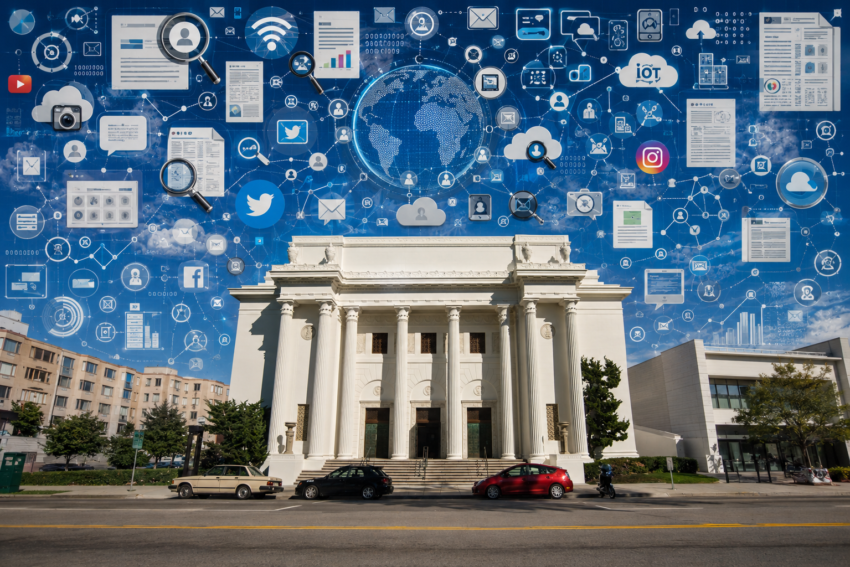
There is something quietly heroic about what Brewster Kahle and his colleagues set out to do in 1996 — and even more heroic in that they actually did it.
At a moment when the rest of the technology world was chasing IPOs and stock options, Kahle looked at the exploding digital universe and asked a different question: What happens when it disappears? He didn’t wait for a government to answer. He didn’t wait for a university consortium or a foundation grant. He took his own money, pointed a crawler at the web, and started saving it — one page at a time, with no audience, no funding model, and no guarantee that history would thank him for it.
Today, the Internet Archive holds over 1 trillion web pages, 44 million books and texts, 15 million audio recordings, 10.6 million videos, and 4.5 million software programs. It has preserved crumbling newspapers, out-of-print books, orphaned government websites, extinct software titles, and countless pieces of human culture that would otherwise exist nowhere on earth. When news organizations, historians, courts, and journalists need to prove what a website said on a particular day, they go to the Wayback Machine. It has become, without fanfare or drama, one of the most essential institutions of the digital age.
And it runs on donations.
Not corporate subsidies. Not government mandates. Not paywalls. Donations — from ordinary people who believe, as Brewster Kahle always has, that universal access to human knowledge is worth fighting for.
If you’ve ever used the Wayback Machine to recover a lost page, read a book you couldn’t afford, or verified a source that had been scrubbed from the internet — someone’s donation made that possible.
I did. Now it’s your turn.
👉 Donate to the Internet Archive — any amount, any size
“Universal access to all knowledge.” It’s a four-word mission statement that may be the most ambitious sentence ever written by a nonprofit. Help them keep it alive. 🌐📚
Here’s how it works:
What kind of technology does the “Wayback Machine” at the Internet Archive use to search and capture its more than 1 trillion web pages?
The Wayback Machine uses several interconnected technologies to capture, index, and serve its massive archive of over 1 trillion web pages.
Web Crawlers
The core capture technology relies on automated web crawlers — most notably an open-source crawler called Heritrix, developed specifically for archival purposes. These crawlers systematically visit publicly accessible web pages, follow hyperlinks to discover new pages, and download everything they find, including HTML, PDFs, images, scripts, and stylesheets. Crawls can take months or even years to complete, and multiple crawls can run simultaneously.
Storage: WARC Files
All captured content is stored in WARC (Web ARChive) and ARC files — standardized archival formats that bundle page content together with metadata like timestamps. These files live on a massive cluster of Linux nodes at the Internet Archive’s data centers, currently holding well over 99 petabytes of data.
Indexing: CDX Index
To make a trillion pages searchable, the Wayback Machine uses a CDX (Capture/Crawl inDeX) — essentially a massive sorted text file sharded across many machines. When you look up a URL, the system performs a binary search across this index to locate the exact file and byte offset where your requested page snapshot is stored. This is surprisingly fast because frequently accessed index points stay cached in RAM.
Three Public APIs
The Wayback Machine also exposes three APIs for developers and researchers:
- SavePageNow — triggers a live capture of any URL
- Availability API — checks whether an archived version of a page exists
- CDX API — enables complex filtering and querying of captured data
Site Search
The Site Search feature builds its index by evaluating terms from hundreds of billions of links pointing to the homepages of more than 350 million sites, ranking results by number of captures and relevance.
In short, it’s a combination of aggressive crawling, efficient archival file formats, binary-searchable distributed indexing, and massive commodity Linux storage — elegantly simple architecture scaled to almost incomprehensible size.
Here’s the plain-English breakdown of how the Wayback Machine actually works — no jargon:
Step 1: The Crawl (Taking the Snapshots)
Think of the Wayback Machine as sending out millions of tiny robot photographers across the internet. These automated programs — called web crawlers — visit a web page, take a complete copy of everything on it (text, images, links, videos), then follow every link on that page to the next page, and the next, and the next. It never really stops. The most well-known crawler the Internet Archive uses is called Heritrix, built specifically for this archival purpose. The crawlers don’t just grab the pretty surface — they pull the underlying code, stylesheets, and scripts needed to reconstruct the page later.
Step 2: The Storage (Filing the Snapshots Away)
Every captured page gets bundled into a standardized file format called a WARC file — essentially a digital envelope that holds the page content plus a timestamp and address label. These envelopes pile up on rows and rows of hard drives at the Internet Archive’s data centers, now totaling well over 99 petabytes of data — that’s roughly 99 million gigabytes. The system runs on massive clusters of ordinary Linux computers working together, not some exotic supercomputer.
Step 3: The Index (Finding a Needle in a Trillion-Page Haystack)
Storing a trillion pages is one thing — finding any one of them in under a second is another challenge entirely. The Wayback Machine solves this with a CDX index — a giant sorted list, spread across many machines, that maps every URL and timestamp to the exact file and location where that snapshot is stored. When you type a web address into the Wayback Machine, it does the digital equivalent of flipping to the right page in an encyclopedia — a technique called binary search — to pinpoint your snapshot almost instantly. Frequently searched pages stay pre-loaded in memory so results come back even faster.
Step 4: The Replay (Showing You the Past)
Once the right snapshot is found, the Wayback Machine doesn’t just dump raw code at you. It rewrites the internal links of the archived page on the fly — swapping out references to images, scripts, and stylesheets so they point to archived versions rather than the live web. This is what makes a 2003 version of a website look like it actually did in 2003, rather than a broken skeleton. When pieces of a snapshot are missing, it quietly pulls the closest available archived version of those missing pieces.
The Bonus: You Can Add Pages Yourself
Anyone can manually trigger a snapshot using the “Save Page Now” feature at archive.org. It captures that one page immediately and preserves it permanently — handy for saving a source before it disappears. Keep in mind it only saves the single page you submit, not the entire website.
In short: crawlers photograph the web nonstop → snapshots get filed in labeled envelopes → a giant sorted index keeps track of every envelope → when you search, it finds your envelope and reassembles the page as it looked on that exact date.
How does the Wayback Machine choose which pages to crawl?
The Wayback Machine doesn’t crawl the web randomly — it uses a layered system of priorities to decide what gets captured, how often, and how deep. Here’s how those decisions actually get made:
It Starts With a Seed List
Every crawl begins with a curated list of starting URLs called seed lists. The crawler fans out from those seeds by following every link it finds. Historically, these seed lists were built from Alexa’s rankings of the most-visited websites. After Alexa shut down in 2022, the Internet Archive now builds seed lists from its own accumulated data, partner contributions, and previously known domains.
Link Popularity Drives Discovery
The single biggest factor in whether your site gets crawled is how many other sites link to it. The Heritrix crawler works exactly like this: visit a page, harvest all its links, queue them, repeat. Sites that are heavily linked from other well-known sites get discovered and re-crawled far more often. It’s the same basic logic as Google’s PageRank — popularity begets visibility.
Crawl Depth Limits What Gets Saved
Every crawl has a depth limit — meaning the crawler will only follow links so many “clicks” away from the starting seed page. For large global crawls, depth is deliberately kept shallow so the crawler can cover the maximum number of domains rather than going very deep into any single site. This is why a small website’s homepage might be archived, but its interior pages never appear.
Multiple Crawls Run Simultaneously
At any given moment, hundreds of parallel crawls are running with different goals — global crawls, thematic crawls, regional crawls, and commissioned crawls through the Archive-It partner program. A single website can end up in several of these simultaneously, which is why some sites have dozens of snapshots in one month and none the next.
Other Ways Pages Get Queued
Beyond automated crawling, several other pipelines feed the archive:
- Save Page Now — any user can manually submit a single URL for immediate capture (though it doesn’t add the page to future automatic crawl queues)
- Cloudflare Always Online — sites using this feature automatically send their popular pages to the archive at regular intervals
- Partner institutions — libraries, universities, and government agencies submit curated collections through the Archive-It service
- Browser extensions — the Wayback Machine extension can automatically archive every page a user visits
What Keeps Pages Out
Not every page makes it in, even if it’s popular. The main blockers:
- A robots.txt file on the site’s server instructing crawlers to stay out — Heritrix respects this, and the Wayback Machine has even retroactively hidden old archived snapshots when a site later added a robots.txt block
- JavaScript-heavy pages that don’t expose links in their raw HTML (though a tool called Umbra helps Heritrix detect JS-generated links without fully rendering the page)
- Sites simply too far from any well-linked seed URL to be discovered
As of 2026, once a page is crawled, it typically appears in the Wayback Machine within 3 to 10 hours.
What factors determine how often a site gets recrawled?
Note that most of these search results describe Google’s recrawl behavior, but the underlying principles apply broadly to the Wayback Machine as well. Here’s a unified answer covering both:
Content Freshness
The single biggest driver of recrawl frequency is how often a site changes. News sites, active blogs, and e-commerce sites with daily updates can get crawled multiple times a day. A static site that hasn’t changed in months may go weeks or longer between visits. The crawler essentially learns your update rhythm over time and adjusts accordingly.
Popularity and Inbound Links
Sites with many high-quality links pointing to them from other well-known sites signal importance to crawlers. The more authoritative and heavily linked your site is, the more frequently crawlers return — both for Google’s Googlebot and for the Wayback Machine’s Heritrix. A site nobody links to may be crawled rarely, if ever.
Site Speed and Server Reliability
A fast-loading, consistently available site gets crawled more often because crawlers can move through it efficiently. If your server is slow or frequently times out, crawlers throttle back their visits to avoid hammering your infrastructure — and they “remember” that your site is unreliable.
Site Structure and Size
A well-organized site with clean internal linking is easier and faster to crawl, which encourages more frequent visits. Larger sites with thousands of pages tend to get crawled more often overall, though not every page gets equal attention — popular interior pages may be recrawled frequently while obscure deep pages go months between visits.
Crawl Budget
Crawlers allocate a finite number of page fetches per site per period — called a crawl budget. Sites can improve their crawl budget efficiency by blocking irrelevant or duplicate pages via robots.txt, fixing broken links, and eliminating redirect chains — all of which free up the budget for pages that actually matter.
User Demand
When users frequently search for content associated with your site, that demand signal tells the crawler your content is worth checking again for updates. High user engagement is essentially a vote for recrawl priority.
In practice, the range is enormous — a major news homepage might be recrawled hourly, while a neglected small site might wait 12–18 months between visits.
Who is involved in the archive.org organization, how is it financed, and where is it headquartered?
Here’s a comprehensive look at the Internet Archive and its organization:
Founder & Leadership
The Internet Archive was founded in 1996 by Brewster Kahle, a digital librarian and internet entrepreneur who remains its driving force today, serving as its head librarian and chief visionary. Kahle is widely regarded as one of the most committed advocates for free and open access to information on the internet.
Headquarters
The organization is headquartered at 300 Funston Avenue in San Francisco, California — a building with a fitting history: it’s a former Christian Science Church. Before that, from 1996 to 2009, it operated out of the Presidio of San Francisco, a former U.S. military base. The organization employs between 51–200 people, with book-scanning operators working at locations worldwide.
How It’s Financed
The Internet Archive is a 501(c)(3) nonprofit funded through several streams:
- Kahle-Austin Foundation — by far the largest single donor, contributing $13.5 million between 2003 and 2024; this is Brewster Kahle and his wife Mary Austin’s personal philanthropic vehicle
- Major foundation grants — including the Knight Foundation, MacArthur Foundation, Ford Foundation, Alfred P. Sloan Foundation, Gordon and Betty Moore Foundation, Open Society Foundations, Craig Newmark Philanthropies, and the William and Flora Hewlett Foundation
- Web crawling and digitization services — paid partnerships with libraries, universities, and institutions that commission archiving work
- Individual public donations — including an unusual option to donate via Bitcoin
- Government and academic partnerships — including Stanford University Libraries and the End of Term Web Archive project, which preserves U.S. government websites at the end of each presidential term
As of 2019, its annual operating budget was approximately $37 million. That figure has likely grown since, given the Archive’s expanding scope and legal battles over digital lending rights.
Write a biography of the founders and how the decision was made to create the archive.
Brewster Kahle: The Man Behind the Mission
Brewster Lurton Kahle was born on October 21, 1960, in New York City and grew up with an early fascination for both technology and the idea of universal human knowledge. He graduated from MIT in 1982 with a degree in computer science and engineering, and immediately joined Thinking Machines — a pioneering supercomputer company — as the lead engineer on the Connection Machine, one of the most powerful parallel processors of its era. It was there, working on how massive amounts of text could be searched and retrieved at speed, that the intellectual seeds of the Internet Archive were planted.
From WAIS to Alexa: Building the Foundation
In 1989, Kahle invented WAIS (Wide Area Information Server) — widely considered the internet’s first distributed search and publishing system and a direct precursor to the World Wide Web. He commercialized it by co-founding WAIS Inc. in 1992 with partner Bruce Gilliat, helping major institutions like the New York Times, Encyclopaedia Britannica, and the U.S. Government Printing Office establish their first online presences. AOL acquired WAIS Inc. in 1995 for $15 million.
Flush with that success, Kahle and Gilliat immediately co-founded Alexa Internet in 1996 — a company that crawled the web to build navigation and discovery tools. Amazon acquired Alexa in 1999 for $250 million in stock. The crawling technology and infrastructure Kahle built for Alexa became the direct engine that powered the early Internet Archive.
The Founding Moment
Internet Archive server racks in their San Francisco headquarters.
Kahle founded the Internet Archive in May 1996 — simultaneously with launching Alexa — driven by a fear that the digital world was evaporating faster than anyone realized. He drew a sobering parallel to history: the burning of the Library of Alexandria and the loss of early silent films, roughly 70% of which no longer exist, haunted him as cautionary tales of cultural erasure.
The specific “aha moment” he often describes came during a visit to the offices of AltaVista, then the web’s most powerful search engine. Standing in front of a computer cluster the size of five or six Coke machines — storing and indexing the entire web — Kahle later recalled: “There was an ‘aha moment’ that said, ‘You can do everything.'” If one search company could index the web for commercial purposes, he reasoned, why couldn’t a nonprofit do it for preservation?
The Vision From Day One
Kahle’s founding vision, articulated in a 1996 essay titled “Preserving the Internet,” was strikingly clear-eyed. He warned that without deliberate archiving, the web would prove even more fragile than paper — a medium that had survived centuries but whose digital successor could vanish in a server crash. He envisioned not just web preservation but universal access to all human knowledge — books, audio, video, software, and film — a mission the Internet Archive still carries on its homepage today.
In 2001, five years after the crawlers had been quietly archiving the web, Kahle opened the doors to the public with the Wayback Machine — named affectionately after the time-travel device used by cartoon characters Sherman and Mr. Peabody in Rocky and Bullwinkle. What had been a private archival project became one of the most visited websites in the world.
Recognition and Legacy
Kahle was inducted into the Internet Hall of Fame in 2012. He has testified before Congress on copyright and digital access issues, and his personal philanthropic foundation — the Kahle-Austin Foundation, run with his wife Mary Austin — remains the Internet Archive’s single largest financial supporter. Now well into his sixties, Kahle still serves as the organization’s head librarian and chief advocate, having never wavered from the mission he wrote down in a 1996 essay when the web was barely three years old.
What were the biggest early obstacles for the Archive?
The Internet Archive faced five major categories of early obstacles that nearly derailed the project before it became a household name.
Storage and Scale Costs
When Brewster Kahle launched the Archive in 1996, hard drive storage was astronomically expensive compared to today. The crawlers were generating terabytes of data monthly, and Kahle was essentially funding it out of his own pocket from the Alexa Internet sale proceeds. There was no proven model for sustaining a nonprofit of this technical scale, and for years the Archive operated with almost no public visibility — quietly accumulating data without anyone knowing it existed.
No Public Access Until 2001
Perhaps the most striking early obstacle was that the Archive spent its first five years as a completely private operation. Kahle was capturing the web starting in 1996, but the public had no way to access any of it. The Wayback Machine interface didn’t launch until October 2001 — meaning five years of irreplaceable early web history was collected with zero public funding, zero public awareness, and no guarantee anyone would ever want it.
The robots.txt Problem
From the beginning, the Archive faced a legal and ethical minefield over website owner consent. Unlike a library archiving physical books, the Internet Archive was copying websites without asking permission first. Many site owners discovered their content had been archived and demanded removal — and the Archive had to develop its robots.txt compliance policy on the fly, even retroactively deleting historical snapshots when site owners objected. This set a complicated precedent that haunts the organization to this day.
Copyright Law’s Unanswered Questions
Early on, there was no clear legal framework for what the Archive was doing. Copyright law had been written for physical media — it said almost nothing about whether archiving a web page constituted reproduction, public display, or distribution. Kahle lobbied Congress and testified about the need for a digital preservation exemption, but the legal ambiguity meant the Archive operated for years in a gray zone where a single aggressive lawsuit could have ended the project.
Convincing the World It Mattered
Perhaps the most underrated obstacle was simply getting anyone to care. In the late 1990s, most people assumed the web was permanent — that anything posted online would always be there. The idea that web pages routinely vanished, that entire companies and cultural moments could disappear without a trace, was not intuitive to the public or to potential funders. Kahle spent years making the case that digital preservation was as urgent as preserving ancient manuscripts — a message that only gained traction after high-profile examples of “link rot” became impossible to ignore.