
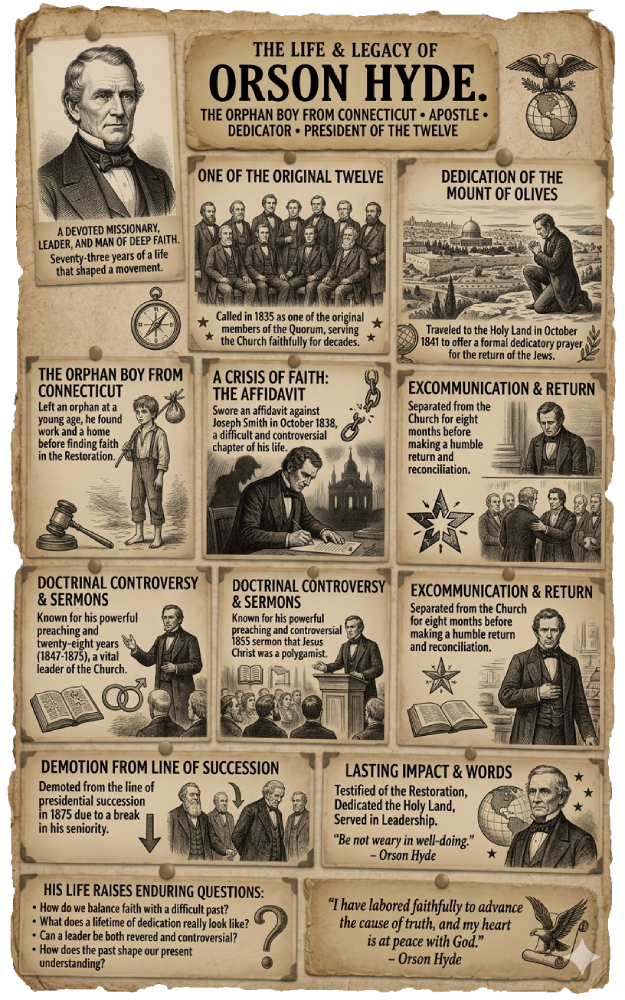
Ninth post in the Early Mormon Personalities Series
The Watchman on Olivet
Orson Hyde — Apostle, Wanderer, and the Long Shadow of an Affidavit
1805 ~ 1878
I. Before Sunrise on the Mount of Olives
Before the first light touched the limestone walls of the Old City, a single figure slipped out of Jerusalem through the unbarred gates and made his way down into the Kidron Valley. He carried pen, ink, and a folded sheet of paper. He was thirty-six years old, an American from Connecticut by way of Ohio, and he had traveled — by sailing ship, river steamer, post coach, donkey, and foot — nearly twenty thousand miles to reach this hillside. He had been gone from his wife and two small daughters for more than five hundred days. He had nearly starved at sea, eating snails gathered from the rocks off uninhabited Greek islands. He had endured robbers, plague, customs officials, fever, and a delegation of armed Englishmen who had welcomed him on the road from Jaffa chiefly because he could handle another rifle.
It was Sunday morning, October 24, 1841. The man climbing the Mount of Olives was Orson Hyde, a member of the original Quorum of the Twelve Apostles of the Church of Jesus Christ of Latter-day Saints, and he had come to the height above Jerusalem to do something no Latter-day Saint had ever done before. He knelt on the slope where the olive trees bent eastward toward the Jordan, and there, in solemn silence, he both wrote and recited a prayer of dedication. He asked God to consecrate the land — “for the gathering together of Judah’s scattered remnants, according to the predictions of the holy Prophets — for the building up of Jerusalem again after it has been trodden down by the Gentiles so long, and for rearing a Temple in honor of Thy name.” He built a small altar of stones, descended into the city, and within hours had begun his long return to a wilderness village on the Mississippi he called home.
It was, by any reckoning, an astonishing scene. The boy who had lost his mother at seven, his father at twelve, and who had walked from Derby, Connecticut, to Kirtland, Ohio, with nothing but the clothes on his back, was now an apostle of a six-year-old American religion, kneeling alone on the holiest mountain in Christendom and pronouncing a prophetic blessing over the Jewish nation a century before the State of Israel would exist. To Latter-day Saints, the moment was incandescent — and remains so. To the historian, it is one of those strange tableaux where ambition, faith, providence, and the long shadow of an unhealed century all converge on a single human silhouette.
And yet the picture is not as simple as the Latter-day Saint hagiographies make it. The man on the mountain had, three years earlier, almost to the day, sworn an affidavit against the prophet who sent him. He had been stripped of his apostleship and put out of the church. He had written a letter to a fellow Saint declaring that God was not with the Latter-day Saints, and that he had left them “for conscience sake.” The blessing he uttered on Olivet — beautiful, sweeping, almost biblical in its cadence — was offered by a man who had been a public defender of the gospel, a public denouncer of the gospel, and would soon become, after Joseph Smith’s assassination, the architect of Mormonism’s strangest doctrinal flourish: the contention that Jesus Christ Himself had been a polygamist.
This is the story of Orson Hyde — a story too often softened in Latter-day Saint memory, too often dismissed in Protestant polemics, and too rarely told with the moral complexity it actually deserves. Like every figure in this series, Hyde is best understood not as a cardboard villain or a stained-glass saint, but as a man — gifted, anguished, ambitious, and finally tragic — whose life illustrates with peculiar force how the Restoration movement gathered its early converts, how it bound them, and how, when their consciences flickered, it learned to bring them back.
❦ ❦ ❦
II. The Orphan from Oxford
Orson Hyde was born January 8, 1805, in Oxford, Connecticut, the eighth of twelve children of Nathan Hyde and Sally Thorpe. The Hyde household sat in the New Light Congregationalist hill country of New Haven County, a landscape of stone walls, white clapboard meetinghouses, and rocky pastures whose soil already wanted to push families westward. Nathan was the kind of man the early Republic ran on — small farmer, occasional artisan, eventually a soldier in the War of 1812. Sally was the kind of mother whose name appears in the next century’s memoirs as something half-remembered and wholly missed.
She died in 1812, when Orson was seven. The dozen Hyde children, like leaves from a shaken tree, were “scattered among several foster parents.” Orson was placed with Nathan Wheeler of nearby Derby, a hard, principled neighbor who had farmland and ambitions but little patience for sentiment. Years later, in his serial autobiography in the Millennial Star, Orson would write of growing up “a stranger to a father’s protection and to a mother’s care” — a sentence that, in its quiet way, opens a window onto the boy.
Orson’s life would take a few unexpected turns. Some were because of his own choices; others were attributed to circumstances beyond his control. The first was the death of his mother when he was only seven. At this age, Orson was placed in the care of Nathan Wheeler of nearby Derby, Connecticut. They were a good but strict family where Orson worked hard but received little education.
— Roy B. Huff, “Orson Hyde: A Life of Lessons Learned,” Religious Educator 3, no. 2 (2002)
When Orson was twelve, Nathan Hyde drowned. The orphaning was now complete. From that point, Orson seems to have considered himself emancipated by sheer attrition — he was, he believed, being treated as a hired hand rather than a son. He left Wheeler’s household, walked to an iron foundry, learned to card wool, and eventually struck out for the western frontier of New England consciousness: Ohio.
In 1819, at fourteen, he walked some six hundred miles from Derby to the new village of Kirtland, where Wheeler — in one of those domestic ironies frontier life specialized in — had himself purchased land. Orson found employment as a clerk in the Newel K. Whitney & Co. store, the same establishment that, only a few years later, would become the temporal hub of the embryonic Mormon Church. He read what he could. He memorized what he could. He hungered, with that peculiar nineteenth-century American hunger, for self-improvement and for some final word from heaven that might explain the silence on his mother’s grave.
The first thing the historian wants to notice about Orson Hyde is this: he was a man whose foundational experience of the world was abandonment, and whose foundational instinct, from boyhood onward, was to attach himself with full force to whatever community would have him. He would, in time, attach himself to Methodism, then to the Reformed Baptists, then to Mormonism, then briefly to nothing at all, then to Mormonism again with redoubled fervor. The pattern is not duplicity; it is the pattern of a soul terrified of being orphaned twice.
❦ ❦ ❦
III. From Methodism to Mormonism
A Mind in Search of a Master
By 1827, the twenty-two-year-old Hyde was a class leader in a Methodist society in the Kirtland vicinity. Methodism, with its ardent preaching, its emotional altar calls, and its democratic license for ordinary men to expound the Scriptures, suited his temperament — and the parallel here with the young Joseph Smith, who had felt drawn to Methodism a few years earlier in Palmyra, is impossible to miss. Hyde and Joseph Smith were born within months of one another in 1805. Both were poor New Englanders. Both grew up religiously restless. Both possessed remarkable verbal gifts and were drawn first to the same denomination. The parallel is one the LDS narrative gleefully exploits and the Christian historian should soberly acknowledge: there were thousands of such young men in the Burned-over District, all charged with the same revivalist current.
Hyde did not stay a Methodist long. By 1830, he had moved into the orbit of Sidney Rigdon, the famously eloquent Reformed Baptist preacher whose pulpit ranged across northern Ohio. Rigdon was then a leading light in the “restorationist” movement led by Alexander Campbell — a movement that sought to strip Christianity back to a New Testament purity unencumbered by creeds, denominations, or the accreted dogmatism of the Protestant centuries. Hyde drank deeply at that well. He became a Campbellite pastor in Elyria and Florence, Ohio, and by some accounts in Mentor as well. He had memorized large portions of the Bible (a feat he would later — with arresting self-confidence — claim to have accomplished in English, German, and Hebrew). He was, by his late twenties, a working minister with a sermon style described by contemporaries as direct, confident, occasionally florid, and never apologetic.
I have once memorized the Bible, and when any one quoted one verse, I could quote the next. I have memorized it in English, German, and Hebrew.
— Orson Hyde, Journal of Discourses 2:81
The Book He Tried to Bury
In late 1830, Oliver Cowdery and three other Latter-day Saint missionaries arrived in northern Ohio on the way to preach to the “Lamanites” west of the Mississippi. They left behind copies of the Book of Mormon and a doctrinal commotion in the Reformed Baptist congregations that no minister could ignore. Hyde, characteristically, did not ignore it. He read the Book of Mormon, pronounced it fiction, and preached against it in public. By his own later admission, he denounced the book on multiple occasions from the pulpit.
It was all fiction.
— Orson Hyde, on his first reading of the Book of Mormon (1830)
Then his mentor, Sidney Rigdon — to the dismay of half of Ohio’s restorationist Christians and the abandonment of Alexander Campbell — accepted the new gospel and was baptized. The cascade that followed is the central story of Mormonism’s 1831 surge. Where Rigdon went, his congregations went, and where his congregations went, his protégés went too. Hyde investigated. He read the Book of Mormon again. He met the missionaries. He met, eventually, Joseph Smith. In October 1831, he descended into the Chagrin River with the man who had once been his Reformed Baptist mentor and was baptized into the Church of Christ — the original name of what would become the Church of Jesus Christ of Latter-day Saints.
Hyde later described the moment of conviction with characteristic frankness, in language that should give every Protestant reader pause:
For the first time, I thought that the Mormon Bible might be the truth of heaven . . . [and I became] pretty strongly convicted in my own mind that I was doing wrong.
— Orson Hyde, “History of Orson Hyde,” Millennial Star 26 (Nov. 19, 1864): 760–61
What the LDS narrative reads as the dawning of light, the Christian historian must read with a careful eye. The conversion of Orson Hyde is not the conversion of a hardened sinner overcome by sovereign grace; it is the conversion of a restless young preacher in a movement specifically designed — Campbellism — to long for a more primitive, more apostolic, more visibly miraculous Christianity. Mormonism arrived in northern Ohio carrying exactly the goods that the Campbellite mind had been trained, for a decade, to want: angels, visions, the gift of tongues, modern apostles, a freshly translated scripture, a restored priesthood, and a prophet who claimed to speak with the voice of the resurrected Christ. To a man who had been an orphan, a Methodist, and a Campbellite — each by turns the strongest community on the field — Joseph Smith’s claim of the only authorized church on earth was less a leap than a step.
This is not to dismiss Hyde’s sincerity. It is to insist on his particularity. He converted, and within weeks of his baptism, the Lord — through Joseph Smith — commanded him to “go ye into all the world, preach the gospel to every creature” (D&C 68:8). He obeyed. He would not stop obeying that command, in some form or another, for forty-seven years.
❦ ❦ ❦
IV. The Apostle, the Scholar, the Itinerant
Missions and the School of the Prophets
From the moment of his baptism in October 1831 until the Mormon trek across the Missouri River in 1846, Hyde scarcely sat still. He served thirteen missions during his lifetime, the first two with the Prophet’s brothers Hyrum and Samuel H. Smith. The second of these covered some thirteen hundred miles and produced roughly sixty converts. He slept in barns. He cast out demons, by his own account. He twice narrowly escaped tar-and-feathering. He walked, by one estimate, two thousand miles on foot between New York, Rhode Island, Massachusetts, and Maine. The man’s shoe leather alone would constitute a monument.
In 1832, Joseph Smith laid hands on Hyde and gave him a prophetic blessing whose words would haunt the next decade of Hyde’s life:
Thou shalt go to Jerusalem . . . and be a watchman unto the house of Israel; and by thy hands shall the Most High do a good work, which shall prepare the way, and greatly facilitate the gathering together of that people.
— Joseph Smith, blessing to Orson Hyde, 1832
This is one of the more striking instances in Mormonism of a prophecy that, in the eyes of believers, was fulfilled — and in the eyes of historians, was self-fulfilled. Hyde would carry that 1832 blessing in his bones for nine years before climbing Mount Olivet. Whether one regards the resulting Jerusalem mission as supernatural foreknowledge or as the persistent, faithful enactment of a deeply internalized prediction depends entirely on whether one accepts the underlying premise — that Joseph Smith was, in fact, a prophet of God. The biblical test of a prophet, as we shall see, complicates that judgment substantially.
In 1833, Hyde entered the School of the Prophets, the remarkable Kirtland-era institute of learning in which Joseph Smith — under the conviction that the kingdom of God required educated men — set early elders to studying history, geology, geography, government, and biblical languages. Hyde was chosen as a teacher at the school. He was one of ten brethren who, in 1836, studied advanced Hebrew under the Jewish convert Joshua Seixas. He was appointed a clerk to the First Presidency on June 6, 1833, and in that capacity recorded large portions of the Kirtland revelations, the Book of Commandments, and the Kirtland council minutes. The same year, he served on the first high council of the Church.
Few men so close to Joseph Smith left so detailed a paper trail in church records and yet remained, in temperament, so independent. Hyde would offend Joseph more than once, would be disciplined more than once, would always come back, and would always be received.
Apostle
On February 15, 1835, in the upper room of the Kirtland printing house, Orson Hyde — at thirty years old — was ordained an apostle of the Church under the hands of David Whitmer, Oliver Cowdery, and Martin Harris, the Three Witnesses of the Book of Mormon. He was originally placed fourth in seniority, then fifth after the Twelve were reordered by age. Two of his brothers-in-law — Luke and Lyman Johnson, brothers of his wife Marinda — were ordained alongside him. It was, for the Hyde-Johnson family, a year of extraordinary apostolic concentration. None of those three apostleships would prove durable to all three men: Luke and Lyman would apostatize within a few years, and Orson would teeter dramatically before steadying himself.
Hyde’s blessing on the day of his ordination is a small theological time capsule:
He may stand on the earth and bring souls till Christ comes. We know that he loves Thee, O Lord, and may this Thy servant be able to walk through pestilence and not be harmed; and the powers of darkness have no ascendency over him; . . . may he be like one of the three Nephites.
— Oliver Cowdery, ordination blessing on Orson Hyde, Feb. 15, 1835
To compare a man to one of the three Nephites — figures in the Book of Mormon who, like the apostle John, were said to have been transfigured into a deathless state until the Second Coming — was already to ascribe to him a kind of immortal apostolic destiny. The Christian reader cannot help but observe how thoroughly the Latter-day Saint world, even at this early date, was constructing a separate scriptural universe. The Three Nephites were already, in 1835, an interpretive coin of the Restoration realm. Cowdery’s blessing was not a Bible blessing. It was a Book of Mormon blessing.
❦ ❦ ❦
V. The British Mission and the Vision of Devils
In the winter of 1836–37, Hyde was caught up in the speculative fever that gripped Kirtland — the bank failure, the Kirtland Safety Society debacle, the loss of confidence in Joseph Smith’s economic judgment that drove a third of Kirtland’s leadership out of the Church. Hyde wavered. He wrote letters of complaint. He even agreed, briefly, to testify against the Prophet in a charge of attempted murder. The next day, his conscience flared. He walked into the room where Joseph was setting Heber C. Kimball apart for the historic first mission to Great Britain, broke down, confessed, and begged to go along.
Joseph consented. On June 13, 1837, Hyde, Kimball, Willard Richards, and three others left Kirtland for the British Isles — the first apostolic mission abroad in Mormon history. They preached in Preston, Bedford, Manchester, and through the Lancashire and Yorkshire mill towns. The fruit, by any standard, was remarkable: roughly fifteen hundred converts in eleven months, and the inauguration of a stream of British immigration that would, within a generation, make the majority of adult Latter-day Saints in Utah natives of the British Isles.
It was here, in a brick boarding-house in Preston on the morning of the first scheduled British baptisms, that Hyde and Kimball had one of the more lurid spiritual experiences in early Mormon history. Kimball, attempting to administer a blessing to a missionary tormented by what they believed to be demonic possession, was struck senseless to the floor. Hyde, by his own account, found himself surrounded by a visionary host of malign spirits in human form. The scene was preserved by his descendant, Myrtle Stevens Hyde, in her biography:
Orson’s vision unveiled, and he saw the throng of awful attackers. They rushed at him with knives, threats, imprecations, and hellish grins . . . These full-statured, bizarrely-clothed devils, men and women, possessed every form and feature of mortals, but some had hideous distortions in face and body. . . . Summoning spiritual power, he eventually forced these fiends of hell to begin to retreat from the area of the room.
— Myrtle Stevens Hyde, Orson Hyde: The Olive Branch of Israel (2000), 86–87
The Christian reader will recognize the language — it is the language of the New Testament narratives of demonic encounter. Whether one accepts the account at face value, regards it as the product of fatigue and revivalist suggestion in a working-class English garret, or sees in it the visionary literature characteristic of frontier American Protestantism is a matter of theological judgment. What is not disputed is that for Hyde and Kimball, the experience cemented an apostolic friendship of unusual depth. That friendship would, within two years, prove decisive in restoring Hyde to the Church he was about to betray.
❦ ❦ ❦
VI. The Affidavit of 1838 — Hyde’s Crisis of Conscience
The Year Mormonism Ate Its Own
Hyde and Kimball arrived back in Kirtland in late May 1838 and found the Church transformed by upheaval. Joseph Smith had fled Ohio under threat of arrest. The headquarters had moved to Far West, Missouri. Apostasy had taken three of the Twelve, four of the Three Witnesses, and a significant fraction of the Kirtland membership. Hyde, exhausted from the British labors and grieving the loss of his brothers-in-law from the Quorum, made his way to Missouri only to fall desperately ill — likely with the malarial ague that was burning through the Mormon settlements along the river bottoms.
In Far West, the gentleman who took the sick apostle into his home was Thomas B. Marsh, the President of the Twelve. Marsh was a man of considerable native ability, considerable native pride, and a wife whose milk-strippings quarrel with Sister Harris had — by the autumn of 1838 — boiled into a permanent grievance against the leadership of the Church. Marsh had concluded, on grounds equal parts theological and domestic, that the Saints in Missouri were no longer the people of God. He was also genuinely alarmed at the Danites — the secret Mormon vigilante society that, through that summer and autumn, had organized into bands of three hundred and conducted reprisal raids on non-Mormon settlements in Daviess County.
It is this last point — the Danites — that is consistently sanitized in correlated LDS retellings of Hyde’s 1838 crisis. The believing LDS historian Marvin S. Hill, in a stern 1979 review of Howard Barron’s biography of Hyde, observed the omission directly:
During the Mormon war in Missouri when 300 elders were organized into Danite bands and sent out to raid Gallatin and burn the town (in retaliation for so many wrongs done the Mormons in Missouri), Orson Hyde took no part. Sick with anguish and despair, and tortured with growing doubt about the truth of Mormonism, Hyde wrote to a Sister Abbot on October 25: ‘I have left the Church called Latter Day Saints for conscience sake, fully believing that God is not with them, And is not the mover of their schemes and projects.’ Hyde told Brigham Young afterward that it was the Danites that repelled him.
— Marvin S. Hill, review of Orson Hyde, BYU Studies 18:4
This is — to put the matter plainly — a Latter-day Saint scholar acknowledging in a BYU journal that an LDS apostle, in October 1838, left the Church on grounds of conscience over the Church’s own vigilantism. It is the single sentence that the official narrative will not let stand without revision. The standard LDS account, faithfully reproduced even in the Joseph Smith Papers commentary, is that Hyde was “sick with a violent fever” (John Taylor’s framing in History of the Church 3:168) and was confused by Marsh’s influence. Marvin Hill, in 1979, was already calling the bluff: Hyde was a man with a conscience, and what repelled him was not Marsh’s opinion but the Danites’ behavior.
The Affidavit
On October 24, 1838 — by an arresting coincidence of date, exactly three years to the day before he would dedicate Jerusalem — Hyde and Marsh appeared before the justice of the peace in Ray County, Missouri, and swore out the affidavit that would help send Joseph Smith to Liberty Jail and the Mormon community into Illinois exile. Marsh’s sworn statement charged that the Mormons in Daviess and Caldwell counties had organized vigilantes who had taken an oath “to support the heads of the church in all things that they say or do, whether right or wrong,” that they had burned and looted non-Mormon settlements, and that:
The plan of said Smith, the prophet, is to take this State, and he professes to his people to intend taking the United States, and ultimately the whole world. This is the belief of the church, and my own opinion of the prophet’s plans and intentions.
— Thomas B. Marsh, Richmond Affidavit, Oct. 24, 1838
Hyde, bed-bound and broken, swore on the same day before the same justice that he either knew Marsh’s statements to be true or believed them to be such. The affidavit reached Governor Lilburn W. Boggs, who used the testimony of two of the highest-ranking Mormon officials in the church as evidence sufficient to justify the Extermination Order — the Missouri executive proclamation that ordered the Saints out of the state or to be exterminated. Joseph Smith and his brother Hyrum were thrown into Liberty Jail. The Latter-day Saints were driven from Missouri into Illinois under conditions of genuine cruelty. Several hundred died on the road or in the camps.
Hyde’s personal complicity in that disaster cannot be tidily disposed of. Years later, he would write of these months with the most aching language he ever set down:
Few men pass through life without leaving some traces which they would gladly obliterate. Happy is he whose life is free from stain and blemish. I sinned against God and my brethren. I acted foolishly. . . . I seek pardon of all whom I have offended, and also of my God.
— Orson Hyde, Autobiography, Millennial Star 26 (1864)
It is one of the most affecting confessions in the entire archive of the early Twelve. And yet — as Marvin Hill noted — Hyde never recanted the substance of his sworn testimony. He confessed, in the end, that he had acted foolishly. He did not say he had lied. He said, in another report, that he had simply come to see matters in a different light.
That distinction matters. It matters historically — because the affidavit was probably substantially accurate about the Danites — and it matters morally, because it tells us something important about Hyde: he was a man capable of being sufficiently grieved by the violence of his own brethren to risk excommunication for it, and sufficiently grieved by his own action against the Prophet to seek to come back. Both griefs were real. The Christian reader who has ever stood between conflicting loyalties will recognize the territory.
Excommunication and Restoration
On May 4, 1839, the church voted Hyde out of the Quorum of the Twelve. He had, eight months earlier, been dropped from fellowship in the Church. He spent his exile teaching school in southern Missouri, where the apostate Allen Joseph Stout encountered him on the road. Hyde’s account to Stout — preserved in Stout’s journal — is worth pausing over:
I saw a man walking behind me. I reined in the team to let him overtake me, and who should it be but Orson Hyde, who had apostatized in the fuss, but had seen a vision in which it was made known to him that if he did not make immediate restitution to the Quorum of the Twelve, he would be cut off and all his posterity, and that the curse of Cain . . . would be upon him.
— Allen Joseph Stout, journal, as quoted in Barron, Orson Hyde, 105
The “curse of Cain,” we should note for honesty’s sake, was the early LDS theological category by which Joseph Smith and his successors explained — and racialized — the inferior priesthood status of black men, a doctrine that would haunt the Latter-day Saint movement until the 1978 revelation overturning it. Hyde’s reported vision threatened him with relegation to that category. Whatever the source of the vision, it had the desired effect. Hyde wrote to Heber C. Kimball asking whether forgiveness was possible. Kimball said it was. Kimball and Hyrum Smith pleaded the case to Joseph, who — newly returned from six months in Liberty Jail in part because of Hyde’s affidavit — was understandably reluctant. He gave way.
On June 27, 1839, in a meeting of the Twelve and First Presidency in Commerce (soon to be Nauvoo), Orson Hyde stood before the assembled Saints, publicly confessed, was forgiven, and was restored both to fellowship and to the Quorum of the Twelve. According to multiple sources, Joseph Smith claimed to have known of Hyde’s approach by revelation and was waiting at the window when he saw him coming up the road — running out to meet his apostate apostle as the father in the parable runs to meet the prodigal.
It is a striking scene. The Christian reader, even at the distance of two centuries, can feel its emotional power. It is also a deeply revealing scene about Joseph Smith’s leadership: he was capable of holding both ferocious grievance and instant pardon in the same gesture. The man who could send Hyde on his Jerusalem mission was the same man whose enemies, only three years earlier, Hyde had helped to arm with sworn testimony.
❦ ❦ ❦
VII. The Long Road to Jerusalem
The Vision and the Companion
In March 1840, Hyde had a vision — six hours of nocturnal contemplation in which the cities of London, Amsterdam, Constantinople, and Jerusalem appeared to him in succession, and the Spirit instructed him that these were to be the field of his labors. The 1832 blessing was being activated. One month later, at the April 1840 General Conference in Nauvoo, Hyde spoke of the vision, and Joseph Smith, on the closing day of the conference, directed that Hyde proceed on a formal mission to the Jews. To accompany him, Joseph appointed the recently ordained apostle John E. Page.
Page failed. He delayed in Pennsylvania, dawdled in New York, never arrived at the rendezvous point in New York City for the ocean passage, and ultimately faltered out of the Church entirely after Joseph Smith’s martyrdom. Hyde, having waited for him in New York for months, finally took a stinging letter of rebuke from Joseph as license to proceed alone. He boarded the ship Oxford in February 1841, crossed to England, briefly conferred at the British General Conference at which seven of the Twelve were present, and then — in a moment of historical poignancy — watched seven of his fellow apostles return to America while he turned eastward into Europe alone.
German in Eight Days
Hyde’s linguistic feats during this period are among the most surprising of any LDS missionary biography. Stopped in Regensburg, Bavaria, by passport difficulties, he arranged a barter with a local lady who spoke French and German: she would teach him German if he would teach her English. He wrote to Joseph Smith two weeks later — having had only eight days of formal study — claiming that he had read one book through, started another, and could now speak and write “considerable German.” He attributed the accelerated learning to the Spirit of the Lord. We may credit either the Spirit or the well-documented capacity of the human mind, under monastic isolation and strong motivation, to acquire languages with surprising rapidity. The result, in either case, was practical: Hyde would carry his German competence into a printing press at Frankfurt the next year and produce the first foreign-language tract of the Church of Jesus Christ of Latter-day Saints — Ein Ruf aus der Wüste — “A Cry from the Wilderness.”
That tract, to which we shall return, contained the earliest published version of Joseph Smith’s First Vision in any non-English source. It differs in important particulars from the account that Latter-day Saints today regard as canonical, and the discrepancy is one of the data points the apologist must explain — usually by appeal to Hyde’s editorial liberties, sometimes by appeal to the assumption that Hyde was reproducing Orson Pratt’s 1840 account from memory.
The Mountain
After harrowing weeks aboard a becalmed sailing vessel in the Aegean — during which Hyde, by his own account, was reduced to eating snails — he reached Jaffa on October 20, 1841, and rode the inland thirty-five miles to Jerusalem in the company of armed Englishmen. He was in the city only four full days. On the morning of October 24, before dawn, he passed out through the unbarred gates, crossed the Kidron, and ascended the Mount of Olives. He knelt facing the Temple Mount, and there he both wrote and recited his now-famous prayer of dedication. The full text was preserved by Hyde himself in his letter to Parley P. Pratt and published in Times and Seasons in April 1842.
Now, O Lord! Thy servant has been obedient to the heavenly vision which Thou gavest him in his native land; and under the shadow of Thine outstretched arm, he has safely arrived in this place to dedicate and consecrate this land unto Thee, for the gathering together of Judah’s scattered remnants, according to the predictions of the holy Prophets — for the building up of Jerusalem again after it has been trodden down by the Gentiles so long, and for rearing a Temple in honor of Thy name. . . . O thou, who didst covenant with Abraham thy friend, and who didst renew that covenant with Isaac, and confirm the same with Jacob with an oath, that thou wouldst also remember their seed forever. . . . Let the land become abundantly fruitful when possessed by its rightful heirs.
— Orson Hyde, Dedicatory Prayer, Mount of Olives, Oct. 24, 1841
Hyde left two altars of stones — one on the Mount of Olives, one on the Temple Mount itself — and departed Jerusalem after only five days. He would never return. He arrived back in Nauvoo on December 7, 1842, after 967 days and roughly twenty thousand miles. Joseph Smith embraced him. Marinda and the two daughters had been provided for in his absence by a special revelation that Joseph had given some weeks after Hyde’s prayer on Olivet.
The dedicatory prayer has had a curious afterlife. In the LDS tradition, it is regarded as one of the great prophetic moments of the dispensation — the foundational dedication of the land that would, a century later, become the modern State of Israel. The land was subsequently rededicated by other apostles ten more times between 1873 and 1933, and the Orson Hyde Memorial Garden on the Mount of Olives, funded through the Orson Hyde Foundation and dedicated in 1979, has become a regular pilgrimage destination for Latter-day Saint travelers.
The Christian historian will note three things. First, the prayer’s scriptural language is genuinely impressive — Hyde knew the Bible, and his cadences here are biblical. Second, the prayer is theologically distinguishable from a Zionist political vision: Hyde is praying for Judah’s gathering as a step in a millennial drama whose subsequent steps include the universal conversion of the Jews to Christ. Third, the historical claim that Hyde’s prayer played any causal role in the establishment of modern Israel must be set against the rather large fact that the Zionist movement, when it actually arose under Theodor Herzl half a century later, was driven by secular nationalist and Christian Zionist forces wholly independent of Mormonism. The post hoc fallacy has been at work. Hyde’s prayer was a beautiful aspiration; modern Israel is the consequence of pogroms, the Balfour Declaration, the Holocaust, and the long arc of European antisemitism and Jewish self-organization. The two are connected only in retrospective LDS memory.
Even the Orson Hyde Memorial Garden — that handsome public park overlooking the Old City — bears, by BYU’s own admission, a marker installed by the Israeli government that contains, in its inscription, mistakes “that are common misconceptions about Hyde’s mission to Jerusalem,” including the suggestion that Hyde was called to preach the gospel there. He was not. He was called to dedicate the land — and to do so in five days flat.
Hyde had traveled roughly four thousand miles by ship, coach, and foot, crossed two continents, navigated the bureaucratic machinery of three empires, survived cholera-ridden ports, and waited out a year-long delay in Germany. John E. Page, appointed to accompany him, had turned back before leaving American soil. He stood alone on the Mount of Olives before sunrise, read a prepared prayer into the morning air, and was gone within days. No congregation gathered. No converts were made. No Jews were present. The land was dedicated. Whether that constitutes the return on the investment is a question Joseph Smith’s successors have been answering with increasing creativity ever since.
❦ ❦ ❦
VIII. Marinda — and the Strange Plural Sealing
One of the most painful chapters of Hyde’s life is one he himself rarely spoke of, and which the modern LDS Church has yet to integrate forthrightly into its official curriculum. Hyde married Marinda Nancy Johnson in Kirtland on September 4, 1834. She was the daughter of John Johnson and the sister of two of Hyde’s fellow apostles, Luke and Lyman Johnson. The marriage was, by every account, a love match, and the early years in Kirtland and Nauvoo were happy.
John D. Lee — the future confessor to the Mountain Meadows Massacre, writing in his 1877 memoir Mormonism Unveiled shortly before his execution — would later claim that Hyde had given his consent: “Hyde’s wife, with his consent, was sealed to Joseph for an eternal state.”
Joseph Smith was sealed to Marinda as a plural wife either in April 1842, or in May 1843. Marinda signed an affidavit saying that her sealing to Joseph Smith occurred in May 1843. However, one of Smith’s scribes, Thomas Bullock, later wrote a list of plural marriage dates in the back of one of Smith’s journals and noted a sealing date of April 1842. It is not clear when or if Hyde learned about his wife’s sealing to Smith, however, John D. Lee, in his book Mormonism Unveiled, reported that Hyde may have given his consent.
— Wikipedia summary citing the Joseph Smith Papers and Marinda Hyde’s affidavit
There is no clean way for the Christian reader to confront this material. It is, on its face, the spectacle of a prophet sealing himself to the absent wife of one of his apostles while that apostle is sleeping on stone floors in the Levant to fulfill a prophetic blessing that the prophet himself pronounced upon him a decade earlier. The defense in LDS historiography is essentially threefold: that polygamy was a divinely commanded principle, that Marinda consented, and that Hyde, on his return, consented as well. The first proposition rests on the truth of Joseph Smith’s prophetic claim; the second rests on testimony given under social conditions in which a wife’s genuine free consent is difficult to verify; and the third rests largely on John D. Lee, a man whose testimony was at various times either invaluable or vilified, depending on which church leader was speaking.
Three months after Hyde returned from Jerusalem, he was introduced to plural marriage himself and, within months, had taken two additional wives. He would eventually be married, by various counts, to seven or eight women and would father between thirty-two and thirty-three children, of whom only seventeen survived to adulthood. He and Marinda divorced in 1870, the only divorce of his life and one of the more poignant terminations among the founding apostles. Whatever the truth of consent and sequence, the Hyde-Smith plural sealing is one of the most piercing illustrations of how the secret introduction of plural marriage tore through families that, on the surface, remained loyal.
Biblical Christianity, on this score, will not negotiate. The marriage union, as established at the Garden, was monogamous (Genesis 2:24). The polygamy of the patriarchs is narrated, not commanded, and is consistently associated in the Genesis text with grief, jealousy, and broken households. Jesus reaffirmed monogamy as the original creation pattern (Matthew 19:4–6). Paul required of bishops and deacons that they be “the husband of one wife” (1 Timothy 3:2, 12; Titus 1:6). The New Testament knows no plural marriage among its leaders. The introduction of plural marriage into nineteenth-century Mormonism was a doctrinal innovation utterly without biblical warrant, and one whose human casualties are difficult to look at squarely even now.
❦ ❦ ❦
IX. The Theological Voice — Hyde’s Doctrine in Print
By the time Joseph and Hyrum Smith were murdered in Carthage Jail in June 1844, Hyde had risen to be one of the half-dozen most influential men in the Church. He oversaw the completion of the Nauvoo Temple. He presided again over the British Mission in 1846–47, where he served as editor of the Millennial Star. He was sustained as President of the Quorum of the Twelve Apostles on December 27, 1847 — a position he would hold longer than any man in the history of the dispensation, for twenty-eight years.
During those years, Hyde preached. The Journal of Discourses, the unofficial but still-canonical archive of Utah-era LDS sermons, contains forty-nine of his discourses. Reading them today is a particular kind of historical experience. They are eloquent, even moving in places, but they document with embarrassing clarity how far early Mormon theology had drifted by the 1850s from any form of historic Christian orthodoxy.
Jesus as Polygamist (Journal of Discourses 2:34, March 1855)
In the spring of 1855, Hyde delivered the most theologically scandalous sermon of his career. It was a wide-ranging political philippic on the United States, the prophets of God, and the persecution of the Saints. But near its end — almost in passing — he reaffirmed and elaborated a doctrine he had introduced at the previous conference: that Jesus Christ was a married man, indeed a polygamist, and that He had begotten children.
I discover that some of the Eastern papers represent me as a great blasphemer, because I said, in my lecture on Marriage, at our last Conference, that Jesus Christ was married at Cana of Galilee, that Mary, Martha, and others were his wives, and that he begat children. All that I have to say in reply to that charge is this — they worship a Savior that is too pure and holy to fulfil the commands of his Father. I worship one that is just pure and holy enough ‘to fulfil all righteousness;’ not only the righteous law of baptism, but the still more righteous and important law ‘to multiply and replenish the earth.’ Startle not at this! For even the Father himself honored that law by coming down to Mary, without a natural body, and begetting a son; and if Jesus begat children, he only ‘did that which he had seen his Father do.’
— Orson Hyde, Journal of Discourses 2:81–82 (March 18, 1855)
Read carefully. Three doctrinal errors are stacked on top of one another here, each one severing a load-bearing cord of Christian orthodoxy.
First, the wedding of Cana (John 2) was the wedding at which Jesus performed His first sign — the turning of water into wine. The Gospel narrative places Jesus and His mother among the guests. There is no textual basis whatsoever — none, in any of the four Gospels, in any of the New Testament epistles, in any of the writings of the apostolic fathers, in any of the second-century Christian sources — for the claim that Jesus was the bridegroom. Hyde’s assertion is a fabrication.
Second, the claim that Mary, Martha, and others were Jesus’ wives is a category error of the most violent kind. The Gospel of John specifically identifies Mary and Martha of Bethany as the sisters of Lazarus (John 11:1). They are nowhere identified as wives of Jesus. The suggestion that they were is not exegesis; it is the projection of nineteenth-century Mormon polygamy onto a sacred narrative, the better to underwrite the doctrine.
Third, and most gravely, Hyde teaches that God the Father physically and sexually begat Jesus upon Mary — that the Virgin Birth was not the miraculous conception of the Holy Spirit (Matthew 1:18, 20; Luke 1:35), but rather a procreative act in which the Father descended “without a natural body” and impregnated the Virgin. This doctrine — sometimes called the “fleshly birth” teaching — would become a recurring theme in nineteenth-century Mormon preaching, particularly under Brigham Young, and is roundly rejected by every confession of historic Christianity, Catholic, Orthodox, and Protestant. It collapses the distinction between Creator and creature, denies the supernatural character of the Incarnation, and replaces the mystery of the hypostatic union with what is, in effect, a divine breeding program.
The Christian reader must say plainly what the texts require. The Virgin Birth, as Scripture presents it, is a sovereign act of the Holy Spirit (Luke 1:35: “The Holy Ghost shall come upon thee, and the power of the Highest shall overshadow thee”). It is not a procreative act of God the Father with Mary. Jesus is the eternal Son of the Father (John 1:1, 14), not the literal biological offspring of a celestial union. Hyde’s teaching, however eloquent, is heresy of the gravest kind — a denial of the Incarnation as the Church has confessed it since the Council of Nicaea.
Salvation as Borrowed Light (Journal of Discourses 5:16, March 1857)
Two years later, in a sermon entitled “The Way to Eternal Life,” Hyde laid out the early Utah-era Mormon doctrine of salvation in a series of striking metaphors. Salvation is not given but achieved. The believer is, in Hyde’s figure, a kernel of wheat that must be separated, by practical works, from straw, chaff, and smut. The reward of the faithful is not the beatific vision of the triune God, but assignment to one of three astronomical kingdoms — the sun, the moon, or the stars — whose physical brightness corresponds to the degree of personal righteousness attained.
The sun, moon, and stars are the representatives of the final homes of the departed dead, if not their real homes. . . . Here are homes for all grades of spirits, from the faithful martyr to Christ’s kingdom and Gospel, whose glory is represented by the sun in the firmament, to the wicked tare, who will be sent away into outer darkness, upon some planet destined to roll in endless night.
— Orson Hyde, Journal of Discourses 5:69–70 (March 8, 1857)
This is the celestial-terrestrial-telestial cosmology of D&C 76, given homiletical force. It transforms the New Testament doctrine of the resurrection and the new creation (1 Corinthians 15; Revelation 21) into a graded planetary destiny system, more reminiscent of Plato’s Timaeus than of the apostolic preaching. It is, importantly, a cosmology that produces a soteriology of progressive merit: the foolish virgins “could never enter a mansion or world that shines by its own light; but as they had no oil in their vessels, they were compelled to borrow.” Salvation, on this view, is not the imputed righteousness of Christ received by faith (Romans 4:5; 2 Corinthians 5:21); it is the personal accumulation of oil — that is, of works — sufficient to qualify the soul for a particular wattage of celestial real estate.
The contrast with Pauline Christianity is total. “By grace are ye saved through faith; and that not of yourselves: it is the gift of God: not of works, lest any man should boast” (Ephesians 2:8–9). “Therefore being justified by faith, we have peace with God through our Lord Jesus Christ” (Romans 5:1). Hyde’s wheat-and-chaff sermon, for all its rhetorical power, preaches a salvation by self-purification that the apostle Paul would not have recognized.
The First Vision in German (Ein Ruf aus der Wüste, 1842)
It is also worth recording, for the sake of historical exactness, that the earliest non-English published account of Joseph Smith’s First Vision — composed by Orson Hyde and published in Frankfurt in 1842 as part of his German tract Ein Ruf aus der Wüste — describes the vision in language different from the now-canonical version.
At this sacred moment, the natural world around him was excluded from his view, so that he would be open to the presentation of heavenly and spiritual things. Two glorious heavenly personages stood before him, resembling each other exactly in features and stature. They told him that his prayers had been answered and that the Lord had decided to grant him a special blessing. He was also told that he should not join any of the religious sects or denominations, because all of them erred in doctrine and none was recognized by God as his church and kingdom.
— Orson Hyde, Ein Ruf aus der Wüste (Frankfurt, 1842), translation in Dean Jessee, Papers of Joseph Smith, 1:409
Two “heavenly personages,” unnamed, identical in features and stature. No clear identification of one as the Father and the other as the Son. The canonized 1838 account, by contrast, has the Father pointing to the Son and saying, “This is my Beloved Son. Hear Him!” The defenders of the canonical account argue, plausibly, that Hyde was drawing on Orson Pratt’s 1840 account and abbreviating for German readers. But the discrepancy is real, it is in Hyde’s own published words, and it forms one strand of the larger problem with the multiple First Vision accounts that LDS apologists must address. The Hyde version is closer to the deistic “two personages” of nineteenth-century revivalism than to the explicit Trinitarian-but-not-quite formulation that has since become Mormon orthodoxy.
❦ ❦ ❦
X. The Colonizer — Decades in the West
After Joseph Smith’s death, Hyde was one of the central figures in the apostolic interregnum that prepared the Saints for the trek west. He supervised the completion and dedication of the Nauvoo Temple in 1846 — the same building whose endowments he and his peers were rushing through before fleeing across the river. He was assigned to the British Mission again. From 1847 to 1852, he presided over the camp of Israel at Kanesville (Council Bluffs, Iowa), where he ran the newspaper Frontier Guardian and shepherded thousands of British and Scandinavian converts up the Missouri toward the valley of the Great Salt Lake.
In 1852, he himself crossed the plains with the last of the Kanesville Saints. From that point until he died in 1878 he was, by turns, an associate judge of the U.S. Supreme Court for Utah Territory, a member of the Utah Territorial Legislature (eventually as president of the Senate), a regent of the University of Deseret, a settlement leader at Fort Supply in Wyoming, an organizer of Green River County, the founding leader of the Carson Valley colony in what is now western Nevada (1855–57), an Indian agent in Sanpete County, an irrigation engineer who incorporated the Provo Canal and Irrigation Company, an early advocate of controlled range grazing, a builder of sawmills, and from 1860 until his death the presiding stake president of the Sanpete-Sevier district.
On a journey to fetch sawmill parts over the Sierra Nevada in midwinter, he nearly froze to death and lost a toe. He fought in the Black Hawk Indian wars and helped negotiate their peace. He recruited fifty Sanpete families to settle in St. George. He kept a substantial polygamous household whose internal dynamics — like every such household in nineteenth-century Utah — alternated between domestic loyalty and unspoken sorrow.
The Utah History Encyclopedia, summarizing his Utah-period accomplishments, observes plainly that:
He served forty-three years as a Mormon apostle, twenty-eight years of which were as president of the Quorum of the Twelve. In addition to his literary contributions, he was a farmer, supervisor of Utah immigration, wagon-train master, irrigation specialist, founder of new Utah settlements, railroad planner, sawmill operator, participant in the Utah War councils, regent of the University of Deseret, legislator, newspaper editor, Indian fighter, peacemaker, lawyer, judge, and statesman. Few men can exceed his list of accomplishments.
— Lynn M. Hilton and Hope A. Hilton, “Hyde, Orson,” Utah History Encyclopedia
This is not exaggerated. Whatever one’s theological judgment of the movement Hyde served, his industry was genuine, his civic contributions to early Utah were substantial, and his preferred posture was always that of a working man — never the cloistered theologian, never the courtier. The historian who finds him only in the polemics around the affidavit or around the Cana sermon misses the man entirely.
❦ ❦ ❦
XI. The 1875 Demotion — How Hyde Was Quietly Set Aside
In June 1875, two years before Brigham Young’s death, the question of apostolic seniority within the Quorum of the Twelve became urgent. Young — sensing the end was near — needed to clarify the line of succession. He produced a ruling whose theological implications were, and remain, considerable: that an apostle’s seniority would be reckoned not from the date of his ordination to the Twelve, but from the date of his most recent uninterrupted service in the quorum.
The effect of the ruling was immediate and dramatic. Both Hyde (who had been disfellowshipped from October 1838 until June 1839) and Orson Pratt (who had been excommunicated in 1842 and rebaptized) were moved down the seniority ladder. John Taylor — who had been called to fill one of the vacancies in 1838 — was advanced ahead of them. Wilford Woodruff was likewise advanced. When Brigham Young died on August 29, 1877, John Taylor, not Orson Hyde, became the President of the Quorum of the Twelve and, in due course, the third President of the Church.
The Utah History Encyclopedia, reflecting the believing LDS position, notes the consequences with disarming candor:
Two years prior to the death of Brigham Young, the seniority among the twelve apostles was reorganized. Orson Hyde had been next in line to become president of the church after Brigham Young. . . . Were it not for this action, Orson Hyde instead of John Taylor would have succeeded Brigham Young. There is no record of any ill will on Hyde’s part over this adjustment in his status.
— Lynn M. Hilton and Hope A. Hilton, Utah History Encyclopedia
Read that sentence twice. The man who, under the existing seniority rules, would have become the third President of the Mormon Church — and thus the prophet, seer, and revelator of the entire restored gospel — was demoted at the very end of his life because of an excommunication that had occurred thirty-seven years earlier and had been formally reversed within eight months. The ruling has the unmistakable look of a leadership move that needed a polite mechanism. Brigham Young, by every indication of the historical record, preferred John Taylor as his successor. The seniority reordering provided the constitutional fiction that allowed the preferred outcome to obtain.
Susan Easton Black, the prominent Brigham Young University historian, writes in the LDS tradition that “if Orson felt any disappointment or resentment at the change, it is not recorded.” That is undoubtedly true of the formal record. Whether it is true of the man’s interior life on his deathbed in Spring City three years later — looking back over forty-seven years of apostolic service, the longest and most varied apostolic service of any member of the original Quorum still living — is something only the Day of the Lord will disclose.
❦ ❦ ❦
XII. Death in Spring City
Orson Hyde died on Thanksgiving Day, November 28, 1878, at the age of seventy-three. He was at home in Spring City, in the Sanpete Valley, the small Utah village he had presided over for the last seventeen years of his life. His health had been declining since 1868. The Saints buried him in the Spring City cemetery, where his marker still stands. He was succeeded in the Quorum by Moses Thatcher.
He is mentioned by name in six sections of the Doctrine and Covenants — sections 68, 75, 100, 102, 103, and 124 — a quantity of canonical reference exceeded by very few other early figures. The Latter-day Saint Biographical Encyclopedia summarizes its assessment of him in language that the man himself, who loved a flourish, would probably have approved:
A man of great natural ability, and by industrious application had acquired a good education, which, with his great and varied experience and extended travels, rendered him a powerful instrument in the hands of God for the defense and dissemination of the gospel and the building up of the Latter-day Work.
— Andrew Jenson, Latter-day Saint Biographical Encyclopedia, vol. 1 (1941), 80–82
❦ ❦ ❦
XIII. How Contemporaries Saw Him
To understand a man, hear those who saw him in motion. Hyde’s contemporaries — within and outside the Church — left a remarkable variety of impressions, ranging from outright reverence to barely concealed alarm.
Heber C. Kimball, Hyde’s closest apostolic friend, wrote during their British mission in 1837 that:
Brother Hyde and myself have labored all the time, night and day, so that we have not had much time to sleep. There are calls on the right and left. . . . There are ten calls where we can only fill one.
— Heber C. Kimball, letter to Willard Richards, Oct. 12, 1837
The Reformed Baptist minister James Fielding, watching Hyde and Kimball strip his congregation in Preston, summed up his consternation with the bitter clarity of a man who had just been outmaneuvered:
Kimball bored the holes, Goodson drove the nails, and Hyde clinched them.
— James Fielding, as quoted in Orson F. Whitney, Life of Heber C. Kimball, 125
Joseph Smith himself, on April 2, 1843, after correcting Hyde on certain doctrinal points in Ramus, Illinois (the correction would eventually become D&C 130), pronounced with the affectionate raillery that always characterized his relationship with Hyde:
[Brother Hyde would speak for three-quarters of an hour], otherwise I would give him a good whipping.
— Joseph Smith, in History of the Church, 5:325–26
Marvin S. Hill, the LDS historian, writing in BYU Studies in 1979, offered the most penetrating modern verdict on Hyde — and on the failure of correlated LDS historiography to do him justice:
Orson Hyde was not only a man [of] great loyalty to the Church, but also a man of conscience who did not believe Danites belonged in the Church of Christ. Hyde’s finest hour may have come here when he broke with group pressures to protest Danite wrongs. . . . To fail to perceive the moral dilemma facing Hyde in 1838 is to miss the man, the movement, the meaning.
— Marvin S. Hill, BYU Studies 18:4
The Christian reader, hearing those voices in succession, will form his own portrait. Hyde was charismatic, indefatigable, learned, and quick. He was also stubborn, vulnerable to flattery and grievance, and capable of crossing the line between sermon and speculation without noticing. He was, in short, a man — neither monster nor saint.
❦ ❦ ❦
XIV. Theological Departure from Biblical Christianity
Let us draw together, with the candor the subject demands, the chief doctrinal positions Orson Hyde defended or originated that depart from the historic Christian faith. This is not a list of grievances. It is the necessary work of comparison, conducted under the sole authority of Scripture, which the apostles of Jesus pronounced “profitable for doctrine, for reproof, for correction, for instruction in righteousness” (2 Timothy 3:16).
1. A Procreative Father and a Compromised Incarnation
Hyde taught that God the Father literally and physically begat Jesus Christ upon the Virgin Mary — that the Father “came down to Mary, without a natural body, and begetting a son.” Scripture is plain. The conception of Jesus was effected by the Holy Spirit (Matthew 1:18, 20; Luke 1:35). The eternal Son took human nature unto Himself in the womb of the Virgin (Hebrews 2:14–17; Philippians 2:6–8). The Virgin Birth is not a divine act of biological generation but a sovereign work of the Triune God by which the Word, who is from eternity, became flesh (John 1:14). Hyde’s teaching not only fails Scripture; it dismantles the Nicene confession that has defined Christian faith for seventeen centuries.
2. A Married, Polygamous, Procreative Jesus
Hyde taught that Jesus was married at Cana, that Mary, Martha, and others were His wives, and that He fathered children. The Gospels know nothing of this. Mary Magdalene is identified as a woman from whom Jesus had cast out seven demons (Luke 8:2). Mary and Martha of Bethany are sisters of Lazarus (John 11:1). The wedding at Cana is the wedding at which Jesus performs His first sign as a guest, not as a groom (John 2:1–11). The doctrine that Jesus is the Bridegroom of the Church (Ephesians 5:25–32; Revelation 19:7–9; 21:9) presupposes a particular kind of monogamous, eschatological union that the doctrine of a polygamous Jesus literally destroys. To say that Jesus was a polygamist is to abolish the New Testament’s most beautiful image of the Church — and to do so for the sake of a sociological argument about nineteenth-century Utah.
3. Salvation as Graded Planetary Reward
Hyde taught that the eternal destiny of human souls is assigned to one of three astronomical kingdoms — the sun, the moon, or the stars — corresponding to the personal righteousness accumulated in this life. Scripture teaches that there are two final destinies: eternal life with Christ in the New Heavens and New Earth, and eternal separation from God in everlasting punishment (Matthew 25:46; Revelation 20:11–21:8). The believer’s righteousness is not his own; it is the imputed righteousness of Christ received through faith (Romans 4:5–8; 2 Corinthians 5:21; Philippians 3:9). The “three glories” of 1 Corinthians 15:40–41, on which Joseph Smith and Hyde built their three-kingdom soteriology, is in fact Paul’s argument from analogy about the difference between the natural body and the resurrected body — not a taxonomy of postmortem destinations.
4. The Sufficiency and Closure of Scripture
Hyde defended, both in print and in pulpit, the addition of new scriptures to the canon — the Book of Mormon, the Doctrine and Covenants, and the Pearl of Great Price (the last of which contained the Book of Abraham, a text we have addressed in earlier installments of our essays). The historic Christian confession is that the canon of Scripture is closed and sufficient. “All scripture is given by inspiration of God, and is profitable for doctrine . . . that the man of God may be perfect, thoroughly furnished unto all good works” (2 Timothy 3:16–17). Jude calls the faith “once delivered unto the saints” (Jude 3). The Book of Revelation closes with a stern admonition against adding to the prophecy (Revelation 22:18–19). The addition of further revelations through Joseph Smith, however beautifully presented, runs against the apostolic claim that the deposit of faith has been delivered.
5. Plural Marriage as a Commandment of God
Hyde defended polygamy as a principle “revealed from heaven with a commandment to enter into it practically.” Scripture is consistent: monogamous marriage is the creation pattern (Genesis 2:24), reaffirmed by Christ (Matthew 19:4–6), and required of Christian leaders (1 Timothy 3:2, 12; Titus 1:6). The patriarchs’ polygamy is recorded as descriptive narrative, not prescriptive command, and the resulting sorrows fill the Genesis chapters. No apostle ever took a plural wife. No early Christian community ever practiced polygamy. The doctrine of plural marriage is one of the clearest theological innovations of nineteenth-century Mormonism and one of its most painful pastoral legacies.
6. The Living Prophet Above the Written Word
Implicit in everything Hyde preached is the early Mormon principle that a living prophet stands above the written word of God. Brigham Young would state this principle in its baldest form. Hyde — the older, scholarly apostle — never quite said it that way, but his entire ministry presupposed it. Biblical Christianity, by contrast, places every prophet under the test of Scripture (Deuteronomy 13:1–5; Deuteronomy 18:20–22; Isaiah 8:20; 1 John 4:1). A prophet whose teachings contradict the canonical word of God is to be rejected, however miraculous his works. Joseph Smith’s prophetic claims meet that test poorly — and Hyde’s sermons, however eloquent, were the test results in action.
None of this is said in malice. It is said because the New Testament insists that the believer “contend earnestly for the faith which was once delivered unto the saints” (Jude 3) and “speak the truth in love” (Ephesians 4:15). For Latter-day Saint readers who may encounter this essay, the writer’s hope is exactly what Peter commanded: “Sanctify the Lord God in your hearts: and be ready always to give an answer to every man that asketh you a reason of the hope that is in you with meekness and fear” (1 Peter 3:15). The hope of the Christian gospel is not a graded planetary reward earned by personal merit; it is the free gift of God in Christ Jesus our Lord (Romans 6:23). That gospel is offered to any who will receive it — including any Latter-day Saint, however far the journey from Olivet to Calvary may seem.
❦ ❦ ❦
XV. Character Study — The Mind and the Soul
What kind of man was Orson Hyde? The most honest portrait must hold several traits in tension at once.
He was, first, a man of astonishing personal industry. The numbers alone tell the story. Forty-three years as an apostle. Twenty-eight years as president of the Quorum of the Twelve. Thirteen formal missions. Twenty thousand miles to Jerusalem alone. The Frontier Guardian newspaper in Council Bluffs. The supervision of the Nauvoo Temple’s completion. Settlements at Council Bluffs, Carson Valley, Fort Supply, and Spring City. The Utah Senate. The University of Deseret. Sawmills, irrigation companies, and range management. The man did not waste daylight.
He was also a genuine linguist — and here the record is impressive enough that it requires no embellishment, though it has received plenty. Hyde memorized the Bible in English, Hebrew, and German. He produced Ein Ruf aus der Wüste — a German-language doctrinal treatise that contained the first published account of Joseph Smith’s First Vision in a foreign language — and he did so well enough to be taken seriously by German readers. He studied Hebrew in Kirtland under Joshua Seixas in 1836, where his entire class was praised by Seixas as the most advanced he had ever taught in the same period of instruction.
Then there is the eight-days-of-German claim — which Hyde himself reported in an enthusiastic letter to Joseph Smith, attributing his rapid progress explicitly to the Spirit of the Lord, and noting that his tutor told him his advancement was “astonishing.” He said he had read one book through, written considerably, and could speak passable German already. The letter is entirely self-sourced, written by a man with obvious reasons to report favorably on his own spiritual gifts, to an audience predisposed to celebrate them.
What the letter actually describes — read carefully and without the devotional gloss — is a week of intensive immersion with a patient tutor in a language exchange arrangement. Hyde taught her English; she taught him German. That is a real and well-documented method of accelerated language acquisition. Hyde had grown up in the Western Reserve of Ohio, where German-speaking immigrants were common, which may have given him prior passive exposure to German cadences and vocabulary he was not fully crediting. And what he claims to have achieved in eight days — reading a simple primer, writing elementary sentences, producing basic conversation — is aggressive but not linguistically impossible for a man with a genuine aptitude for memorization and pattern recognition.
No LDS apologist has offered a cognitive or linguistic framework for the claim. Institutionally, it has always been categorized as a spiritual gift and left there. The honest biographer is entitled to note that it may have been both — a genuine aptitude, working at full capacity, under conditions of intense motivation, attributed entirely to the supernatural by a man for whom that attribution was instinctive and sincere.
Hyde believed he could learn a language in eight days because God was with him. The evidence suggests he was an exceptionally gifted man who worked very hard for eight days. Those two explanations are not mutually exclusive — but only one of them requires a miracle.
He was, second, a man whose chief intellectual gift was retention and synthesis. The memorization of Scripture in three languages was not, in his case, a parlor trick. It functioned as a constant interpretive reservoir for the rest of his theological and political thinking. When he preached on Joseph in Egypt as a type of the persecuted Saints (Journal of Discourses 2:34), he was drawing on long mastery of the Genesis narrative. When he composed his dedicatory prayer on Olivet, he was writing in a register that had been deeply shaped by years of immersion in the prophets. The Bible — even when its plain teaching had been left behind — was always the substrate of his rhetoric.
Yet there is a telling gap in that otherwise formidable linguistic inventory. Hyde memorized the Bible in English, Hebrew, and German. What he never acquired — so far as the record indicates — was a working knowledge of Koine Greek, the language in which every word of the New Testament was originally written. This is not a trivial omission. The ability to read the Greek text directly, without the mediation of translation, is precisely the discipline that would have equipped him to interrogate the exegetical foundations of the theology he was so energetically propagating. The Greek New Testament raises, with uncomfortable clarity, questions that the King James Version conveniently softens — about the nature of God, the uniqueness of Christ, the sufficiency of apostolic revelation, and the finality of the canon. A man who could read Paul’s letter to the Galatians in the original — “But even if we, or an angel from heaven, preach any other gospel to you than what we have preached to you, let him be accursed” (Galatians 1:8, Greek: anathema esto) — might have paused considerably longer on Moroni’s appearance in that Palmyra bedroom. Hyde possessed the intellectual machinery for that kind of inquiry. He simply never aimed it in that direction. Whether that reflects the limits of his education, the insular theological culture of early Mormonism, or the altogether human tendency to master the texts that confirm what one already believes, the absence is worth noting.
The Bible was always the substrate of Hyde’s rhetoric. The Greek New Testament, which might have been its corrective, was a room he never entered.
He was, third, a man unusually subject to grievance and to flattery. The 1838 episode with Marsh shows the grievance side; he was peeled off the Church by a single embittered apostle in a few weeks of intimate care during illness. The Cana sermon of 1855 shows the flattery side; he had been complimented at the previous conference on his boldness, and he doubled down at the next. He was capable of being moved — sometimes correctly, sometimes catastrophically — by the immediate emotional weather of his circle.
He was, fourth, a man of conscience who could, when conscience flickered, override it. Marvin Hill is right that Hyde’s finest hour was probably his protest against the Danites. Hyde’s recantation of that protest, on his return to the Church in 1839, never quite reached the substance of the Danite charge; he confessed only that he had acted foolishly. The Danites really did exist. The Danites really did burn Gallatin. Hyde really had been right to be horrified. He came back to a Church whose leaders had not, at that point, fully renounced the very vigilantism that had broken his nerve. He must have known what he was doing. He did it anyway, because the alternative was again to be orphaned.
He was, fifth, a man of genuine pastoral warmth. The letters to his wife Marinda, the affectionate retellings of his friendship with Kimball, the painstaking care he took with the dying Connecticut minister in the Egyptian port — these are not the actions of a hard man. They are the actions of someone whose default position toward another human being in distress was practical kindness.
He was, sixth, a man whose theological audacity outran his theological care. He said things in the Tabernacle in Salt Lake City that no Christian preacher should have said — and that no apostle of Jesus Christ would have said. The Christian reader cannot soften that judgment. Eloquence is not exegesis. Boldness is not orthodoxy. The man who said that Jesus Christ was married to Mary and Martha and begat children was speaking outside the apostolic deposit altogether.
Ian Kershaw’s biographical method — to ask “what working assumptions made this man’s choices intelligible to himself?” — applies here with peculiar force. Hyde’s working assumption, from the day he stepped into the Chagrin River in 1831, was that the apostolic Church had been lost and was now restored, that Joseph Smith spoke for God, and that the price of being on the right side of history was indistinguishable from the price of being on the right side of the Quorum of the Twelve. Once that assumption was made, every subsequent choice — the affidavit, the recantation, the Cana sermon, the multiple wives, the silence about the 1875 demotion — followed with a kind of grim consistency.
The biographer’s task is not to absolve. It is to understand. The Christian theologian’s task, having understood, is to call the assumption itself into question.
❦ ❦ ❦
XVI. How LDS Sources Sanitize Hyde
This series has, in each installment, paid careful attention to the question of how official Latter-day Saint sources handle the unflattering portions of early Mormon history. With Hyde, the pattern is by now familiar — but also unusually well-documented, because the very best LDS scholars have themselves flagged the sanitization.
Consider four examples.
The Danite Omission
Howard H. Barron’s 1977 biography Orson Hyde: Missionary, Apostle, Colonizer — the book most often cited in LDS Sunday School lessons on Hyde — treats the 1838 crisis without ever seriously engaging the Danite question. The standard account in the correlated materials is that Hyde was sick, was influenced by Marsh, and that his affidavit was untrue. Marvin S. Hill — himself a believing Latter-day Saint historian — wrote his BYU Studies review of Barron precisely to expose this evasion:
Hyde confessed that he had acted foolishly, and that he had sinned, but we have no record of his saying that his testimony in his sworn affidavit was a misrepresentation. . . . Professor Barron accepts John Taylor’s statement that the testimony of Marsh and Hyde was untrue, without any attempt to evaluate the evidence.
— Marvin S. Hill, BYU Studies 18:4
In other words, an apostle of the Church witnessed against the Prophet because the Prophet’s lieutenants were burning down towns, and the official biography substitutes “he had a fever and was confused by an angry friend” for what the man himself, by his own letters, says was a crisis of conscience over actual moral wrongdoing. This is not subtle revisionism. It is the substitution of an exculpatory narrative for the historical record.
The Sister Abbot Letter
Hyde’s letter to a Sister Abbot, dated October 25, 1838 — written the day after the affidavit — has the apostle declaring, in his own hand:
I have left the Church called Latter Day Saints for conscience sake, fully believing that God is not with them, And is not the mover of their schemes and projects.
— Orson Hyde to Sister Abbot, Oct. 25, 1838
That letter is not mentioned in any of the standard correlated LDS biographies of Hyde. It is mentioned in the Joseph Smith Papers commentary and in independent LDS historiography (Marvin Hill, BYU Studies). It is absent from the Sunday School narrative. A Latter-day Saint reading the typical lesson manual or institute textbook would have no idea that the man whose dedicatory prayer is celebrated on Mount Olivet had, eight months earlier, written that God was not with the Church.
The 1875 Seniority Reordering
The Utah History Encyclopedia and BYU sources are now relatively candid about the 1875 demotion: Hyde was, under the existing rules, next in line to be Prophet of the Church, and was removed from that position by a procedural ruling that retroactively re-counted his disfellowshipment of 1838–39 against him. Even so, the consistent LDS phrasing — “if Hyde felt any disappointment or resentment, it is not recorded” — does the soft work of suggesting that Hyde graciously accepted being denied the presidency for which forty years of apostolic service had prepared him. The believing historian Susan Easton Black is the source of that particular phrase. It is, of course, perfectly possible that Hyde said nothing because he had nothing to say. It is equally possible that an aging apostle in Spring City had no public forum in which to register a disappointment that would have been read as disloyalty. The historiographical convention is to count silence as consent. The honest reader will weigh that convention skeptically.
The First Vision Discrepancy
Hyde’s 1842 German tract Ein Ruf aus der Wüste contains the earliest non-English version of Joseph Smith’s First Vision. It describes “two glorious heavenly personages” identical in features, with no clear identification of one as the Father and the other as the Son. This is the canonical 1838 account passed through Hyde’s editorial hand and into German type. The FAIR Latter-day Saints website acknowledges the discrepancy and addresses it primarily by noting that Hyde was likely working from Orson Pratt’s 1840 account. Fair enough. But the discrepancy is one of several First Vision accounts that the LDS Church has, in the past forty years, been obliged to integrate into its public history — a process beginning with the publication of the Joseph Smith Papers and continuing through the Gospel Topics Essays on lds.org. Hyde’s name appears in that material when the apologist needs his account explained; it does not appear in the Sunday School lesson where one might worry the simple believer.
The pattern, taken altogether, is the same pattern this series has documented for Brigham Young, Oliver Cowdery, Sidney Rigdon, Joseph Smith himself, and the early witnesses. Correlated LDS history is hagiography. Independent LDS history is steadily improving. The unprepared believer is rarely given the chance to compare the two. The honest historian — Latter-day Saint, Protestant, Catholic, secular — is obliged to insist on the comparison.
❦ ❦ ❦
XVII. Legacy
Orson Hyde’s long legacy can be marked under three heads.
First, institutional. He was, for twenty-eight years, the senior member of the Quorum of the Twelve. The settlements he founded — Council Bluffs, Carson Valley, Fort Supply, Spring City, his stake leadership in Sanpete — remain visible on the map of the American West. The Orson Hyde Memorial Garden on the Mount of Olives, dedicated in 1979, attaches his name to the most theologically significant LDS site outside the United States.
Second, theological. Hyde’s sermons in the Journal of Discourses contributed to the consolidation of distinctively LDS doctrines that, by the 1880s, had moved Mormonism decisively outside the boundaries of historic Christianity. The Cana sermon on the polygamous Jesus, the wheat-and-chaff sermon on graded planetary salvation, the German tract on the First Vision — all of these formed part of the doctrinal vocabulary that subsequent LDS apologists would inherit, qualify, occasionally retract, and never quite escape. The Cana sermon, in particular, was largely abandoned in twentieth-century Mormon teaching but has never been formally repudiated. It still sits in the Journal of Discourses, in print, in libraries — a sermon by a sitting apostle, defending the polygamy of Jesus, never withdrawn.
Third, human. Hyde’s biography stands as a kind of parable of the early Restoration movement’s ability to bind its adherents through a combination of charismatic friendship, prophetic blessing, personal cost, and the threat of being unchurched. Hyde sinned and was forgiven. Hyde wandered and was brought back. Hyde wavered and was steadied. Hyde was promoted, demoted, and reburied with full ecclesiastical honors. The narrative is, by any reckoning, a powerful one. It is, to the Latter-day Saint, a witness of the long-suffering of the Restoration. It is, to the Christian historian, a witness of how the movement’s social and doctrinal architecture combined to keep men in, even when their consciences and the plain witness of Scripture were, at certain moments, calling them out.
This essay does not pretend to settle the case. It does not need to. The simple obligation of Christian honesty is to tell Hyde’s story as it actually unfolded — the orphan boy, the Campbellite preacher, the apostle, the deserter, the dedicator of Olivet, the polygamist, the doctrinal innovator, the colonizer, the demoted senior apostle, the silent old man dying on Thanksgiving in Spring City. That story is, by turns, deeply moving and deeply alarming. It is the story of a real man, and it deserves a real telling — neither the airbrushed portrait of the LDS lesson manual nor the easy caricature of the polemicist.
The Mount of Olives still stands. So does the empty tomb a half-mile away. Both bear witness — and the witness of the second is, as the Christian must finally insist, the older and the surer.
❦ ❦ ❦
Author’s note: This essay is the ninth installment in the Early Mormon Personalities Series, published at The Righteous Cause (novus2.com/righteouscause). It is written in the conviction expressed by the apostle Peter — “Be ready always to give an answer to every man that asketh you a reason of the hope that is in you with meekness and fear” (1 Peter 3:15) — and in the irenic tradition of historians such as Barbara Tuchman and Ian Kershaw, who taught us that to understand a man is not yet to absolve him, and that to absolve a man before we understand him is to fail both the man and the truth. Research and drafting assistance provided by Claude (Anthropic). All theological and editorial judgments remain the author’s.
Primary Resources:
• https://en.wikipedia.org/wiki/Orson_Hyde
• https://rsc.byu.edu/vol-3-no-2-2002/orson-hyde-life-lessons-learned
• https://www.uen.org/utah_history_encyclopedia/h/HYDE_ORSON.shtml
• https://doctrineandcovenantscentral.org/people-of-the-dc/orson-hyde/
• https://byustudies.byu.edu/article/orson-hyde
• https://josephsmithfoundation.org/dedicatory-prayer-orson-hyde/
• https://journalofdiscourses.com/2/34
• https://journalofdiscourses.com/5/16
• https://journalofdiscourses.com/20/12
• https://www.lightplanet.com/mormons/people/orson_hyde.html
• https://www.fairlatterdaysaints.org/evidences/Category:First_Vision/Orson_Hyde
• https://www.reddit.com/r/exmormon/comments/cq47m7/today_in_mormon_history_orson_hydes_false_account/
• https://www.ldsliving.com/the-holy-land-was-dedicated-180-years-ago-for-judahs-scattered-remnants-heres-what-that-means-today/s/10133
• https://byustudies.byu.edu/article/in-the-footsteps-of-orson-hyde-subsequent-dedications-of-the-holy-land
• https://scholarsarchive.byu.edu/cgi/viewcontent.cgi?article=1069&context=re
• https://rsc.byu.edu/fall-2017/orson-hyde-nauvoo-jerusalem-back-again
A Note on Research Methods and Accuracy
In recent years, some have voiced concern that artificial intelligence may distort facts or introduce inaccuracies into serious research. That criticism deserves acknowledgment. However, AI has now evolved into the most powerful research instrument available to any dedicated scholar—capable of analyzing vast datasets, cross‑referencing historical records, and surfacing overlooked connections across sources. This work represents a collaboration between the author’s investigative inquiry, verified primary documentation, and the advanced analytic capabilities of AI research tools. Here, AI was not used as a ghostwriter or a shortcut for scholarship, but as a disciplined research partner devoted to rigor, accuracy, and transparency.
Every factual claim in this work has been subjected to active verification. Where AI‑generated content was used as a starting point, it was tested against primary sources, peer‑reviewed scholarship, official institutional documentation, and established historical records. Where discrepancies were found—and they were found—corrections were made. The author has made every reasonable effort to ensure that quotations are accurately attributed, historical details are precisely rendered, and theological claims fairly represent the positions they describe or critique.
That said, no work of this scope is immune to error, and the author has no interest in perpetuating inaccuracies in the service of an argument. If you are a reader—whether sympathetic, skeptical, or hostile to the conclusions drawn here—and you identify a factual error, a misattributed source, a misrepresented teaching, or a claim that cannot be substantiated, you are warmly and genuinely invited to say so. Reach out. The goal of this work is not to win a debate but to get the history right. Corrections offered in good faith will be received in the same spirit, and verified corrections will be incorporated into future editions without hesitation.
Truth, after all, has nothing to fear from scrutiny—and neither does this work.
An interesting read. But there are some problems with the pictorial (cartoon) summary at the top:
* No, he was not a “Ship Captain” (He did travel a lot of miles on ships)
* No, Joseph Smith didn’t seal Marinda to Orson in 1844. Joseph had himself sealed Marinda in 1842 or 1843 (probably without Orson’s knowledge), then Marinda & Orson were sealed in 1846.
Where did that cartoon summary come from? (From AI maybe?)
I too noticed that. I’ll have to adjust those elements. When ChatGPT creates a collage from a summary text, it apparently gets a little liberal with its interpretation of the facts. Thanks for checking in with that.
Check out the new header. I went back to Google Gemini for a more accurate rendering.
OK, those incorrect panels are gone, but now it has some (almost) duplicate panels. (I knew that thing must be AI generated).