
Why Truth Matters — and Why We Must Share the Gospel Now More Than Ever
❦ ❦ ❦
Introduction: A Journalist, a Sunset, and the Question Beneath the Question
On the morning of May 12, 2026, a producer at The New York Times sat down with her colleague Lauren Jackson, host of the paper’s Believing newsletter, and asked her to explain a quiet but extraordinary turn in American religious life. After decades of accelerating secularization — what demographers had begun calling “the Great Dechurching,” the largest and fastest shift in American religiosity on record — something has happened that no one quite predicted. The bleeding has stopped. The youngest adults, the ones everyone assumed would finish off the church, are showing up. Young men, in particular, now report that religion is “very important” to them at rates not seen in a generation. Chaplains at Harvard tell reporters they have not seen this level of curiosity about faith in twenty-five years.
The story is striking not because the numbers are dramatic — Jackson herself is careful to call this a “pause,” not a revival — but because of what it reveals about the people behind the numbers. They are hungry. They are exhausted. They are looking, and they do not always know what they are looking for. One man Jackson interviewed had spent decades as a self-described “actively hostile” atheist before, in the loneliness of a post-pandemic Easter morning, he sent a single confessional email to a Catholic diocese: I want to come back. Another woman, having watched her grandmother praise God beside the body of her own dead daughter, said simply, “I want that.” Jackson herself, a former Latter-day Saint who left her family’s faith over the course of college and graduate school, ended the interview saying she still prays — though she does not know to whom.
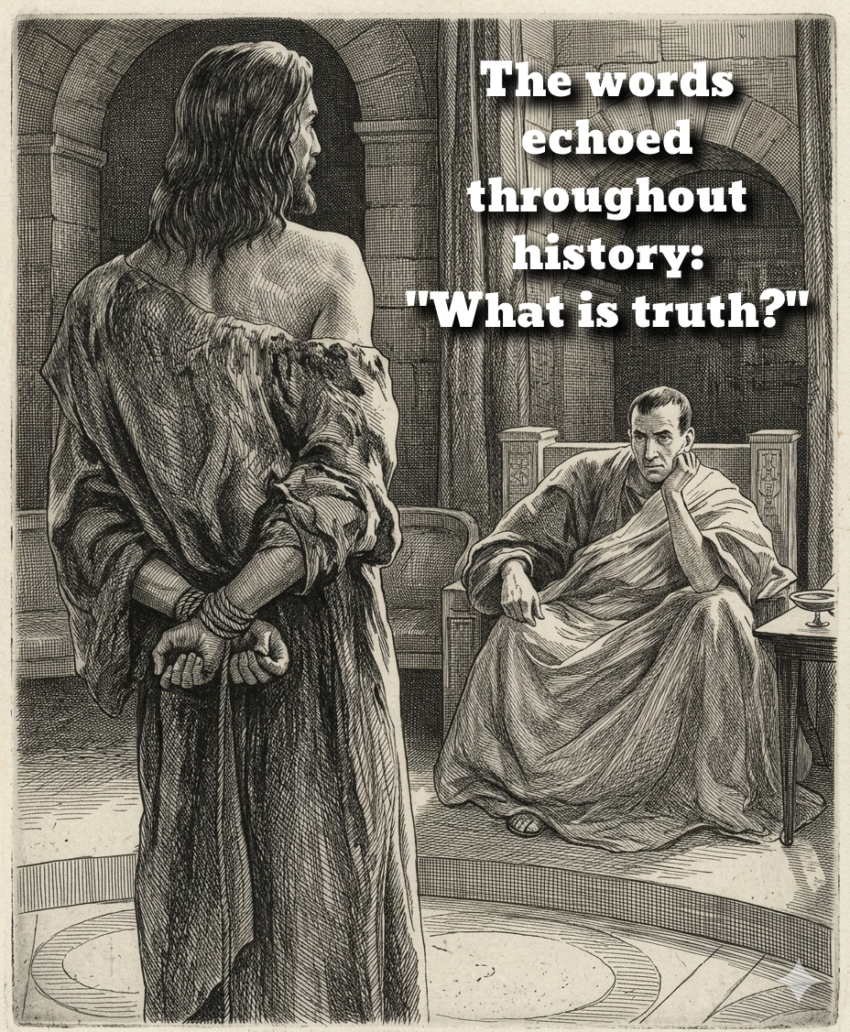
That last sentence is the door through which this essay must walk. A nation is rediscovering that it cannot live on jobs, SoulCycle, astrology apps, and political activism. Vast numbers of people are praying without knowing the One they pray to. The question Pontius Pilate posed nearly two thousand years ago, “What is truth?” — has reasserted itself in subway cars, in dorm rooms, in 3 a.m. YouTube rabbit holes, and at kitchen tables. For those who confess that Jesus is the way, the truth, and the life (John 14:6), this is not a season to study from a distance. It is a moment of opportunity that may not return.
This essay argues, plainly and pastorally, that the cultural moment described in the Daily podcast is a divinely-given opening for ordinary Christians to share the gospel — with our neighbors, our colleagues, our family members, and the strangers we encounter in the course of any given week. It also argues that the very confusion documented by Jackson — the “spiritual but not religious” melange of Bible verses and crystals, the Co-Star app and Greta Thunberg rallies, Father Mike Schmitz YouTube videos and unanswered prayers — is itself the strongest reason to anchor our message and our lives in the unchanging truth of Scripture. A confused generation cannot be helped by a confused message.
❦ ❦ ❦
The Inflection Point: What the Numbers Actually Say
Before we can speak faithfully into this moment, we must understand it accurately. The temptation in evangelical circles is to treat any positive religious data point as a long-awaited revival; the temptation in skeptical circles is to dismiss the same data as statistical noise. Both temptations should be resisted. The truth of the situation is more interesting than either.
Lauren Jackson framed the numbers carefully in her conversation with Asthaa Chaturvedi:
We’ve seen for the first time since Pew Research has been gathering data on religion that people have stopped leaving churches. In essence, secularization is paused… We had expected that every cohort coming up… would be less religious than their parents or their grandparents. But Pew published a report that shows if you actually look at the youngest group of Americans, so 18 to 23-year-olds, there are signs that that group is even more likely — and it’s slight, but it’s more likely to attend religious services at least once a month than those just older than them.
— Lauren Jackson, Believing newsletter host, in “Why More Americans Are Seeking Religion,” The Daily, May 12, 2026
A separate Gallup survey she cited found that the share of men under thirty who report religion as “very important to them” jumped from 28 percent in 2023 to 42 percent in 2025 — a fourteen-point swing in twenty-four months, and historically remarkable in that young men have, for decades, lagged behind young women on this measure. Meanwhile, the non-religious share of the U.S. population declined again in 2025, and the number of atheists and agnostics is back down to where it stood almost fifteen years ago.
Independent research from the Barna Group has been telling a parallel story for over a year. In an April 2025 study released as part of its State of the Church 2025 initiative, Barna reported the following:
According to Barna’s latest data, 66 percent of all U.S. adults say they have made a personal commitment to Jesus that is still important in their life today. That marks a 12-percentage-point increase since 2021, when commitment levels reached their lowest in more than three decades of Barna tracking… In aggregate terms, the multi-year climb in public sentiment toward Jesus equates to nearly 30 million more U.S. adults who claim to be following Jesus today than in 2021.
— Barna Group, “New Research: Belief in Jesus Rises, Fueled by Younger Adults,” April 7, 2025
David Kinnaman, Barna’s CEO, was candid about what this means and what it does not. He called it the clearest indication of spiritual renewal Barna had recorded in over a decade, but warned that the shift looks different from past revivals — it is, in his words, quiet, personal, unconventional, and unlikely to translate immediately into church affiliation. Almost three in ten Americans who do not identify as Christian now nonetheless say they have made a personal commitment to Jesus; many are interested in Jesus while remaining hesitant about institutional Christianity. Kinnaman’s word for what he sees is “openness.”
There are dissenting voices, and they deserve a hearing. A NYT commenter writing as “M” pointed out that PRRI’s most recent data shows religious affiliation in America has changed little in the past year. Others, including the Public Religion Research Institute itself, have argued the pause is real but localized, and that the gains among young men are partly offset by losses among young women. None of this contradicts the core picture: a generational hunger is surfacing, the long secular decline has at minimum stalled, and a numerically significant population is now considering Jesus in ways nearly all sociologists had ruled out only five years ago.
For the Christian, the proper response to such data is neither triumphalism nor cynicism. It is the patient seriousness of a farmer who notices, after a long drought, that the ground is once again ready to receive seed. The window is real. The window may not stay open. The question is whether the people of God will speak.
❦ ❦ ❦
The Confusion at the Heart of the Search
To say that Americans are searching is not to say they have found. Indeed, what is most striking in Jackson’s interview is not the renewed appetite for the transcendent — that has always been latent in the human heart — but the bewildering range of objects toward which that appetite is now directed. The interview itself reads like a catalogue of the modern soul’s hungers and substitutes.
Listen carefully to what Jackson describes. She herself, raised as a devout Latter-day Saint, left the faith of her childhood after encountering Isaiah Berlin’s pluralism in a political-science classroom — “the idea that many truths and realities are equally valid and worthy of consideration and examination.” After college she “threw herself into work,” took up SoulCycle and CrossFit, downloaded the astrology app Co-Star, watched a Greta Thunberg climate rally feel “distinctly religious,” experienced the Eras Tour as “an extraordinary, ecstatic form of communal gathering rarely found outside of religious spaces,” and continued to pray to an unnamed addressee. The interviewees she speaks with describe similar arcs: years of corporate exhaustion, post-pandemic loneliness, a sister or a grandmother whose faith provoked envy, a quiet sense that something is missing that promotions and Pelotons cannot supply.
This is not the confident atheism of the New Atheists circa 2007. It is something softer and sadder — a culture that suspects it has been lied to by every institution it once trusted, and that is now reaching, often unsystematically, for whatever can hold the weight of meaning. As one young woman put it, in words that should arrest every Christian reader:
I would love to find a way to have what I had then without compromising who I feel I am. I couldn’t do it then, and I don’t know where to do it now. I still want more. I still want something to believe in.
— Anonymous interviewee, The Daily, May 12, 2026
Behind those sentences lies the architecture of what RELEVANT magazine, in an August 2025 piece by Ellen Hayes, called the “highly edited” Christianity of the spiritually-but-not-religious. Hayes observed that for many Gen Z believers, the version of Christianity now being assembled “keeps the comfort of God’s love but cuts the cost of discipleship. It borrows language from Scripture and pairs it with crystals, manifestation and self-help mantras. It praises Jesus and quotes the Enneagram in the same breath — but balks at the idea of submission, obedience or biblical authority.” She concluded with the question that lingers over the entire cultural moment: “Is this still Christianity?”
The honest answer, given with kindness and not contempt, is that it is not — at least, not yet. It is the genuine first stirring of spiritual hunger overlaid on a marketplace of incompatible spiritual brands, none of which can do what only the gospel of Jesus Christ can do. The apostle Paul’s image, almost two millennia old, fits the moment exactly. He warned the church at Ephesus of the danger of remaining spiritual infants, “tossed back and forth by the waves, and blown here and there by every wind of teaching and by the cunning and craftiness of people in their deceitful scheming” (Ephesians 4:14). That is a near-perfect description of what Jackson, without intending to, has documented.
❦ ❦ ❦
Why Truth Matters in an Age of Many Paths
If a culture cannot agree that truth is real, knowable, and binding, every other conversation eventually breaks down. This is not a sectarian assertion; it is the lesson of human experience. Yet truth — capital-T truth, the kind that does not bend to mood or majority — is precisely what postmodern Western culture has been trained to suspect. Pilate’s question is now the cultural air we breathe.
Brandon Todd Clay of Truth Story offers what I take to be the most useful working definition for our moment. Following the C. S. Lewis Institute and the late John MacArthur, he argues that truth is “whatever is in accordance with the way in which God created the world; falsehood is anything that goes against God’s reality.” Truth, in other words, is not a popular vote or a personal feeling, and certainly not a scientific consensus held hostage to social pressure. Truth is what is, and what is, is anchored in the character of the God who is.
Truth is that which is consistent with the mind, will, character, glory, and being of God. Even more to the point: Truth is the self-expression of God.
— John MacArthur, quoted in Brandon Todd Clay, “What Is Truth? A Christian Perspective,” Truth Story
That definition matters because every other answer to Pilate’s question collapses under its own weight. If truth is whatever I feel, then I have no grounds to complain when someone else’s feelings authorize behavior that injures me. If truth is whatever my tribe affirms, then might makes right, and the strongest tribe wins. If truth is whatever can be empirically measured, then love, justice, beauty, and the dignity of the human person — none of them measurable in a laboratory — become superstitions. Only a truth anchored in a personal, holy, self-revealing God can carry the moral weight that human life requires.
Thiago M. Silva, writing in the C. S. Lewis Institute’s Knowing & Doing in mid-2025, captured the stakes with admirable clarity. Discipleship, he argued, must form the whole person — “mind, heart, and imagination” — so that believers can withstand cultural pressures and witness compellingly in a fragmented world.
Truth forms the mind to recognize reality as God has revealed it. Goodness shapes the heart to love what is right and just. Beauty captivates the imagination and draws the soul toward worship. Without truth, discipleship is shallow. Without goodness, it is hypocritical. Without beauty, it is lifeless.
— Thiago M. Silva, “When Truth Is Lost, Goodness Distorted, And Beauty Forgotten,” C.S. Lewis Institute, July 29, 2025
Lewis himself made the point with characteristic bluntness more than seventy years ago: Christianity, if false, is of no importance, and if true, of infinite importance. The one thing it cannot be is moderately important. This is the single sentence the spiritual-but-not-religious moment must reckon with. The Jesus who said “I am the way and the truth and the life” (John 14:6) and “the entirety of Your word is truth” (Psalm 119:160) is not asking to be added to a curated spiritual playlist. He is asking — gently, but unmistakably — to be Lord.
❦ ❦ ❦
The Pattern of a Life Not Anchored in Biblical Truth
The interview transcript is, among other things, a quiet anthropology of life lived apart from the God of Scripture. Each story Jackson collected is a portrait of a particular human good distorted by isolation from its proper source. Read again, with theological eyes, the patterns are stark.
Work That Cannot Save
One interviewee describes her parents’ generation: “a much stronger belief that work is good, and by working, we’re making the world a better place. But my generation, a lot of us do not feel that way. A lot of us see our jobs as just a job. We don’t see it as an outlet for making meaning.” The exhaustion is unmistakable, and it is theological at root: vocation, severed from a calling given by a Creator, becomes either an idol that consumes us or a transaction that does not nourish us. Lauren Jackson herself confessed that after leaving her faith, she “threw herself into work… all the time, all the time.” It is a confession countless readers will recognize.
Community That Cannot Be Conjured
Again and again, the transcript returns to loneliness. One man longs to host barbecues, but he never manages to host. A woman who left her church mourns “a pain I don’t really know how to describe.” Another speaker observes that even when something hard happens — illness, grief, crisis — people are looking for tactile, embodied care that comments on the internet cannot give. They want a meal train. They want a body of believers, even if they do not know how to call it that. Scripture has a name for what they are missing: it is the body of Christ, the family of God, the very thing the rugged American individualism of the past century told them they did not need.
Movements That Cannot Bear Worship
Jackson describes encountering at a Greta Thunberg rally “a desire for deliverance in the crowd that felt distinctly religious.” She describes the Eras Tour as “an extraordinary, ecstatic form of communal gathering rarely found outside of religious spaces.” Social-justice marches, political movements, athletic identities, fandom — all of them now bear a weight they were never engineered to carry. Even astrology, the ancient pagan superstition Pew finds practiced by roughly thirty percent of American adults, has been rebranded as therapeutic self-knowledge through apps like Co-Star. It is, as one observer of New Age spirituality has noted, a counterfeit religion that promises self-mastery through visualization, manifestation, and vision boards — and which fails, predictably, the moment real suffering arrives.
A Self That Cannot Hold
Identity built on performance, popularity, productivity, or political tribe is identity built on sand. Pastor and writer Mark Cole catalogues the predictable result: “Lose a job, age a little, fail publicly, or face rejection — and identity collapses.” By contrast, identity received from a Creator who knows us, loves us, and has redeemed us cannot be cancelled, fired, or aged out. The contrast between these two foundations becomes most visible exactly when life gets hardest — which is also when many of Jackson’s interviewees said they began to wonder if there might be something more.
❦ ❦ ❦
The Dangers of a Life Untethered from God’s Word
It would be unloving to leave the description there. The reason a generation should consider returning to the Scripture-anchored faith of Jesus Christ is not merely that pluralism is intellectually unstable. It is that a life genuinely untethered from God’s revealed truth carries dangers that, while quiet, are real and cumulative.
Mark Cole, in a December 2025 essay that has circulated widely in evangelical circles, summarized those dangers under several headings. They are worth restating, not as scare tactics, but as a sober inventory:
• Life without God loses its true center. Something else always takes God’s place — success, money, pleasure, achievement, approval — and none of these can carry the weight of meaning. Augustine’s famous prayer (“Our hearts are restless until they rest in You”) is not a slogan; it is a diagnosis.
• Morality becomes flexible and self-serving. When right and wrong are negotiated case by case, trust erodes, integrity weakens, and society fractures.
• Suffering becomes meaningless. Pain that cannot be located within any redemptive story becomes something to escape or merely endure — never something that shapes.
• Identity becomes fragile. Foundations built on performance and approval cannot survive ordinary failure.
• Relationships suffer. Self-interest, untempered by transcendent love, makes forgiveness costly and commitment conditional.
• Hope shrinks to the size of this life. If this is all there is, then every loss is final, and every disappointment is devastating.
• The heart hardens, quietly. Awe fades. Pride grows. What once stirred the soul eventually feels irrelevant.
These are not the speculative worries of an alarmist preacher. They are the empirical findings of pastors, psychologists, sociologists, and journalists — including, in less explicit terms, the very Times reporter whose own life mirrors what she describes. Jackson is too honest a journalist to claim that secular substitutes have satisfied her; she still prays, after all.
There is, in addition, a particular danger that the spiritual-but-not-religious frame introduces: it offers the language of Jesus while quietly emptying it of its biblical content. Doreen Virtue, the former New Age author who came to Christ in 2017 after years as one of the world’s most influential New Age teachers, has written with first-hand knowledge of how the language of Jesus can be repurposed to mean something He never said:
The New Age teaches that Jesus was merely a man, a created being who came as a role model… The New Age also redefines Jesus by changing the vocabulary used to describe Him. They may refer to Him as “Sananda,” a channeled spirit, or use the name “Yeshua” while rejecting the biblical identity and authority of Jesus. They often use biblical-sounding language and even sprinkle in Scripture verses to appear legitimate.
— Doreen Virtue, “How the New Age Redefines Jesus and Why It’s Spiritually Dangerous,” Servants of Grace, January 19, 2026
This is precisely the spiritual environment a generation of new seekers is wandering into. Some will find pastors like Father Mike Schmitz, whose careful catechesis can reorient them; many others will land in TikTok feeds and Instagram reels that quote Jesus while telling them they are little gods who can manifest their own reality. Without a clear scriptural anchor, well-meant seeking can deliver someone into something further from Christ than where they started.
❦ ❦ ❦
The Advantages of a Life Anchored in Biblical Truth
The Christian message is not, at its core, a list of dangers to flee. It is good news. Behind every warning Scripture offers stands a positive promise — a life so abundant that Jesus described it (John 10:10) as the very reason He came. What does that anchored life actually look like in 2026?
A Center That Holds
To be anchored in biblical truth is to know — not vaguely, but specifically — Who made you, why you are here, where you are going, and what your life is for. The questions that drive Co-Star downloads and 3 a.m. existential dread are not unanswerable. They are answered in the opening chapters of Genesis, in the prologue to John’s Gospel, and at the foot of a particular cross outside Jerusalem in approximately A.D. 30.
Truth That Sets Free
Jesus said, “You will know the truth, and the truth will set you free” (John 8:32). This is not a slogan. Freedom in the biblical sense is not the freedom to do whatever one wishes; that turns out, in practice, to be a particularly subtle slavery. Biblical freedom is the freedom to become what God created you to be — to love rightly, to suffer faithfully, to forgive when forgiveness is costly, to hope when hope seems naïve. As GotQuestions summarizes, Scripture “sanctifies” the believer: “Make them holy by your truth; teach them your word, which is truth” (John 17:17).
Community That Bears the Weight
The very community Jackson’s interviewees ache for is what Christ promised to build and is, in fact, building. The local church — flawed as it sometimes is, and let us be honest about that — remains the only institution on earth designed by God for the precise hunger this generation describes. It is the “meal train,” the “tactile, meaningful care” one interviewee said he wanted. It is the place where guilt finds a Yom Kippur and a cross and a confession and a meal.
Suffering That Means Something
Christianity does not promise the elimination of pain in this life. It promises, more profoundly, the redemption of pain. Lewis described the dynamic in The Problem of Pain: God whispers in our pleasures, speaks in our conscience, and shouts in our pain — using even our suffering as a megaphone to rouse a deaf world. Many of the converts and reverts in Jackson’s reporting describe exactly this experience. The pandemic shouted. They began to listen.
Hope That Outlasts the Grave
And finally, biblical truth offers something no political movement, fitness studio, astrology app, or self-improvement regime can offer: a hope that survives the funeral. The resurrection of Jesus Christ — historically attested, theologically central, and pastorally indispensable — anchors the Christian’s confidence that suffering is not the last word and that death is not the end. As Debra Hodges has argued in a careful recent essay refuting modern reinterpretations of Jesus, “the resurrection of Jesus is the foundation of our faith, hope, justice, and ultimate renewal. It assures us that evil will not triumph, that it won’t have the last word, and that our suffering is not meaningless.”
❦ ❦ ❦
The Counterfeit Christs of Our Moment
Anyone who has worked seriously in evangelism for any length of time learns to expect a particular pattern: where genuine spiritual hunger emerges, counterfeit gospels follow. The same Jesus whose name now trends across podcasts and TikTok feeds is being remade, in dozens of mutually incompatible directions, to fit the spiritual needs of the moment.
One can hear the counterfeits at work in the very transcript before us. A Texas state representative, James Talarico, quotes Jesus to advocate for what he calls “a more compassionate form of economic populism.” He has every right to draw moral inspiration from Scripture, but it is worth noticing that his Jesus speaks emphatically about tax systems and notably less about the cross, the resurrection, and the call to personal repentance. Meanwhile, on the political right, certain influencers have begun to weaponize Christianity in ways that left-leaning convert Nick Rumar-Detors — interviewed at length in the podcast — found so toxic that he was driven, in reaction, into the arms of historic Catholicism. As columnist Ross Douthat famously warned, if you hated the religious right, you may not like what an irreligious right brings instead. Jesus is being pulled, ideologically and theologically, in every direction at once.
The challenge is therefore not merely apologetic — defending the Christian faith against unbelief — but discernive: helping seekers distinguish the real Jesus of Scripture from the constructed Jesuses of the cultural marketplace. Debra Hodges, writing at BCWorldview, names the issue with precision:
The real Jesus is the Biblical Jesus, Who is the eternal Son of God. He came to Earth and lived a sinless life. He died for our sins and rose again from the dead. The evidence shows that He was not simply a myth or a good moral teacher. He is the Christ, the Son of the living God, and in Him alone is forgiveness, peace, and eternal hope.
— Debra Hodges, “Refuting Modern Lies About the Real Jesus,” BCWorldview, April 17, 2026
This is the Jesus who must be presented — not a Jesus shaped to whichever political project happens to be ascendant, not a Jesus stripped of the resurrection because it embarrasses our scientific friends, not a Jesus reduced to a moral influencer for personal flourishing. The Jesus of Scripture is the only Jesus who can do for the spiritually hungry what they actually need done. Every counterfeit ultimately disappoints, because counterfeits cannot do what only the real can do: they cannot forgive sin, defeat death, or remake a human heart.
Pastor Jack Selcher, of Christian Growth Resources, has noted the apologetic dimension as well. The notion that all religions teach essentially the same thing is, on inspection, false. Christianity teaches that Jesus died for our sins; Islam teaches that He did not. They cannot both be right. As Selcher writes:
Those who believe Christianity and other religions are the same do not understand Christianity or other religions, or at least do not take their teachings seriously. It is like saying Windsor Castle and a pup tent are the same because they provide shelter.
— Jack Selcher, “Is Jesus the Only Way? Why Many Paths Cannot Lead to God,” Christian Growth Resources
To say that Jesus is the only way to the Father, as He Himself said (John 14:6; Acts 4:12), is not arrogance. It is faithfulness to His own claim. And it is the very thing a confused generation needs to hear from people who say it with humility, with tears in their eyes, and with the kind of life that demonstrates the claim is true.
❦ ❦ ❦
Why Now, More Than Ever
Three convergent realities make this particular cultural moment uniquely urgent for the church’s evangelistic witness.
Openness That May Not Last
First, the openness that Pew, Barna, and Gallup are documenting is real but fragile. Lauren Jackson herself was careful to distinguish a “renewed interest” or a “renewed curiosity” from anything she would call a revival. Curiosity that is not met with substance becomes cynicism. The young man who watched Father Mike Schmitz videos in the middle of the night, hate-watching at first and gradually softening, eventually emailed a diocese and asked for help. Someone helped him. But hundreds of thousands of similar searchers are right now Googling questions about Jesus, joining Reddit threads with subject lines like “Seeking truth about Jesus — how can I know He’s real?” and watching TikTok sermons that range, as Ellen Hayes put it, “from helpful to heretical.” If the church does not speak now, others will.
Counterfeit Suppliers Are Ready
Second — and this follows directly from the first — the supply side of the spiritual marketplace is already mobilized. Pastor Dave Jenkins, in a recent episode on the inadequacy of emotionalism for the Christian life, observed that false teachers are particularly drawn to emotionally hungry audiences because emotion-led seekers bypass discernment and are easier to persuade, manipulate, and exploit. Every one of the seekers Jackson interviewed is a target — for legitimate ministry, yes, but also for the manifesting gurus, the prosperity hucksters, the channelers, and the conspiracists. The question is not whether they will be reached. The question is who reaches them first.
The Church Has the Answer the Culture Is Asking For
Third — and this is the most encouraging point — the very things our neighbors are asking for are the very things the local church, at its biblical best, already supplies. They want community? The church has communion. Do they want meaning in suffering? Christianity has a cross and an empty tomb. They want an identity that does not collapse under failure? The gospel offers a sonship by grace that no failure can revoke. They want a center that holds? Jesus Christ holds — He is, in the language of Hebrews 13:8, the same yesterday, today, and forever. They want truth in a sea of opinion? The Word of God endures (1 Peter 1:25).
Anchored is the right word. Hebrews 6:19 calls the hope of the gospel “an anchor for the soul, firm and secure.” Storms come; storms are coming. The hope of the seeker outside the church is that someone inside the church will lean over the railing and offer them the anchor.
❦ ❦ ❦
The Evangelistic Appeal: Making the Gospel a Daily Practice
All of which brings us, finally, to the personal and practical question for those who name the name of Christ: what does this moment require of you, today, on the way to the coffee shop, the office, the park, the neighbor’s front porch?
Three things, at minimum.
Anchor Yourself First
You cannot offer an anchor you do not hold. Daily, persistent, prayerful engagement with the Scriptures is not optional. It is the only way a Christian remains a Christian, particularly in a cultural moment as theologically chaotic as ours. The Apostle Paul’s exhortation to Timothy still stands: rightly handle the word of truth (2 Timothy 2:15). Read the Bible. Memorize it. Submit to it. Let it correct you. Allow it to interpret your feelings, rather than allowing your feelings to interpret it.
Be Ready, Always
The first epistle of Peter contains what may be the most concise evangelism manual ever written: “Always be prepared to give an answer to everyone who asks you to give the reason for the hope that you have. But do this with gentleness and respect” (1 Peter 3:15). Note the assumption: someone is going to ask. Statistically, in 2026, that assumption is more warranted than it has been in our lifetimes. The question is whether your answer will be ready, biblically grounded, charitable in tone, and personally honest. Memorize a simple gospel outline. Know your own testimony. Be prepared to name your hope — Jesus Christ, crucified and risen — without flinching.
Live Toward the People in Front of You
Finally, recognize that the people described in the New York Times podcast are not abstractions. They are your sister-in-law, who quietly downloaded the Bible app last month. They are the colleague who told you, at the holiday party, that he had started attending mass “for the kids.” They are the woman in the Pilates class who, when you asked how she was, paused longer than you expected before saying “fine.” The Great Commission was never given to professionals; it was given to ordinary disciples (Matthew 28:18-20). The harvest, Jesus said, is plentiful — and after a season when many of us wondered if there was any harvest left, the fields once again look ripe.
Share the gospel everywhere you go. Share it in conversations and over meals and at gravesides and in waiting rooms. Share it on social media without being obnoxious about it. Share it in the way you handle disappointment, the way you treat people who can do nothing for you, the way you spend money, and the way you mourn. Share it because Jesus is true; share it because Jesus is alive; share it because Jesus is coming back; share it because the people you love are, every single one of them, going to die one day, and the only One who can do anything about that is the One you know. Share it, in short, because you actually believe what you say you believe.
❦ ❦ ❦
Conclusion: A Window of Grace
Lauren Jackson, near the end of the interview, recalls a tense conversation with her mother in which she pushed back against her family’s faith. Her mother, struggling for a metaphor, said something that, perhaps without intending to, captured the whole of the situation: “If there was a sunset, sometimes you say to somebody, come see the sunset because you get excited. And that’s all. You know? You can make it sound so demeaning, but it’s like a sunset to me. It’s like, wait a second, let’s not go look at the bush. Let’s look at the sunset.”
Christian readers will know what to do with that image. The gospel is not a bush we want our neighbors to come admire. It is the sunset itself — the great drama of God’s love for the world, displayed in His Son, finished at the cross, sealed by the resurrection, and offered freely to all who will receive it. We do not invite people to a denomination or a building or a political coalition. We invite them, with Pilate’s question still echoing in the air, to come and see the One who answered it with His own life.
There is a window open in our culture right now that none of us expected to see. Pews are pausing. Souls are awakening. Twenty-three-year-old men are taking down their stoicism quotes and putting up crosses. Forty-six-year-old former leftists are emailing dioceses. Journalists are praying without knowing to whom. The harvest is ripe. The laborers, as ever, are few.
May we — by the grace and Spirit of the God who is Truth, Goodness, and Beauty itself — take our places among them. May we speak the gospel boldly and live it humbly. May we be the people who, when a hungry generation asks Pilate’s old question, give an honest answer in the words of the One who came to be the answer: I am the way, and the truth, and the life. No one comes to the Father except through Me.
Now is the time. The window will not stay open forever. Speak.
❦ ❦ ❦
References & URL Citations
Primary Source — Interview Transcript:
https://www.nytimes.com/2026/05/12/podcasts/the-daily/americans-religion-believing.html
Supporting Sources Consulted and Cited:
• https://medium.com/backyard-theology/what-the-church-needs-to-discover-about-truth-daf56b8b06a
• https://medium.com/backyard-theology/as-pilate-once-said-to-jesus-what-is-truth-196f9c8ee218
• https://www.barna.com/research/belief-in-jesus-rises/
• https://relevantmagazine.com/faith/what-do-christians-who-say-im-spiritual-but-not-religious-actually-believe/
• https://bcworldview.org/refuting-modern-lies-about-the-real-jesus/
• https://servantsofgrace.org/how-the-new-age-redefines-jesus-and-why-its-spiritually-dangerous/
• https://servantsofgrace.org/why-emotionalism-cannot-replace-biblical-truth/
• https://www.dreamcitychurch.us/the-importance-of-biblical-truth-in-a-confused-world/
• https://www.cslewisinstitute.org/resources/when-truth-is-lost-goodness-distorted-and-beauty-forgotten/
• https://truthstory.org/blog/what-is-truth/
• https://www.gotquestions.org/Bible-truth.html
• https://www.markcole.ca/the-dangers-of-life-without-god/
• https://www.christiangrowthresources.com/post/is-jesus-the-only-way-why-many-paths-cannot-lead-to-god
• https://www.christiangrowthresources.com/post/the-new-age-gospel-exposed-why-all-paths-do-not-lead-to-god
• https://www.gty.org/articles/A383/is-truth-worth-fighting-for
• https://www.fastmissions.com/article/importance-of-truth
• https://nextstepdisciple.org/article/anchored-in-peace-amid-lifes-storms
• https://www.reddit.com/r/TrueChristian/comments/1m5vzgk/seeking_truth_about_jesus_how_can_i_know_hes_real/
• https://www.reddit.com/r/TrueChristian/comments/1olqkt3/mature_christians_only_how_do_you_know_youre/
Selected Scripture Cited:
• John 14:6 — “I am the way and the truth and the life. No one comes to the Father except through me.”
• John 17:17 — “Sanctify them in the truth; your word is truth.”
• Ephesians 4:14 — “Tossed back and forth by the waves, and blown here and there by every wind of teaching…”
• 1 Peter 3:15 — “Always be prepared to give an answer… with gentleness and respect.”
• Hebrews 6:19 — “We have this hope as an anchor for the soul, firm and secure.”
• Acts 4:12 — “Salvation is found in no one else.”
• Matthew 28:18–20 — The Great Commission.
❦ ❦ ❦
A Note on Research Methods and Accuracy
In recent years, some have voiced concern that artificial intelligence may distort facts or introduce inaccuracies into serious research. That criticism deserves acknowledgment. However, AI has now evolved into the most powerful research instrument available to any dedicated scholar—capable of analyzing vast datasets, cross‑referencing historical records, and surfacing overlooked connections across sources. This work represents a collaboration between the author’s investigative inquiry, verified primary documentation, and the advanced analytic capabilities of AI research tools. Here, AI was not used as a ghostwriter or a shortcut for scholarship, but as a disciplined research partner devoted to rigor, accuracy, and transparency.
Every factual claim in this work has been subjected to active verification. Where AI‑generated content was used as a starting point, it was tested against primary sources, peer‑reviewed scholarship, official institutional documentation, and established historical records. Where discrepancies were found—and they were found—corrections were made. The author has made every reasonable effort to ensure that quotations are accurately attributed, historical details are precisely rendered, and theological claims fairly represent the positions they describe or critique.
That said, no work of this scope is immune to error, and the author has no interest in perpetuating inaccuracies in the service of an argument. If you are a reader—whether sympathetic, skeptical, or hostile to the conclusions drawn here—and you identify a factual error, a misattributed source, a misrepresented teaching, or a claim that cannot be substantiated, you are warmly and genuinely invited to say so. Reach out. The goal of this work is not to win a debate but to get the history right. Corrections offered in good faith will be received in the same spirit, and verified corrections will be incorporated into future editions without hesitation.
Truth, after all, has nothing to fear from scrutiny—and neither does this work.