
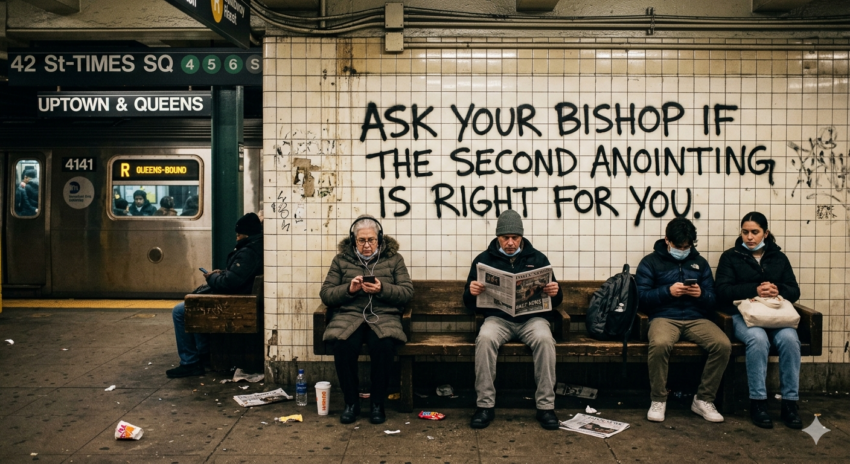
Calling, Election, and Carte Blanche: The Crowning Ordinance Most Mormons Have Never Heard Of
I. The Room Behind the Curtain
Picture a Sunday evening inside a granite temple, the kind that crowns a hill or anchors a city square. The doors are locked. The visitors’ rooms are empty. The chapels are dark. Somewhere within, in a small private chamber, a senior Apostle stands before a married couple who have been quietly invited to this hour without explanation. A bottle of consecrated oil sits ready. A basin and a folded towel wait on the floor. The husband is washed; oil is poured over his head; a blessing is spoken, slowly and deliberately. He is anointed not merely as a priest — that he was already — but as a king. His wife is then anointed a queen and priestess unto him. They are pronounced sealed up unto eternal life, called and elected, and made sure, secured against every sin save two: shedding innocent blood, and blaspheming against the Holy Ghost. The other temple workers withdraw. The couple is led to a private room where the wife, on her knees, will later wash her husband’s feet and lay her hands upon his head and pronounce her own blessing upon him. They are charged on their honor to tell no one what has happened — not their children, not their stake president, not even one another in any setting where another could overhear.
This is the Second Anointing — the ordinance that the founder of the Latter-day Saint movement, Joseph Smith, called the highest and holiest order of the priesthood. It is the capstone, the consummation, the crowning rite of Mormonism’s temple system. It is also the ordinance that the modern Church of Jesus Christ of Latter-day Saints will not let its teachers discuss. Its own official manual instructs instructors with an emphatic injunction: do not in any way attempt to discuss or answer questions about the second anointing. Most Latter-day Saints have never heard the words. Most of those who have heard the words assume they describe something done long ago in Nauvoo and quietly retired in some grandfatherly past. They are wrong. It is still done. It was done last month. It will be done next month. And if recent first-hand accounts are accurate, it has been done for a sitting British stake president, for senior Apostles, and for the past three Presidents of the Church.
This essay attempts, with charity and at length, to bring this hidden rite into the daylight of historical and theological scrutiny. The goal is not ridicule and not exposure for its own sake. The Apostle Peter charges every Christian to be ready always to give a reasoned defense — a logos — of the hope that is within him, and to do so with meekness and reverence (1 Peter 3:15). What follows is offered in that spirit. The Second Anointing matters because it is the doctrinal place where the LDS gospel reveals, perhaps most clearly of any single ordinance, what it actually is — and what it cannot be reconciled with the gospel of Jesus Christ as the prophets and apostles delivered it once for all to the saints.
II. The Pulpit and the Padlock: A Doctrine Both Preached and Suppressed
In April 1981, the LDS Apostle Bruce R. McConkie stood at General Conference and proclaimed in the church’s clearest possible public voice the doctrinal substance of the Second Anointing. The Saints, he taught, possess the power to make their calling and their election sure — to be sealed up unto eternal life and to have the unconditional promise of eternal life in the presence of God while yet in mortality. This is precisely what the Second Anointing accomplishes. McConkie did not name the ordinance from the pulpit, but his published works name and define it without ambiguity. In Mormon Doctrine, McConkie writes that those whose calling and election is made sure receive the more sure word of prophecy, which means that the Lord seals their exaltation upon them while they are yet in this life — that their exaltation is assured.
Those members of the church who devote themselves wholly to righteousness, living by every word that proceedeth forth from the mouth of God, make their calling and election sure. That is, they receive the more sure word of prophecy, which means that the Lord seals their exaltation upon them while they are yet in this life.
— Bruce R. McConkie, Mormon Doctrine (1966)
Yet the very church manual that quotes McConkie’s words clamps a padlock onto the rest of his exposition. The Doctrines of the Gospel Teacher Manual, Chapter 19, opens with an arresting instruction printed in bold italics at the top of the lesson — a warning to every instructor in every Institute of Religion classroom across the church’s global education system:
Caution: Exercise caution while discussing the doctrine of having our calling and election made sure. Avoid speculation. Use only the sources given here and in the student manual. Do not attempt in any way to discuss or answer questions about the second anointing.
— Doctrines of the Gospel Teacher Manual, ch. 19
Two postures emerge from a single institution. The pulpit gestures at it; the classroom forbids it. The official manual cites McConkie’s language about making one’s calling and election sure, but omits the same author’s parallel teaching that this sealing is, in his words, the unconditional guarantee of exaltation in the highest heaven of the celestial world. Why omit it? The answer, one suspects, lies in the very contradiction the ordinance now creates for a global modern church striving to present its theology as one of grace tempered by discipleship. To explain the Second Anointing fully is to admit that some Mormons have been guaranteed exaltation by an ordinance that the average Mormon will never receive, while the average Mormon is told, week after week, to endure to the end as if the question of their own destiny remained genuinely open. That is the padlock. And that is also, as the rest of this essay will argue, the doctrinal pressure point at which the entire structure groans.
III. The Origin: Nauvoo, 1843, and the Anointed Quorum
The student of Latter-day Saint origins cannot understand the Second Anointing without first standing in the upper room above Joseph Smith’s red brick store in Nauvoo, Illinois, in the spring and summer of 1842 and 1843. There, in a series of small private meetings, Joseph introduced to a tiny inner circle of trusted men and women what would become the temple endowment. The Prophet had hinted at the existence of something greater for years. As early as 1839, he had taught his followers, drawing from Second Peter 1:10, that a person could, after a lifetime of faithfulness, have his calling and election made sure — that is, be sealed up to exaltation while yet in mortality. But in August 1843, even his closest disciple, Brigham Young, was forced to admit that he did not know of anyone in the church who yet possessed what Joseph called the fullness of the priesthood. Joseph’s pronouncements were aspirational. The crowning rite had not yet been instituted.
That changed on the evening of September 28, 1843. Gathered in a small council in the front upper room of the Mansion House in Nauvoo, Joseph Smith was, by common consent and unanimous voice, chosen president of the quorum and anointed and ordained to what his own journal calls the highest and holiest order of the priesthood, alongside his wife Emma. Wilford Woodruff, decades later in his Historian’s Private Journal, would confirm without ambiguity that what Joseph received that night was his Second Anointing. Over the next five months, the same ordinance was extended to at least twenty men and seventeen women in Joseph’s intimate circle — the Quorum of the Anointed, sometimes called the Holy Order. Approximately forty percent of male recipients during Joseph’s lifetime were also in plural marriages. The ordinance and the polygamy doctrine emerged together, in the same secret rooms, among the same trusted few.
After Joseph’s murder in June 1844 and the succession crisis that followed, the historical record yields a telling pattern. None of the rival contenders for leadership of the movement — not Sidney Rigdon, not William Smith, not James Strang, not Lyman Wight, not Joseph Smith III — had received the Second Anointing. Only Brigham Young and the Twelve possessed that mark of doctrinal continuity. Andrew Ehat and other scholars have persuasively argued that this is no small fact: in the eyes of those who had received the ordinance, it constituted the unbroken thread of priesthood authority, and it bound the Twelve to one another in a way none of the schismatics could match. By the time the Nauvoo Temple was opened and then frantically closed in the winter of 1845–46 ahead of the western trek, nearly six hundred additional Saints had received the rite at the hands of Brigham Young and his delegates. Then, on the migration to Utah, the ordinance fell silent for two decades — not revived until 1866 under Brigham Young’s mature presidency in Salt Lake City.
The contours of the practice in the late nineteenth and early twentieth centuries are well documented by the historian David John Buerger, whose 1983 article in Dialogue: A Journal of Mormon Thought remains the gold-standard scholarly treatment of the subject. Buerger draws on diaries, journals, First Presidency correspondence, and the Book of Anointings (an internal record kept in the Salt Lake Temple) to trace a clear arc. Under Wilford Woodruff, roughly 300 second anointings per year were administered in the Salt Lake Temple. Under Lorenzo Snow, the rate roughly doubled. Under Joseph F. Smith, it fell again. Under Heber J. Grant in the 1920s, it collapsed to a trickle. By 1941, just under 15,000 second anointings had been performed for the living and just over 6,000 for the dead. After 1941, the records are sealed; historians are denied access. What we know thereafter we know only because individual recipients have spoken — sometimes against explicit instruction.
IV. Anatomy of the Rite: What Happens Behind the Locked Door
From contemporaneous nineteenth-century journals, the Book of Anointings, the testimony of Tom Phillips (a former British stake president who received the ordinance in May 2002 from Apostle M. Russell Ballard at the Preston England Temple), and the public testimony of former Area Authority Seventy Hans Mattsson and his wife Birgitta concerning their second anointing at the Frankfurt Temple, scholars have reconstructed the rite in three movements. The historical and the modern accounts agree on essentials, differing only at the margins.
First Movement: Prayer Circle and Washing
The couple, in temple clothing, enters a small dedicated room with one or two officiators. A prayer circle, conducted by the husband, opens the ordinance. A male officiator — most often an Apostle in modern practice, with the President of the Church frequently present in the room — then washes only the husband’s feet.
Second Movement: The Anointing
The husband is then anointed with consecrated oil and pronounced a king and a priest unto God, sealed up unto eternal life, and given the more sure word of prophecy. The wife, in turn, is anointed a queen and priestess — but here a critical historical detail must be noted. In the Nauvoo years and the early Utah period, the wife was anointed a queen and priestess unto God. Brigham Young changed the wording in 1846 such that the woman is anointed queen and priestess unto her husband, conditional upon her obedience to his counsel. Maxine Hanks and other Mormon feminist scholars have documented this shift, which subordinated the woman’s eternal status in a way Joseph Smith had not. The historical Heber C. Kimball words used over Brigham Young in the Nauvoo Temple on January 8, 1846, capture the ordinance’s claim with unforgettable precision:
Brother Brigham Young, I pour this holy consecrated oil upon your head and anoint thee a king and a priest of the most high God … and I seal thee up unto eternal life, that thou shalt come forth in the morn of the first resurrection … and thou shalt attain unto the eternal Godhead and receive a fulness of joy, and glory, and power; and that thou mayest do all things whatsoever is wisdom that thou shouldst do, even if it be to create worlds and redeem them.
— Heber C. Kimball, Nauvoo Temple, Jan. 8, 1846
Brigham Young was being told, with the full sacramental gravity of a temple altar, that he would create worlds and then redeem them — that he was being inducted into the divine plurality. The language is staggering when read against the backdrop of biblical monotheism, and we will return to it in due course. For now, observe only that this is the unedited promise of the ordinance: not figurative theosis, not Eastern Orthodox “partaking of the divine nature” (2 Pet. 1:4), but literal entry into the Eternal Godhead, complete with the prerogatives of cosmogony and atonement.
Third Movement: The Private Washing of Feet
Later, in private, the husband dedicates the home and a room within it. There, the wife symbolically prepares her husband for his death and resurrection. As his priestess, she washes and anoints his feet and then lays her hands upon his head to pronounce a personal blessing upon him. This is the only ritual context within Latter-day Saint practice in which a woman lays hands upon a man and pronounces a priesthood-style blessing — a fact upon which the historian D. Michael Quinn famously argued that Mormon women have, in some sense, held the priesthood since 1843, though without office. Birgitta Mattsson described the moment in a 2018 interview on the Mormon Stories podcast as a deeply strange experience: she was given a bowl of water and a towel and instructed to cleanse her husband’s feet and then bless him with her hands upon his head.
In modern practice, recipients are strictly enjoined not to discuss the ordinance. Tom Phillips’ candid testimony of his 2002 second anointing — that he was instructed to mislead family members about his whereabouts on the temple weekend, and that he and his wife felt acute moral discomfort about “lying for the Lord” — captures the social texture of the secrecy. The ordinance is not merely private. It is shielded by an active duty of concealment.
V. The Calvinist Echo and the Theological Carte Blanche
The most theologically explosive feature of the Second Anointing is not the ritual washing or the gendered anointing language. It is the soteriological promise the ordinance makes. McConkie’s clearest statement, drawn from his 1966 Mormon Doctrine, is worth reproducing in its argumentative weight:
To have one’s calling and election made sure is to be sealed up unto eternal life. It is to have the unconditional guarantee of exaltation in the highest heaven of the celestial world. It is to receive the assurance of godhood. It is, in effect, to have the day of judgment advanced so that an inheritance of all glory and honor of the Father’s kingdom is assured prior to the day when the faithful actually enter into the divine presence.
— Bruce R. McConkie, Mormon Doctrine
McConkie continues — and this is the line the official church manual omits — by explaining that when one has been thus sealed up unto eternal life, he is sealed up against all manner of sin except blasphemy against the Holy Ghost and the shedding of innocent blood. Buerger, drawing on Doctrine and Covenants 132:26, makes the same point in scholarly form: the only loss of exaltation available to a person whose calling and election has been made sure is the unpardonable sin. Every other sin — adultery, theft, extortion, and so on — may merit the sorrows of “buffetings in the flesh” but cannot, under McConkie’s reading, dislodge the exaltation already sealed.
Buerger himself observed that this language stands remarkably close to the Reformed Calvinist doctrine of the unconditional perseverance of the elect — closer than to any other Protestant position of the nineteenth century. Joseph Smith’s framework, with its language of being sealed up and made sure, mirrors at the lexical level the categories that John Calvin and the Westminster divines had drawn from Pauline and Petrine assurance texts. But the resemblance is superficial. In Reformed theology, the sealing is the work of the Holy Spirit upon faith in Christ; here, it is the work of a man with a vial of oil, pronouncing words over another man. In Reformed theology, every justified believer is sealed; here, only an invited elite among the most loyal of an already exclusive movement is sealed. In Reformed theology, the basis of assurance is Christ’s finished work and the witness of the Spirit through the Word; here, the basis is a ritual performance behind a locked door.
And so a question must be asked plainly. What does it do to a man’s moral imagination to be told that his eternal exaltation is guaranteed, that the day of judgment for him has effectively been advanced and decided, that there are now only two sins he cannot commit and survive? Tom Phillips described the experience in his own words: he and his wife had “made it,” the Lord had certified them through his prophet, and unless they shed innocent blood or denied the Holy Ghost — both of which seemed at the time unthinkable — celestial glory was theirs. This is precisely the structure that the apostle Paul warned against when he asked, “Shall we continue in sin, that grace may abound? God forbid” (Rom. 6:1–2). The Christian doctrine of assurance is not a license; it is the bedrock from which holiness springs. The doctrine of the Second Anointing, by contrast — at least in its unconditional reading — installs a theological floor above which behavior need not rise. McConkie himself acknowledged this danger and tried, by means of later qualifications, to retreat from it. But the qualifications produce contradictions far worse than the original problem, as the next section shall show.
VI. The Two-Tier Salvation: Elders Holland, Ballard, Nelson, and the “Permanent Pass”
In December 2023, the senior Apostle Jeffrey R. Holland, speaking at a tribute event for President M. Russell Ballard, made a striking observation that few who heard it in real time fully understood. He told the audience that Ballard, like Elder Cook and the wives present, did not keep coming to church gatherings for the sake of his own salvation — that question, Holland said, had been “taken care of a long time ago.” Holland called this status a “permanent pass” that the men in question had “earned and been blessed with by the atonement of the Lord Jesus Christ and the principles of the gospel.” Holland was speaking from the pulpit at a public event. To outsiders, the comment passed for warm sentimentality. To those who know what the Second Anointing is, Holland was naming it without naming it. There is only one doctrinal mechanism within the LDS Church that secures a person’s salvation before the day of judgment, and it is the rite that Holland — out of deference to its required secrecy — could not directly name.
This is the social fact that secrecy cannot finally conceal. A two-tier salvation has been constructed: an ordinary tier in which the rank-and-file member must endure faithfully to the end and hope to be judged worthy, and an elite tier in which a select handful of leaders and their spouses have already been judged worthy and sealed up. D. Michael Quinn documented that both President Spencer W. Kimball and President Russell M. Nelson received their second anointings together in 1974, and Nelson himself alluded to the experience in his 1979 autobiography From Heart to Heart. The current pattern of practice is also clear from Tom Phillips’ first-hand testimony: a sitting British stake president was invited to receive his second anointing in 2002, demonstrating that the rite is not confined to General Authorities but extends to a wider, still elite, circle of long-serving regional leadership. The Hans and Birgitta Mattsson account confirms the same. The ordinance is alive, and it is selective.
It would be uncharitable to assume bad faith on the part of those who have received it. Many recipients describe the experience in tones of profound reverence and joy, as the nineteenth-century diarist John D. Lee did when he wrote that the ordinance produced more joy, comfort, and reconciliation of feeling than he could have imagined. Abraham O. Smoot called it a day of great enjoyment that gave birth to the greatest blessings. These are sincere men describing a deeply meaningful experience. The pastoral critique that follows in this essay is not aimed at their sincerity. It is aimed at the theological structure that produced and continues to produce a faux Christianity in which some of the redeemed are more redeemed than others — a structure profoundly at odds with the apostolic gospel that knows nothing of inner-circle assurance.
VII. The Nemo Investigation: A Mormon Researcher Catches His Own Church
Among the most accessible recent investigations into the Second Anointing is a documentary-style video essay by the British researcher Douglas Stilgoe, who publishes on YouTube under the pseudonym “Nemo the Mormon.” Stilgoe, raised a Latter-day Saint and writing as one, set out to do what the church’s own teaching manual forbids: to examine the doctrine of the Second Anointing using its own primary sources, the Joseph Smith Papers, the Wilford Woodruff Papers, and the historical scholarship that has accumulated around the rite. What he found, and what his transcription preserves, deserves a careful narrative summary because it illustrates with unusual clarity the institutional pattern that should concern every serious student of the LDS Church.
Stilgoe opens his investigation with a recent General Conference clip in which Bruce R. McConkie, decades earlier, openly preached the substance of the Second Anointing — proclaiming that the faithful possess the power to make their calling and election sure, to be sealed up unto eternal life, and to have the unconditional promise of eternal life in the presence of God while yet in mortality. He then contrasts that public proclamation with the current Doctrines of the Gospel Teacher Manual, which not only forbids any classroom discussion of the Second Anointing but also commands instructors to use only church-provided sources on the related doctrine of calling and election. Stilgoe observes the obvious irony: the best material on the subject is precisely the material the church has told its teachers not to teach. He notes too that the same manual quotes McConkie himself, but with surgical selectivity — preserving the language about making one’s calling and election sure while quietly omitting McConkie’s parallel explanation that this sealing is unconditional and amounts to godhood.
From this opening contradiction, Stilgoe proceeds to the documentary evidence. He locates and reads aloud the relevant passage from Joseph Smith’s own diary for September 28, 1843 — the entry in which Joseph, under the scriptural code-name “Baurak Ale,” is recorded as having been by common consent and unanimous voice chosen president of the quorum and anointed and ordained to the highest and holiest order of the priesthood, with his “companion” Emma. He cross-references the footnote in the Joseph Smith Papers, which directs the reader to a passage in Wilford Woodruff’s Historian’s Private Journal of February 26, 1867, where Woodruff confirms the giving of “second endowments” and “second anointing” in unambiguous terms.
It is here that Stilgoe’s investigation makes its most damaging discovery. Attempting to verify Wilford Woodruff’s words in the church-owned scans of Woodruff’s original journal, he finds that the relevant phrases — “second endowments” and “second anointing” — have been redacted from the online images. Only the transcript made available through the independently operated Wilford Woodruff Papers Project preserves the unedited text. The church-controlled images, in other words, hide the very evidence that confirms the rite’s historical centrality. Stilgoe is calm in his presentation, but the implication he draws is not subtle: when a religious institution actively obscures the primary documents of its own past while simultaneously insisting that there has been no attempt on the part of church leaders to hide anything from anyone, the institution’s truth claims about its own transparency must be re-evaluated.
This is proof that the Church attempts to hide parts of its history from public view … It’s also important to note that the second anointing is still being performed today. Current leaders in the LDS Church are receiving entry into an elite club of those who are guaranteed salvation.
— Douglas Stilgoe (“Nemo the Mormon”)
Stilgoe rounds out his investigation by walking through the three-part anatomy of the modern rite — drawing primarily on the well-referenced Wikipedia article and the Buerger scholarship — and by quoting the Heber C. Kimball anointing of Brigham Young verbatim. He notes the staggering theological claim it contains: Brigham was anointed to attain unto the eternal Godhead and to create and redeem worlds. He acknowledges D. Michael Quinn’s observation that the wife’s laying hands on her husband to bless him implies a form of priesthood power for women dating to 1843. He cites the testimony of Tom Phillips and the Mattsson couple. And he closes by asking the question that ought to be asked: why does the modern church wish to hide an ordinance that, by its own internal logic, ought to be the great and joyful crown of every faithful Latter-day Saint life? The asking of that question is itself the apologetic act.
Stilgoe’s investigation is significant for two reasons that bear on the larger argument of this essay. First, the redaction of the Wilford Woodruff journal images is not an inference from disgruntled critics; it is something an observer can verify by comparing the church-controlled and independent transcriptions side by side. Second, the contradiction between the modern instructional reticence and the historical centrality of the ordinance is so stark and so easily documented from the church’s own sources that one need not be a hostile critic to find it troubling. A faithful Mormon researcher can find it troubling. Stilgoe has. The reasonable response, surely, is to take his question seriously.
VIII. A Limited Comparison: Secret Tiers and the Sociology of Confidentiality
It is important here to draw a carefully circumscribed comparison — and equally important to mark its limits at the outset. The Latter-day Saint Second Anointing is not the Scientology OT levels. The doctrinal content of the two systems is incommensurable; the LDS rite is rooted in nineteenth-century American restorationism with biblical and Masonic resonances, while the Scientology system is rooted in mid-twentieth-century American science-fiction cosmology and quasi-therapeutic auditing methodology. To collapse them would be a category mistake, and no responsible scholar would do so. The comparison is sociological and structural, not doctrinal.
That said, the sociology of confidentiality in both traditions is illuminating when set side by side. Scientology’s eight Operating Thetan levels, particularly OT III — the so-called Wall of Fire, in which the founder L. Ron Hubbard related the cosmological account of the alien ruler Xenu and the body thetans who attach themselves to all human beings — are guarded by an extraordinary apparatus of secrecy. Access requires years of progressive auditing and substantial financial investment, often reaching the hundreds of thousands of dollars by the time the upper levels are reached. The Church of Scientology has historically pursued legal action under copyright and trade-secret law against those who reveal the upper-level content. Hubbard’s own writings warned that exposure to the OT III material without sufficient preparation could cause physical illness or death. The structural pattern is clear: a graduated initiation, an inner elite, an absolute requirement of non-disclosure, and a doctrine that justifies the secrecy as protective.
The LDS Second Anointing displays a related — though not identical — structure of confidentiality. Initiation is by direct invitation from senior leadership rather than by financial advancement; the requirement of non-disclosure is enforced by ecclesiastical authority rather than by litigation; the doctrinal justification is the sacredness of the ordinance rather than its dangerousness. But the social topography is recognizable in both: a small inner circle possessing knowledge of something the broader membership cannot share, a culture of silence around that knowledge, and an institutional defensiveness when researchers attempt to bring the practice into public view. When David John Buerger published his scholarly article in Dialogue in 1983, the LDS Church responded by banning him from further access to its historical archives and tightening public access to relevant documents. The structural parallel to the Scientology church’s posture toward researchers and ex-members is, while not identical, not nothing.
This is not an indictment by association. It is, rather, a sober recognition that traditions which preserve esoteric inner tiers tend to develop, over time, certain shared institutional reflexes — including a discomfort with primary-source transparency. The biblical contrast is decisive on this point. Jesus, on trial before the Sanhedrin, said: “I spake openly to the world; I ever taught in the synagogue, and in the temple, whither the Jews always resort; and in secret have I said nothing” (John 18:20). Paul, addressing King Agrippa, declared that the events of the gospel had not been done in a corner (Acts 26:26). The apostolic gospel is by its very nature publishable, broadcastable, examinable. Secrecy belonged to the mystery religions of the Greco-Roman world, against whose contagion the New Testament writers wrote with consistent vigor. To find a tradition naming itself Christian and yet locating its highest ordinance behind a vow of strict concealment is, at minimum, a fact that requires explanation.
IX. The Confusions and Contradictions of “Calling and Election Made Sure”
The doctrinal core of the Second Anointing is the claim that an LDS recipient has had his or her calling and election made sure — the language Joseph Smith drew from 2 Peter 1:10. The phrase is biblical; the meaning Joseph Smith assigned to it is not. And the meaning the LDS Church has assigned to it has shifted, sometimes wildly, between Joseph’s day and the present, generating contradictions that no faithful Latter-day Saint reader has been able to fully resolve. Buerger’s article documents the shifts with patient precision. Five major confusions emerge.
-
First, the unconditional-vs-conditional confusion. Joseph Smith taught, and his earliest successors generally repeated, that the sealing made calling and election unconditional — sure against all sin save the unpardonable. McConkie wrote in that tradition. Orson Pratt, Brigham Young, and Heber C. Kimball, all in their public sermons, made statements pointing in this direction. But beginning in the late nineteenth century and intensifying through the twentieth, LDS leaders began to retreat from the unconditional reading because of its obvious moral hazard. Heber C. Kimball himself, in a famous sermon, said that even one who has been sealed up to eternal life will be no better off than a bag of sand baptized and anointed if he does not live up to his profession. Twentieth-century LDS writers transformed the Holy Spirit of Promise from Joseph’s “sealing power of Elijah” into what Buerger calls a divine censor that both seals and unseals according to ongoing worthiness. The result is a doctrine that wants both to promise unconditional security to its elite recipients and to retain the conditional accountability of ordinary discipleship — and which therefore promises both at the same time, in different documents, sometimes by the same author.
-
Second, the elite vs. universal confusion. Joseph Fielding Smith, sixth president of the LDS Church, wrote that there is no exaltation in the kingdom of God without the fullness of the priesthood. If that is so, then exaltation requires the Second Anointing — and only fifteen thousand living recipients had received it by 1941, in a denomination that had then surpassed seven hundred thousand members. The arithmetic is brutal. Either the rite is essential for exaltation, and the overwhelming majority of faithful Latter-day Saints are excluded from the highest celestial glory; or the rite is not essential, in which case its function and meaning become genuinely unclear. FAIR, the leading LDS apologetic organization, has chosen the second horn of the dilemma, asserting that the ordinance is not regarded as essential in this life. But this position contradicts Joseph Fielding Smith’s explicit statement, and it leaves entirely opaque what the ordinance does accomplish.
-
Third, the redaction confusion. If the ordinance is sacred but not strictly secret, why are the documents that mention it being redacted in church-controlled archival scans? If it is benign and faith-promoting, why does the church manual command teachers not to discuss it? If it is irrelevant to ordinary salvation, why was it taught from the pulpit by McConkie and alluded to by Holland? Each of these moves makes sense individually; collectively, they generate a fog through which no clear doctrinal position can be discerned.
-
Fourth, the polygamy confusion. Approximately forty percent of male recipients during Joseph Smith’s lifetime were in plural marriages, and many of the early Nauvoo and Utah second anointings sealed multiple wives to a single husband. The ordinance and the doctrine of plural marriage were historically interwoven. Modern LDS doctrine has officially repudiated the practice of plural marriage (since the 1890 Manifesto and its 1904 reinforcement). What, then, is the status of an ordinance whose original meaning was deeply enmeshed in a practice the church no longer endorses? The historical and theological tangle is real, and no clear pastoral resolution has been offered.
-
Fifth, the priesthood-for-women confusion. The historian D. Michael Quinn argued, based on the ordinance’s structure — in which a woman lays hands upon her husband and pronounces a blessing — that LDS women have, in fact, held a form of priesthood power since 1843, though without office. This view has been resisted by official LDS pronouncements and is the subject of ongoing internal debate within the church’s feminist scholarship. The question is not merely academic; it touches on the contemporary discussion about women and ordination within the LDS movement and exposes a deep ambiguity about what the Second Anointing actually conveys to the wife who receives it.
These five tangles arise not from hostile criticism but from a careful reading of LDS primary sources and from the writings of LDS-friendly scholars themselves. They are tangles internal to the system. Their persistence over more than a century suggests that the underlying doctrine cannot be made coherent because it was never coherent. Joseph Smith’s restless theological imagination produced revelation upon revelation, ordinance upon ordinance, and the institution that inherited his work has been left to harmonize what was never harmonized in the first place.
X. What Peter Actually Meant: A Biblical Reading of “Calling and Election Sure”
The text from which Joseph Smith drew his terminology is Second Peter 1:10. Read in its full apostolic context, the passage shows beyond reasonable doubt that Peter is teaching no esoteric secondary rite, no temple ordinance, no advanced initiation. He is teaching the universal Christian doctrine of assurance grounded in moral transformation. The passage reads (in the Authorized Version Joseph Smith himself used):
Wherefore the rather, brethren, give diligence to make your calling and election sure: for if ye do these things, ye shall never fall: For so an entrance shall be ministered unto you abundantly into the everlasting kingdom of our Lord and Saviour Jesus Christ.
— 2 Peter 1:10–11, KJV
The “these things” Peter references are not temple ordinances. They are the moral and spiritual graces he has just listed in verses 5 through 7: faith, virtue, knowledge, temperance, patience, godliness, brotherly kindness, and charity. Peter’s exhortation is that the believer, by adding these qualities to his faith, makes his calling and election sure — that is, gives himself and others the moral evidence by which his election is shown to be genuine. This is precisely the historic traditional Christian teaching: not that good works produce election, but that they evidence it. The Apostle John makes the same point throughout his first epistle, asking his readers to examine themselves by the threefold tests of doctrine, righteousness, and love.
Peter’s very next sentences in the same chapter expose the misuse Joseph Smith made of the passage. In verse 16, Peter writes that the apostles “have not followed cunningly devised fables” but “were eyewitnesses of his majesty” — referring to the Transfiguration of Christ on the holy mount. In verse 19, he says, “We have also a more sure word of prophecy.” This is the very phrase Joseph Smith took to mean a second anointing! But Peter explicitly tells us what he means by it. The “more sure word of prophecy” is the prophetic Scripture, confirmed by the apostolic eyewitness of Christ’s glory — “to which ye do well that ye take heed, as unto a light that shineth in a dark place.” The more sure word of prophecy is the written Word of God, made more sure by the eyewitness testimony of the apostles. It is not a ritual. It is the Bible.
This is no minor exegetical correction. It is the difference between locating Christian assurance in the open, public, accessible witness of Scripture and locating it in a secret temple ordinance reserved for an invited few. The Reformation recovery of the sufficiency of Scripture as the believer’s ground of assurance — sola Scriptura — was, in part, a recovery from exactly this kind of esotericism. The medieval mystery, the gnostic initiation, the Masonic degree, and the Second Anointing all share a structural premise that the Reformation rejected: that there is something true and saving and necessary that is not in the Book that lies open on every kitchen table. The Apostle Peter, properly read, undermines that premise from the inside.
XI. The Traditional Christian Perspective: Eight Points of Departure
From the standpoint of historic Christianity — the faith confessed by the Apostles’ Creed, the Nicene Creed, and the great catholic and Reformation confessions — the LDS Second Anointing departs from biblical Christianity at eight clearly identifiable points. The departures are not minor liturgical preferences. Each one touches the substance of the gospel. They are presented here not in a spirit of attack but in the spirit of 1 Peter 3:15: with reasoned argument, with respect, and with the desire that every honest reader will weigh the evidence.
1. Salvation is by grace through faith, not by ritual ordinance. Paul’s plainest summation lies in Ephesians 2:8–9: “By grace are ye saved through faith; and that not of yourselves: it is the gift of God: not of works, lest any man should boast.” The Second Anointing makes the highest celestial glory contingent on an ordinance performed by a man’s hands in a private room. The apostolic gospel makes salvation contingent on union with Christ by faith — a union open to every repentant sinner, from the dying thief at Golgotha to the eunuch on the Gaza road.
2. Every believer is already a king and priest. The Revelation of John describes the redeemed in plain corporate language: Christ “hath made us kings and priests unto God and his Father” (Rev. 1:6). Peter, in his first epistle, calls the church “a royal priesthood” (1 Pet. 2:9). The kingly and priestly anointing of the Second Anointing is, in biblical theology, the present possession of every Christian by virtue of union with Christ — not a future status reserved for the inner circle by a temple rite.
3. Eternal security is universal among the justified, not selective. Jesus said of his sheep: “I give unto them eternal life; and they shall never perish, neither shall any man pluck them out of my hand. My Father, which gave them me, is greater than all; and no man is able to pluck them out of my Father’s hand” (John 10:28–29). Paul, in Romans 8, declares that nothing in all creation can separate the believer from the love of God in Christ. This is the inheritance of every believer. To install a secondary rite that confers an additional, elite, sealed security upon a chosen few is to invent a tier the apostles did not know.
4. Christ alone is High Priest and Mediator. The book of Hebrews labors at length to establish that Jesus Christ is the one and final High Priest, after the order of Melchizedek, whose priesthood is unchangeable (Heb. 7:24) and who “is able also to save them to the uttermost that come unto God by him, seeing he ever liveth to make intercession for them” (Heb. 7:25). The Second Anointing inducts a man and his wife into a priestly and kingly status mediated by a fellow human officiator. The New Testament knows of no priesthood now interposed between the believer and Christ. “There is one God, and one mediator between God and men, the man Christ Jesus” (1 Tim. 2:5).
5. The “more sure word of prophecy” is Scripture, not a ritual. As established in the previous section, Peter himself identifies the more sure word of prophecy as the written prophetic Word, confirmed by apostolic eyewitness, to which the believer does well to take heed as unto a light shining in a dark place (2 Pet. 1:19). To recruit Peter’s phrase for service to a private temple ordinance is to do violence to Peter’s own immediate context.
6. There is no esoteric Christianity. Jesus testified plainly at his trial that he had taught openly, in the synagogue and in the temple, and “in secret have I said nothing” (John 18:20). The apostolic mission was a public mission to every nation and every man. The early creeds were recited corporately in the assembly. The sacraments — baptism and the Lord’s Supper — are corporate, public, and accessible. A form of Christianity whose highest ordinance is forbidden from discussion in the church’s own classrooms is, by that very fact, a Christianity at variance with the open shape of New Testament discipleship.
7. Godhood is not the destiny of the redeemed. The Heber C. Kimball blessing pronounced over Brigham Young promised that he would attain unto the eternal Godhead and create and redeem worlds. The Scriptures are unmistakable on this point. Isaiah, speaking for the LORD, declares: “Before me there was no God formed, neither shall there be after me” (Isa. 43:10); “I am the first, and I am the last; and beside me there is no God” (Isa. 44:6); “Is there a God beside me? yea, there is no God; I know not any” (Isa. 44:8). The Christian doctrine of glorification, rightly understood, conforms the redeemed to the image of Christ (Rom. 8:29) and grants them to be “partakers of the divine nature” (2 Pet. 1:4) — but never as gods alongside God. There is and ever shall be one God, eternally Father, Son, and Holy Spirit.
8. The gospel is settled and cannot be added to. Paul, writing to the Galatians, pronounces anathema upon any preacher — even an angel from heaven — who preaches another gospel than the one once for all delivered (Gal. 1:6–9). Jude similarly exhorts the saints to contend for the faith once for all delivered to the saints (Jude 3). The introduction in the 1840s of an entirely new temple ordinance, conferring a status the apostles did not name and securing a benefit the apostles did not promise, is on its face an addition to the gospel. It must therefore be examined under Paul’s standard.
Each of these eight points is not an arbitrary doctrinal preference. Each is rooted in the apostolic deposit of faith, the same deposit the early church received from the eyewitnesses of Christ’s resurrection. The traditional Christian objection to the Second Anointing is not that it is strange — Christianity has always lived comfortably with the strange and the sacramental — but that it is at every key point a different gospel from the one the apostles preached.
XII. Conclusion: An Invitation, Not an Indictment
This essay has not been written to embarrass our Latter-day Saint neighbors. It has been written because the Second Anointing is the doctrinal pressure point at which the most loving and clarifying conversation between Christians and Mormons may begin. The ordinance promises something every human heart longs for — the settled, unconditional assurance of being known, accepted, and held by God. That longing is genuine, and the church that traffics in it is not cynical. But the Christian witness must say plainly, in love, that what the Second Anointing promises only to the few, the gospel of Jesus Christ promises to all who will come.
Stand to Reason’s Amy Hall, writing on this very topic, made the point with elegant economy. She noted that in Mormonism, there exists a concept of certainty about receiving every eternal blessing, but the concept is rare, secret, and reserved for a chosen handful. The gospel, by contrast, declares that having believed, the Christian is sealed in Christ with the Holy Spirit of promise, the earnest of an inheritance not earned but freely given (Eph. 1:13–14). The certainty that the Second Anointing dangles before the elite Mormon is, in the gospel, the present possession of every believing sinner. The thief on the cross had it. The Philippian jailer had it. The illiterate African in the third century had it. The most ordinary believing grandmother in your congregation has it. There is no room behind a curtain. There is no oil in a vial. There is no apostle in a private chamber. There is only the open Christ, the open Word, and the open invitation: come.
To our Mormon friends and family, the invitation of this essay is simple and full of hope. Examine the Second Anointing in the light of the Scriptures Joseph Smith himself recognized as authoritative. Read Second Peter chapter one in its entirety. Read Ephesians chapters one and two. Read the tenth chapter of John and the eighth chapter of Romans. Ask whether the sufficient Christ there could require for your salvation what he has not promised in his Word. Ask whether a gospel that holds its dearest gift in a locked room is the gospel of the One who said: “Come unto me, all ye that labour and are heavy laden, and I will give you rest.”
The throne behind the curtain is already empty. The veil has been rent from top to bottom. The High Priest has entered once for all into the holiest of all by his own blood, having obtained eternal redemption for us (Heb. 9:12). What he has obtained is offered to you and to me, freely, on the same terms it has always been offered: by grace, through faith, in him. To that gospel we commend you with all charity, with all clarity, and with all the assurance that the open Word affords.
Primary Resources:
• https://mormonr.org/qnas/5y13H/second_anointing
• https://web.archive.org/web/20130818001618/https://www.roadkilldelight.com/NOM/TPT.pdf
• https://en.wikipedia.org/wiki/Second_anointing
• http://www.mormonthink.com/glossary/secondendowment.htm
• https://web.archive.org/web/20130310002424/https://blog.mrm.org/2013/01/the-second-anointing-of-modern-day-mormonism/
• https://www.fairlatterdaysaints.org/answers/Question:_What_is_the_%22second_anointing%22%3F
• https://www.dialoguejournal.com/articles/the-fullness-of-the-priesthood-the-second-anointing-in-latter-day-saint-theology-and-practice/
• https://www.exmormon.org/mormon/mormon508.htm
• https://www.churchofjesuschrist.org/study/manual/doctrines-of-the-gospel/chapter-19?lang=eng
• http://www.ldsendowment.org/secondanointing.html
• https://uncorrelatedmormonism.com/the-lds-second-anointing/
• https://www.str.org/w/a-second-endowment-ceremony-
• https://askgramps.org/are-second-annointings-still-performed-in-temples-today/
• https://eom.byu.edu/index.php/Calling_and_Election
• https://mormonwiki.org/second-anointing
• https://mrm.org/the-second-anointing-of-modern-day-mormonism
• https://web.archive.org/web/20240509233201/https://www.newordermormon.net/viewtopic.php?t=4388
• https://www.exmormon.org/Second-Anointing-1949-Mormon-Church-Presidency.pdf
• https://mormonstudies.as.virginia.edu/princes-research-excerpts-temples-mormonism/bergera-2nd-anointing-1/
• https://novus2.com/righteouscause/wp-content/uploads/2026/05/Secrets_Secrets_Secrets_Concealment_Sur.pdf
• https://en.wikipedia.org/wiki/Xenu
A Note on Research Methods and Accuracy
In recent years, some have voiced concern that artificial intelligence may distort facts or introduce inaccuracies into serious research. That criticism deserves acknowledgment. However, AI has now evolved into the most powerful research instrument available to any dedicated scholar—capable of analyzing vast datasets, cross‑referencing historical records, and surfacing overlooked connections across sources. This work represents a collaboration between the author’s investigative inquiry, verified primary documentation, and the advanced analytic capabilities of AI research tools. Here, AI was not used as a ghostwriter or a shortcut for scholarship, but as a disciplined research partner devoted to rigor, accuracy, and transparency.
Every factual claim in this work has been subjected to active verification. Where AI‑generated content was used as a starting point, it was tested against primary sources, peer‑reviewed scholarship, official institutional documentation, and established historical records. Where discrepancies were found—and they were found—corrections were made. The author has made every reasonable effort to ensure that quotations are accurately attributed, historical details are precisely rendered, and theological claims fairly represent the positions they describe or critique.
That said, no work of this scope is immune to error, and the author has no interest in perpetuating inaccuracies in the service of an argument. If you are a reader—whether sympathetic, skeptical, or hostile to the conclusions drawn here—and you identify a factual error, a misattributed source, a misrepresented teaching, or a claim that cannot be substantiated, you are warmly and genuinely invited to say so. Reach out. The goal of this work is not to win a debate but to get the history right. Corrections offered in good faith will be received in the same spirit, and verified corrections will be incorporated into future editions without hesitation.
Truth, after all, has nothing to fear from scrutiny—and neither does this work.