
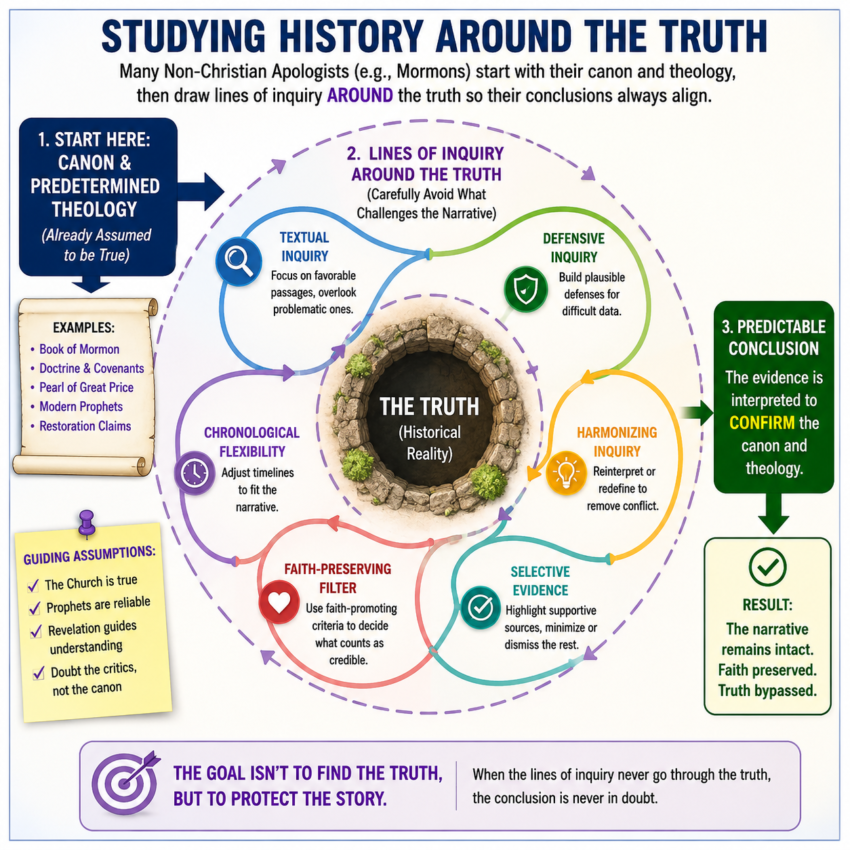
Drawing Lines Around the Truth: How Latter-day Saint Apologetic Method
Predetermines Its Conclusions on Early Christian History and the Great Apostasy
❦ ❦ ❦
Introduction: A Compass Set Before the Pencil
Among the rarer pleasures of a long career spent reading apologetic literature is the discovery of an argument that cannot lose. Not an argument that wins on the merits—those are common enough in any tradition that takes its claims seriously—but an argument that has been constructed in such a way that no possible evidence could ever count against it. Such an argument is not, properly speaking, a piece of historical reasoning at all. It is a piece of architecture. The conclusion has already been laid down as a foundation stone, and every subsequent inquiry is shaped to fit the floor plan.
This essay is concerned with one such architecture: the body of Latter-day Saint apologetic writing on the early Christian church and the doctrine of the Great Apostasy. The argument is not that Latter-day Saint scholars are dishonest, nor that they are unintelligent. Many are deeply learned, and the best of them—Hugh Nibley in his prime, John Gee, Daniel C. Peterson, Robert L. Millet, Noel B. Reynolds, the contributors to the BYU Religious Studies Center—write with a seriousness and a command of sources that any traditional Christian apologist would do well to emulate. The argument, rather, is that the method by which the LDS apologetic enterprise approaches early Christian sources has been designed—often consciously, sometimes not—to draw its lines around the truth rather than through it. The conclusion (that a universal apostasy occurred and that a restoration was therefore required) is treated as a fixed point. The historical, biblical, and patristic evidence is then surveyed for whatever can be made to converge on that fixed point. Anything that will not converge is reclassified, contextualized, softened, or quietly set aside.
This is not a charge brought from outside the Latter-day Saint tradition only. Latter-day Saint scholars themselves have, in moments of unusual candor, admitted as much. The Foundation for Apologetic Information and Research (FAIR), the Maxwell Institute, BYU Studies, the Religious Studies Center at Brigham Young University, and the Interpreter Foundation each produce work of varying technical sophistication, and the better among them is well worth reading. But the work is, by its own description, apologetic—that is, it begins from the assumption that the Latter-day Saint claim is true, and it labors to render that claim defensible. The discipline does not pretend otherwise.
The traditional Christian who engages this body of literature must therefore do two things at once. First, he must read it generously, on the assumption that the writers mean what they say and believe what they write. Second, he must read it carefully, on the assumption that the method itself, however earnest its practitioners, produces predictable distortions of the historical record. This essay attempts both, and uses several specific cases—the FAIR working definition of “anti-Mormonism,” a catalog of recurring logical fallacies, the patristic parallels argument, John Gee’s Ten Views on the Falling Away, Robert L. Millet’s Reflections on Apostasy and Restoration, and the curious deployment of a fourteen-year-old’s testimony as a theological diagnosis—to show how the architecture is built and where its load-bearing walls give way.
The Method, Stated Plainly
Latter-day Saint apologetics, as practiced by its leading institutions, operates from a stated methodological commitment. The FAIR position paper LDS Apologetics 101 describes the discipline in terms that the discipline itself would not contest: apologetics exists, in the words of Scott Gordon, to “provide reasonable arguments to supposed Mormon difficulties so that a conclusive decision of the truth of Mormonism can be determined by the Spirit.” Argumentation, in other words, is not the proper instrument for concluding. It clears away rational obstacles so that the conclusion—already secured by other means—may be received without rational resistance. Austin Farrer’s much-quoted line is invoked: “Though argument does not create conviction, lack of it destroys belief. What seems to be proved may not be embraced, but what no one shows the ability to defend is quickly abandoned.”
This is a respectable position, and it has analogues throughout the history of Christian apologetics. C. S. Lewis, whom FAIR frequently cites, held something close to it. The difficulty arises not from the position itself, but from what happens when this disposition is brought to bear on historical questions. A historian’s question is open by definition: what happened, and how do we know? An apologist’s question is closed at one end: granted that X is true, how shall we read the evidence so as not to contradict it? When the two postures are merged—when the apologist styles himself a historian and produces work for academic publication—the result is a hybrid that reads like history but cannot function as history, because it cannot, in principle, follow the evidence where the evidence leads. The Christian Research Institute has put the point bluntly:
Many apologists begin with the assumption that the Book of Mormon is historical and that Joseph Smith was a prophet, then look for data that fits this framework.
— Christian Research Institute, “LDS Apologetics and the Battle for Mormon History”
The point can be sharpened. In any genuine historical inquiry, the investigator must specify in advance what kind of evidence would falsify the hypothesis. A historian who claims that Caesar crossed the Rubicon in 49 BC can specify the kinds of evidence—contemporaneous letters placing him elsewhere, archaeological dating placing the Roman camp at a different latitude—that would force him to retract. Latter-day Saint apologetic writing on the Great Apostasy rarely specifies any such test. There is no admitted set of facts which, if discovered, would compel the apologist to conclude that no apostasy occurred. The doctrine is, in the strict philosophical sense, unfalsifiable—and to be unfalsifiable is to be, in any rigorous historical sense, untestable. That is the architecture. The remainder of this essay walks through its rooms.
“I Know It When I See It”: The FAIR Definition of Anti-Mormonism
One of the more revealing artifacts of LDS apologetic culture is the working definition of “anti-Mormonism” supplied by Scott Gordon at the 2003 FAIR Conference. The passage deserves quotation in full, since its rhetorical posture is instructive in itself.
Are all critics “anti-Mormons”? The answer is no. There are responsible critics who disagree with Church doctrine. I don’t think that the term “anti-Mormon” should apply to all those who disagree with us. How then is “anti-Mormonism” defined? As Justice Potter Stewart once said about attempts to define pornography, “I know it when I see it.”
— Scott Gordon, “LDS Apologetics 101,” FAIR Conference, August 2003
The opening sentence is a concession of admirable spirit. The closing sentence retracts it. What is offered with one hand—the recognition that not every critic is an enemy of the faith—is taken back with the other, because the operative definition of the enemy is left wholly to subjective recognition. “I know it when I see it” is, of course, the most famous formulation in modern American jurisprudence of an admittedly arbitrary standard. Justice Stewart, in Jacobellis v. Ohio (1964), used the phrase precisely to confess that he could not articulate a principled definition of hard-core pornography but felt himself competent to identify it by sight. To borrow that confession as the working definition of “anti-Mormonism” is to admit, in advance, that the category will be applied without principle.
This matters because the category does enormous rhetorical work in LDS discourse. Members are routinely warned away from materials labeled “anti-Mormon.” Apologetic responses are routinely framed as defenses against “anti-Mormon” attacks. Critical scholarship—including, on occasion, the critical scholarship of practicing Latter-day Saints—is routinely classified as “anti-Mormon” and thereby placed outside the bounds of legitimate engagement. The MormonThink editors have documented the pattern with characteristic understatement: “The LDS Church is very selective about the information it shares with its members—anything that is not faith-promoting is deemed ‘anti-Mormon,’ which immediately shuts down questioning from members.”
The consequences are not theoretical. Once a category is governed by intuitive recognition rather than articulable criteria, three things follow. First, the category will expand to fit the convenience of the user. Second, it will contract to protect favored allies. Third, it will become, functionally, a genetic fallacy—a rhetorical device for disqualifying an argument by reference to the supposed character of the arguer rather than to the substance of the argument. Bill McKeever of Mormonism Research Ministry has documented, over more than four decades, dozens of cases in which careful, scholarly, source-based critiques of LDS history and doctrine have been dismissed not on their merits but by application of the “anti-Mormon” label.
Note, too, the asymmetry built into the definition. The faithful apologist is permitted to be passionate, polemical, even “shrill”—the word is from the journalists Richard and Joan Ostling describing the rhetorical posture of FARMS in Mormon America—without forfeiting his standing as a scholar. The critic, however passionate, polemical, or shrill, and however well-sourced, is liable at any moment to be reclassified as an “anti-Mormon” by an apologist who has only to consult his own intuition. The Ostlings put the asymmetry without ornament: “All too often, Saints use the label ‘anti-Mormon’ as a tactic to forestall serious discussion.” John-Charles Duffy, writing in Sunstone, observed of certain FAIR and FARMS authors that their work “can be unabashedly aggressive: scornful, peremptory, propelled by hostile emotion.” The aggression is permitted; the response to the aggression, by the working FAIR definition, is at the apologist’s discretion to label.
There is a further, and graver, problem. The Potter Stewart standard concedes—without quite saying so—that the apologist does not, in the end, expect the category to be defined. It is to be felt. This is consistent with the larger apologetic move, in which the conclusion is held by spiritual witness, and the arguments are constructed downstream of that witness. But when the conclusion is felt, and the category of those who dispute the conclusion is also felt, the entire epistemic apparatus collapses into a closed circuit. Inside the circuit, every datum confirms the conclusion; outside the circuit, every objection is the work of an “anti-Mormon.” There is no door.
It is worth pausing on the religious dimension. The Apostle Peter’s charge in 1 Peter 3:15—“be ready always to give an answer to every man that asketh you a reason of the hope that is in you, with meekness and fear“—presumes that the answer can be given. It presumes that the hope can be defended in language a sincere inquirer might recognize as honest. The Potter Stewart standard, applied to the inquirers themselves, makes such an answer impossible to deliver, because the inquirer’s status as a sincere inquirer is itself subject to the apologist’s intuitive veto. The very text from which LDS apologetics derives the Greek term apologia forbids the rhetorical posture that has come to define it. That is no small irony.
❦ ❦ ❦
Religious Logical Fallacies in LDS Apologetic Method
It is one thing to say that LDS apologetics begins from its conclusion. It is another to identify, by name, the specific fallacies that proceed from that starting point. The following are not invented for this essay. Each is a recognized informal fallacy in the standard literature on logic, and each appears with sufficient frequency in LDS apologetic writing to warrant individual treatment. The intent is not to mock—every apologetic tradition, including evangelical Protestantism, is liable to such errors—but to identify them clearly enough that careful readers, Latter-day Saint and traditional Christian alike, can recognize them when they appear.
1. Begging the Question (Petitio Principii)
The classic form of this fallacy is to assume in the premises what one is attempting to prove in the conclusion. In LDS apologetic writing on the Great Apostasy, the form is almost ritualized. The argument begins from the premise that the priesthood authority was withdrawn after the death of the original apostles. It surveys early Christian history and finds—unsurprisingly—that the post-apostolic church developed in ways that differed from the Latter-day Saint understanding of the apostolic original. It concludes that priesthood authority was, indeed, withdrawn. The premise and the conclusion are the same proposition stated twice. The intervening historical material does no logical work; it merely furnishes illustrations.
A concrete example: when LDS writers cite the rise of episcopal authority in the second century as “evidence” of apostasy, the move presupposes that episcopal authority was not part of the apostolic deposit. But that is the very point in dispute. Traditional Christians—Catholic, Orthodox, and most Protestants—regard episcopal authority as the apostolic deposit, descending in unbroken succession from the apostles themselves. To call its emergence “apostasy” is to assume the LDS view of what authority looked like in the apostolic age. The historical data does not prove the apostasy; the historical data is read through the assumption of apostasy and then offered as proof.
2. A Sneaky Logic Trick
There is a common mistake in reasoning that looks like this:
“If it rained, the sidewalk would be wet.”
“The sidewalk IS wet.”
“Therefore, it rained.”
Can you spot the problem? The sidewalk could be wet for lots of other reasons — maybe someone ran a sprinkler, or spilled a bucket of water. Just because the sidewalk is wet doesn’t prove it rained. This logic mistake has a fancy name: affirming the consequent. It means you see the result you expected and automatically assume your cause must be right, even though other causes could explain the same result.
How This Applies to LDS Arguments:
Some LDS writers make this exact mistake when they look at very early Christian writings — texts written by church leaders in the first few centuries after Jesus. Their argument goes like this:
“If the LDS Church is the restored true church, then we’d expect to find ideas in early Christian writings that sound like LDS teachings.”
“Hey, look! Some early Christian writings DO sound a little like LDS teachings!”
“Therefore, the LDS Church must be the restored true church!”
But wait — just like the wet sidewalk, there are many other explanations for what they found.
Why the Argument Doesn’t Hold Up:
Misreading the texts: The early Christian writings are old, complex, and written in Greek or Latin. It’s easy to pull out a sentence and make it sound like something it doesn’t actually mean.
Same words, different meanings: Early Christians used words like “salvation,” “eternal life,” and “glory” all the time — but they didn’t mean the same things by those words that LDS theology means today.
Fringe ideas, not mainstream ones: Sometimes what looks like an LDS-sounding idea was actually the odd opinion of one writer that the broader church rejected, not something the church as a whole ever taught.
Rejected as heresy: In some cases, the ideas that sound most like LDS doctrine are precisely the ones the early church officially voted down and called false teaching.
The Bottom Line:
This argument only works if you already believe the LDS Church is true before you start looking. If you start with that assumption, then of course anything that vaguely resembles LDS teaching looks like “evidence.” But good reasoning doesn’t work that way. Finding a wet sidewalk doesn’t prove it rained — and finding an early Christian quote that sounds a little LDS doesn’t prove the Restoration happened.
3. The No True Scotsman Maneuver
The fallacy takes its name from Antony Flew’s example: a Scotsman insists that no Scotsman puts sugar in his porridge; informed of a Scotsman who does, he replies that no true Scotsman puts sugar in his porridge. The form is to immunize a generalization against counterexamples by redefining the relevant category. The LDS apologetic version: the church Christ established necessarily included Latter-day Saint distinctives (priesthood organization on the Aaronic-Melchizedek model, temple endowment, plural marriage in certain dispensations, eternal progression to godhood). When confronted with the historical fact that the post-apostolic church manifestly did not include these distinctives, the apologist replies that the post-apostolic church was not, then, the true church—it had apostatized. The historical Christian church is excluded from the category of “the true church” by definition, regardless of the evidence of its continuity, its martyrs, its councils, its scriptures, or its preservation of apostolic teaching.
4. Equivocation
Equivocation is the use of a term in two different senses within the same argument. The LDS apologetic literature on the Great Apostasy equivocates persistently on the word “apostasy” itself. In strong contexts—missionary lessons, the older sermons of Brigham Young and John Taylor, the writings of B. H. Roberts and James Talmage—the word means total, universal, catastrophic. “Nothing less than a complete apostasy from the Christian religion,” wrote Roberts in his preface to History of the Church, “would warrant the establishment of the Church of Jesus Christ of Latter-day Saints.” In weak contexts—contemporary interfaith dialogue, the recent work of Alexander Morrison, Matthew Bowman, and Robert Millet—the word means a gradual, partial drift, with much truth preserved. When traditional Christians point out that the historical record does not support the strong version, LDS apologists retreat to the weak version. When traditional Christians point out that the weak version does not justify the founding of a new church, LDS apologists advance the strong version. The two versions are never permitted to confront each other directly, because they cannot both be true.
5. The Genetic Fallacy
This fallacy dismisses an argument by reference to its source rather than its substance. The FAIR “anti-Mormon” classification, examined above, is its institutional form. Its sub-forms include the dismissal of nineteenth-century sources as “sectarian,” the dismissal of twentieth-century evangelical scholarship as “heresiological,” and the dismissal of post-Mormon scholarship as “bitter.” The substance of the argument is not engaged. The source is contaminated; the argument is therefore set aside. By the same logic, no Latter-day Saint apologetic argument would survive, since all are produced by sources committed to the conclusion they defend.
6. The Red Herring
A red herring is a deliberate or unintended diversion: a strongly scented argument introduced to lead the inquiry off the trail of the original question. Religious red herrings are common across traditions, but the LDS apologetic literature on the apostasy has elevated certain of them to convention. When pressed on whether the universal apostasy is consistent with Christ’s promise in Matthew 16:18 that “the gates of hell shall not prevail against” his church, the apologist may divert to the meaning of “the gates of Hades” (it is said to mean the spirit world, from which the spirits of the apostles would be released); when pressed on the implausibility of every Christian everywhere abandoning the faith within a few decades, the apologist may divert to the existence of the Three Nephites and the Apostle John, who, it is said, did not die; when pressed on the historical continuity of the apostolic succession, the apologist may divert to the corruption of individual medieval bishops. In each case, the strong scent of a peripheral question draws the inquiry off the central one. We will examine a particularly elegant specimen in Robert L. Millet’s Reflections on Apostasy and Restoration below.
7. Confirmation Bias as Method
Confirmation bias is not, strictly, a logical fallacy. It is a cognitive disposition: the tendency to seek and weigh evidence that supports a held belief and to ignore or discount evidence that contradicts it. What distinguishes the LDS apologetic literature is that confirmation bias has been formalized as a method. The Maxwell Institute (formerly FARMS), the Religious Studies Center, and the Interpreter Foundation each publish work that scours antiquity, often with great learning, for whatever may be assembled into a parallel with Latter-day Saint doctrine. The work is genuine; the parallels, taken individually, are sometimes genuine. But no comparable institutional effort is made to scour antiquity for evidence against Latter-day Saint distinctives. The asymmetry is structural. A method that systematically seeks confirmation and systematically ignores disconfirmation does not, in the end, produce history. It produces a litany.
❦ ❦ ❦
Patristic Parallels: Finding What One Came to Find
Few features of contemporary LDS apologetic literature are more visible, or more vulnerable, than the patristic parallels argument. The form is straightforward: an apologist surveys the writings of the early church fathers—Justin Martyr, Irenaeus, Clement of Alexandria, Origen, Athanasius, occasionally as far as Augustine—and identifies passages that, when extracted and translated, resemble distinctively Latter-day Saint doctrines. The catalog typically includes premortal existence, divine embodiment, theosis (the deification of the believer), baptism for the dead, secret prayer circles thought to anticipate the temple endowment, and a divine council of multiple gods. Each parallel is presented as a remnant of authentic apostolic teaching that survived the Great Apostasy in attenuated form before being recovered, in fullness, by Joseph Smith.
The method has been pursued with particular energy in the writings of Hugh Nibley, Daniel C. Peterson, David L. Paulsen, Barry Bickmore, John Gee, and the contributors to the Maxwell Institute’s Mormonism and Early Christianity series. It is the institutional core of what FAIR calls “Apologetics 2.0”—a more academically sophisticated successor to the older, more openly polemical Mormonism of the nineteenth and early twentieth centuries. The work is, in its own terms, often impressive. The difficulty is that it almost uniformly violates four basic rules of historical and theological method.
Rule One: Read the Father in His Own Theological World
A patristic text means what it means in the context of the entire theological output of its author and the council-shaped tradition within which he wrote. A two-line extract divorced from that context can be made to mean almost anything. The most-cited example is the famous formulation of Athanasius: “For he was made man that we might be made God.” Latter-day Saint apologists routinely cite this as evidence that the early church taught the doctrine of human exaltation to godhood in the Latter-day Saint sense. But Athanasius’s On the Incarnation, from which the line is drawn, devotes its entire fifty-four chapters to the proposition that there is one God, eternal and uncreated, and that the Son shares fully and uniquely in that one divine essence by eternal generation, not by elevation from a prior creaturely state. The deification Athanasius describes is participation, by grace, in the divine life through union with the incarnate Word. It is not, and cannot be, the becoming of additional gods of the same ontological order as the Father. Christian Research Institute scholar Robert Bowman has documented the pattern at length:
The writings of such men as Justin Martyr, Irenaeus, Clement of Alexandria, and Athanasius have played an ongoing, continuous role in theological studies and reflection throughout church history. We are not talking here about long-lost writings… We are talking about the writings of men whose writings have never stopped circulating and that have been cited, quoted, and discussed in every generation from their own time to the present. Moreover, the specific patristic idea of deification was never lost in any sense.
— Robert Bowman, “The Mormon Doctrine of Becoming Gods,” Institute for Religious Research
The doctrine of theosis, in its patristic sense, is alive and well in the Eastern Orthodox tradition. It has not been lost and does not need to be restored. The Latter-day Saint doctrine of exaltation—of becoming a god of the same kind as the Father, with eternal progression, the procreation of spirit children, and the inheritance of one’s own planetary domain—is something quite different, and is no part of the patristic tradition the apologists invoke.
Rule Two: Distinguish Speculation from Doctrine
Origen of Alexandria, the third-century theologian most frequently mined for Latter-day Saint parallels, offers a useful test case. Origen did speculate, in De Principiis, about the preexistence of souls. He also speculated about universal restoration (apokatastasis), the post-mortem rehabilitation of demons, and the eventual salvation of Satan. Latter-day Saint apologists are pleased to cite the first speculation as evidence of an ancient doctrine of premortal existence parallel to their own. They are markedly less pleased to acknowledge that Origen’s other speculations were condemned by the Fifth Ecumenical Council in 553 AD as heretical, that his preexistence doctrine was not, at any point, the consensus position of the church, and that the council that condemned the doctrine did not have to invent its rejection—it simply followed what the broader church had always taught. The Latter-day Saint apologist’s selective reception of Origen reproduces the same patristic refuse-pile excavation that the Christian Research Institute identified more than two decades ago, in which apologists pick over the works the early church rejected and present the rejections as recoveries.
Rule Three: Beware the Anachronistic Reading
Anachronism is the cardinal sin of historical scholarship. The LDS patristic parallels literature commits it routinely. When Tertullian writes that the Father is corporeal (corpus), he is using a Stoic philosophical vocabulary in which corpus denotes any substantial reality, including spirit. He is not asserting that God has hands and feet of flesh and bone in the Joseph Smith sense. When the Shepherd of Hermas describes pre-existent souls or angelic counsels, it is using imagery drawn from Second Temple Jewish apocalyptic literature, not anticipating the LDS doctrine of spirit children begotten by a Heavenly Father and Mother. When Clement of Alexandria speaks of secret traditions and progressive enlightenment, he is describing the catechumenate’s graduated instruction in the mysteries of the faith, not the LDS temple endowment with its washings, anointings, and signs. To extract such passages and read them through the lens of nineteenth-century Nauvoo theology is not historical exegesis. It is ventriloquism.
Rule Four: Be Willing to Lose
This is the rule the apologetic method most consistently violates. A historian, in principle, must be willing to find that his hypothesis is wrong. The LDS apologist working in patristics is structurally unwilling to find this. The patristic literature can confirm; it cannot disconfirm. When the fathers say something that resembles a Latter-day Saint distinctive, they are remnants of true doctrine. When the fathers say something that contradicts a Latter-day Saint distinctive—say, the relentless monotheism of Athanasius and the Cappadocians, or the rejection of preexistence as Origenist heresy—they are evidence of the apostasy in progress. The same evidence cannot do both kinds of work in the same argument, but the method requires that it do so. The Mormon Dialogue board pinpointed this years ago: “Critics argue that apologists often find ‘parallels’ by taking quotes out of context—for example, citing early Christians who spoke of God becoming man, which actually refers to the incarnation, not human eternal progression to godhood.”
None of this is to say that the LDS apologists are insincere. The conviction is real, and the labor is often genuinely impressive. But labor does not make a method valid. A method that cannot, in principle, recognize disconfirming evidence has ceased to be historical. It has become a system for arranging evidence around a fixed centerpiece. And that brings us to the most refined contemporary specimen of the method: John Gee’s Ten Views on the Falling Away.
❦ ❦ ❦
A Closer Look at “Ten Views on the Falling Away”
John Gee, the William (Bill) Gay Research Professor at the Maxwell Institute, published “Ten Views on the Falling Away” in BYU Studies in 2024. The article surveys, as its title suggests, ten interpretations of the New Testament term apostasia (2 Thessalonians 2:3), the word the King James translators rendered as “falling away.” Gee surveys the Greek and Hebrew lexical background, the Septuagint usage, the patristic reception, and the rabbinic and modern readings. The article is competent, careful, and exemplary of what FAIR has called “Apologetics 2.0.”
Article: https://byustudies.byu.edu/article/ten-views-on-the-falling-away
It is also, on careful reading, a case study in the method this essay has been describing. Gee surveys ten views; nine of them are surveyed for the purpose of demonstrating their inadequacy; the tenth, naturally, is the Latter-day Saint view, which emerges from the survey as the position that best accounts for the data. This is not, in itself, an objection. Every author of every survey article tends to end with the conclusion he came in with. The objection lies in what Gee’s survey omits, and how it weights what it includes.
Three observations are decisive.
First, Gee’s survey treats the Latter-day Saint view as the obvious meaning of 2 Thessalonians 2:3 within a framework supplied entirely by Latter-day Saint scripture. The article cites Joseph Smith’s letter (D&C 128:9) on the cycling of priesthood dispensations as a hermeneutical key for reading Paul. It cites the 2020 First Presidency proclamation as a confirming authority. It cites the Doctrine and Covenants and the Book of Mormon as if their treatment of the apostasy were exegetical of Paul rather than dependent upon a particular reading of Paul. This is, structurally, a closed loop. The Latter-day Saint scriptures are used to interpret the New Testament; the resulting interpretation of the New Testament is then offered as evidence for the truth of the Latter-day Saint scriptures. The reader is not told, but should know, that this is the procedure.
Second, the article does not seriously engage the position that has dominated Christian exegesis of 2 Thessalonians 2:3 from the patristic period through the Reformation to the present day: that the apostasia Paul prophesies is the eschatological rebellion immediately preceding the revelation of “the man of lawlessness” (verses 3-4), an event still future from Paul’s standpoint and—on most readings—future even from ours. On this view, the “falling away” is not the institutional collapse of the post-apostolic church but a final apostasy at the close of the age. The view has the merit of taking Paul’s grammar and immediate context seriously. It has the merit of being the unanimous reading of the early Greek and Latin fathers, including Irenaeus, Tertullian, Cyprian, John Chrysostom, Augustine, and Jerome. Gee acknowledges the view in passing but does not engage its strongest defenders or its strongest exegetical arguments. The reader of his article would be excused for assuming the view to be marginal. It is not.
Third, Gee’s article concludes with a remarkable claim: “Prophets and apostles had foretold the falling away (see 2 Thessalonians 2:1–3). They had also foretold that the gospel and Church of Jesus Christ would be restored to the earth (see Acts 3:20–21). If there had not been a falling away, a restoration would not have been needed.” The logic of the final sentence is worth examining. It is structurally identical to the argument B. H. Roberts made in his 1900 preface to History of the Church: “Nothing less than a complete apostasy from the Christian religion would warrant the establishment of the Church of Jesus Christ of Latter-day Saints.” In other words, the existence of the restored church requires that there have been an apostasy; therefore, there was an apostasy. The need for a restoration is presented as evidence that a restoration occurred. The argument is unanswerable because it cannot be refuted; it is also, by the same token, empty of historical content. It establishes that the LDS theological system requires the apostasy. It does not establish that the apostasy occurred.
The traditional Christian, reading Gee with the respect his learning deserves, will close the article with the impression of a learned survey conducted within a closed system. The system’s premises generate the system’s conclusions. The historical material, however carefully presented, does not enter as a genuine variable. It enters as a chorus.
❦ ❦ ❦
Robert L. Millet’s “Reflections” and the Red Herring of Reasonableness
If John Gee represents the technical face of contemporary LDS apologetic scholarship, Robert L. Millet represents its pastoral and irenic face. Millet, emeritus dean of religious education at BYU, has spent two decades cultivating dialogue with evangelical Protestants—Richard Mouw at Fuller Seminary, Greg Johnson, and others. His essay “Reflections on Apostasy and Restoration,” published in the Religious Studies Center volume No Weapon Shall Prosper (2011) and still widely circulated, is the most genial statement of the modern apostasy doctrine in print. It is also a textbook specimen of the religious red herring as defined in the standard literature on informal fallacies: a diversionary tactic that distracts from the core issue by introducing irrelevant, emotionally charged, or tangential information.
Article: https://rsc.byu.edu/no-weapon-shall-prosper/reflections-apostasy-restoration
The essay opens with a moment of professional embarrassment. A faculty member at an eastern university tells Millet, after a fifty-minute presentation, that he has “great difficulty taking seriously any religious group that dismisses out of hand two thousand years of Christian history.” The remainder of Millet’s essay is, in effect, an attempt to answer that interlocutor. Millet’s procedure is to walk through what the phrase “the only true and living church” (D&C 1:30) does not mean—five propositions—before stating what it does mean. The five denials are unimpeachably generous. The Latter-day Saint church does not, Millet says, hold that other Christians are insincere, that other Christian doctrines are all false, that the Bible is unreliable, that God disapproves of other Christian work, or that Latter-day Saints wish to do their own thing. The reader closes those five paragraphs with the warm impression that he has been listening to a thoughtful, ecumenical, humble servant of God whose church has been badly misunderstood.
Then the affirmative claims arrive. The Latter-day Saint church is the only true and living church. Doctrinal finality rests with apostles and prophets, not theologians or scholars. The creeds spoken of in Joseph Smith’s First Vision are abominations. The post-apostolic church lacked priesthood authority for saving ordinances. Joseph Smith’s mission was “to restore, rather than reform.” The affirmations are not softened; they are, if anything, sharper for having been delivered after the irenic preface. Millet quotes Gordon B. Hinckley with approval: “The Lord said that this is the only true and living Church upon the face of the earth with which He is well-pleased. I didn’t say that. Those are His words… But they are hard words for those of other faiths. We don’t need to exploit them.”
The rhetorical structure is the red herring made systematic. The strongly scented material—the five concessions to other Christians—leads the reader off the trail of the question the eastern faculty member actually asked. He did not ask whether the LDS church regards other Christians as sincere. He asked whether the LDS church dismisses two thousand years of Christian history out of hand. The five concessions do not answer that question. They displace it. By the time the reader reaches the affirmative claims, the question that prompted the essay has been forgotten.
Consider Millet’s third denial: “It does not mean that the Bible has been so corrupted that it cannot be relied upon to teach us sound doctrine and provide an example of how to live.” This is true; the LDS church does not teach biblical corruption in the strong sense. But the essay’s affirmation that “there are simply too many ambiguous sections of scripture to let the Bible speak for itself”—offered to justify the need for prophetic interpretation—reverses the implication of the denial. The Bible is reliable, but it cannot, by itself, settle theological questions. Joseph Smith is necessary. The denial functions as a courtesy; the affirmation does the doctrinal work. The reader, however, is left with the courtesy.
Consider the fourth denial: “It does not mean that God disapproves of or rejects all that devoted Christians are teaching or doing.” Millet quotes Ezra Taft Benson, quoting Orson F. Whitney: “Perhaps the Lord needs such men on the outside of His Church to help it along. They are among its auxiliaries.” This is a generous formulation, and Latter-day Saints can fairly point to it as evidence of doctrinal moderation. But “auxiliaries” is not, theologically, a complementary category. Auxiliaries serve the principal. The principal is the only true and living church. Other Christians, however devoted, are accessory personnel in the divine economy. The denial conceals the affirmation; the affirmation reasserts what the denial appeared to surrender.
This is what makes Millet’s essay so worth reading—and so worth reading carefully. The technique is masterful. The reader who is not paying close attention will leave with the impression that the LDS doctrine of apostasy has been substantially softened. The reader who is paying close attention will see that nothing has been softened at all; only the rhetoric has been retuned. The apostasy is still total in its theological function (it justifies the founding of a new church), even when it has been verbally moderated in its historical description. Boyd K. Packer, whom Millet cites, taught that “the line of priesthood authority was broken”—the same strong claim, only without the harsh language of nineteenth-century Mormonism. The conclusion remains; only the manner of stating it has changed.
This is the red herring made institutional: the introduction of irrelevant generosity to distract from a doctrinal claim that has not, in substance, moved. The traditional Christian who engages Millet must therefore do something difficult. He must accept Millet’s denials as offered, in good faith. And he must, at the same time, refuse to allow the denials to displace the question of whether the affirmations are true. The questions are: Did the church Christ founded fall into total apostasy? Was priesthood authority withdrawn? Was a restoration necessary? Millet’s essay does not answer those questions. It diverts from them.
❦ ❦ ❦
A Fourteen-Year-Old’s Theological Diagnosis
The Religious Studies Center essay “A World in Darkness: Early Latter-day Saint Understanding of the Apostasy, 1830–1834,” by Richard E. Bennett and Amber J. Seidel, opens with a remarkable quotation from Joseph Smith himself. It is the foundational autobiographical statement on which the entire apostasy-and-restoration narrative rests:
When about fourteen years of age I began to reflect upon the importance of being prepared for a future state, and upon enquiring [about] the plan of salvation I found that there was a great clash in religious sentiment; if I went to one society they referred me to one plan, and another to another. . . . Considering that all could not be right . . . I determined to investigate the subject more fully.
— Joseph Smith, 1832 history, cited in Bennett & Seidel, “A World in Darkness”
The Latter-day Saint reader is accustomed to receiving this passage as the spiritual awakening of a uniquely sensitive boy. The traditional Christian reader, reading the passage at the speed at which it was written, encounters a problem the apologetic literature does not, in my experience, address: a fourteen-year-old, in 1820 rural western New York, is being credited with reaching a theological judgment that the entire post-apostolic Christian tradition—Athanasius, Augustine, Anselm, Aquinas, Luther, Calvin, Edwards, Wesley—either failed to reach or actively contradicted. He inspected “religious sentiment” at the level available to a frontier adolescent with limited formal education; he found that the available denominations contradicted one another on points of doctrine; he concluded, in essence, that none of them could be right; and from that conclusion (the LDS narrative now adds) he began the inquiry that would yield, by 1830, a new dispensation of the everlasting gospel, the restoration of priesthood authority, and the founding of the only true and living church on the face of the earth.
The question I wish to raise is not whether Joseph Smith was sincere at fourteen. He probably was. The question is whether sincerity at fourteen constitutes evidence. Fourteen-year-olds are notoriously sincere, and notoriously wrong, about a great range of subjects. They are at an age of intense religious feeling and limited critical perspective. They have not yet had the experience of changing their minds in the face of evidence they failed to consider. They lack, by the developmental nature of the case, the broad and slow exposure to historical theology that would equip them to evaluate the claims of competing Christian traditions. To say this is not to demean the boy; it is to describe a fact about human cognitive development that has been documented across every culture in which adolescence has been studied.
The “Young Founder” Problem:
Perhaps the closest modern analogy is the teenager who starts a movement, business, or ideology based on intense personal conviction — only to revise or abandon it dramatically in adulthood. Numerous young people have launched religious splinter groups, online ideological movements, or cults of personality in their mid-teens, driven by the same combination of sincerity and cognitive inexperience this text describes. The sincerity is never in doubt. The critical apparatus simply isn’t there yet.
Adolescent Political and Ideological Certainty:
Fourteen-year-olds routinely become passionate converts to radical political ideologies — whether far-left or far-right — often with the absolute certainty that everyone who came before them had the essential thing wrong. Researchers in adolescent development note that the prefrontal cortex, which governs long-term judgment, weighing of competing evidence, and recognition of complexity, is not fully developed until the mid-twenties. The intensity of conviction a teenager feels is neurologically real — but it is not epistemologically reliable. The same brain that makes adolescence a period of powerful spiritual awakening also makes it a period of poor risk assessment and overconfident conclusion-drawing.
Deconversion and Reconversion Stories:
A useful modern mirror is the large population of adults who report having been certain of a sweeping religious conclusion at fourteen — whether a dramatic conversion, a dramatic deconversion, or a dramatic switching of traditions — and who later, with more exposure to history, theology, and life experience, revised that conclusion significantly. Their earlier sincerity was never in question. What changed was their access to evidence they had not yet encountered. This is precisely the developmental phenomenon this segment describes: fourteen-year-olds “have not yet had the experience of changing their minds in the face of evidence they failed to consider.”
The Cognitive Science Behind It:
This is not merely anecdotal. Developmental psychologists following the frameworks of Piaget and James Fowler’s stages of faith development have documented that early adolescence is characterized by what Fowler called Synthetic-Conventional faith — a stage in which beliefs are powerfully held but largely unexamined, absorbed from the surrounding environment and felt as self-evident rather than critically tested. The capacity for what Fowler called Individuative-Reflective faith — the ability to step outside one’s inherited framework and evaluate it critically — typically does not emerge until late adolescence or early adulthood at the earliest. Joseph, at fourteen, was, by every developmental measure, operating squarely in the earlier stage.
A Direct Analogy Worth Using:
Consider this: if a fourteen-year-old today attended three different churches, heard the pastors disagree about baptism, eternal security, and the Lord’s Supper, and concluded that therefore all of Christianity was corrupt and God was about to commission him personally to restore the true church — we would not treat that conclusion as evidence. We would recognize it as the sincere but unequipped response of an adolescent mind encountering theological complexity for the first time. The LDS claim is that this specific instance should be treated differently — not because the reasoning is stronger, but because of what allegedly happened next.
It should also be noted that Joseph Smith apparently did not consult the Bible already present in his household before reaching his sweeping theological conclusions. The King James Version was the standard Scripture of the Smith family and of virtually every Protestant household in early nineteenth-century America. A careful engagement with that text alone — without any formal theological training — would have surfaced the very passages that centuries of Christian thinkers had wrestled with on questions of salvation, ecclesiology, and apostolic authority.
Now consider the theological scope of the judgment Joseph is credited with reaching. He concluded that the Methodists, Presbyterians, Baptists, Episcopalians, Lutherans, Catholics, and Orthodox communions of his region were all in some essential way mistaken about “the plan of salvation.” He concluded this not after any formal theological education, comparative reading in Augustine and Aquinas and Calvin and Wesley, sustained engagement with the Greek New Testament, mastery of Hebrew, immersion in patristic literature, or seminary instruction in systematic theology. He concluded it after observing that the local ministers disagreed with one another on points of denominational distinctiveness.
What makes it more than an adolescent observation is what comes next: the LDS narrative loads it with the weight of a divine commissioning. And yet even the Bible Joseph reportedly did read — the very text that prompted him, according to LDS accounts, to pray in the grove — contained within it a robust and coherent “plan of salvation” that had informed Christian theology for nearly two millennia. The tradition he dismissed as hopelessly corrupt had been carefully building, debating, and refining its understanding of grace, atonement, justification, and sanctification from the apostolic era forward. That Joseph neither engaged that tradition seriously nor apparently searched the Scriptures already at hand before pronouncing all existing communions in error is not a minor detail. It is a telling one — and it becomes more telling still when one observes that the movement he founded to replace those quarreling denominations promptly generated its own quarrels. Within decades of the church’s 1830 founding, over a hundred independent splinter groups had broken away, fracturing over precisely the kinds of disputes Joseph had cited as proof of everyone else’s corruption: conflicts over leadership succession, doctrinal authority, and the binding nature of controversial new teachings such as plural marriage. The disagreement Joseph witnessed among Methodists, Presbyterians, and Baptists was, it turned out, not a unique symptom of apostasy. It was a feature of any human religious institution, including his own.
This is, in apologetic terms, a strange foundation on which to construct the doctrine that two thousand years of Christian history fell into universal apostasy. The argument is essentially this: a sincere fourteen-year-old in upstate New York observed that the local denominations disagreed with each other; therefore, the post-apostolic church had been in catastrophic spiritual collapse for nineteen centuries. The leap from premise to conclusion is breathtaking. It would be breathtaking for a forty-year-old. For a fourteen-year-old, it is structurally impossible. He has not lived long enough, read widely enough, or experienced enough of theological dispute to be in any position to make the judgment the narrative requires him to have made. And the subsequent history of his own movement quietly confirms it. If doctrinal disagreement among sincere believers is evidence of divine abandonment, Mormonism condemned itself by the same standard within a single generation of its founding.
The traditional Christian response is not to mock the boy. It is to insist that the doctrinal weight placed on his testimony must be proportional to the testimony’s actual evidentiary value. Sincere religious feeling at fourteen is real, and worth respecting, and is no basis for overturning the church the apostles founded. The First Vision narrative may be defended on theological grounds—on the basis, say, of subsequent revelation—but it cannot be defended based on the fourteen-year-old’s diagnostic competence. He had none. No fourteen-year-old does.
And yet the LDS literature continues to cite the passage as if it were exegetical. Bennett and Seidel use it as the opening of their academic study of the early apostasy doctrine. Missionary lessons cite it as the spiritual foundation of the Restoration. The Joseph Smith Memorial, Joseph Smith Building, and visitor centers reproduce it on display panels. The boy’s adolescent observation has been carried by an entire institutional apparatus into the role of a theological premise. Removing it from that role would not remove the LDS narrative—the narrative claims later revelations that did not depend on the fourteen-year-old’s competence—but it would expose how much of the popular apologetic energy still flows from a foundation the apologists themselves know cannot bear the load.
❦ ❦ ❦
Errors in the LDS Presentation of the Great Apostasy
The accumulated effect of the apologetic method is, on the doctrine of the Great Apostasy itself, a series of historical and theological errors that have proved remarkably durable. The errors are not all of equal weight, and the better LDS scholars have, in recent decades, conceded some of them. But they remain pervasive in the popular literature, the missionary lessons, and the institutional rhetoric of the church. The traditional Christian critic owes them a clear identification.
Error One: The Contradiction of Matthew 16:18
Our Lord’s promise to Peter—“upon this rock I will build my church; and the gates of hell shall not prevail against it“—is the single most damaging biblical text for the doctrine of universal apostasy. If the church Christ founded fell, on the LDS account, into total apostasy within a few generations of the apostles, then the gates of hell did prevail against it for nearly two thousand years. The promise failed. The LDS apologetic response has been to redefine “the gates of hell” as the gates of Hades, the spirit world from which (it is said) the spirits of the dead would be released at the resurrection. Barry Bickmore advances this reading. Bill McKeever and Eric Johnson of Mormonism Research Ministry have demonstrated that the reading cannot be sustained: the Doctrine and Covenants itself uses “the gates of hell shall not prevail” in the conventional sense of spiritual safety, security, and stability (D&C 10:69; 17:8; 18:5). The LDS scripture contradicts the LDS exegesis.
And the conventional reading—the reading the Greek and Latin fathers, the Reformers, and the modern evangelical and Catholic exegetical traditions all confirm—is that the gates of Hades cannot prevail against Christ’s church. The church, in this promise, is the one Christ founded. It cannot, by his own word, be overcome. To assert that it was overcome is to assert that Christ’s promise failed. Latter-day Saint apologists rarely frame the question that starkly, and never resolve it.
Error Two: The John and Three Nephites Problem
Latter-day Saint scripture teaches that the apostle John did not die (D&C 7:1-3) and that three of the twelve Nephite disciples were granted the same gift (3 Nephi 28:6-9). On the LDS account, these four men have continued to minister on the earth, in some form, from the first century to the present. If they did, the apostolic priesthood was never absent from the earth, and the doctrine of universal apostasy collapses. If they did not, the LDS scriptures are mistaken. The dilemma is real, and the apologetic literature has not resolved it. The usual move is to argue that the four were translated rather than continuing to exercise priesthood authority, or that their ministry was hidden. Neither move satisfies the text, and neither is consistent with the strong language of the older missionary lessons, which describe priesthood authority as having been wholly withdrawn.
Error Three: The Continuity of Faith and Practice
The historical record of the post-apostolic church is not the record of a religious vacuum. It is the record of communities that gathered weekly for the Eucharist, baptized in the name of the Trinity, confessed the Apostles’ and Nicene Creeds, sang the Psalms, read the apostolic writings, suffered martyrdom in the persecutions, fed the poor, established hospitals, preserved the scriptures, evangelized the Germanic peoples, the Slavs, the Ethiopians, the Armenians, the Syriac-speaking peoples of Mesopotamia. To describe this two-millennium witness as a darkness in which “the lights went out” is not historically defensible. Robert Millet himself, in the essay critiqued above, concedes the point in his closing pages: “The view that changes in the early church resulted in the descent of a blanket of stygian darkness over the entire earth such that humankind had no contact with God or the Spirit for nearly two millennia simply doesn’t stand up to the scrutiny of modern scholarship.” The concession is welcome. It is also fatal to the doctrine in its strong form.
Error Four: The Reliance on Outdated Sources
Much of the older LDS literature on the Great Apostasy—Talmage’s The Great Apostasy (1909), B. H. Roberts’s Outlines of Ecclesiastical History (1893)—relies on nineteenth-century Protestant historiography of a kind that has not survived modern patristic scholarship. The portrait of a quasi-uniform “Hellenization” of Christianity, in which Greek philosophy infiltrated and corrupted an originally Hebraic gospel, was the Harnackian thesis of the late nineteenth century. It has been comprehensively revised by the patristic scholarship of the last sixty years, beginning with the work of Jaroslav Pelikan, John Behr, Khaled Anatolios, Lewis Ayres, and Frances Young. The fathers were not naïve consumers of Platonism; they were sophisticated theologians who critically engaged philosophy while retaining a robustly biblical doctrine of God. The LDS apologetic literature has, in some quarters, begun to absorb this revision; in others, it has continued to invoke a Harnackian framework long since abandoned by the patristic guild.
Error Five: The Misinterpretation of “Plain and Precious Things”
First Nephi 13:26-29 prophesies that an apostate “great and abominable church” will remove from the Bible “many parts which are plain and most precious.” This text has been read, in the popular LDS imagination, as a literal allegation that corrupt scribes excised passages from the New Testament. The textual record does not support this reading. The manuscript tradition of the New Testament is one of the best-attested in all of antiquity, with more than 5,800 Greek manuscripts, including substantial papyrus fragments dating to within decades of the originals. The textual variants are real, but they are well-understood, well-cataloged, and substantially without doctrinal significance. There is no manuscript-historical evidence of the kind of systematic doctrinal excision First Nephi requires. Better LDS scholars have moved toward reading “plain and precious things” as referring to a loss of understanding of the biblical covenants rather than to literal textual deletion. This is a more defensible reading. It is not, however, the reading that the popular literature has propagated for a century and a half.
We have examined this claim in greater detail in our essay, “Book of Mormon: The Most Correct Book on Earth — Except for the Doctrines That Aren’t in It.”
🧐Thought Experiment Three: The Conspiracy of Silence
The Great Apostasy demands a silence so total, so perfectly coordinated across every branch of Christianity for eighteen centuries, that it leaves no dissenting voice, no manuscript, no archaeological artifact. Such an erasure defies all historical plausibility. To affirm that the true church vanished from the earth shortly after the apostolic age — taking with it sacred ordinances, priesthood authority, and essential doctrines that would only resurface in nineteenth-century America — requires asserting that every geographical region, every linguistic tradition, every theological school, and every persecuted community of believers participated, knowingly or unknowingly, in a coordinated suppression spanning roughly eighteen hundred years.
The historical record is not silent. It is a roaring archive of disputes, schisms, councils, anathemas, and competing claims. Arians wrote against Athanasians. Nestorians wrote against Cyrillians. Donatists wrote against Catholics. Iconoclasts wrote against iconodules. The Reformers cataloged every perceived corruption Rome had introduced over a thousand years, naming them in painstaking detail. Yet across this cacophony of accusation and counter-accusation, no voice — not one — laments the disappearance of doctrines later claimed to be essential. No bishop, no obscure heretic, no village priest, no dying martyr scrawled on a parchment that the temple endowment had been taken from us, that the plurality of gods had been forgotten, that we no longer baptize for the dead. The Gnostic writings survived. The Ebionite traditions left traces. Even movements ruthlessly persecuted by imperial power left behind enough evidence for modern scholars to reconstruct them in considerable detail. Yet the supposedly lost truths of the original church left nothing — no fragment, no echo, no artifact, no hostile witness, no marginal preservation.
The argument from silence cuts in only one direction here. Ordinarily, an absence of evidence is not evidence of absence. But this is no ordinary absence. This is the absence of any trace whatsoever of doctrines and practices alleged to have been central to Christian worship and salvation. When something genuinely existed and was later suppressed, fragments survive. The supposedly lost truths of the original church left nothing. The honest historian must therefore ask: is it more plausible that an unbroken chorus of believers across eighteen centuries somehow conspired in perfect silence to erase the same truths in the same way without leaving a single trace of dissent, or that those truths were never part of apostolic Christianity to begin with?
The silence is not the residue of a lost faith. The silence is the answer.
❦ ❦ ❦
When the Going Gets Tough: The Softening of the Apostasy Doctrine
A perceptive observer of contemporary LDS literature on the apostasy will notice that the doctrine has shifted significantly over the last forty years. The earlier formulation—total, immediate, catastrophic—is increasingly difficult to find in the church’s official publications. In its place has appeared a more nuanced view, in which the apostasy was gradual rather than sudden, and in which much truth and goodness are conceded to have survived in the post-apostolic church. Alexander B. Morrison’s Turning from Truth: A New Look at the Great Apostasy (2005), Miranda Wilcox and John D. Young’s Standing Apart: Mormon Historical Consciousness and the Concept of Apostasy (2014), and Gregor McHardy’s Eight Myths of the Great Apostasy (2023) represent the new direction. The Salt Lake Tribune summarized the shift in 2023 with the headline “What Latter-day Saints Get Wrong”—a journalistic acknowledgment that the older doctrine had problems even the church itself had begun to admit.
This softening is not, as it might first appear, a doctrinal concession. It is a rhetorical migration. The institutional claim of the LDS church has not changed: priesthood authority was withdrawn, a restoration was necessary, and the LDS church is the only true and living church on the face of the earth. What has changed is the manner of stating the claim. The strong language—the language of B. H. Roberts (“nothing less than a complete apostasy”), James Talmage (priesthood has been broken), Joseph Smith (creeds are an abomination)—has been quietly retired from contemporary apologetic writing. The substance of the claim has been preserved; the offense of the claim has been managed.
This is a familiar pattern in religious traditions that find themselves engaging more directly with the broader culture. Concessions are made at the rhetorical level while the underlying doctrinal commitments are held intact. The Wheat & Tares blog observed in 2025 that the softening has been driven in part by the need for interfaith credibility:
Some scholars argue that, instead of viewing all other Christian denominations as purely apostate, recent perspectives suggest the need for a Restoration arose because the church was incomplete rather than entirely corrupt.
— Wheat & Tares, “The Less Than Great Apostasy,” June 2025
“Incomplete rather than entirely corrupt” is a much easier doctrine to defend than “total apostasy.” It is also a doctrine that, taken seriously, would not require a restoration—it would require a completion. If the historical church was incomplete in certain respects but not corrupt, then what was needed was supplementation, not replacement. The continuing existence of a separate Latter-day Saint church, claiming to be the only true and living church on the face of the earth, is hard to justify on the new formulation. The new formulation is, in this sense, theologically unstable. It cannot be held without forfeiting the strong claim. It cannot be relinquished without forfeiting the credibility of the church’s contemporary witness.
The traditional Christian response to the softening should be appreciative, but cautious. We can welcome the recognition that the historical Christian church has not been a wasteland of darkness. We can welcome the acknowledgment that good men and women have served Christ in every century since the apostles. But we should not allow the rhetorical softening to obscure the doctrinal claim that remains. The LDS church still holds that priesthood authority was withdrawn, that the church Christ founded fell into apostasy, that a restoration was required, and that the restored church is the only true and living church on the face of the earth. Until those claims are withdrawn, the softening is decoration, not reformation.
❦ ❦ ❦
Conclusion: Drawing the Line Through, Not Around
The architecture this essay has surveyed is impressive in its own way. It has produced a substantial body of scholarship, sustained an institutional culture of considerable seriousness, and trained generations of bright young Latter-day Saints in the academic defense of their faith. It has also, by structural necessity, predetermined the conclusions it could reach. A method that begins from a fixed point and surveys evidence for what can be made to converge on that point will, in the end, produce a litany of convergences. It will not produce history.
Traditional Christian engagement with this body of literature must therefore proceed on two tracks. The first is generous attention to the genuine learning of the better LDS scholars. There is real philological, historical, and exegetical work to be found in the pages of BYU Studies, the Journal of Book of Mormon Studies, and the publications of the Religious Studies Center. To ignore that work would be to repeat, in inverted form, the FAIR genetic fallacy. The second track is the steady, patient, source-grounded refusal to allow the architecture to determine our reading of the evidence. Patristic texts mean what they mean within their own theological worlds. Matthew 16:18 says what it says about the inability of the gates of Hades to prevail. The historical post-apostolic church is what the historical record shows it to have been: not a wasteland, not a darkness, not a vacuum, but the costly, faithful, suffering, missionary witness of Christ’s body through the centuries.
The Apostle Peter’s charge in 1 Peter 3:15 remains the anchor of this work, as it has been of every traditional Christian engagement with the Latter-day Saint claim. We are to be ready always to answer every man who asks of us a reason for the hope that is in us, with meekness and fear. The meekness is required; the fear (reverence before God) is required; the answer is required also. To withhold the answer in the name of meekness is to withhold what 1 Peter commands us to give. To answer without meekness is to forfeit the credibility the answer requires. To answer with meekness is to commit oneself to the long work of careful reading, charitable engagement, and unflinching attention to the evidence.
The Latter-day Saint friend who has read this essay this far is owed a final word. I do not, in writing it, regard you as an enemy of the gospel. I regard you as a fellow inquirer who has reached different conclusions on questions of grave importance, and I take those conclusions seriously enough to disagree with them in print rather than to dismiss them in private. The Lord of all the earth will do right. He will sort the architectures from the truths. The pencil, in the end, will be his. Our work, in the meantime, is to read carefully, to argue honestly, and to draw whatever lines we draw with whatever instruments we have been given, in the hope that they will turn out, at last, to have been drawn straight.
❦ ❦ ❦
Colophon
This essay is part of The Righteous Cause, an investigative and apologetic series published by Dennis Robbins at novus2.com/righteouscause. The author writes from a traditional evangelical Christian perspective, with 1 Peter 3:15 as the anchor of every engagement. AI-assisted research and drafting were used in the preparation of this manuscript; final editorial judgment, theological commitments, and all errors of fact or interpretation remain the author’s own.
Companion essays include “The Gates Did Not Prevail: A Biblical and Historical Case Against the LDS Great Apostasy Doctrine“ and “Mormon Theology: Thus Saith the Lord, Until Further Notice.”
Primary Resources:
• https://www.fairlatterdaysaints.org/conference_home/2004-1999-fair-conferences/august-2003-fair-conference/lds-apologetics-101
• https://www.equip.org/articles/lds-apologetics-and-the-battle-for-mormon-history/
• https://www.reddit.com/r/mormon/comments/1jz8s2i/genuine_question_about_church_history_for_current/
• https://www.facebook.com/groups/christvm/posts/25152956384378619/
• https://www.ldsdiscussions.com/apologetics
• https://www.mormonstories.org/the-harmful-and-or-dishonest-tactics-of-mormon-apologists/
• https://novus2.com/righteouscause/2026/02/24/the-gates-did-not-prevail-a-biblical-and-historical-case-against-the-lds-great-apostasy-doctrine/
• https://novus2.com/righteouscause/2026/03/19/mormon-theology-thus-saith-the-lord-until-further-notice/
• https://en.wikipedia.org/wiki/Mormonism_and_history
• https://www.equip.org/articles/mormons-and-patristic-studies/
• https://mrm.org/restoration-review
• https://rsc.byu.edu/window-faith/early-mormonism-early-christianity
• https://interpreterfoundation.org/journal/should-we-apologize-for-apologetics
• https://www.churchofjesuschrist.org/study/ensign/2013/04/the-restoration-and-early-christian-teachings?lang=eng
• https://www.dbu.edu/mitchell/ancient-christian-resources/apologistsintro.html
• https://storage2.snappages.site/9W5VCF/assets/files/Early-Church-History-The-Apologists.pdf
• https://mrm.org/deny-great-apostasy
• https://mrm.org/apostasy-bickmore
• https://douglasbeaumont.com/2014/05/27/mormonism-and-the-apostasy-narrative/
• https://rsc.byu.edu/no-weapon-shall-prosper/reflections-apostasy-restoration
• https://www.mormonhandbook.com/home/apostasy.html
• https://prosaletheian.wordpress.com/2021/04/29/refuting-lds-apologist-kwaku-el-on-the-great-apostasy/
• https://www.churchofjesuschrist.org/study/manual/the-restoration/the-great-apostasy?lang=eng
• extension://bkiigpldmceajfoficoongclnmgjkoaa/data/reader/index.html?id=534993109
• https://mit.irr.org/great-apostasy-did-church-disappear
• https://web.archive.org/web/20240510030123/https://newordermormon.net/viewtopic.php?t=5491
NOTES:
Mormon apologists study church history by blending traditional academic research with theological presuppositions to defend the faith against critics. They typically utilize evidence to establish the plausibility of doctrine—rather than definitive proof—focusing on contextualizing challenging historical events, analyzing primary sources, and addressing criticisms directly.
LDS Key Approaches to Studying History:
- Contextualization: Apologists often place controversial topics in the context of 19th-century American culture to explain actions that seem out of place today.
- Plausibility Arguments: They aim to show that the church’s claims are “plausibly true.” This often involves finding alternative, faith-promoting interpretations of historical documents.
- Direct Engagement with Criticism: Organizations like FAIR (Foundation for Apologetic Information and Research) directly address critical questions by providing detailed counter-arguments and alternative perspectives, often working to debunk misunderstandings or narrow views of history.
- Interdisciplinary Tools: They often employ diverse fields, including archaeology, linguistics, and legal analysis, to defend the historicity of scriptures like the Book of Mormon.
- “Neo-Apologetics” (Apologetics 2.0): Modern approaches sometimes move away from strict literalism in favor of more nuanced, academic approaches, encouraging scholarly rigor while maintaining faith-based conclusions.
Key Organizations and Figures:
- FAIR: Known for providing rapid, in-depth responses to criticisms of the Church.
- The Maxwell Institute (formerly FARMS): Historically known for scholarly, often technical, defenses of Book of Mormon historicity, now focusing on broader religious scholarship.
- BYU Religious Studies Center (RSC): Publishes research that, while academic, is often geared toward supporting the restoration narrative.
Common Methodologies:
- “Negative” Apologetics: Negating or debunking arguments made against the Church.
- “Positive” Apologetics: Providing affirmative evidence and reasons that support the Church’s truth claims.
- Reading Through a Faith Lens: While using standard historical methods, many apologists begin with the assumption that the Book of Mormon is historical and that Joseph Smith was a prophet, then look for data that fits this framework.
Mormon apologists study early Christian history by searching for ancient beliefs and practices that resemble modern Latter-day Saint (LDS) doctrines, arguing that these remnants prove the “Restoration” of the original church, rather than a totally corrupt, vanished entity. They often look for evidence of preexistence, temple concepts, and a divine council in the writings of the Early Church Fathers, often highlighting how these ideas were rejected by later Catholic/Protestant theology.
❦ ❦ ❦
A Note on Research Methods and Accuracy
In recent years, some have voiced concern that artificial intelligence may distort facts or introduce inaccuracies into serious research. That criticism deserves acknowledgment. However, AI has now evolved into the most powerful research instrument available to any dedicated scholar—capable of analyzing vast datasets, cross‑referencing historical records, and surfacing overlooked connections across sources. This work represents a collaboration between the author’s investigative inquiry, verified primary documentation, and the advanced analytic capabilities of AI research tools. Here, AI was not used as a ghostwriter or a shortcut for scholarship, but as a disciplined research partner devoted to rigor, accuracy, and transparency.
Every factual claim in this work has been subjected to active verification. Where AI‑generated content was used as a starting point, it was tested against primary sources, peer‑reviewed scholarship, official institutional documentation, and established historical records. Where discrepancies were found—and they were found—corrections were made. The author has made every reasonable effort to ensure that quotations are accurately attributed, historical details are precisely rendered, and theological claims fairly represent the positions they describe or critique.
That said, no work of this scope is immune to error, and the author has no interest in perpetuating inaccuracies in the service of an argument. If you are a reader—whether sympathetic, skeptical, or hostile to the conclusions drawn here—and you identify a factual error, a misattributed source, a misrepresented teaching, or a claim that cannot be substantiated, you are warmly and genuinely invited to say so. Reach out. The goal of this work is not to win a debate but to get the history right. Corrections offered in good faith will be received in the same spirit, and verified corrections will be incorporated into future editions without hesitation.
Truth, after all, has nothing to fear from scrutiny—and neither does this work.