Inside the Holy Place You’re Never Heard Of.
I. A Petrol Bomb in Paradise
On the morning of July 29, 2013, in a sun-bleached square at the heart of the oldest unbroken monastic settlement in Christendom, a small fire arced through the air. It came not from a Greek riot policeman, nor from an Aegean smuggler, nor from any of the modern actors who have so often disturbed the peace of northern Greece. It came from the hand of a monk. The bottle of burning gasoline struck the stones at Karyes — the administrative capital of the Holy Mountain — and the long, polite fiction that Mount Athos was a place outside of history shattered along with the glass.
The bailiffs had arrived early. Court-appointed, accompanied by a small earth-moving machine, they intended to enforce a Greek Supreme Court ruling and pry the dissident monks of Esphigmenou Monastery out of the Karyes building they had refused, for over a decade, to vacate. The monks were ready. They had warned the bailiffs. When the doors began to give, rocks came first, then petrol bombs, then an improvised explosive device. The bailiffs retreated. A photograph soon went viral across Greece: a bearded Athonite monk, his black robes flying, hurling a Molotov cocktail like a Spartan throwing a spear. The Abbot Methodios would, in time, receive a twenty-year prison sentence for the day’s work — later reduced, on appeal, to less than six.
They came in the morning and started banging on the doors. We had warned them that if they provoked us, we would respond.
— Elder Savvas of Esphigmenou Monastery, to the Associated Press, July 29, 2013
It is the sort of image one cannot quite metabolize. A monk who has renounced the world — who rises at three in the morning to sing the Psalter in candlelight, who has not seen a woman in decades and may never see one again, who eats two silent meals a day and prays without ceasing — and yet there he is, on the front page of every Greek newspaper, lobbing incendiaries at the agents of the Hellenic Republic. To understand how Mount Athos arrived at that moment, one must reach back a thousand years and more, into a story stitched together from mythology, empire, theology, geopolitics, and the most ancient human impulse to flee the noise of the world for the silence of God.
This is the story of a peninsula that became a republic of prayer. It is also the story of how that republic — sealed off by sea, by tradition, and by Greek constitutional law — has nevertheless been buffeted by every storm of European history, from Persian invasion to Russian intelligence operations, and how a community of monks who claim to have stepped outside of time has, against its will, kept being dragged back into it.
❦ ❦ ❦
II. A Mountain Born of Giants
Long before Athanasius the Athonite drove his stake into the granite at the southern tip of the peninsula, long before the first hermit slipped into one of its caves to wage his private war against the passions, the mountain belonged to myth. The Greeks said that in the war between the gods and the giants — the Gigantomachy — a Thracian giant named Athos hurled a massive rock at Poseidon. He missed. The rock fell into the Aegean and froze there, two thousand meters of sheer marble rising abruptly from the sea, a sentinel that the Iliad already knew by name. A second tradition reversed the moral: Poseidon, victorious, had buried the defeated giant beneath the mountain. Either way, the peninsula was already, in the Hellenic imagination, a place where the divine and the earthly had grappled — and the scar remained.
It would not be the last time the mountain frustrated a power that thought itself invincible. In 492 B.C., Herodotus tells us, the Persian admiral Mardonius rounded the Athos peninsula with a fleet of three hundred ships and twenty thousand men. A sudden northern gale dashed the fleet against the cliffs and drowned the army. When Xerxes I came west a decade later to make a second attempt on Greece, he refused to trust the same waters. He spent three years and the labor of an empire excavating a canal — a mile and a half long, a hundred feet wide — through the soft neck of the isthmus, so that his warships could be dragged across the land and pass the mountain in safety. Faint traces of the Xerxes Canal can still be seen today. Athos, even in the era of the Greek polis and the Persian satrap, was already a place where the powers of the world had to bend, dig, sail around, or perish.
Herodotus writes that during the Persian invasion of Thrace in 492 B.C., the fleet of the Persian commander Mardonius was wrecked with losses of 300 ships and 20,000 men, by a strong North wind while attempting to round the coast near Mount Athos.
— Wikipedia, summarizing Herodotus, The Histories, Book VI
There are other legends. After Alexander the Great died in Babylon, his court architect Dinocrates proposed, in all seriousness, to carve the entire mountain into a colossal statue of the conqueror — one hand cupping a city, the other catching the waters of a river. The project was never attempted; the mountain refused to be sculpted into anyone’s monument. Pliny the Elder, writing in the first century A.D., reported with characteristic credulity that the inhabitants of Athos lived to four hundred years of age, owing to a diet of viper skin. By the time Christian hermits began to drift up the slopes in the fourth and fifth centuries, the peninsula already had the air of a place set apart, a place where ordinary biographies did not apply.
❦ ❦ ❦
III. The Garden of the Virgin
The Christian foundation legend is more tender than the pagan one, and a great deal more consequential, because the Athonites believe it. They tell it as follows. The Virgin Mary, accompanied by John the Evangelist, was sailing from Joppa to Cyprus to visit Lazarus of Bethany when a storm drove the vessel off course and forced it ashore on the eastern flank of the peninsula, near the present site of Iviron Monastery. The Virgin walked the beach and was, by every account, undone by the wild beauty of the place. She turned her face toward heaven and asked her Son for the mountain as her own.
Let this place be your inheritance and your garden, a paradise and a haven of salvation for those seeking to be saved.
— The voice of Christ in response to the Virgin Mary, as preserved in Athonite tradition
Whatever the historicity of the moment — and a careful pilgrim need not require it to be anything more than a beautiful tradition — the consequence has been immense and continuous. Mount Athos is, to every man who has set foot on it for over a thousand years, the Περιβόλι της Παναγίας, the Garden of the All-Holy. It belongs to her. And because it belongs to her, no other woman may step upon it. The principle is called the Avaton — literally, “that which must not be entered” — and it is the most famous, the most scandalized, and the most fiercely defended of all Athonite rules.
It is also, in its broader stroke, ancient. Justinian’s Roman code of 539 A.D. had already forbidden women from entering male monasteries and men from entering female ones — sober precaution against the press of human nature. On Athos, the principle expanded to fit the geography: when the entire peninsula came to be regarded as a single monastery, the entire peninsula came to be Avaton. The chrysobull of Emperor Constantine Monomachos formalized the prohibition in 1046. The Greek constitution of 1975 protects it. Article 105 grants the Holy Mountain its self-governing privilege. Article 186 of the Athonite Charter states it plainly: “The entry of females into the peninsula of Mount Athos, according to the long-standing custom, is prohibited.” Greek Law 2623 of 1953 gives the rule its teeth — up to twelve months in prison for any woman who crosses the border.
There have been breaches, of course, almost always remembered. The Serbian empress Helen, fleeing the plague in the fourteenth century, was permitted to enter — but her servants carried her aloft so that her feet never touched the ground. A more shocking violation came in April 1953, when a Pontian Greek named Maria Poimenidou, twenty-two years old and tired of being told what she could not see, dressed herself in men’s clothing, slipped into a delegation of the Ninth International Congress of Byzantine Studies, and spent three days wandering through the monasteries before her ruse was discovered. The Greek parliament, humiliated, passed the criminal-penalty law of 1953 within weeks. Maria Poimenidou had burned her name into a thousand-year-old rule book.
Even today, female heads of state are turned away at the boundary. Sweden’s and Finland’s female foreign ministers have objected. A 2003 European Parliament resolution called for the Avaton’s repeal; the monks did not budge, and the Council of the European Union did not press the point. The Athonites remind their European critics, with a certain weary irony, that the rule predates the Treaty of Rome by roughly nine centuries.
❦ ❦ ❦
IV. Athanasius and the Forge of Monasticism
The hermits came first. As early as the third century, almost certainly by the fourth, Christian ascetics had begun slipping into the caves and ravines of the peninsula to wage their solitary war on the passions. After the Islamic conquest of Egypt in the seventh century, monks displaced from the deserts of the Thebaid drifted west and north and ended up here. An early Athonite manuscript notes that they “built huts of wood with roofs of straw, and by collecting fruit from the wild trees were providing themselves with improvised meals.” It was the hermit’s life — bare, ferocious, individualist. The mountain was not yet a republic. It was a refuge.
All of this would change in 963 A.D., the year that a stern and supremely organized monk named Athanasius of Trebizond — Athanasius the Athonite, as he became — drove the first foundation stake of the Great Lavra Monastery into the rocky tip of the peninsula. He had the imperial purse behind him. His friend and patron, the Byzantine emperor Nikephoros II Phokas, had promised before his coronation that he would one day retire to the monastic life on Athos. Nikephoros never made it (he was murdered in his bedchamber by his own nephew in 969), but the funds did, and the Great Lavra rose.
The hermits hated it. The whole point of the eremitic life was to flee the structured world, and Athanasius had brought structure — refectories, dormitories, a bell to call men to prayer, and a rule. Some of the old solitaries petitioned the new emperor, John I Tzimisces, to halt the project. Tzimisces, an unsentimental soldier, instead issued in 972 the Tragos or Typikon of Tzimisces, the founding charter of the monastic community. It imposed the cenobitic — communal — model on the mountain, recognized the Lavra’s primacy, and made Athos a self-governing republic answerable to the Patriarch of Constantinople. The Holy Mountain was born — not as a hermitage but as a state.
Hermits inhabited Athos before 850 ce, but organized monastic life began in 963, when St. Athanasius the Athonite, with the help of his Byzantine imperial patron, Nicephorus II Phocas, founded the first monastery, the Great Laura.
— Encyclopædia Britannica, “Mount Athos”
From that moment, the trajectory was vertical. The eleventh and twelfth centuries saw new monasteries multiply along the coasts: Vatopedi and Iviron at the very dawn, then Hilandar (founded by Serbian princes in 1198), Zographou (Bulgarian), and Panteleimon (Russian). What had begun as a Byzantine outpost was becoming pan-Orthodox. Slavic principalities and Georgian kings poured wealth into the foundations on Athos as a way of buying into the spiritual prestige of the empire. By the year 1400, there were forty monasteries on the peninsula. The Holy Mountain had become the most important spiritual center of the entire Eastern Christian world — what Princeton’s Anastasios Ntouros has called “the most authentic continuation of the Byzantine tradition.”
Mount Athos and the monks that live there represent the most important and most authentic continuation of the Byzantine tradition, a fact that is manifestly evident in the continuous, uninterrupted observance of the Byzantine monastic typika for over ten centuries.
— Anastasios Ntouros, Mapping Eastern Europe, Princeton University
The fourteenth century proved both the high point and the proving ground of Athonite spirituality. While the Byzantine state staggered through civil wars and Turkish encroachment, the monks of the Holy Mountain refined a contemplative practice called hesychasm — “stillness” — built around the unceasing whispered repetition of the Jesus Prayer. Its great defender, Gregory Palamas, was an Athonite who would become Archbishop of Thessalonica and a saint. The hesychast controversy fractured Byzantine theology for a generation; when it was over, the Athonite practice had been canonized as the heart of Orthodox spirituality. Whatever the empire was losing in territory, the mountain was gaining in authority.
❦ ❦ ❦
V. Under the Crescent
Then Constantinople fell. On May 29, 1453, the Theodosian walls were breached, the last Byzantine emperor died in the streets in a borrowed cuirass, and the world that had nurtured Mount Athos for half a millennium was extinguished. The monks did the practical thing: they submitted. A delegation traveled to the new Ottoman sultan, Mehmed II, and offered formal submission in exchange for autonomy and the preservation of their property. The sultan, needing the Orthodox Church to govern his vast Christian population, agreed.
For four centuries, the Holy Mountain lived under the crescent. It was not, as some pious narratives suggest, a golden interval. The Ottomans imposed an enormous poll tax on each monk; entire monasteries fell into debt; many of the wealthy mainland dependencies (metochia) that had sustained Athonite life were confiscated. The cenobitic rule of Athanasius slowly broke down. By the fifteenth century, several houses had abandoned communal life for the looser “idiorrhythmic” pattern, in which individual monks owned property and elected two annually rotating trustees instead of an abbot. In reaction, the first skítes — ascetic settlements of two or three monks attached to a parent monastery — appeared in the sixteenth century, a way of preserving the old strictness within the new looseness.
There were moments of revival. Donations from the Romanian princes of Moldavia and Wallachia, and from the Russian tsars, kept Athos solvent across the seventeenth and eighteenth centuries. The Cretan school of icon-painters covered the refectory walls of Dionysiou and Stavronikita with frescoes that still draw scholars across the world. The patriarch Gabriel IV introduced reforms in 1783. And then, in 1821, the Greek War of Independence broke out, and Athos paid a terrible price.
Ottoman troops descended on the peninsula. Libraries that had survived the Crusaders, the Catalan mercenaries, and four centuries of Ottoman taxation were burned in days. The monastic population, which had numbered in the thousands, was decimated; many monks were executed. When Greece won its independence in 1832, the Holy Mountain was a shadow of itself. The numbers would not begin to recover until the Russian patronage of the mid-nineteenth century brought tens of thousands of Russian pilgrims, and Russian rubles, to the peninsula.
❦ ❦ ❦
VI. The Clockwork of Eternity
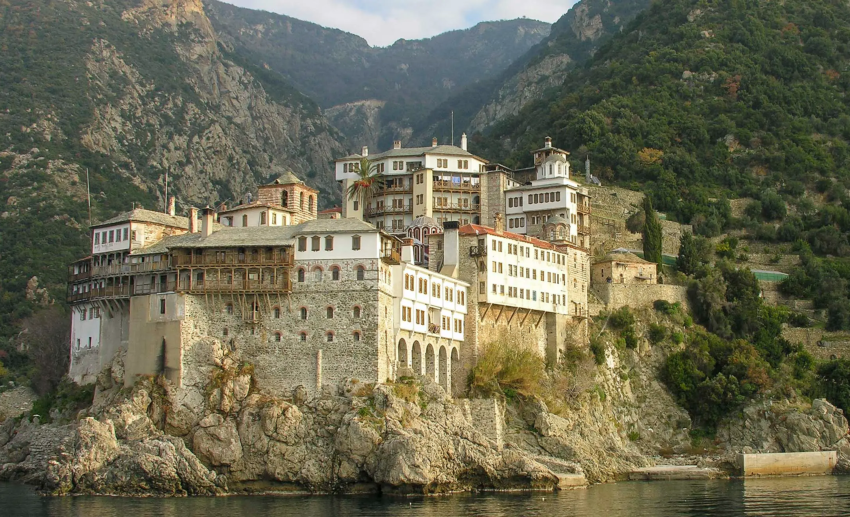
What does one actually find, then, after the long boat ride from Ouranoupolis with one’s diamonitírion — the special permit that admits no more than ten non-Orthodox men per day — tucked carefully in one’s pocket? One finds a peninsula thirty miles long, six miles wide, and forested with chestnut and oak; twenty monasteries set like fortresses along the coast or perched on cliffs above the sea; a network of footpaths trod for a thousand years; a capital, Karyes, with perhaps a hundred residents and the modest dignity of a Tuscan hill-village; and a rhythm of daily life that has not appreciably altered since the time of John Tzimisces.
The monks rise before four in the morning. They sing Orthros — Matins and Vespers — for several hours in the candlelit katholikon, by the light of oil lamps that flicker on the Byzantine frescoes. The Divine Liturgy follows. Then comes the first of the day’s two meals, taken in silence, eaten quickly — fifteen minutes is typical — while a designated reader recites Scripture or a saint’s life aloud. Afterward, each monk turns to his diakonima, his assigned labor: icon-painting, woodcarving, manuscript cataloguing, the olive harvest, the kitchens, the guesthouse, the bookkeeping. A shorter Vespers service follows in late afternoon, then the second meal, then Apodeipnon (Compline), then private prayer in the cell, then a few hours of sleep, then the bells again. The schedule advances by the Julian calendar, thirteen days behind the rest of Europe. In some monasteries, the day begins at sunset, not at midnight, because that is how Genesis numbered it.
On Mount Athos, monks generally wake before 4 AM for the daily service of Orthros, consisting of readings from the Psalms and the Gospel and singing of hymns. Orthros is directly followed by the Divine Liturgy. Following Liturgy is the first of two daily meals, conducted quickly (typically, for 15 minutes); during the meal, spiritual texts are also read aloud by a monk.
— Mount Athos Foundation of America, Monasteries FAQ
First-person accounts of the experience tend to converge on the same vocabulary. A Stanford professor, traveling with an Anglican priest and a Bavarian neurologist in 2016, asked a monk at Stavronikita what he thought pilgrims came for. The monk’s answer was a single word: tranquility. Another monk, asked whether he ever left Athos, replied simply: “No. Why would I ever leave?” An American Catholic pilgrim, after four days of close-shouldered courtesy, wrote that he had been struck by the strange fact that the monks fed him, washed his dishes, gave him a bed, and asked nothing in return — and that they had, against the ravages of every developer’s instinct, preserved an entire peninsula. “TripAdvisor will never create a list of the top Athos monasteries to visit. None of the refectories will be turned into luxury boutique hotels.” Mount Athos has been, in his striking phrase, “a protected park for over a thousand years, a Yosemite ahead of its time.”
A second American pilgrim found the experience less serene. He noted the chill that descended whenever it emerged he was a Roman Catholic; the wariness with which Catholics are received in the holiest land of an Orthodoxy that has never quite forgiven the Latin West for the Fourth Crusade; the hushed warning from one monk that the United States and Russia would soon engage in an atomic war, after which Greece would retake Constantinople. Yet even he was given a private tour of Dionysiou and was loaned, before he left, a slim volume of the Wisdom of Staretz Silouan, on the hope that he might be “spiritually interested in Orthodoxy.” The mountain proselytizes by lending books.
The purpose of all of this, the monks would patiently explain, is theosis — the slow transformation of the human person into a vessel of the divine through unceasing prayer, ascetic discipline, and the sacramental life. Athos is not a museum, however much it resembles one. It is not a heritage site, though UNESCO declared it one in 1988. It is a spiritual laboratory, where two thousand men attempt, each day, an experiment that the modern world has more or less forgotten: the attempt to belong, with the whole of one’s existence, to God.
❦ ❦ ❦
VII. The Holy Exchange
But the modern world has its own appetite, and it does not always stop at the gates of the Holy Mountain. In the autumn of 2008, just as the global financial system was beginning to convulse, Greek newspapers broke a story that would consume Greek politics for a decade. It concerned the Holy and Great Monastery of Vatopedi — the second-ranked monastery on Athos, home to more than a hundred young, educated, and energetic monks under the abbacy of the charismatic Cypriot Archimandrite Ephraim. The story had everything: a Byzantine chrysobull, a freshwater lake, a parade of Greek cabinet ministers, a notary whose husband served in the government, and, allegedly, a hundred million euros.
Vatopedi claimed, based on a document said to date from 1080 and bearing imperial golden seals, ownership of Lake Vistonida in Thrace and a long fringe of coastal land. The Greek state disputed the claim — until, in 2003, the Finance Minister of the day quietly withdrew the dispute. Between 2006 and 2008, the monastery exchanged its Vistonida holdings with the state for prime commercial real estate in Athens, Thessaloniki, and elsewhere. The monastery turned around and resold much of it. Critics calculated that the exchange had transferred to Vatopedi assets worth roughly one hundred million euros above their stated valuation. The deal was a coup. It was also, depending on whom one asked, either a long-overdue restoration of medieval rights or a textbook case of clerical influence peddling.
In the 2006-2008 period, plots of land around the lake were being swapped for high value state property. The deal is estimated to have cost the Greek state 100 million euros.
— Greek Reporter, “Vatopedi Monastery Land Scandal Trial to be Adjourned,” 2015
When the press exposed the affair in August 2008, the political detonation was immediate. Two government ministers resigned. Parliament voted unanimously to constitute a commission of inquiry. The Karamanlis government, weakened, fell within the year. Abbot Ephraim was arrested in 2011 and held briefly in detention. In December 2010, a Court of Appeals handed him a ten-month suspended sentence (along with the monk Arsenios and a former judge) on charges of misconduct. The case bounced through the Greek judicial system for nearly a decade. In the end, on March 23, 2017, Abbot Ephraim was fully acquitted. The court ruled that the valuations had, in fact, been in order. The supporters of the monastery declared vindication; their critics declared cover-up; the Greek public, weary, moved on.
The Vatopedi affair revealed something more consequential than its specifics. It made visible the strange constitutional fact that Mount Athos — a self-governing republic embedded inside a member state of the European Union — is structured in such a way that the Greek state cannot easily audit it, the Ecumenical Patriarchate cannot easily discipline it, and the Holy Community at Karyes has little appetite for either. The monasteries are not required to file financial reports. The mainland legal system reaches inside the peninsula only with great delicacy. For a small monastery preserving icons and praying for the salvation of the world, the arrangement is sublime. For a wealthy monastery brokering real-estate deals in Thessaloniki, it is, to put it cautiously, convenient.
❦ ❦ ❦
VIII. The Rebel Monastery
Three years after the Vatopedi deal was first negotiated, an entirely different scandal was reaching boiling point at the northern tip of the peninsula. The Holy Monastery of Esphigmenou — eighteenth in the Athonite hierarchy, ancient, austere, and proud — had been at war with the rest of the Holy Mountain since 1972.
The quarrel began, as so many ecclesiastical quarrels do, with an embrace. In December 1965, Ecumenical Patriarch Athenagoras of Constantinople and Pope Paul VI lifted the mutual excommunications that had divided Catholic and Orthodox Christianity since the Great Schism of 1054. To the monks of Esphigmenou, this gesture of ecumenical reconciliation was apostasy. The Latin Church had never recanted what the Athonites considered its heresies — papal supremacy, the filioque, purgatory, leavened bread — and to greet the Pope with a kiss of peace was to greet a heretic. The Esphigmenites stopped commemorating Athenagoras in their liturgies. When his successors, Dimitrios and Bartholomew, continued the ecumenical path, the monks stopped commemorating them too. They raised a black flag over the monastery emblazoned with the slogan ORTHODOXY OR DEATH.
By the early 2000s, the standoff had calcified into an open schism. The monastery aligned itself with the Old Calendarist movement — the “Genuine Orthodox Christians,” or G.O.C. — a small denomination that the Greek Council of State regards as outside the Orthodox Church. Greek law does not permit non-Orthodox to reside on Athos. In 2002, Patriarch Bartholomew formally declared the Esphigmenou occupants in schism. In 2005, he established a parallel “New Esphigmenou Brotherhood,” twenty-three monks strong, recognized by Constantinople and lodged provisionally in a building in Karyes. The Greek courts ruled that the old brotherhood squatters and ordered them to leave.
They did not leave. They barricaded the gates, cut themselves off from electricity, lived off what they could grow and bake, and waited. In 2006, when bailiffs arrived to enforce the first eviction order, the monks resisted; an ugly scuffle ensued, and the police withdrew. In July 2013, came the Molotov-cocktail incident that opened this essay. Abbot Methodios was sentenced in 2017 to twenty years; the sentence was reduced on appeal in 2019 to seventeen, and again in 2021 to roughly five and a half. He served his time without ever quite leaving the monastery, in spirit if not in body. Today, perhaps a hundred and ten monks still live behind the walls of Esphigmenou, without electricity, growing their own food, painting their own icons, praying their own prayers, refusing to recognize a Patriarch they consider compromised.
This is our spiritual homeland. This is where we were born spiritually and this is where we will die.
— Elder Methodios of Esphigmenou Monastery, ThessToday.gr, July 2024
In July 2024, the Greek police submitted a written request to the Holy Epistasia — the executive committee of the Athonite government — for permission to mount a major operation to evict the dissident monks. Father Bartolomeos, abbot of the recognized New Brotherhood and the man who would inherit the building once the schismatics were gone, told reporters that the occupiers “possess explosives and guns inside the monastery.” Whether or not this is true, the police, mindful of the political risks, have not yet moved. Fans at a Thessaloniki football match unfurled a banner in support of the Esphigmenites. The standoff endures — a slow, theological insurgency in a place where most of the world has stopped expecting either theology or insurgency.
❦ ❦ ❦
IX. Shadows from the North
If the Vatopedi affair exposed the financial opacity of the Holy Mountain, and the Esphigmenou rebellion exposed its theological brittleness, a third controversy — gathering since 2022 — has exposed something larger and more disquieting. It is the question of Russia.
Russian patronage of Mount Athos is ancient. The Russian Monastery of St. Panteleimon (Rossikon) was founded in the eleventh century. Russian tsars from Ivan the Terrible onward sent silver, manuscripts, and pilgrims. In the late nineteenth century, the Russian presence on Athos swelled so dramatically — at one point, Russian monks outnumbered Greeks on the peninsula — that the Greek government grew alarmed. The Bolshevik Revolution shattered the connection; by the 1960s, Panteleimon had been reduced to a skeleton crew of aging monks tending the ruins of a once-magnificent foundation. The post-Soviet revival brought a new wave of Russian money, Russian monks, and Russian power into Athos. In May 2016, Vladimir Putin himself made the pilgrimage, ostensibly to mark the thousandth anniversary of the Russian presence on the Holy Mountain.
Few minded — until February 24, 2022, when Russian tanks rolled into Ukraine, and the European Union began to scrutinize every channel through which Russian money could escape Western sanctions. Greece’s Anti-Money Laundering Authority, which had quietly been examining suspicious transfers since 2021, accelerated its inquiry. Sources told the Athens daily Kathimerini that at least twenty separate transactions involving Athonite monks or monasteries had been flagged as suspect within a single twelve-month window — transfers of tens or hundreds of thousands of euros, in one case more than a million, from Russian banks and money-transfer services into the personal accounts of individual monks. Investigators noted, with some delicacy, that none of the senders were on the EU sanctions list — a fact which proved nothing in either direction, because Russian money tends to change hands several times before it crosses a border.
Wealthy Russians chose to take their money out of Russia with the help of monks on Mount Athos in order to save their funds in the event of the collapse of their country’s financial institutions or the confiscation of their funds by the Kremlin because of the war.
— Greek government source describing one investigative scenario, October 2022
Other observers raised a graver possibility. The German tabloid Bild reported in 2022 that it had seen a classified European intelligence dossier alleging that certain Kremlin-linked monks were entangled in money laundering, arms trafficking, and even human trafficking. Six of the twenty Athonite monasteries, by one Ukrainian count, were openly supportive of the Russian invasion of Ukraine. A network of pro-Kremlin media platforms — including one tied to the sanctioned Russian businessman Konstantin Malofeev — was found to be operating out of, or in close coordination with, monastic addresses on Athos. The investigative journalist Alexandros Massavetas, who has written a book on Russia’s penetration of Greek society through Orthodox channels, told NPR bluntly: “The church appeared as a very convenient Trojan horse to influence and sway Greek society toward Russia’s ends.”
The monks themselves, as one might expect, reject the framing. Athanasios (“Thanassis“) Martinos — the Greek shipping magnate and government-appointed civil governor of Athos — called the allegations “a gross exaggeration.” Martinos, however, is himself an awkward spokesman: his shipping line, Minerva Marine, has been named by the government of Ukraine as a “sponsor of terrorism” for transporting Russian crude oil. The European Anti-Fraud Office (OLAF) examined the situation; OLAF’s most recent completed investigation, in 2014, concerned a different earlier matter and has been overtaken by events. Whether anything criminal will ever be proved is doubtful. What is undeniable is that a thousand-year-old monastic republic, governed by men who took vows of poverty, is once again a stage on which the great powers of Europe play out their quarrels — as they did, in their fashion, in 492 B.C., and in 1204, and in 1453, and in 1821, and now in 2022.
❦ ❦ ❦
X. What the Mountain Has Yet to Tell
And so we arrive at the strange present moment of the Holy Mountain. The mid-twentieth century saw the Athonite population collapse to perhaps a thousand aging men, and many serious observers expected the experiment to die out within a generation. It did the opposite. Beginning in the 1970s, under the influence of charismatic elders such as Joseph the Hesychast and his disciples — and aided by a worldwide hunger for contemplative tradition in an exhausting age — Athos experienced what scholars now call the Athonite Revival. The monasteries were filled with young men, many of them university-educated, many of them from beyond Greece’s borders. The peninsula today holds roughly two thousand monks drawn from Greece, Russia, Romania, Bulgaria, Serbia, Georgia, Moldova, the United States, and almost every other corner of the Orthodox world.
The pilgrims come, and come, and keep coming. In 2025, Greek press reports estimated that roughly two hundred thousand men passed through the gate at Ouranoupolis on their way to Athos — most of them Orthodox, the majority self-identifying not as tourists but as pilgrims. One recent academic survey found that 82 percent of visitors described their journey as a pilgrimage rather than a vacation; nearly 96 percent attended liturgical services during their stay; almost 79 percent took part voluntarily in the monks’ daily labors. The diamonitírion costs between twenty-five and thirty-five euros, but the hospitality — a bed, two meals, the right to enter ancient churches and pray at the miraculous icons — is free.
The flood has forced new restrictions. On January 1, 2025, the Sacred Community imposed the strictest cap on pilgrim access in modern memory: a maximum of two hundred per month at any communal skete, fifty at any smaller central church, and twenty at any cell or hut. Groups of more than five are forbidden, with narrow exceptions for theological students and military personnel. Invitations must be confirmed by the Pilgrims’ Office no later than noon on the day before arrival. The mountain is not, the monks insist, a destination; it is a discipline, and the discipline is in danger of being eroded by the very enthusiasm it inspires.
So what does the future hold? The honest answer is that no one knows, but the same was true in 1453, and in 1821, and the mountain endures. Several pressures are visible. The Russian question will not soon resolve itself; the war in Ukraine will continue to splash geopolitical complications onto the Holy Mountain’s politically autonomous shores. The Esphigmenou eviction, deferred for nearly a quarter-century, must eventually be carried out one way or another. The pressures of mass pilgrimage — a kind of religious tourism that the monks did not invite and cannot quite refuse — will test the boundary between hospitality and intrusion. The Avaton will continue to draw the indignation of a European public ever less tolerant of monastic anomalies, but the legal protections are solid, and the rule shows no sign of yielding.
And yet, behind all these specific anxieties, the larger drama of Mount Athos is the drama it has always been. It is the drama of men who believe that prayer is real work — perhaps the only work that ultimately matters — and who have organized their entire lives, and indeed an entire peninsula, around that conviction. The Athonites pray for the world. They pray for individual pilgrims who scribble their names and the names of their loved ones onto slips of paper at the door of every katholikon. They pray, in their own way, for the Greek policeman who may one day arrive to evict their schismatic brothers, and for the Russian oligarch whose questionable euros may or may not flow through their bank account. They pray at four in the morning, and at midnight, and at every hour between. Whether the world deserves their prayers is not, for them, the question. The question is whether the prayers are offered. They are. They will be.
Mount Athos has essentially been a protected park for over 1000 years, a Yosemite ahead of its time. This is a major reason men visit the place. Over and over again they told me they longed for peace and serenity — to be delivered from cares and anxieties of life. Indeed, when in Stavronikita I asked a monk what he thought pilgrims would gain on Athos, his answer was quick: tranquility.
— First-person pilgrim account, Stanford Humanities Center, 2016
The petrol bomb of 2013 will, in the long view, be remembered as one moment among ten thousand on a peninsula that has burned and rebuilt itself a dozen times. The Garden of the Virgin has survived Persian fleets, Catalan mercenaries, the Fourth Crusade, the Ottoman conquest, the Greek War of Independence, the Bolsheviks, the Nazis (who occupied Greece during the Second World War but were obliged by their own propaganda to leave Athos alone), and the collapse of the Soviet Union. It will, almost certainly, survive the European Union and the Kremlin and the algorithm-fed tour-bus industry. Whether the men who pray there will survive — as a community, as an idea, as a living transmission of something that began in 963 — depends, as it always has, on whether young men keep stepping off the boat at Daphni and discovering, sometimes to their own astonishment, that they cannot quite bring themselves to leave.
The mountain endures. The garden endures. And in the candlelight before dawn, somewhere behind walls that one cannot reach by car, men are still singing the psalms of David in Greek, in Slavonic, in Georgian, in Romanian — singing as if the salvation of the world depended on it. Perhaps, in their telling, it does.
❦ ❦ ❦
Colophon: Researched and drafted in collaboration with Anthropic’s Claude as a scholarly research assistant. Primary sources include Encyclopædia Britannica, Wikipedia, the Princeton Mapping Eastern Europe project, the Mount Athos Foundation of America, the Stanford Humanities Center, the National Catholic Reporter, Kathimerini, NPR, OrthoChristian, Pilgrimaps, Greek Reporter, the Christian Century, and CBS News. The Righteous Cause.