
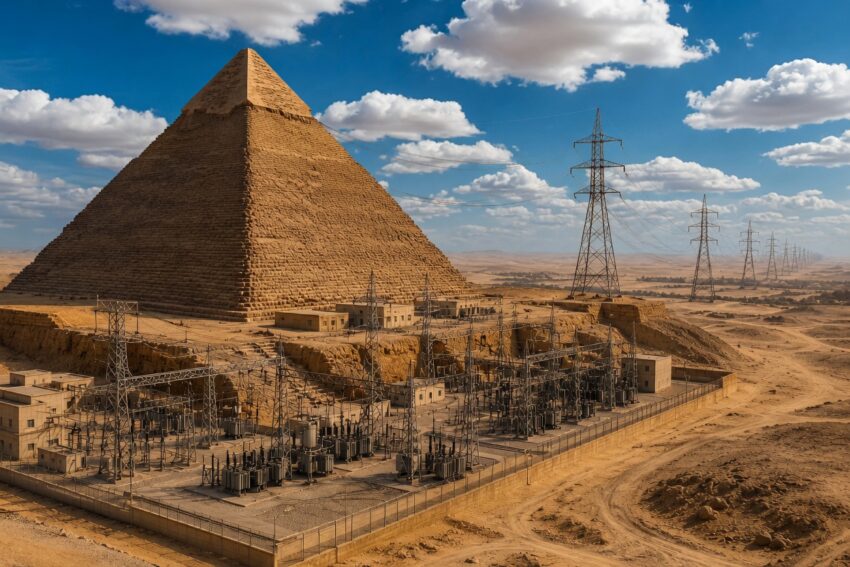
A Scholarly Audit of Christopher Dunn’s “Giza Power Plant” Thesis
❖ ❖ ❖
Introduction: The Pyramid That Powered Nothing
The Great Pyramid of Giza has been many things to many people. To Pharaoh Khufu’s funerary architects in the Fourth Dynasty, it was a monument. To Herodotus and Strabo, it was a marvel. To Charles Piazzi Smyth, the nineteenth-century Astronomer Royal of Scotland, it was a divinely engineered prophecy carved in limestone, encoding the Exodus, the Crucifixion, and the foundation of British naval supremacy in a single elegant geometry. To Edgar Cayce, it was the surviving fingerprint of a vanished Atlantean civilization. And in 1998, to a precision-engineering machinist from Illinois named Christopher Dunn, it became something stranger still: a vast, silent, mineral-powered electrical generating station — a 6.5-million-ton acoustical machine that allegedly converted the Earth’s seismic vibrations into microwave radiation for the use of an advanced ancient civilization whose name, address, technology, and customer base have somehow gone missing from every other archaeological site on the planet.
I came to The Giza Power Plant: Technologies of Ancient Egypt expecting another late-twentieth-century fringe pamphlet of the sort that has cluttered alternative-history bookshelves since Erich von Däniken first wondered aloud in 1968 whether the Egyptians’ great achievement could have been the work of mere Egyptians. What I found instead was an unusually serious — and an unusually frustrating — book.
Serious, because Dunn is not a crank. He is a manufacturing engineer with five decades of aerospace precision experience, an intelligent man with a real eye for tolerance and a genuine fascination with the surface finishes of Old Kingdom granite. Frustrating, because for all its technical seriousness, his thesis collapses on contact with the simplest of historical questions: where, in 4,500 years of Egyptian archaeology, is the wire?
That is the central puzzle of this essay, and it will not go away. A power plant produces power. Power has to go somewhere. Somewhere has to be on the receiving end. The complete archaeological record of dynastic Egypt — thousands of excavated sites, millions of catalogued artifacts, an unbroken textual tradition running from the Pyramid Texts to the Coptic papyri — contains no electrical generator, no electrical conductor, no electrical appliance, no transmission infrastructure, no metallurgical residue consistent with industrial-scale current production, and no textual reference to anything resembling an electrical phenomenon. The first recorded human observation of static electricity, by the Greek philosopher Thales of Miletus, would not occur until around 600 BC — nearly two thousand years after Khufu’s pyramid was sealed.
This essay is not an exercise in academic gatekeeping. Dunn’s book deserves a fair hearing because the man is plainly sincere, his engineering credentials are real, and his observations about the precision of certain Egyptian artifacts — the granite boxes of the Serapeum, the fine-tolerance core drillings at Saqqara — raise questions that legitimate scholars have not entirely answered. He has earned the courtesy of a careful response. What he has not earned, on the evidence available, is acceptance. This essay attempts to explain why, in language as fair as it can be made and as brutally honest as the subject requires.
❖ ❖ ❖
I. The Architect of the Hypothesis
A Machinist Goes to Giza
Christopher Dunn entered the public conversation about ancient Egypt in 1984, when an article he wrote for Analog magazine asked whether the precision visible on certain Old Kingdom granite artifacts could plausibly have been produced by the hand tools mainstream Egyptology assigned to the Bronze Age. He was, by his own account, a working machinist with twenty years on the shop floor. He had handled granite. He had cut hard stone with modern equipment. He believed he could recognize the signatures of machine tooling when he saw them, and he believed he was seeing them on the inner walls of the King’s Chamber, on the lids of the Serapeum boxes at Saqqara, and on a dozen other surfaces that, in his judgment, no copper chisel had ever touched.
That observation became the seed of The Giza Power Plant: Technologies of Ancient Egypt, published by Bear & Company in 1998 and never quite out of print since. The book’s reception was telling. Mainstream Egyptology declined to engage with it at any depth. The Wikipedia entry on pyramidology lists Dunn’s thesis explicitly under the heading ‘pseudoarchaeology,’ grouping him with David Hatcher Childress and the broader ‘advanced lost technology’ school whose intellectual ancestors include Ignatius Donnelly, Manly Palmer Hall, and Edgar Cayce. Alternative-history communities, by contrast, embraced him as the engineer who had finally said out loud what the archaeologists were too proud to admit. Joe Rogan would, in due course, host him repeatedly.
“Linked to the pseudoarchaeological ancient astronaut theory and Orion correlation theory are related claims that the Great Pyramid was constructed by the use of an advanced lost technology. Proponents of this theory often link this hypothetical advanced technology to extraterrestrials but also Atlanteans, Lemurians or a legendary lost race. Notable proponents include Christopher Dunn and David Hatcher Childress.”
— Wikipedia, “Pyramidology,” § Pseudoarchaeology
It is worth being precise about what Dunn does and does not claim. He does not argue that the Egyptians built the pyramid. He argues that someone built the pyramid, and that the someone in question possessed engineering capabilities far beyond anything documented for the Bronze Age. He does not argue that the pyramid produced electricity in the modern sense. He argues that it produced microwave-frequency electromagnetic radiation, harvested from the Earth’s ambient vibrational energy, through a sequence of acoustical, chemical, and piezoelectric transformations. He does not argue that the Egyptians used this power for lighting or appliances. He argues that the use of the power is, at present, unknown, and that the absence of evidence for its use is no evidence of its absence — a piece of reasoning that, as we shall see, does most of the heavy lifting in his case.
❖ ❖ ❖
II. The Anatomy of the Power Plant Thesis
To debunk a hypothesis fairly, one must first describe it accurately. Dunn’s engineering picture of the pyramid is internally elaborate and worth laying out in some detail.
The Queen’s Chamber: A Hydrogen Generator
In Dunn’s reconstruction, the so-called Queen’s Chamber, located on the level below the King’s Chamber and reached by a narrow horizontal passage, was the chemical heart of the machine. He proposes that two chemical solutions — hydrated zinc chloride and dilute hydrochloric acid — were piped into the chamber through the so-called ‘air shafts’ (which he reinterprets as conduits), where they combined to generate hydrogen gas in industrial quantities. The salty efflorescence observed on the walls of the Queen’s Chamber, and a foul smell reported by several early explorers, are offered as residual evidence of this long-departed chemical process.
The Grand Gallery: A Resonator Array
The Grand Gallery — 28 feet high, 153 feet long, with seven corbelled tiers rising at a 26-degree incline — is recast as a battery of Helmholtz resonators. Dunn proposes that the niches along its walls once held tuned resonating chambers that transduced the Earth’s background microseismic vibration into amplified acoustic energy. The architectural elegance of the Grand Gallery, in this reading, is not aesthetic. It is mechanical.
The King’s Chamber: A Piezoelectric Cavity
The King’s Chamber, constructed of Aswan granite, roughly fifty-five percent of which is quartz, is treated as a resonant cavity in which the amplified acoustic energy from the Grand Gallery induced mechanical stress on the quartz-rich walls. Quartz is genuinely piezoelectric: it generates a small electrical charge under mechanical stress. Dunn argues that the architecture forced this latent property into industrial-scale electromagnetic output.
The Shafts as Microwave Plumbing
The two narrow shafts leading from the King’s Chamber to the pyramid’s exterior — long understood by Egyptologists as ritual channels associated with stellar alignment and the journey of the king’s ka — are reimagined as electromagnetic waveguides. The Northern Shaft channels cosmic microwave background radiation at the resonant frequency of atomic hydrogen; the hydrogen gas atoms are stimulated into emission inside the King’s Chamber, and the resulting amplified microwave beam exits via the Southern Shaft. The granite ‘coffer’ in the King’s Chamber serves as a refracting and beam-shaping element. The result, in Dunn’s description, is a three-stage microwave amplifier of geological scale.
“By its size and dimensions, this crystal edifice created a harmonic resonance with the Earth and converted Earth’s vibrational energies to microwave radiation. The King’s Chamber, built of igneous granite containing silicon quartz crystals, served as the power centre while the Queen’s Chamber was used to generate hydrogen, the fuel that ran the plant.”
— Christopher Dunn, The Giza Power Plant: Technologies of Ancient Egypt (Bear & Co., 1998)
Each component of the system is described in detail and accompanied by photographs, diagrams, and the kind of cross-referenced specifications one expects from a competent engineer. The cumulative effect is impressive. A reader unfamiliar with Egyptology, and inclined to trust the visual authority of a tolerance drawing, may finish the book believing that Dunn has done something that mainstream scholarship has failed to do — namely, explain the pyramid.
He has not. He has explained how, given a set of starting assumptions for which no historical or archaeological evidence exists, the pyramid could conceivably have functioned as a power plant. That is not the same thing as explaining the pyramid, and the difference is the entire problem with the book.
❖ ❖ ❖
III. The Two-Millennia Silence: Where Electricity Actually Began
Set Dunn’s engineering picture against the historical record of electricity, and an enormous chronological problem appears at once. The Great Pyramid was completed during the reign of Khufu, in the Fourth Dynasty, roughly 2560 BC. The first recorded human observation of an electrical phenomenon — static electricity produced by rubbing amber with fur — was made by the Greek philosopher Thales of Miletus around 600 BC, very nearly two thousand years later. Multiple authoritative reference works converge on this point.
“Around 600 BC, Thales, a Greek, found that when amber was rubbed with silk, it became electrically charged and attracted objects. He had originally discovered static electricity.”
— U.S. Energy Information Administration, “Electricity Timeline,” eia.gov/kids
“Ancient cultures around the Mediterranean knew that certain objects, such as rods of amber, could be rubbed with cat’s fur to attract light objects like feathers. Thales of Miletus made a series of observations on static electricity around 600 BCE… Electricity would remain little more than an intellectual curiosity for millennia until 1600, when the English scientist William Gilbert wrote De Magnete.”
— Wikipedia, “Electricity,” § History
Britannica, similarly, traces the conceptual lineage from the Greek elektron to William Gilbert’s coining of the modern word in 1600, the static-electricity experiments of the seventeenth century, the Leyden jar of the 1740s, Benjamin Franklin’s kite of 1752, Galvani’s frog-leg experiments, and Volta’s pile of 1800 — the first device in human history capable of producing a sustained electric current. The earliest centralized electric power station, Edison’s Pearl Street facility in Manhattan, did not begin operation until 1882. The history of electricity is a slow, painstaking, fully documented chain of discoveries with a fixed point of origin twenty centuries after the Fourth Dynasty.
Dunn does not deny this chronology. He sidesteps it. The civilization he posits as the pyramid’s real builder is, by his own description, lost — a culture whose technology was forgotten so completely that no trace of it remains anywhere else. This is an unfalsifiable move, and it carries an enormous evidentiary cost. To accept it is to accept that an electrical civilization existed somewhere on Earth at least 1,900 years before the first known observation of any electrical phenomenon, that it produced its astonishing infrastructure without leaving a single corroborating artifact in any other location, and that it vanished so cleanly that the entire Greek, Roman, Persian, Indian, and Chinese intellectual traditions of antiquity — societies with sophisticated mining, metallurgy, and natural philosophy — not only failed to inherit its technology but failed to remember its existence.
Civilizations leave fingerprints. The Industrial Revolution left coal seams, foundries, rail lines, and patent offices. The Roman Empire left roads, aqueducts, coins, and a literature. Bronze Age Egypt itself left tomb paintings, administrative papyri, temple inventories, mining records, copper smelting sites at Timna, gold workings at Wadi Hammamat, faience workshops, glass furnaces, and the meticulously catalogued grave goods of forty centuries of pharaohs. An electrical Egypt would have left wire. It did not, because it was not electrical.
❖ ❖ ❖
IV. The Question That Ends the Conversation: Where Is the Wire?
This is the question on which the Giza Power Plant thesis ultimately fails, and it fails decisively. A power plant is not merely an energy source. It is one node in an infrastructure. To generate microwave radiation is to do work that must be done for some reason, by something or someone, with some apparatus on the receiving end. The signature of a working electromagnetic civilization is not the generator. It is everything downstream of the generator.
Consider what an industrial-scale microwave generating station would necessarily imply. There must be conductors to carry charge or guide radiation. There must be devices that consume what the station produces. There must be storage of some kind — batteries, capacitors, or their functional equivalents — to buffer demand. There must be distribution: pylons, ducts, antennae, receivers. There must be a manufacturing tradition capable of producing precision-tolerance metalwork at scale, the metallurgical residues of which would be unmistakable in the archaeological record. There must be a literature — administrative, technical, religious, or commercial — that names these things, describes them, complains about their cost, debates their merits, mourns their malfunctions, and trains the next generation in their care.
Egypt has left us the literature of a culture that recorded everything. The Pyramid Texts. The Coffin Texts. The Book of the Dead. The administrative documents of every dynasty from the Old Kingdom to the Ptolemies. The Wadi al-Jarf papyri, discovered in 2013 and dating to the twenty-sixth year of Khufu’s reign, include the daily logbooks of a middle-ranking inspector named Merer, whose team transported Tura limestone by boat to a place the papyri call Akhet-Khufu — the Horizon of Khufu — which is the Great Pyramid itself. We possess a day-by-day account of pyramid construction written by one of its participants. It describes oxen, boats, canals, sailors, bread rations, and the supervisory authority of Ankhhaef, Khufu’s half-brother and vizier. It does not describe wire, voltage, resonators, hydrogen plumbing, or microwave receivers.
“Day 25: Inspector Merer spends the day with his phyle hauling stones in Tura South; spends the night at Tura South. Day 26: Inspector Merer casts off with his phyle from Tura South, loaded with stone, for Akhet-Khufu; spends the night at She-Khufu.”
— Diary of Merer (Papyrus Jarf B), c. 2562 BC, trans. Pierre Tallet
This is, on the available evidence, what the pyramid was for and how it was built. Dunn’s power plant, by contrast, has no diary. No inspector ever wrote down a single day of its operation. No requisition order survives for its chemicals. No tax receipt records its outputs. No customer ever billed it. No technician ever maintained it. No archaeologist has ever turned up a single component of its alleged distribution network. The absence is not a gap in the record. It is the record.
This same evidentiary collapse, on the same plateau, has played out as recently as April 2025, when an Italian research team led by Corrado Malanga of the University of Pisa and Filippo Biondi of the University of Strathclyde announced the alleged discovery, through satellite-based radar, of an underground city extending two kilometers beneath the three pyramids of Giza. The story moved at the speed of social media, amplified by Alex Jones and Joe Rogan, before serious scientists and Egyptologists pointed out that no peer-reviewed publication accompanied the claim, that the radar technology cited cannot reach the depths described, and that the geological record contained no trace of the millions of cubic meters of excavated rubble such a structure would necessarily produce. The Giza underground city is the Giza Power Plant’s direct intellectual descendant: the same fascination with hidden ancient power, the same selective use of legitimate scientific terminology, the same conspicuous absence of corroborating physical evidence, the same media amplification through celebrity podcasters. The pattern is not new. It is the formula.
❖ ❖ ❖
V. The Piezoelectric Mirage and the Acoustic Excuse
It is worth pausing on the two pieces of real physics that Dunn presses into service, because the misuse is instructive. Quartz is indeed piezoelectric, a property discovered by Pierre and Jacques Curie in 1880. Apply mechanical pressure to a quartz crystal, and a small voltage appears across its faces. The effect is real, well-characterized, and underlies a host of modern technologies from quartz watches to ultrasound transducers.
What it does not do is generate industrial-scale power. The voltages produced by piezoelectric stress on natural quartz are on the order of microvolts to millivolts per applied force. To convert the diffuse, low-frequency seismic vibration of the Earth’s crust into commercially significant electromagnetic output by way of a passive quartz-rich resonant cavity would require an energy density orders of magnitude beyond anything physics permits. The piezoelectric properties of Aswan granite are real. The amplifier Dunn imagines is not. Real physics has been stretched far past its breaking point and pressed into the service of an engineering claim that the underlying phenomenon cannot support.
The acoustic argument fares no better. The Great Pyramid does have notable acoustic properties. So does any large structure made of dense stone with vaulted, corbelled, or pyramidal ceilings. The Gothic cathedrals of medieval Europe have splendid acoustics; nobody argues that Chartres was a microwave generator. The acoustic resonance of the King’s Chamber is a byproduct of its mass and geometry, not the signature of a tuned mechanical system. To interpret it as the latter is to commit the same category error a paranormal investigator commits when interpreting an old house’s creaking floorboards as evidence of haunting.
“While the pyramid does possess notable acoustic properties, this is a byproduct of its heavy stone construction and vaulted corbelled ceilings. The book interprets these architectural features as components of a power grid rather than features designed to resonate during rituals or chants.”
— Egypt Tours Portal, “Ancient Egyptian Electricity”
❖ ❖ ❖
VI. The Bronze Age Toolkit and the Builders of Khufu
The Heit el-Ghurab Workers’ Village
If the Great Pyramid was the silent reactor of an electrical civilization, no one told the people who actually built it. Beginning in 1988, the American archaeologist Mark Lehner and a team from Ancient Egypt Research Associates began a systematic excavation of a Fourth Dynasty settlement at Heit el-Ghurab, a few hundred yards south of the Wall of the Crow on the Giza Plateau. Over more than thirty years of fieldwork, Lehner’s team has documented a full functional infrastructure of pyramid construction: rows of barracks for the workforce, dozens of bakeries capable of producing thousands of loaves a day, breweries, butcheries, administrative quarters for overseers, dormitories for skilled artisans, and a cemetery in which the workmen and their foremen were buried with the dignity owed to honored laborers, not the chains of slaves.
Radiocarbon and ceramic dating place the settlement squarely within the reigns of Khufu, Khafre, and Menkaure. The bones found in the workers’ cemetery show signs of healed fractures — evidence that the laborers were given medical care — and isotopic analysis of their diet shows that they ate meat regularly, an unusual privilege in the ancient Middle East. This is the documented workforce of the pyramid. They were Egyptian. They were paid in bread and beer. They organized themselves into named teams. They left graffiti praising the names of their gangs in the recesses of the relieving chambers. Their technology was the technology of the Bronze Age, used at peak Bronze Age efficiency.
Dolerite Pounders, Copper Saws, and Abrasive Sand
Mainstream archaeology has long established — by experimental archaeology, by direct examination of tool marks under a microscope, and by the analysis of waste deposits at quarry sites — that the Egyptians cut, dressed, and polished even the hardest granite using a coordinated suite of techniques. Hard stone pounders of dolerite, harder than granite, were used to bash out the rough shapes of blocks. Copper saws used wet quartz sand as an abrasive to slice through hard stone over many hours of patient effort, the copper acting as a soft carrier for the harder abrasive grit. Tubular copper drills produced the cylindrical cores that Dunn (correctly) admires for their precision and (incorrectly) attributes to high-speed mechanical drilling. The labor was enormous, and the tools were modest, but the results, given centuries of refinement, are not mysterious. They are documented.
The Wadi al-Jarf Papyri: A Logbook for the Pyramid
The 2013 discovery of the Wadi al-Jarf papyri — in particular the daily logbook of Inspector Merer — settled, for any honest observer, the question of who built the Great Pyramid, when, and under whose authority. Merer’s diary, written in the twenty-sixth and twenty-seventh years of Khufu’s reign, records his crews’ round-trip from the Tura limestone quarries to the construction site at Akhet-Khufu. The Khufu cartouches that Vyse first observed in 1837, sealed inside the relieving chambers above the King’s Chamber, were doubted by some alternative-history writers as nineteenth-century forgeries. Whatever one thinks of Vyse’s field methods, the question is now closed. The Khufu cartouche appears in a logbook independently buried in a Red Sea cave for four and a half millennia. The pyramid is Khufu’s. It was built during his reign. It was a tomb. There is no longer any serious archaeological room for doubt.
❖ ❖ ❖
VII. The Pattern: From Pyramid Power to Underground Cities
Why, then, does the Giza Power Plant thesis persist? The same reason every entry in the long, dignified roll-call of pyramid pseudoarchaeology has persisted: because the formula works on a human audience whose appetite for mystery exceeds its tolerance for the boring discipline of evidence.
The lineage is long and well-documented. John Taylor, an eccentric London publisher, kicked it off in 1859 with the suggestion that the pyramid was built by the Hebrews under divine direction. Charles Piazzi Smyth, in 1864, added pyramid inches and prophetic chronology. Ignatius Donnelly added Atlanteans. Edgar Cayce, in the 1930s, added the Hall of Records. Erich von Däniken, in 1968, added extraterrestrials. Patrick Flanagan, Max Toth, and a wave of New Age authors in the 1970s added pyramid power as a generic property of the geometric form itself, capable of preserving razor blades and dehydrating fruit. The Toronto Society for Psychical Research, taking the claim seriously enough to test it, established by controlled experiment that pyramid-shaped containers were no more effective at preserving organic matter than any other shape. The result was duly published. It changed nothing. The believers believed.
“Even in modern times when people, one would think, should know better, the Great Pyramid of Giza has proved a fertile field for fantasy. The people who do not know better are the Pyramid mystics… Egyptologists sometimes uncharitably refer to this group as ‘Pyramidiots,’ but the school continues to flourish despite scholarly anathemas.”
— Barbara Mertz, Temples, Tombs, and Hieroglyphs (1964)
Dunn is the engineering wing of a much older intellectual movement. His refinement is to dress the old fascination with hidden ancient power in the vocabulary of modern manufacturing tolerance and electromagnetic engineering. The dressing is more sophisticated than Donnelly’s Atlanteans or von Däniken’s spacemen. The substance is the same.
The same formula is currently being recycled in real time, in the form of the Khafre Project’s 2025 claim of a vast underground city beneath the Giza Plateau. Same legitimate university affiliations stretched far past their proper scope. Same dramatic AI-generated imagery substituting for peer review. Same press-conference rollout in lieu of scientific publication. Same celebrity amplification through Joe Rogan and the conspiracy media ecosystem. Same conspicuous absence of corroborating physical evidence — in the Khafre case, the basic geological problem that one cannot excavate millions of cubic meters of limestone without producing a small mountain range of rubble that the Egyptian sky has spent four millennia refusing to record. The Giza Power Plant is the Khafre Project’s grandfather. Both are variations on the same dance.
❖ ❖ ❖
VIII. What the Pyramid Actually Is
There is a final irony worth recording. The defenders of pseudoarchaeology habitually accuse mainstream Egyptology of selling the ancient Egyptians short, of treating them as primitive farmers who could not possibly have produced the pyramid without alien, Atlantean, or lost-civilization assistance. The accusation has it precisely backwards. It is Dunn and his intellectual lineage who refuse to credit the Egyptians with their own achievement. Mainstream archaeology has spent more than two centuries patiently establishing that the people who built the Great Pyramid were exactly the people the inscriptions, the workers’ villages, the supply records, the logbooks, the cemeteries, and the religious texts say they were: Fourth Dynasty Egyptians, working under a centralized state, using the materials, tools, and organizational capabilities of their own time, scaled to a level of national commitment that has rarely been matched in human history.
The Great Pyramid is approximately 481 feet tall in its original configuration, contains roughly 2.3 million blocks of stone, and was the tallest human-made structure on Earth for nearly four thousand years. It was conceived, planned, organized, built, finished, sealed, and used as the tomb monument of a king whose name we know, whose dynasty we can trace, and whose half-brother served as vizier of the project. It is one of the greatest engineering feats in human history. It does not need to have been a power plant. The actual story is far more remarkable than the fiction.
Christopher Dunn, in the end, has produced a serious-looking technical hypothesis about a pyramid that did not function the way he describes, built by a civilization he does not believe existed, to produce a kind of power for which there is no archaeological evidence and no historical context. His engineering instinct is admirable. His attention to certain anomalies in the precision of ancient stoneworking poses real questions that deserve real answers. But the framework into which he places those observations cannot bear their weight, and no amount of further reverse-engineering will make it bear that weight, because the framework is not falsified by a missing detail. It is falsified by an entire missing civilization.
Until that civilization’s wire, conduits, receivers, distribution network, metallurgical residues, technical literature, and even one consumer of its mysterious power are produced, the Giza Power Plant must be classed where mainstream scholarship has gently and correctly classed it for nearly thirty years: as a thought experiment of considerable technical imagination, conducted in the absence of the evidence that would allow it to be anything more.
The pyramid is what it has always been. A monument. A boundary stone between the world of the living and the world of the dead. A breathtaking achievement of Bronze Age engineering and political will. It needs no microwaves. It needs no hydrogen. It needs no resonant quartz cavity. It needs only what it has always had: the sun rising over the eastern plateau, the desert wind on its limestone, and the long memory of the people who walked away from it and never built anything quite like it again.
❖ ❖ ❖
Primary Sources Consulted
• Wikipedia, Pyramidology (§ Pyramid Power, § Pseudoarchaeology) — https://en.wikipedia.org/wiki/Pyramidology
• Wikipedia, Electricity — https://en.wikipedia.org/wiki/Electricity
• U.S. Energy Information Administration, Electricity Timeline — https://www.eia.gov/kids/history-of-energy/timelines/electricity.php
• Encyclopaedia Britannica, Electricity (summary) — https://www.britannica.com/summary/electricity
• Egypt Tours Portal, “Ancient Egyptian Electricity” — https://www.egypttoursportal.com/blog/ancient-egyptian-civilization/ancient-egyptian-electricity/
• Christopher Dunn, The Giza Power Plant (full text reference) — https://archive.org/details/the-giza-power-plant-christopher-dunn
• Pierre Tallet et al., Diary of Merer, Wadi al-Jarf Papyri — https://en.wikipedia.org/wiki/Diary_of_Merer
• Ancient Egypt Research Associates (Lehner / Heit el-Ghurab) — https://aeraweb.org/projects/lost-city/
• Robbins, “Pyramids, Phantoms, and Pure Hokum,” The Righteous Cause (April 17, 2026) — https://novus2.com/righteouscause/2026/04/17/pyramids-phantoms-and-pure-hokum-the-internets-greatest-archaeological-hoax-debunked/
A Note on Research Methods and Accuracy
In recent years, some have voiced concern that artificial intelligence may distort facts or introduce inaccuracies into serious research. That criticism deserves acknowledgment. However, AI has now evolved into the most powerful research instrument available to any dedicated scholar—capable of analyzing vast datasets, cross‑referencing historical records, and surfacing overlooked connections across sources. This work represents a collaboration between the author’s investigative inquiry, verified primary documentation, and the advanced analytic capabilities of AI research tools. Here, AI was not used as a ghostwriter or a shortcut for scholarship, but as a disciplined research partner devoted to rigor, accuracy, and transparency.
Every factual claim in this work has been subjected to active verification. Where AI‑generated content was used as a starting point, it was tested against primary sources, peer‑reviewed scholarship, official institutional documentation, and established historical records. Where discrepancies were found—and they were found—corrections were made. The author has made every reasonable effort to ensure that quotations are accurately attributed, historical details are precisely rendered, and theological claims fairly represent the positions they describe or critique.
That said, no work of this scope is immune to error, and the author has no interest in perpetuating inaccuracies in the service of an argument. If you are a reader—whether sympathetic, skeptical, or hostile to the conclusions drawn here—and you identify a factual error, a misattributed source, a misrepresented teaching, or a claim that cannot be substantiated, you are warmly and genuinely invited to say so. Reach out. The goal of this work is not to win a debate but to get the history right. Corrections offered in good faith will be received in the same spirit, and verified corrections will be incorporated into future editions without hesitation.
Truth, after all, has nothing to fear from scrutiny—and neither does this work.