
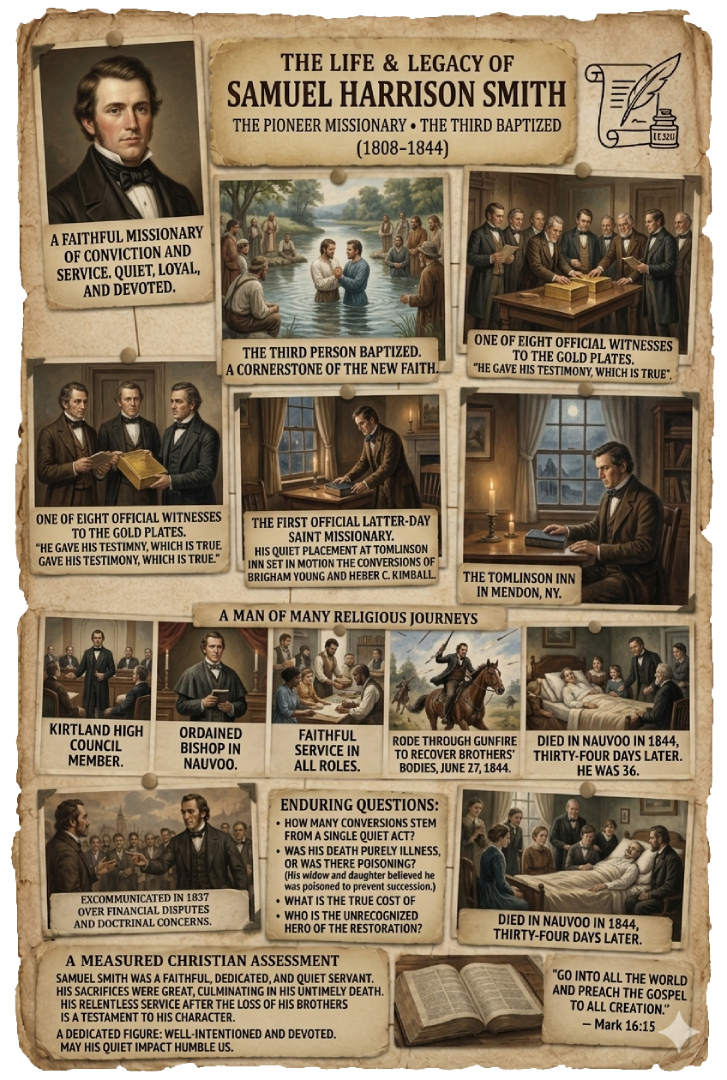
Faithful as the Sun: The Brother in the Shadow
✦ ❖ ✦
I. A Horseman in the Illinois Heat
The afternoon of June 27, 1844, sat heavy over western Illinois. Heat pressed down on the prairies, and in the dust of the road a wagon rattled westward, its young driver — a fourteen-year-old boy — gripping the reins beside a thirty-six-year-old man with broad shoulders, a tradesman’s hands, and the unmistakable Smith family jawline. The man was Samuel Harrison Smith, sixth child of Joseph and Lucy Mack Smith, baptized by Oliver Cowdery fifteen years earlier in a Pennsylvania creek, the third person ever immersed in the new movement his brother Joseph had founded. Word had reached Plymouth, Illinois, that Joseph and Hyrum lay in danger at the Carthage jail. Samuel set out at once. He did not yet know what most of his church already half-feared: that the danger was already finished, and that two of his brothers were dead.
The mob found them on the road. Samuel sent the boy on with the wagon and slipped into the trees. He ran. He clawed his way through brush, took blows, and gathered enough breath to circle back home. Then, mounting a fast horse, he set out a second time — this time alone, this time at a gallop. The mob, expecting his return, lay in wait. A bullet tore through the crown of his hat. He outrode them. By the time he reached Carthage, his brothers were laid out in the upstairs of the Hamilton Hotel, and Samuel Smith — pious, plain-spoken, never charismatic, never theatrical — became the first Latter-day Saint to look on the corpses of the Prophet and Patriarch.
He bent to load the bodies. He drove a wagon home through the same hostile country. He arrived in Nauvoo on the twenty-eighth, the body of Joseph on the boards behind him, and complained to his mother of a sharp pain in his side. Thirty-four days later, Samuel was dead. The official cause of death, scrawled in the sexton’s register, was “bilious fever.” His widow, his daughter, and at least one of his brothers would spend the rest of their lives insisting it was something else.
This is the story of the Smith brother that nearly everyone forgets. He was the first official missionary of the church his brother founded. He was one of the Eight Witnesses to the gold plates. He fought at Crooked River, served on the Kirtland high council, was ordained a bishop in Nauvoo, and walked, by one credible reckoning, more than four thousand miles on foot to leave copies of the Book of Mormon in the hands of strangers — copies that would, by a long chain of providence and persuasion, place Brigham Young and Heber C. Kimball inside the movement. He was also, in the hot summer of 1844, the most plausible heir to his murdered brother’s prophetic mantle. And he died, in circumstances his own family considered suspicious, before he could lay any claim to it.
To tell Samuel’s story is to walk into a corner of early Mormonism that the polished correlated histories have rarely entered comfortably. It is the story of a quiet man caught inside an extraordinary one, a man whose loyalty to family carried him from the Vermont hills to the Illinois prairie, a man whose theology departed sharply from the Christianity of his forefathers, and a man whose death — by fever, exhaustion, grief, or something worse — helped clear the path for Brigham Young’s consolidation of power. Samuel’s life sits at the seam between everything that early Mormonism wished to be and much of what it became.
✦ ❖ ✦
II. Vermont Roots and a Family Adrift
Samuel Harrison Smith was born on March 13, 1808, in Tunbridge, Vermont, the sixth of eleven children. His father, Joseph Smith Sr., was a sturdy New England farmer, restless, beset by failed business ventures and a habit of dreaming. His mother, Lucy Mack Smith, was a more determined and articulate believer than her husband, the daughter of a Revolutionary War officer, possessed of a mystical streak and a tongue that could carry a fireside sermon for hours. The Smith household was poor without being squalid: a working farm family, scripture-reading, prayer-bound, and frequently uprooted.
The Vermont years were hard. A series of crop failures — climaxed by the disastrous “year without a summer” in 1816, when New England suffered killing frosts in every month of the calendar — drove the Smiths from one rented patch of soil to another. By the autumn of 1816, the family had decided to abandon Vermont altogether, and they arrived in upstate New York “destitute of friends, home, or employment.” Eight-year-old Samuel walked much of the way.
The land of their new home — the rolling country between Palmyra and Manchester — was already known by 1816 as the “Burned-Over District,” a strip of western New York so frequently scorched by the fires of religious revivalism that, locals joked, no kindling was left for the next preacher. Methodists, Baptists, Presbyterians, Universalists, Shakers, Campbellites, and itinerant revivalists of every variety crisscrossed the region, holding camp meetings, baptizing the convicted in icy creeks, and waging public arguments over the order of the millennium. The Smith family, who occasionally sold cider and gingerbread from a cart at the larger gatherings, lived in the thick of it.
Within this atmosphere of competing claims, the Smiths quietly developed their own habits. Family prayer was unfailing. William Smith, Samuel’s younger brother, remembered the daily signal:
I well remember father used to carry his spectacles in his vest pocket, and when we boys saw him feel for his specs, we knew that was a signal to get ready for prayer.
— William Smith, in Deseret Evening News, January 20, 1894, p. 11
There were stories told around the hearth, too — Joseph Jr.’s descriptions of “the ancient inhabitants of this continent, their dress, their manner of traveling, the animals which they rode.” Lucy Mack Smith recalled that during these evenings “the sweetest union and happiness” came over the family and “tranquility reigned.” But outside the door, after the older Joseph began telling neighbors of his 1820 vision, the same family was met with “contempt” and “a great deal of prejudice.” Samuel, who was twelve, watched both sides of that line — peace within, suspicion without — and seems to have absorbed the conviction that his family was a tight unit at war with the village.
There is no record of Samuel having undergone the sort of theological convulsion that gripped his older brother in the woods of Manchester. He was a working son. He cleared timber, plowed land, tapped the great groves of sugar maple, and helped construct the modest log home into which the family moved in 1818. A daughter would later remember him as the kind of man who “worked every day and part of every moonlight night.” That detail — moonlight nights — captures something essential about Samuel Smith. He was a creature of obligation. The labor came first. Whatever doubts he held about his brother’s ever-stranger announcements seem to have stayed quiet until the work was done.
✦ ❖ ✦
III. The Third Person Baptized
By 1827, Samuel was nineteen, six feet tall, and physically formidable. His mother proudly described his “great strength, far exceeding that of ordinary men.” That September, Joseph announced that he had retrieved the plates of gold from the Hill Cumorah. Enemies — real or imagined — began appearing at the Smith doors, and Joseph and Emma fled to Harmony, Pennsylvania, to live near Emma’s parents and undertake the translation work. Samuel made the 135-mile journey between Palmyra and Harmony repeatedly that winter and spring, sometimes carrying provisions, sometimes simply offering his presence.
On one such trip, Samuel served briefly as Joseph’s scribe. Soon after, in April 1829, he brought Oliver Cowdery — the Vermont-born schoolteacher who had boarded with the Smiths in Manchester — to Harmony. Within days, Oliver had taken over as Joseph’s full-time amanuensis, and the translation effort began moving at a remarkable pace. Samuel returned to the farm; the heavy lifting still needed doing.
But the unseen pressure of the project told upon him. Joseph repeatedly preached to his brother about what was being inscribed on the plates, and Samuel — by his own later admission — “was not, however, very easily persuaded of these things.” Whatever his quiet exterior, he was not credulous. So Samuel, mimicking his brother’s pattern, went into the woods alone to pray. According to the family record, he “obtained revelation” that Joseph’s teachings were true. Oliver Cowdery baptized him on May 25, 1829 — the third person in the new movement to receive the rite, after Joseph Smith and Oliver himself.
Within weeks, in late June 1829, Samuel stood near Palmyra as one of the Eight Witnesses to the golden plates, alongside his father, his brother Hyrum, and four members of the Whitmer family, plus Hiram Page. The collective statement appended to the Book of Mormon would, in time, be read by tens of millions:
Joseph Smith, Jun., the translator of this work, has shewn unto us the plates of which hath been spoken, which have the appearance of gold; and as many of the leaves as the said Smith has translated, we did handle with our hands; and we also saw the engravings thereon, all of which has the appearance of ancient work, and of curious workmanship.
— Testimony of the Eight Witnesses, Book of Mormon (1830 edition)
It is worth pausing here. Samuel’s relationship to the plates was different in kind from that of the Three Witnesses (Cowdery, Whitmer, and Harris), who reported a visionary or angelic experience. The Eight reported a tactile encounter — a handling. Many later critics and several of the Eight themselves, in unguarded moments, would describe the experience in language that softened the physicality of it (Martin Harris would speak of seeing the plates “by the eye of faith,” and John Whitmer reportedly hedged similarly). But Samuel never softened his testimony. To his death, he insisted he had handled the plates and seen the engravings thereon, and his closest associates — including Orson Hyde, who traveled with him for thousands of miles — never recorded a moment when he flinched.
When the Church of Christ was organized on April 6, 1830, at the Peter Whitmer Sr. farmhouse in Fayette, New York, Samuel Smith was one of the six original members and was ordained to the Aaronic Priesthood. His revelation — Section 23 of the Doctrine and Covenants — was characteristic of him: “Thy calling is to exhortation, and to strengthen the church; and thou art not as yet called to preach before the world” (D&C 23:4). It was a quiet commission, fitted to a quiet man. Joseph wore the mantle of prophet; Hyrum carried the gravity of patriarch; Samuel was assigned the task of holding the small new fellowship together.
✦ ❖ ✦
IV. The Book in the Innkeeper’s Hand
Two months later, in June 1830, Joseph called Samuel to embark on what would become the first formal missionary journey of the new church. He set out from Palmyra carrying a pack of newly printed Book of Mormon copies, with no companion, no formal training, and — by the standards of the seasoned circuit-riding clergy of his region — almost no public-speaking polish. Orson Hyde, who later traveled with him for months on end, described him plainly:
A man slow of speech and unlearned, yet a man of good faith and extreme integrity.
— Orson Hyde, quoted in Daniel Peterson, “Defending the Faith: Meet three of the Eight Witnesses,” Deseret News
Samuel walked the country lanes around Palmyra and into Livonia, Bloomfield, Lima, and at last Mendon. He knocked on doors. He offered the book at five dollars a copy when nearly no one had five dollars, and gave it away when he could not sell it. He returned to Palmyra discouraged, having baptized no one. The mission appeared to be a failure.
And yet the most consequential moment of his life — perhaps the most consequential moment in the demographic history of the Latter-day Saint movement — took place on this discouraging trip. At the Tomlinson Inn in Mendon, New York, Samuel approached a traveling Methodist preacher named Phineas Young.
“There is a book, sir, I wish you to read.”
“Pray, sir, what book have you?”
“The Book of Mormon, or, as it is called by some, the Golden Bible.”
“Ah, sir, then it purports to be a revelation.”
… “If you will read this book with a prayerful heart, and ask God to give you a witness, you will know of the truth of this work.”
— “History of Brigham Young,” Millennial Star, vol. 25, no. 23 (June 6, 1863), 360–61
Phineas Young took the book home, intending to read it to expose its errors. Reading produced the opposite effect. He passed the copy to his sister Rhoda and her husband, John P. Greene, and through them, eventually, to their brother Brigham Young and to Brigham’s closest friend, Heber C. Kimball. The chain of conversion that would, within a generation, produce the Utah church and its empire on the Wasatch Front can be traced back to one slow-speaking, “unlearned” young man laying a fresh-bound book on an innkeeper’s table.
Brigham Young himself, much later, described his conversion in terms that — read carefully — are nothing less than an unintended tribute to Samuel’s manner:
If all the talent, tact, wisdom, and refinement of the world had been combined in one individual, and that person had been sent to me with the Book of Mormon, … it would have been to me like the smoke which arises only to vanish. But when I saw a man without eloquence, or talents for public speaking, who could only just say, “I know by the power of the Holy Ghost that the Book of Mormon is true, that Joseph Smith is a prophet of the Lord.”
The Holy Ghost proceeding from that individual illuminates my understanding, and light, glory, and immortality is before me; I am encircled by it, filled with it, and know for myself that the testimony of the man is true.
— Brigham Young, “A Discourse,” Deseret News, February 9, 1854, p. 24
It is a striking inversion of the era’s revival aesthetics. The men who packed the Charles Finney tents and the Methodist camp meetings wanted lightning and tears, fire and trembling. Brigham Young credits his conviction to the precise absence of those things. Samuel Smith persuaded him by being unable to perform.
In December 1830, Samuel went to Kirtland, Ohio, to consolidate the work begun there by Cowdery and Parley P. Pratt. The next year, he traveled with Reynolds Cahoon into Missouri, baptizing William E. McLellin (later a member of the original Quorum of the Twelve, and later still a sharp critic of Brigham Young). With Orson Hyde, he carried the message into Connecticut, Massachusetts, Rhode Island, and Maine — opening a Boston branch and a New Rowley branch, surviving threats of violence in Providence after only twelve days, baptizing a small handful of converts. By the close of 1832, he had walked, by the family’s reckoning, more than four thousand miles. Andrew Jenson’s nineteenth-century biographical encyclopedia counts six missions in all.
Among the converts of the New England tour was a young woman from Boston named Mary Bailey, who would, in time, travel west to Kirtland, board with the Smiths, and become Samuel’s wife.
✦ ❖ ✦
V. Kirtland: The Quiet Center
By the summer of 1833, the headquarters of the new church had shifted to Kirtland, Ohio. Mary Bailey arrived in Kirtland with her friend Agnes Coolbrith. Samuel courted Mary in the modest, courteous fashion of the time, and the two married on August 12, 1834. Samuel was twenty-six. Their first daughter, Susannah, was born in October of the following year; Mary, the second, came in March 1837.
In February 1834, Samuel was named to the first high council in Kirtland — the chief judicial and legislative body of the church at the time, ranked second only to the First Presidency. The minutes of that body show him serving with what one nineteenth-century historian described as “the mingled qualities of justice and mercy.” Joseph appointed him a general agent of the printing house responsible for the church’s first hymnal and its early instructional materials, putting him in close working partnership with Emma Smith and W. W. Phelps. He labored on the rising Kirtland Temple. At its dedication on March 27, 1836, Samuel stood among the brethren in the tiered pulpits reserved for Melchizedek priesthood officers.
Joseph Smith Sr. would, in time, pronounce a patriarchal blessing on Samuel, which reads, in part:
Thou hast been faithful in all thy days, and ministered comfort to thy father’s family. … Thou hast labored much and toiled hard. … The just shall rise up and call thee a perfect man.
… Thou shall hear the Lord’s voice saying, “Samuel, Samuel. Thou shalt be equal to thy brethren.”
— Patriarchal blessing, quoted in Kyle R. Walker, United by Faith (American Fork: Covenant Communications, 2005), 223; cited in Gaunt & Smith, “Samuel H. Smith: Faithful Brother of Joseph and Hyrum,” Ensign (Aug. 2008)
The blessing — “thou shalt be equal to thy brethren” — would, two decades later, sound to certain ears like prophecy and to others like provocation. In 1836, it sounded merely like the gentle benediction of an aging father over his most reliable son.
The Kirtland years were not, however, untroubled. In 1837, the Kirtland Safety Society — Joseph’s ill-advised anti-bank — collapsed in the wider panic of that year. Samuel, like nearly every Saint in Kirtland, lost what little he had saved. Many of the most prominent men of the movement apostatized over the affair: Frederick G. Williams, the Whitmers, and eventually even Oliver Cowdery. Samuel did not. He continued to plow, to preach when he could, and to follow Joseph westward when the time came.
✦ ❖ ✦
VI. Crooked River and the Mud of Missouri
In March 1838, the Smiths joined the general migration to Missouri, settling on 160 acres at Marrowbone in Daviess County. Samuel cleared land yet again. In August of that year, Mary gave birth to a son, Samuel Harrison Bailey Smith. By autumn, the situation in northwestern Missouri had collapsed into open conflict. The state was poisoned with rumor, the Saints had angered old neighbors with their tight-knit voting bloc and their militant rhetoric (the Danites had been organized), and Governor Lilburn Boggs would shortly issue the so-called “extermination order.”
On October 25, 1838, Samuel rode with the Latter-day Saint militia at the Battle of Crooked River — a brief, bloody skirmish in which the Mormon apostle David W. Patten was killed. Samuel was on the line beside him. The next day, while Samuel was away at Far West attempting to procure a wagon to evacuate his family, a Missouri mob descended on the Marrowbone cabin. They dragged Mary and the newborn infant out into pouring rain on a feather bed, lifted the two toddlers onto it, and burned the house. Mary, frail-spirited and never robust, was carried by a neighbor a day and a half through driving rain to Far West, where Samuel finally found her. She arrived “having not spoken above a whisper” since the mob, and never fully recovered.
On Brigham Young’s counsel, Samuel and a small group fled east through the snow toward Quincy, Illinois — among the very first of the Saints to cross out of Missouri. In Quincy, he eventually surrendered his rented house to his parents, who arrived later in worse shape than he. With his younger brother Don Carlos, he took up an offer of leased farmland near Macomb, sixty miles inland. There, Mary, whisper-voiced, ailing, mothered three small children on the kindness of the Don Carlos family.
It is hard to read the Missouri narrative without a measure of horror — and harder still to imagine Samuel Smith remaining outwardly composed through it. Yet the documentary record gives no hint that he wavered. He neither cursed his brother for the policies that had brought the Saints to Missouri nor renounced his testimony of the gold plates. He kept working.
✦ ❖ ✦
VII. Nauvoo: A Bishop in the City of Joseph
By 1840, the Smiths had relocated to Nauvoo, the swampy bend of the Mississippi that Joseph had renamed and was rapidly transforming into the largest city in Illinois. Samuel was given a small house on the flats and resumed the rhythms of farm work and church service. Of those early Nauvoo days, his daughter Mary later remembered her father seated in the middle of the room in the evening, her younger brother on his lap:
The first on his lap got a kiss; so we would continue until we had all obtained the coveted kiss. … When we were all well tired out and quite sleepy … Father would take my brother — who was the youngest — in his lap, and sing him to sleep.
— Mary Smith Norman, quoted in Ruby K. Smith, Mary Bailey (1954), 87
It is one of the few intimate domestic glimpses we have of Samuel Smith. The portrait is of a tender, weary father who did not raise his voice. In January 1841, though, Mary Bailey Smith died at thirty-two after the birth of her fourth child, Lucy. The infant followed her mother within weeks. Samuel was left at thirty-three with three living children, all under six, and a household that had collapsed around him.
On April 29, 1841, while serving a brief mission to Scott County, Illinois, he married Levira Clark — a Latter-day Saint convert he had known from earlier missionary travels. By the time he and Levira returned to Nauvoo in the fall, he had been appointed to a bishopric (see Doctrine and Covenants 124:141), seated in the city government, and commissioned as a captain in the Nauvoo Legion.
There is, in this period, one episode whose theological and historical weight cannot be passed over lightly. On December 17, 1843 — about seven months before his death — Samuel Smith attended a prayer meeting in the upper room of Joseph’s red brick store and received the temple endowment ordinances Joseph had introduced earlier that year. The Nauvoo Temple itself was still rising. Samuel never lived to see it completed. But he had, by the standards of the inner circle, been sealed into the highest mysteries of the Restoration. The doctrinal architecture into which Samuel had been initiated — celestial marriage, multiple gods, a graduated path of human exaltation toward eventual deification — was not the Christianity into which his Vermont father had baptized him in spirit. Of that, more in a moment.
✦ ❖ ✦
VIII. Carthage and the Ride Home
On the morning of June 27, 1844, Samuel Smith and his family were living in Plymouth, Illinois — about forty miles northeast of Nauvoo and roughly thirty miles from Carthage. He had moved there in the autumn of 1842 to help his erratic brother William keep an inn while William served in the Illinois Legislature. By the time the news of trouble at Carthage reached him, he was farming north of Plymouth with Levira and the children. His six-year-old daughter, Mary, decades later, set down the most arresting eyewitness account of the moment her father heard:
My father came into the house in much excitement, and said … “I think I can break through the mob and get to Carthage” and immediately he mounted the horse and was gone.
— Mary Smith Norman, quoted in Ruby K. Smith, Mary Bailey (1954), 90
He had already tried once. With a hired fourteen-year-old boy at the reins of a wagon, Samuel had set out from Plymouth and run into a mob along the road. The boy continued with the wagon; Samuel fled into the woods, taking a beating and developing, somewhere in the chase, what he would later call “a dreadful distress in my side.” He returned home, traded the wagon for a fast horse, and set out alone. Bullets followed him; one passed through the crown of his hat. He outran the mob. He was the first Latter-day Saint to reach the jail after the killings. Joseph and Hyrum were already gone. John Taylor lay grievously wounded. Willard Richards, miraculously untouched, sat alone with the dead.
That night, Willard wrote a letter to Emma. Samuel co-signed it. The next morning, Samuel drove the wagon carrying the body of his brother Joseph back to Nauvoo. A guard of eight men accompanied them; he did not need their protection from the mob, but he did need it from the spectators who lined the road. By the time he arrived at the Mansion House on June 28, Samuel was visibly ill. He told his mother quietly that the pain in his side had not let up.
And then the politics began.
✦ ❖ ✦
IX. Thirty-Four Days
It is at this point that the historical record divides — and the LDS-sanctioned narrative and the more critical readings begin to part company. The undisputed facts are these: in the weeks between June 27 and July 30, 1844, with Brigham Young and most of the Quorum of the Twelve still hundreds of miles away on missionary travels in the eastern states, the question of who would lead the church was wide open. Sidney Rigdon, surviving member of the First Presidency, was hurrying back from Pittsburgh to claim a guardianship. William Marks, president of the Nauvoo Stake, had Emma Smith’s support and a quiet inclination toward Rigdon. James Strang, off in Wisconsin, was preparing a “letter of appointment” claim. Willard Richards, the lone surviving apostle in Nauvoo and Brigham Young’s first cousin, was working to delay any decision until Brigham and the Twelve could arrive.
And then there was Samuel Smith.
William Clayton’s contemporaneous Nauvoo journal — Clayton served as Joseph’s personal secretary and is perhaps the single most reliable source for the inner workings of Nauvoo during this period — records on July 12, 1844:
The Trustee must of necessity be the first president of the Church and Joseph has said that if he and Hyrum were taken away Samuel H. Smith would be his successor.
— William Clayton Journal, July 12, 1844, typescript; see George D. Smith, ed., An Intimate Chronicle: The Journals of William Clayton (Signature Books, 1995), 138
A second contemporary witness — Bishop Newel K. Whitney, who reported the same conversation — corroborates the substance. Joseph, in other words, had said in the hearing of trusted men that if both he and Hyrum were taken, Samuel would be his successor. By mid-July, the Smith family knew it. Lucy Mack Smith was reportedly urging that Samuel move into Nauvoo “and take the Patriarch’s office,” with the unstated assumption that the higher office would follow. Even the secular press caught wind: the St. Louis People’s Organ on August 9, 1844, reported that “a son of Joe Smith [Sr.] it is said, had received the revelation that he was to be the successor of the prophet.” (The St. Louis paper misidentified Samuel as Smith Sr.’s “son,” but the substance was clear enough.)
Even sympathetic LDS historians admit the awkwardness of this moment. Ronald W. Walker, in his careful reconstruction “Six Days in August,” notes that William Clayton, on July 6, was already worried that “the greatest danger that now threatens us is dissensions and strifes amongst the Church,” and that Saints in Nauvoo were openly discussing “four or five possible successors,” among whom Samuel’s name was inevitably prominent.
But there was a deeper problem. Samuel Smith was — by every reliable account — opposed to the secret practice of plural marriage that had been spreading through Nauvoo’s inner circle for at least two years. If he became president, it was widely assumed he would denounce it. For those in the know — for Brigham Young and the apostles who would soon return, for Willard Richards who held the keys of the city in their absence, for the Council of Fifty who had crowned Joseph a “Prophet, Priest and King” only months before — Samuel’s elevation would have meant the unraveling of the most theologically distinctive (and politically dangerous) practices of the Restoration.
Then Samuel got sicker. He was treated by Nauvoo physicians, including Council of Fifty member John M. Bernhisel. Hosea Stout — a former Missouri Danite, head of Nauvoo’s police force, and a man whose own diary would later record routine discussions of “ridding ourselves” of inconvenient persons — was, according to Samuel’s widow Levira, brought in as Samuel’s daily nurse. Stout administered a “white powder” prescribed as medicine. By July 24, Samuel was “very sick.” On July 30, he was dead. The cause of death was written into the Nauvoo sexton’s book as bilious fever.
Samuel Harrison Smith, born in Tunbridge, Vt., March 13, 1808. Died July 30, 1844, broken hearted, and worn out with persecution. Aged 36. The righteous are removed from the evils to come.
— Times and Seasons, vol. 5, no. 24 (Aug. 1, 1844), p. 760
✦ ❖ ✦
X. “He Spit Out and Said He Was Poisoned”
The poisoning allegation is not a recent invention of disgruntled ex-Mormons, nor was it cooked up in some later moment of partisan score-settling. It first surfaced — quietly — within months of Samuel’s death, and it persisted through two unrelated lines of family testimony for the better part of seventy years.
Brigham Young himself acknowledged the rumor publicly in 1857, three thousand feet up in the Salt Lake Valley, to a tabernacle congregation:
And William Smith has asserted that I was the cause of the death of his brother Samuel, when brother Woodruff, who is here to day, knows that we were waiting at the depot in Boston to take passage east at the very time when Joseph and Hyrum were killed. … In a few weeks after, Samuel Smith died, and I am blamed as the cause of his death.
— Brigham Young, July 1857, Journal of Discourses, vol. 5, p. 77
Notice what Brigham does not deny here. He denies being personally present in Nauvoo, which is true — he was indeed in Boston on June 27. He does not deny that someone in Nauvoo, acting at the apostles’ direction or with their knowledge, may have done what William Smith was accusing him of. The defense is one of geography. It is the same defense a mob boss in a later century might offer: I wasn’t there.
In June 1892, William Smith — now an old man, long estranged from the Brighamite leadership but with no obvious financial motive remaining for fabrication — wrote a letter to a Brother Kelley spelling out a more direct charge: that Willard Richards had instructed Hosea Stout to kill Samuel to prevent his elevation before Brigham Young and the Quorum of the Twelve returned to Nauvoo.
Sixteen years later, in 1908, Samuel’s own daughter Mary B. Smith Norman wrote independently to the poet Ina Coolbrith — daughter of Don Carlos Smith — with what may be the single most arresting fragment of testimony in the whole affair:
My father was undoubtedly poisoned. Uncle Arthur Millikin was poisoned at the same time — the same doctors were treating my father and Uncle Arthur at the same time. Uncle Arthur discontinued the medicine — without letting them know that he was doing so. (Aunt Lucy [Smith Millikin] threw it in the fire). Father continued taking it until the last dose — he spit out and said he was poisoned. But it was too late — he died.
— Mary B. Smith Norman to Ina Coolbrith, March 27, 1908; cited in D. Michael Quinn, The Mormon Hierarchy: Origins of Power (Signature Books, 1994), 152–153
It is the line “he spit out and said he was poisoned” that has, more than any other detail, kept the allegation alive in Mormon historical debate for more than a century. A six-year-old girl in the upstairs room of a Nauvoo house, watching her father die, heard him name what was happening to him.
The historian D. Michael Quinn, in The Mormon Hierarchy: Origins of Power, set out the circumstantial case at length:
Stout’s diary also describes several occasions when Brigham Young and the apostles seriously discussed having Hosea “rid ourselves” of various church members considered dangerous to the church and the apostles. Stout referred to this as “cut him off — behind the ears — according to the law of God in such cases.” … When the Salt Lake “municipal high council” tried Hosea Stout for attempted murder, he protested that “it has been my duty to hunt out the rotten spots in the Kingdom.”
— D. Michael Quinn, The Mormon Hierarchy: Origins of Power (Signature Books, 1994), 152–153
Quinn’s honesty is worth noting. He concedes flatly that “evidence does not exist to prove if the prophet’s brother was such a ‘case’ Stout handled.” The poisoning charge is unproven and probably unprovable. The autopsies of frontier Illinois did not test for arsenic. The Nauvoo sexton’s register, the only contemporary medical record we have, lists “bilious fever” — but Quinn notes that no other adult that summer was listed with the same cause of death; only two children.
The FAIR (Faithful Answers, Informed Response) apologetic counter is, in the main, fair-minded: the 1892 William Smith letter is late, William was estranged from the Twelve, and the 1908 Mary Norman letter is sixty-four years removed from the events. The chain of testimony is what historians call a “tradition,” not a “deposition.” We are dealing with family memory, and family memory has its own gravitational pull toward the dramatic.
But the apologetic response also concedes the bare facts on which the suspicion rests: that William Clayton’s diary confirms Willard Richards’ effort to defer all succession decisions until his cousin Brigham could return; that Stout’s own diary confirms a culture of casual lethal violence within the inner Nauvoo police; that Samuel was the leading candidate for succession; and that his death conveniently removed the principal obstacle to apostolic consolidation.
The reasonable verdict, then, is the one any responsible historian must reach when confronted with a smoke that thick over a fire whose embers we can no longer see clearly: not proven, but not absurd. A poisoning sufficient to be alleged by two of the closest people on earth to the victim — his widow and his daughter — is not the kind of claim a careful biographer simply dismisses. It is the kind of claim he weighs, places on the record, and leaves with the reader.
✦ ❖ ✦
XI. A Witness — But to What?
Samuel Smith’s personal piety is hard to fault. The sources, friendly and hostile alike, present a consistent picture: a hard-working man of plain habits and unforced kindness, a husband and father whose tenderness with small children was remarked upon by all who saw him, a missionary who walked thousands of miles in homespun and rough boots, a brother who twice rode through gunfire to retrieve the bodies of his murdered siblings. There is nothing in the documentary record of which any Christian, at the level of moral character, needs to be ashamed.
And yet — and this is the heart of any honest theological assessment — Samuel did not merely witness to the existence of golden plates. He witnessed to, and helped propagate, a system of belief that departed in fundamental ways from the historic Christian faith into which his Vermont parents had been baptized. The departure was not a peripheral one. It cut to the center of the gospel itself.
What the System Taught
By the time of Samuel’s December 1843 endowment in the upper room of Joseph’s red brick store, the architecture of distinctively LDS doctrine was substantially in place. The 1844 King Follett discourse — delivered just two months before the Carthage killings — had publicly articulated the doctrine that God Himself had once been a man, that men in turn might become gods, and that the council of the gods was the proper backdrop for understanding the origin of the cosmos. Joseph had introduced celestial plural marriage among a tight inner circle. He had taught that men are spirit-children of heavenly parents and that the soul is uncreated and eternal. He had introduced new ordinances — washings, anointings, an oath-bound endowment — that were said to be necessary for exaltation beyond what historic Christianity called “salvation.”
Samuel had received these teachings. He had taken the endowment. He had served on the high council that adjudicated discipline in light of them. He had, by his quiet credibility, helped lend them their plausibility to converts who would otherwise have hesitated.
Where the System Departs from Scripture
The Bible knows nothing of a once-human God. Its God is the one who declares: “Before me there was no God formed, neither shall there be after me” (Isaiah 43:10), and “I am the LORD, and there is none else, there is no God beside me” (Isaiah 45:5). The Christian creeds — Nicene, Apostles’, Athanasian — were not late corruptions; they were the second- and fourth-century church’s careful reading of these same scriptures against the gnostic and Arian alternatives.
The Bible knows nothing of a salvation by ordinance-chain. Paul writes: “For by grace are ye saved through faith; and that not of yourselves: it is the gift of God: not of works, lest any man should boast” (Ephesians 2:8–9). The New Testament’s “exaltation” — to use a word Samuel’s movement would later weaponize — is conformity to the image of Christ (Romans 8:29), not progression toward godhood. The “great and precious promises” of 2 Peter 1:4 — that we may be “partakers of the divine nature” — describe sanctification, not deification in any literal ontological sense, as the patristic consensus consistently insisted.
The Bible knows nothing of new scripture beyond the apostolic deposit. The author of Hebrews writes: “God, who at sundry times and in divers manners spake in time past unto the fathers by the prophets, hath in these last days spoken unto us by his Son” (Hebrews 1:1–2). The Christ who came in flesh, died, rose, and ascended is the final and complete word. The early church accepted no later witness on equal footing. Samuel Smith, in signing the Testimony of the Eight Witnesses, was not adding to a list of admissible revelations; he was, however earnestly, helping establish a competing canon.
Why the System Was Compelling to a Man Like Samuel
It would be unfair to Samuel — and historically dishonest — to dismiss his commitment as gullibility. The Burned-Over District in which he came of age was a marketplace of competing certainties, each louder and more contradictory than the last. The denominations into which his parents had wandered — at various points Methodist, Universalist, briefly Presbyterian — were themselves fragmenting and warring. Joseph’s 1820 vision, as the Smith family received it, offered something the surrounding theology could not: a clean answer to which church was true, anchored not in argument but in claimed firsthand encounter with the divine. To a young man whose temperament ran toward tangible work rather than speculative theology, an offer of physical plates with physical engravings — plates he could touch, weigh, see — was an answer that could be accepted without philosophical apparatus.
There is, in short, a coherent psychological logic to Samuel’s loyalty. His brother Joseph had given the family an explanation for everything, including the family’s suffering — and the suffering was real and severe. He had given them, too, a community. To repudiate the system was to step away not only from a theology but from a family. Samuel never had the temperament for such a step. The same loyalty that drove him to ride through bullets to reach Carthage was the loyalty that bound him to a theological project he might, on more abstract grounds, have struggled to defend.
There is also, the Christian must acknowledge, a sobering reminder here. Sincerity is not a sufficient condition for orthodoxy. Samuel Smith was, by every credible witness, a sincere and gentle man. He was, by the measure of the biblical gospel, a witness to teachings the apostle Paul would have called “another gospel” (Galatians 1:6–9). The two truths sit uncomfortably together. They are part of why the Latter-day Saint tradition has remained, for nearly two centuries, so persistently fascinating and so persistently outside the historic Christian fold.
✦ ❖ ✦
XII. How the Story Has Been Told
The official Latter-day Saint treatment of Samuel Smith is not so much a rewriting of history as a curating of it. The August 2008 Ensign profile by LaRene Porter Gaunt and Robert A. Smith — the source most contemporary Latter-day Saints will encounter if they encounter Samuel at all — is touching, well-researched, and almost entirely silent on three matters that any complete portrait must address.
The Silences
First, the Ensign article does not mention that contemporaneous Latter-day Saints — including Joseph Smith himself, according to William Clayton’s journal — considered Samuel a likely successor. The article ends with the Patriarchal blessing’s phrase “thou shalt be equal to thy brethren,” but does not pause on what that phrase came to mean in the political theology of Nauvoo. The succession question is excised. The reader of the Ensign would have no way of knowing that Samuel had been, in mid-July 1844, the leading candidate to lead the church his brother had founded.
Second, the article does not mention the poisoning allegation at all. Hosea Stout is unnamed. The “white powder” is unnamed. The 1908 letter from Samuel’s own daughter is unnamed. The article notes simply that “His cause of death was listed as bilious fever,” and proceeds directly to a quotation from his obituary in the Times and Seasons. A reader could be forgiven for emerging from the article unaware that any controversy of any kind had ever surrounded Samuel’s death.
Third, the article does not discuss Samuel’s known opposition to plural marriage — though that opposition is precisely the political fact that would have made his removal advantageous to the inner circle of polygamists who would dominate the post-1844 Quorum of the Twelve. The doctrine of plural marriage is also missing from the article, even as a passing fact about Nauvoo. The result is a portrait of a quiet, faithful, missionary martyr — historically accurate as far as it goes, but bounded by an editorial choice not to follow the harder questions to their conclusions.
A Pattern Beyond One Article
This pattern is not idiosyncratic. The official Doctrine and Covenants Historical Resources entry on Samuel — only a few hundred words — likewise notes only that “Samuel died in Nauvoo only a month after his brothers Joseph and Hyrum Smith were martyred,” with no acknowledgment of either the succession claim or the poisoning allegation. The LDS.org Wikipedia-style entries on Samuel are similarly trimmed. The “Forgotten Martyr” piece in LDS Living frames Samuel’s death almost devotionally as a “third martyrdom,” sidestepping the harder textures.
It would be unfair to describe this as suppression in any active or conspiratorial sense. It is, rather, the gravitational pull every institutional history exerts on its own dead. Hagiography is the polite form of forgetting. The Latter-day Saint church has every institutional interest in remembering Samuel as a faithful missionary brother and no institutional interest in remembering him as a leading candidate for succession whose unexpected death cleared the way for Brigham Young. That second story exists in the historical record. It simply does not appear in the chapel manuals.
For Christians engaging respectfully with Latter-day Saint friends and neighbors, the lesson is not that the LDS sources are dishonest. They are, on the level of what they say, generally accurate. The issue is what they omit. The fuller picture is recoverable only by reading the Joseph Smith Papers project alongside the older private journals (Clayton, Stout, Lucy Mack Smith), the dissident testimonies (William Smith’s letter, Mary Norman’s letter, Bernhisel’s remembered remarks), and the work of historians like D. Michael Quinn, who have specialized in following the inconvenient threads.
✦ ❖ ✦
XIII. Legacy: The Faithful Brother in Christian Perspective
It is fitting to end where we began — with a horseman riding through dust toward Carthage. Whatever one’s theological judgment of the movement Samuel Smith served, the man himself emerges from the sources as something rare: a person of plain integrity in an age of religious extravagance, a worker in a movement of orators, a brother in a family of prophets, a quiet, steady gravity at the edge of every photograph in which his more flamboyant siblings dominate the frame.
Brigham Young’s tribute to him in 1854 — a tribute Brigham probably did not intend as the inadvertent admission it became — captures something that any honest Christian reader must concede. Brigham was converted not by argument, not by signs and wonders, not by the rhetorical power of Charles Finney or Lorenzo Dow, but by the modest direct testimony of a man “without eloquence” who simply said what he believed. There is, in that, an echo of the apostolic pattern: “we cannot but speak the things which we have seen and heard” (Acts 4:20). Samuel Smith spoke what he had seen and heard. The tragedy is that what he had seen and heard was, in the Christian assessment, finally a different gospel than the one Peter and John had risked the same kind of speech to declare.
For students of religious history, Samuel Smith remains an indispensable figure. Without his quiet trek through the Mendon-Bloomfield country in 1830, Brigham Young is likely never converted, and the church that would arise from the Utah migration is likely never built — at least not in the form it took. Without his ride to Carthage on June 27, 1844, the bodies of Joseph and Hyrum might never have made it back to Nauvoo for the riverside burials and the spiritual closure those burials provided. Without his death thirty-four days later, the succession crisis would have unfolded differently, and Brigham Young’s consolidation of apostolic authority might never have proceeded so swiftly or so smoothly.
For Christians, Samuel Smith remains a sobering case study in the limits of personal virtue. His character was not the problem. The system to which his character lent its credibility was. He was, in the language of 1 Peter 3:15, ready to give an answer to anyone who asked him concerning the hope that was in him — but the hope that was in him was anchored, finally, not in the apostolic gospel preserved in Scripture but in the dictation of a brother who had revised, expanded, and ultimately departed from that gospel. To grieve over Samuel is to grieve over how easily a faithful heart can be enlisted in the service of a teaching that the same Scripture would call him to test and reject.
And to grieve over the manner of his death — whether by fever and fatigue alone, or by the colder calculation of men whose theology had taught them to “rid ourselves” of inconvenient persons — is to grieve over the specific kind of corruption that gathers around movements which place authority in a single human line and then, when that line frays, fight over the broken thread. The Lord Jesus warned His disciples: “By their fruits ye shall know them” (Matthew 7:20). Samuel’s fruit was sweet. The succession that followed him was, in its first weeks, bitter. The two facts can stand together. They must.
His obituary in the Times and Seasons declared, with the slightly stilted poetry of frontier journalism: “If ever there lived a good man upon the earth, Samuel H. Smith was that person.” A Christian — even a Christian unable to share the theology Samuel died proclaiming — can read that sentence without disagreement. The deeper question the obituary does not ask is what such a good man was finally bearing witness to. To that question, the Bible, the historic creeds, and the witness of two thousand years of Christian theology offer one answer; Samuel Smith offered another. The two answers cannot both be right. The reader must judge.
“Faithful as the sun,” his younger brother Don Carlos had said of him. The sun, Scripture reminds us, was made on the fourth day, and does its work each morning whether or not the watchers below it know what light is for. Samuel Smith rose, labored, and set; his light is gone now from the page of history except for what the careful historian, candle in hand, brings back to it. He deserves better remembrance than the official correlated histories have given him. He deserves, above all, the kind of memorial only the truth can build.
✦ ❖ ✦
Colophon
This essay is the tenth in The Righteous Cause’s Early Mormon Personalities series, which examines the foundational figures of the Latter-day Saint movement with measured historical analysis and biblical theological reflection. Earlier installments have profiled Brigham Young, Sidney Rigdon, Oliver Cowdery, and others. The series is written for thoughtful Christian readers, for Latter-day Saint friends and neighbors willing to look honestly at their own history, and for anyone interested in the larger nineteenth-century American religious landscape from which Mormonism emerged.
Research collaboration for this essay was provided by Claude (Anthropic), an AI research assistant, working under the author’s direction and editorial control. All historical claims have been documented against primary and secondary sources cited herein, and all theological judgments are the author’s.
Principal Sources Consulted
• LaRene Porter Gaunt and Robert A. Smith, “Samuel H. Smith: Faithful Brother of Joseph and Hyrum,” Ensign, August 2008.
https://www.churchofjesuschrist.org/study/ensign/2008/08/samuel-h-smith-faithful-brother-of-joseph-and-hyrum
• “Samuel Smith,” Doctrine and Covenants Historical Resources (2025), The Church of Jesus Christ of Latter-day Saints.
https://www.churchofjesuschrist.org/study/history/doctrine-and-covenants-historical-resources-2025/people/bio-samuel-h-smith
• “Samuel Smith: Missionary to Prophets,” Church History Museum.
https://history.churchofjesuschrist.org/content/museum/samuel-smith-missionary-to-prophets
• “Samuel H. Smith (Latter Day Saints),” Wikipedia.
https://en.wikipedia.org/wiki/Samuel_H._Smith_(Latter_Day_Saints)
• “The Forgotten Martyr: Joseph & Hyrum’s Brother Who Died for the Church,” LDS Living, January 14, 2016.
https://www.ldsliving.com/the-forgotten-martyr-joseph-hyrums-brother-who-died-for-the-church/s/81047
• D. Michael Quinn, The Mormon Hierarchy: Origins of Power (Salt Lake City: Signature Books, 1994), pp. 152–153.
• William Clayton Journal, July 2 and July 12, 1844; see George D. Smith, ed., An Intimate Chronicle: The Journals of William Clayton (Signature Books, 1995).
• Mary B. Smith Norman, letter to Ina Coolbrith, March 27, 1908.
• William Smith, letter to Brother Kelley, June 1, 1892.
• Brigham Young, Journal of Discourses, vol. 5, July 1857.
• “Was Joseph Smith’s brother Samuel murdered?” (think-link.org compilation).
https://user.xmission.com/~dderhak/think/leaders/brigham_murder.htm
• “Did Hosea Stout murder Joseph Smith’s brother Samuel H. Smith?” FAIR Latter-day Saints.
https://www.fairlatterdaysaints.org/answers/Question:_Did_Hosea_Stout_murder_Joseph_Smith%27s_brother_Samuel_H._Smith%3F
• Ronald W. Walker, “Six Days in August: Brigham Young and the Succession Crisis of 1844,” in A Firm Foundation (BYU Religious Studies Center, 2011).
• Andrew Jenson, Latter-day Saint Biographical Encyclopedia, vol. 1 (1901), pp. 278–82.
A Note on Research Methods and Accuracy
In recent years, some have voiced concern that artificial intelligence may distort facts or introduce inaccuracies into serious research. That criticism deserves acknowledgment. However, AI has now evolved into the most powerful research instrument available to any dedicated scholar—capable of analyzing vast datasets, cross‑referencing historical records, and surfacing overlooked connections across sources. This work represents a collaboration between the author’s investigative inquiry, verified primary documentation, and the advanced analytic capabilities of AI research tools. Here, AI was not used as a ghostwriter or a shortcut for scholarship, but as a disciplined research partner devoted to rigor, accuracy, and transparency.
Every factual claim in this work has been subjected to active verification. Where AI‑generated content was used as a starting point, it was tested against primary sources, peer‑reviewed scholarship, official institutional documentation, and established historical records. Where discrepancies were found—and they were found—corrections were made. The author has made every reasonable effort to ensure that quotations are accurately attributed, historical details are precisely rendered, and theological claims fairly represent the positions they describe or critique.
That said, no work of this scope is immune to error, and the author has no interest in perpetuating inaccuracies in the service of an argument. If you are a reader—whether sympathetic, skeptical, or hostile to the conclusions drawn here—and you identify a factual error, a misattributed source, a misrepresented teaching, or a claim that cannot be substantiated, you are warmly and genuinely invited to say so. Reach out. The goal of this work is not to win a debate but to get the history right. Corrections offered in good faith will be received in the same spirit, and verified corrections will be incorporated into future editions without hesitation.
Truth, after all, has nothing to fear from scrutiny—and neither does this work.