
EARLY MORMON PERSONALITIES — INSTALLMENT XI
A Perfect Pack of Nonsense: John Taylor and the
Theological Divorce of Mormonism from Christianity
❝
I would like to obey and place myself in subjection to every law of man. What then? Am I to disobey the law of God? Has any man a right to control my conscience, or your conscience? No man has a right to do it.
— JOHN TAYLOR, last public sermon, 1 February 1885
❖
How can I revoke an everlasting covenant, for I the Lord am everlasting and my everlasting covenants cannot be abrogated nor done away with, but they stand forever.
— Revelation of 27 September 1886, in the hand of JOHN TAYLOR
I. The Mob and the Man
On a warm evening in the summer of 1837, in a clearing not far from Columbus, Ohio, a tall, dark-complected Englishman with a Lake District accent stepped to a makeshift platform and looked out into a crowd that had come to silence him. Word had reached the local Latter-day Saints that a mob had gathered tar and feathers, ready for the customary frontier ceremony reserved for unwelcome preachers. His brethren begged him not to go. He went anyway. He was not yet thirty years old. He had been a Mormon for fifteen months. He had been an American citizen for not a single day. And he was about to give one of the strangest, most theatrical speeches in the early history of the Latter Day Saint movement.
He began, of all things, by praising his hearers. He praised their fathers, the patriots of 1776, for purchasing with blood the right of free worship. He praised the Stars and Stripes hanging over the platform as a beacon to the oppressed of every nation. He praised the very word liberty, saying it fell from the tongue of the highest official to the lowliest infant, until the very breeze seemed to whisper it through the trees of Ohio. He let them believe, for a moment, that he was one of them.
Then he turned the knife.
“I have been informed that you purpose to tar and feather me, for my religious opinions. Is this the boon you have inherited from your fathers? Is this the blessing they have purchased with their dearest hearts’ blood—this your liberty? If so, you now have a victim, and we will have an offering to the goddess of liberty.”
— John Taylor, near Columbus, Ohio, 1837
Then, in a gesture borrowed from no Methodist pulpit but from the stage of some half-remembered English melodrama, he tore open his vest and bellowed: “Your victim is ready; and ye shades of the venerable patriots, gaze upon the deeds of your degenerate sons!” The crowd, expecting a cringing apologist, faced a man inviting his own martyrdom and shaming their fathers in the same breath. The tar and feathers were quietly put away. John Taylor preached, by his own account, for three hours.
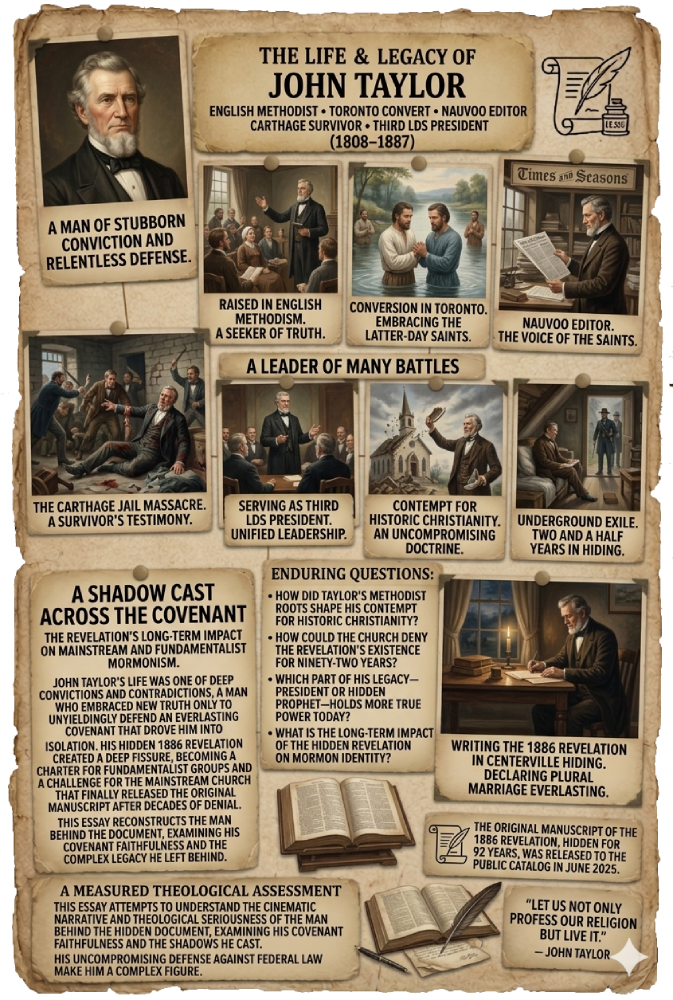
Half a century later, that same man—older, white-haired, his stately presence undimmed—would be hiding in a farmhouse in Kaysville, Utah, sealed away from the world, dying in exile. At the same time, federal marshals scoured the territory for him. By then, he was the third President of The Church of Jesus Christ of Latter-day Saints, the successor of Joseph Smith and Brigham Young, the editor who had set the type for Joseph Smith’s last sermons, the witness who had taken four bullets at Carthage Jail. And in his pocket—or in a desk drawer, or among the papers of a dutiful son—lay a single penciled sheet that would become one of the most consequential and most embarrassing documents in the history of Mormonism: the so-called 1886 Revelation, in which John Taylor’s God forbade the very surrender to Caesar that his successor would carry out four years later.
This is the story of how a Westmorland cabinetmaker became an outlaw prophet, how an English Methodist became the chief defender of polygamy, and how a man who tore open his vest for the goddess of liberty ended up writing, alone and afraid, a revelation that his own institution would deny for ninety-two years.
✦ ✦ ✦
II. England’s Reluctant Pilgrim
John Taylor was born on 1 November 1808 in the village of Milnthorpe, in the old county of Westmorland—now absorbed into Cumbria—at the edge of the Lake District, whose poets and painters defined Romantic England. His parents, James and Agnes Taylor, were modest farmers of Anglican heritage and stubborn northern character. He was the second of ten children; four siblings died young, and the eldest, Edward, died at twenty-one, leaving John as his father’s chief support. The household read the Bible in the evenings, sang hymns at the hearth, and christened its children into the Church of England by reflex more than conviction.
Taylor’s own conviction came earlier, and from a different direction. As a small boy, by his later account, he saw “in vision, an angel in the heavens, holding a trumpet to his mouth, sounding a message to the nations.” He did not understand the vision at the time, and he was honest enough never to claim he had. He recorded, however, that he often heard “sweet, soft, melodious music, as if performed by angelic or supernatural beings,” both alone and in company. Whatever these experiences were—genuine numinous encounter, adolescent imagination, the susceptibility of a sensitive nature reared on hymn-singing and the cadences of the Book of Common Prayer—they left him persuaded that the visible world was thinly skinned over a louder, brighter one. He was a believer before he had anything specific to believe in.
Formal schooling ended at fourteen, the customary terminus for a working-class English boy of his generation. He apprenticed first as a cooper, then trained as a woodturner and cabinetmaker—a trade that demanded patience, precision, and a craftsman’s respect for grain and joinery. The shop floor would mark his entire life. Even as a Quorum of the Twelve apostle in the Salt Lake Valley, he would still describe himself instinctively as a mechanic and tradesman. He understood doctrine the way he had once understood wood: there was a way it wanted to fit together, and a way it did not, and a man who pretended otherwise produced furniture that fell apart.
At sixteen, he left the Church of England—not in anger but in restlessness—and joined the Methodists, whose more ardent preaching and class-meeting intimacy answered his sense that religion ought to mean something. A year later, he was appointed an exhorter, a lay preacher, a striking commission for a boy of seventeen. He prayed in the fields behind hedgerows. He preached in market squares. And, more strangely, he began to feel “a strong impression on my mind that I must go to America to preach the gospel.” He had never crossed the Channel. He had no relations in the New World. America was, for a Westmorland apprentice, a distant rumor of cotton mills and Indians. But the impression would not lift.
In 1830, his parents and several siblings emigrated to Upper Canada, settling near Toronto. John remained behind to sell the family property, an act of filial duty that consumed nearly two years. In 1832, he boarded a ship bound for New York and the Atlantic, as if to confirm what he already believed, nearly killed him. The vessel was caught in a storm that had already sunk other ships in the same waters. Officers wept on deck. Taylor, by his own report, walked the deck at midnight “amidst the raging elements” and felt “as calm as though I was sitting in a parlor at home.” The voice, he wrote, told him: You must yet go to America and preach the gospel. He arrived. The voice had been right about that much.
✦ ✦ ✦
III. The Methodist’s Disappointment
In Toronto, Taylor rejoined his family and reentered Methodist preaching. He also met Leonora Cannon, a refined and devoutly religious woman from the Isle of Man, twelve years his senior, who had originally rejected his first proposal of marriage but reconsidered after dreaming, she said, of being his companion. They were married on 28 January 1833 in an Anglican ceremony in Toronto. She was a steady, intelligent, faithful woman who would bear his first children, share his exile, and never live to see him become president of the Church she helped him discover.
For three years, the Taylors prospered in their respectability. He preached. She kept a clean home. He worked in his trade, supplying woodturned chairs and cabinetry to the growing town. But the same restlessness that had pushed him out of the Church of England now began to push him out of Methodism. He could not square what he read in the New Testament with what he saw in the Methodist establishment. Apostles, prophets, gifts of the Spirit, healings—these belonged, the Bible insisted, to the church Christ founded. Where were they now?
He began to attend a study group of similarly disenchanted Methodists in Toronto—men and women so persistent in their questions that the local Methodist hierarchy nicknamed them “the Dissenters.” Among the group were Joseph Fielding and his sisters Mary (who would marry Hyrum Smith) and Mercy (who would marry Robert B. Thompson and later Hyrum). They prayed, they argued, and they reached, week by week, the same uncomfortable conclusion: the present Christian world was not the Christian world of the New Testament. Something had been lost—something needed to be restored.
Taylor did not yet know what that something looked like. But when, in the spring of 1836, an American missionary named Parley P. Pratt walked into Toronto with a strange new book and a stranger new gospel, the Dissenters were already in the posture of expectancy. Pratt had been told by Heber C. Kimball that he would find in Toronto “a people prepared for the gospel.” He had not exaggerated.
✦ ✦ ✦
IV. The Toronto Baptism
Taylor’s first response to Parley Pratt was wary. He had heard rumors of the Mormons, none of them complimentary. He kept his distance until a neighbor, struck by Pratt’s bearing, offered the apostle a room and a forum. From that platform, Pratt preached the doctrines of the Restoration: the falling away of the primitive church, the calling of Joseph Smith, the Book of Mormon as an ancient American scripture, the restoration of apostolic priesthood, the gifts of the Spirit, and the literal gathering of Israel. Taylor, characteristic of him, refused to be merely impressed.
“We are here, ostensibly in search of truth. Hitherto we have fully investigated other creeds and doctrines and proven them false. Why should we fear to investigate Mormonism? I desire to investigate his doctrines and claims to authority. If I find his religion true, I shall accept it, no matter what the consequences may be; and if false, then I shall expose it.”
— John Taylor, Toronto, 1836
He set out to do precisely that. He followed Pratt from preaching point to preaching point for three weeks, took down the sermons in shorthand, and compared each claim, line by line, against the New Testament he had been reading since childhood. The conclusion, when it came, was not a leap but the completion of a slow argument. On 9 May 1836, John and Leonora Taylor were baptized into the Church of Jesus Christ of Latter-day Saints in a private pond on the property of Joseph Fielding. Taylor would later say, with the literalism of a cabinetmaker who had measured every joint, that he had “never doubted any principle of Mormonism since.”
There is something poignant in that sentence. A man who had searched all his life for a settled religious home declares, in his late twenties, that the search is over. Everything that follows—forty-one years of apostleship, mission presidencies, newspaper editorships, polygamous marriages, an underground exile, and a contested deathbed revelation—rests on that bedrock certainty acquired in a Toronto parlor in the spring of his thirtieth year. For better and for worse, John Taylor was now a Mormon. He would die one. And the historian who wishes to understand him must take that certainty seriously, even when the historian himself does not share it.
Within a year of his baptism, Taylor was the presiding officer over Latter Day Saint congregations in Upper Canada, preaching tirelessly across the region, organizing six branches, and arranging for Joseph Smith’s own visit in the summer of 1837. When Taylor finally met the Prophet at the Smith home in Kirtland, Ohio, that spring, he later wrote that he felt “a charge like an electrical shock” run through him as he took Joseph Smith by the hand. The phrase has been quoted devotionally for nearly two centuries within the LDS Church. It deserves to be quoted with care. A man as analytical and observant as Taylor does not use the word electrical casually in 1837—it was a fashionable scientific image for an invisible force that was real, immediate, and quantifiable. Whatever happened in that handshake, it convinced Taylor, on the level of bodily sensation, that he was in the presence of something he had been looking for since the angel with the trumpet first crossed his boyhood sky.
✦ ✦ ✦
V. The Apostle from Canada
In December 1838, in the rebuilt log cabins of Far West, Missouri, John Taylor was ordained an apostle of the restored church—one of the youngest in its young history. He was just over thirty. He had been a Latter-day Saint for two and a half years. The Quorum of the Twelve to which he was called had been gutted by defections; three of its members had been disfellowshipped the previous year, another excommunicated, and the apostle David W. Patten had just been killed by Missouri militia at the Battle of Crooked River. The institution that had ordained Taylor in Far West was, in worldly terms, broken.
It was during this same Missouri winter that Taylor encountered the dark side of the American liberty he had so theatrically defended near Columbus the year before. He watched homes burn. He watched neighbors—aged veterans of the Revolution among them—beaten in the streets by their fellow citizens for the crime of being Mormon. He would never forget the sight of one such old man, his white hair clotted with his own brains and blood, dying “on the soil he that had heretofore shed his blood to redeem.” Taylor’s writings on America—his abiding love for its founding principles, his fury at the failure of its citizens to live up to them—were forged in those months. He kept the belief in liberty. He lost any innocence about how reliably his American neighbors would honor it.
With the Quorum of the Twelve, Taylor was assigned in 1839 to the mission to Great Britain. It was a moment of extraordinary improbability: a starving Missouri refugee church, driven from Far West, regrouping in malarial Commerce, Illinois, sent its apostles across the Atlantic to recruit British converts. Taylor, the only native-born British apostle, was uniquely positioned. He preached in Liverpool, opened Mormon missionary work in Ireland and on his wife’s native Isle of Man, and helped baptize her brother George Cannon’s family, one of whom—a twelve-year-old boy named George Q. Cannon—would grow up to be Taylor’s most trusted lieutenant in the First Presidency. The mission cost Taylor his daughter Leonora Agnes, who died in infancy back in Nauvoo while he was away. He came home in 1841 to find his children grown, his wife exhausted, and his church established.
✦ ✦ ✦
VI. The Nauvoo Editor
Back in the new city of Nauvoo on the bend of the Mississippi, Taylor entered the most consequential phase of his pre-presidential career. He was made a city councilman, a chaplain, a colonel, and a judge advocate in the Nauvoo Legion. But his real influence flowed from a pen and a printing press. From 1842 onward, he was editor of Times and Seasons, the official church newspaper—nominally under Joseph Smith, but practically the man in charge. He simultaneously ran the Wasp and its successor, the Nauvoo Neighbor, the more politically and culturally aggressive Nauvoo publications. For four years, almost every word printed in the official voice of Joseph Smith’s gathered Saints passed under John Taylor’s blue pencil.
It was through Taylor’s columns that the most extraordinary doctrines of late Nauvoo Mormonism—plurality of gods, eternal progression, baptism for the dead, the theological speculations of the King Follett discourse—reached the membership. Taylor edited the printed version of the King Follett discourse itself, the sermon in which Joseph Smith declared that “God himself was once as we are now,” the foundational text of LDS exaltation theology. If we look for the moment when Mormonism passed from a heterodox American restorationism into a theology unmistakably and irretrievably outside historic Christianity, we will find John Taylor’s hand on the type.
It was also during these Nauvoo years that Taylor first encountered the doctrine that would define, and ultimately exile, the rest of his life. Joseph Smith confided to a small circle of trusted men that the Lord had revealed to him the doctrine of plural marriage. Taylor’s reaction was not the enthusiastic embrace later mythologized in LDS retellings. It was very nearly the opposite:
“I had always entertained strict ideas of virtue, and I felt as a married man that this was to me, outside of this principle, an appalling thing to do. The idea of going and asking a young lady to be married to me when I had already a wife! It was a thing calculated to stir up feelings from the innermost depths of the human soul. … Nothing but a knowledge of God, and the revelations of God, and the truth of them could have induced me to embrace such a principle as this.”
— John Taylor, recalling the introduction of plural marriage
The passage is honest in a way that LDS apologetics rarely permits itself to be. Taylor did not want polygamy. He recoiled from it. The decisive factor in his acceptance was not personal desire but his prior, total commitment to Joseph Smith’s prophetic authority. If Joseph said the Lord had commanded it, then the Lord had commanded it. By the time the Saints left Nauvoo in 1846, John Taylor had married at least nine additional women beyond Leonora—some for eternity only, some as guardians of widows, some who bore him children, others who never lived as wives in any conventional sense. Over the rest of his life, he would marry at least sixteen women in all, fathering thirty-four documented children, raising thirty-five with one adopted. The boy from Westmorland who had “entertained strict ideas of virtue” had become the most fertile and theologically committed polygamist in the Quorum of the Twelve.
And the man who had said his “innermost depths” were stirred by the very idea of asking a young woman to marry an already-married man would, forty years later, write a revelation declaring that this practice could never be revoked while the world endured.
✦ ✦ ✦
VII. Carthage: The Witness with Four Bullets
On the afternoon of 27 June 1844, four men sat in an upstairs room at the county jail in Carthage, Illinois. Joseph Smith and his brother Hyrum were under guard on charges arising from the destruction of the Nauvoo Expositor, the dissident newspaper Joseph had ordered torn down two weeks earlier. With them, by his own free choice and against the instinct of self-preservation, was John Taylor. The fourth man was Willard Richards, fellow apostle and church recorder.
Taylor was not under arrest. He had no legal reason to be in Carthage. He had ridden out from Nauvoo because his prophet was in danger, and he had remained because his prophet had asked him to stay. That afternoon, Hyrum Smith asked Taylor to sing the hymn “A Poor Wayfaring Man of Grief.” Taylor sang it once, sang it again when asked, and was beginning a third verse when a mob with blackened faces stormed the stairs.
In the ensuing assault, Hyrum was shot in the face and killed almost instantly. Joseph fired a small pepperbox revolver smuggled in by a friend, then made for the open window, where he was shot down and killed in the yard below. Willard Richards, miraculously untouched, dragged the wounded Taylor away from the gunfire. Four musket balls had struck Taylor: in the left thigh, below the left knee, in the left hip, and in the left forearm. A fifth ball, fired from outside the window, struck him in the chest—and either passed through, or was deflected by, the pocket watch he carried. Taylor and the church would later make much of that watch, displaying it as a relic of divine preservation. Recent forensic analysis by LDS Church historians has tentatively concluded that the watch was probably damaged not by a bullet but by Taylor’s fall against the windowsill—a small but instructive case of pious legend overtaking documentary fact.
What is not in doubt is that John Taylor was the most severely wounded survivor of Carthage. He bled on the floor of that upper room while Joseph and Hyrum bled in the yard. He carried the lead in his body for the rest of his life. He became, in the language of his admirers, a living martyr—the one apostle who had stood with the Prophet at the moment of death and lived to testify. The phrase carried weight. Few things in Mormonism are more valuable than the witness of an eyewitness who has himself shed blood.
Taylor’s tribute to the fallen brothers, composed in convalescence, was eventually canonized as Section 135 of the Doctrine and Covenants. “Joseph Smith, the Prophet and Seer of the Lord,” he wrote, “has done more, save Jesus only, for the salvation of men in this world, than any other man that ever lived in it.” The line is a thunderclap. It places Joseph Smith above every apostle, prophet, reformer, missionary, theologian, and martyr of two millennia of Christian history—above Paul, above Athanasius, above Augustine, above Luther, above Wesley—second only to Christ Himself. Taylor meant it. He was not a writer given to rhetorical overshoot. The statement is a clean, accurate index of the place Joseph Smith occupied in the post-1844 Mormon imagination, and of the place he would continue to occupy as long as the Restoration was preached. John Taylor put it into the canon. The canon has not removed it.
✦ ✦ ✦
VIII. Champion of Liberty
The decade and a half after Carthage saw Taylor in nearly every role the young Utah church required of him. He returned briefly to England in 1846 to settle disputes among the British Saints; he led 1,500 emigrants across the plains to the Salt Lake Valley in 1847; he applied for and was granted American citizenship in 1849; he served in the provisional Utah legislature and was elected Speaker of the Utah Territorial House of Representatives for five consecutive sessions. He served as probate judge of Utah County, as territorial superintendent of schools, and as president of two missions—one in France and Germany from 1849 to 1852, the other a later assignment to the Eastern States from his New York City base in the 1850s.
In France, he supervised the translation and publication of the Book of Mormon into French, founded a newspaper named L’Étoile du Deseret, and—at Brigham Young’s request—purchased expensive sugar-processing equipment in Liverpool with the intention of establishing a sugar industry in Utah. The equipment lacked a critical component, the retorts, and the venture produced only molasses. It was Taylor’s most public failure. He took it well. A man who had survived Carthage was unlikely to be devastated by an industrial-scale syrup factory.
As a writer, he was prolific. His 1852 book The Government of God contrasted divine and human political systems, declaring that “in God’s government there is perfect order, harmony, beauty, magnificence, and grandeur; in the government of man, confusion, disorder, instability, misery, discord, and death.” His 1882 book The Mediation and Atonement of Our Lord and Savior Jesus Christ gathered scriptural passages on atonement and offered his commentary. He composed hymns, two of which (“Go, Ye Messengers of Glory” and “Go, Ye Messengers of Heaven”) remain in the LDS hymnal.
From his New York pulpit in the 1850s, he edited a newspaper called simply The Mormon, whose masthead carried, beneath the title, the motto: “Mormon Creed. Mind Your Own Business.” It was a characteristic Taylor turn of phrase—polite, deadpan, and unmistakably hostile. He defended his people, debated their critics, and was eventually labeled by Sir Richard Burton, the British explorer who visited Utah and met him in 1860, as “a stout, good-looking, somewhat elderly personage, with a kindly gray eye, pleasant expression, and a forehead of the superior order.”
Above all, in this middle career, he became known as the Champion of Liberty. The phrase was earned. “I’m God’s free man,” he once declared in a sermon. “I cannot, will not be a slave!” He hated coercion. He insisted that the Mormon kingdom would be built by inspired persuasion or not at all. He inveighed against tyranny, against forced obedience, against the suppression of conscience, against the involuntary surrender of religious liberty to the state. These convictions were not opportunistic. He had held them since the day he tore open his vest in Ohio. He would hold them, almost catastrophically, in the underground years to come.
✦ ✦ ✦
IX. The Presidency
Brigham Young died on 29 August 1877. For three years thereafter, the church was governed by the Quorum of the Twelve, with John Taylor as its president. On 10 October 1880, at the church’s semi-annual general conference, Taylor was sustained as the third President of the Church, with Joseph F. Smith and George Q. Cannon (his wife’s nephew) as counselors. He was sixty-eight years old. His hair had turned snow-white. His complexion remained the dark, almost saturnine cast of the Lake District. Contemporaries described him as fastidious, dignified, gracious, and formally polite. He was, said one observer, a man whom “a friend, however intimate, would [not] slap familiarly on the back or turn and twist about when shaking hands.”
His motto as president: The Kingdom of God or Nothing. It was a brave declaration, and it would prove an exhausting one. The presidency he inherited from Brigham Young was, on paper, the unquestioned spiritual and temporal authority of an isolated Great Basin theocracy. By the time he died seven years later, it was an institution barely surviving in a war with the United States government—a war it would, within three years of his death, decisively lose.
The administrative record of his presidency is impressive. He organized the Primary Association as a churchwide auxiliary in 1880, with Louie B. Felt as its first general president. He oversaw the canonization of the Pearl of Great Price that same October. He issued a new edition of the Doctrine and Covenants with cross-references and explanatory notes. He more fully organized the seventies quorums. He established Zion’s Central Board of Trade to coordinate cooperative economic activity. He proclaimed 1880 a jubilee year in imitation of the Old Testament, forgave half the debts owed by Saints to the Perpetual Emigrating Fund (about $802,000), and distributed one thousand cows and five thousand sheep to the poor. He directed the construction of temples in Logan, Manti, and Salt Lake City, dedicating the Logan Temple in 1884.
He also expanded Mormon settlement beyond the Wasatch Front. Mormon colonies were planted in Colorado, Wyoming, Arizona, the Canadian Northwest Territories, and—decisively—the Mexican state of Chihuahua. These last colonies were not a matter of routine missionary expansion. They were an escape route for polygamists. The President of the Church was, in effect, building safe harbors for his own people beyond the reach of American law.
✦ ✦ ✦
X. The Edmunds Act and the Outlaw Prophet
In March 1882, the United States Congress passed the Edmunds Act, declaring polygamy a felony, defining a new misdemeanor of “unlawful cohabitation,” barring polygamists from voting, jury service, and public office, and authorizing federal marshals to hunt them down. At the church’s April general conference, John Taylor warned the Saints that a storm was coming. He was right. Federal officers fanned out across Utah Territory, arresting Mormon men in their homes and at their workplaces. Wives were forced to testify against husbands. The territorial press called the resulting prosecutions the Mormon underground. The Saints called it the Raid.
Taylor at first tried to comply with appearances. He moved into the official church residence, the Gardo House on South Temple, alone with his unmarried sister Agnes, to avoid showing preference to any of his polygamous wives and to deny federal prosecutors evidence of unlawful cohabitation. By February 1885, that pretense had collapsed. President Taylor and his counselors went into the underground themselves. For the next two and a half years, he led the largest religious denomination in the Mountain West from a succession of safe houses, communicating with his family chiefly by letter, moving by night, sleeping in upstairs bedrooms with the doors bolted, hearing every footstep on the gravel outside as a possible federal marshal.
In what proved to be his last public sermon, delivered on 1 February 1885, the day he went into hiding, Taylor laid down the principle that would govern his final years:
“I would like to obey and place myself in subjection to every law of man. What then? Am I to disobey the law of God? Has any man a right to control my conscience, or your conscience? … No man has a right to do it.”
— John Taylor, last public sermon, 1 February 1885
It was the conviction of his Ohio tar-and-feathers speech, refined in the kiln of forty-eight years. The state had no authority to overrule the conscience of a believer. If the law of man clashed with the law of God, the law of man would lose. The phrasing was magnificent. The application was polygamy. A frank Christian observer must hold both facts simultaneously: Taylor was articulating a noble and historic principle of religious liberty, and he was applying it in defense of a practice that the Christian world had universally rejected since the apostolic era. The contradiction was not visible to him. It would be invisible to most of his followers. It was painfully visible to nearly everyone else.
In July 1887, after two and a half years on the run, John Taylor died of congestive heart failure at the Roueche home in Kaysville, Utah, surrounded by a small circle of family and trusted associates. He was seventy-eight years old. He was buried in the Salt Lake City Cemetery. Federal marshals were still looking for him at the time of his death. He had never surrendered.
✦ ✦ ✦
XI. The 1886 Revelation
On the night of 26 September 1886, while in hiding at the Centerville home of John W. Woolley, a Mormon polygamist later associated with the fundamentalist movement, President Taylor was visited by a delegation of church leaders urging him to consider abandoning the practice of plural marriage to relieve federal pressure on the church. Taylor, by his own later account and the corroborating recollections of his secretary L. John Nuttall withdrew to his room to pray. According to the fundamentalist witness, Lorin C. Woolley, who claimed to have been in the house that night, Taylor’s room glowed all night with the light of an extraordinary visitation, and three distinct voices could be heard in conversation through the bolted door.
In the morning, John Taylor took up a pencil and wrote out, in his own unmistakable hand, on a single sheet of paper, a revelation answering the question his unnamed son John had pressed on him: how binding was the New and Everlasting Covenant—the doctrine of plural marriage—on the people of God?
“My son John, you have asked me concerning the New and Everlasting Covenant how far it is binding upon my people. Thus saith the Lord: All commandments that I give must be obeyed by those calling themselves by my name unless they are revoked by me or by my authority, and how can I revoke an everlasting covenant, for I the Lord am everlasting and my everlasting covenants cannot be abrogated nor done away with, but they stand forever. … I have not revoked this law, nor will I, for it is everlasting, and those who will enter into my glory must obey the conditions thereof; even so, Amen.”
— John Taylor, Revelation of 27 September 1886
Three years later, John Taylor’s successor, Wilford Woodruff, issued the Manifesto of 1890, officially suspending the church’s authorization of new plural marriages. Six months before that Manifesto, Heber J. Grant recorded in his journal that John W. Taylor had read his father’s 1886 revelation aloud to the Quorum of the Twelve. The brethren knew the revelation existed. They knew its author. They knew its content. They proceeded with the Manifesto anyway.
And there the trouble began. A small but determined community of polygamists, refusing to accept that an eternal commandment could be revoked under government pressure, broke fellowship and continued the practice. They became the Mormon fundamentalists. Their movement claims today some 100,000 adherents in the Mountain West, in Mexico, and along the borders of Utah, Arizona, and British Columbia. Their founding document, the rock upon which their continued existence rests, is the 1886 Revelation.
In 1933, embarrassed by the proliferation of fundamentalist groups and pressed for an answer, the First Presidency—Heber J. Grant, Anthony W. Ivins, and J. Reuben Clark—issued an Official Statement (sometimes called the “Third Manifesto”) declaring that the so-called 1886 revelation was a “pretended revelation,” that “the archives of the Church contain no such revelation,” and that they were therefore “justified in affirming that no such revelation exists.”
Less than a month after that public denial, Frank Y. Taylor, John Taylor’s son, walked into the office of President Heber J. Grant and deposited in his hands the original handwritten revelation, in his father’s penciled script, found among the papers of his late brother John W. Taylor. The First Presidency now had in its possession the very document it had just told the world did not exist. The First Presidency placed it in the church archives, where it would remain for ninety-two years.
In 1974, Apostle Mark E. Petersen continued the denial in print, writing that “recalcitrant brethren … concocted a false revelation, allegedly given to President John Taylor in 1886.” Other LDS leaders and apologists continued the same line for decades. Then, on 14 June 2025, with little fanfare, the LDS Church History Catalog quietly posted to its public-facing website a digitized scan of the original 1886 revelation in John Taylor’s handwriting, along with transcripts, a 1909 typescript copy by Joseph Fielding Smith, and J. Reuben Clark’s own 1933 memorandum describing how the document had come into the First Presidency’s possession that summer—exactly when Clark and Grant and Ivins had been publicly declaring it did not exist.
The LDS historian Brian C. Hales, who has spent his career defending the church on questions of polygamy, has written with admirable candor: “The greatest significance of the 1886 revelation is that the Church tried to suppress its existence.” That suppression lasted from at least 1933 to 2025. Whatever one’s opinion of John Taylor or of the doctrine he was defending, the institutional record is now public. The man wrote a revelation. The institution denied the revelation. The institution had the revelation in its vault while denying it. Ninety-two years later, the institution released it, without apology, without statement, without explanation, simply as one more cataloged item in a digital archive. The story of the 1886 revelation is, among other things, a master class in how a modern religious bureaucracy manages an inconvenient prophetic legacy.
✦ ✦ ✦
XII. When Is a Revelation Just a Religious Opinion?
The 1886 revelation forces, with unusual clarity, a question that haunts every prophetic religious tradition: when is a so-called revelation actually a revelation, and when is it a deeply held religious opinion clothed in revelatory language?
Taylor’s contemporaries did not doubt his sincerity. His private secretary, George Reynolds, who took down most of his revelations from dictation, described the process in detail. Taylor would receive an impression, sit down, and write. The Lord, Reynolds insisted, “makes no preface” when he speaks—the language of the revelations differed in cadence and concision from Taylor’s normal speech. Reynolds was convinced he was witnessing the dictation of divine words. Taylor evidently believed it as well. The 1879 Salt Lake Tribune had nicknamed him “John the Revelator” in mockery, and Latter-day Saints adopted the title in earnest.
But the question of when prophetic speech is binding upon the church—and when it is merely the private religious opinion of a particular prophet—has dogged Mormonism since Joseph Smith. Brigham Young’s Adam–God doctrine, taught from the pulpit of the Salt Lake Tabernacle, was later quietly repudiated by his successors. His blood atonement sermons were softened, then disavowed. His teaching that the priesthood ban on Black members was a divinely revealed eternal principle was reversed in 1978 and reinterpreted in 2013 by an official church essay as a product of cultural prejudice rather than divine instruction. The pattern is clear: prophetic statements that prove costly or embarrassing tend, over time, to be redefined as personal opinion.
Taylor’s 1886 revelation is the most acute case. He framed it with the words Thus saith the Lord. He claimed direct divine authorship. He insisted the everlasting covenant could not be abrogated. Four years after his death, his immediate successor revoked the covenant anyway. The church’s modern position, as articulated in volume 2 of Saints (2020), is that the revelation was “never presented to the Quorum of the Twelve or accepted as scripture by the Saints” and is therefore not binding. This is institutionally tidy. It is also theologically dangerous. If a sitting prophet of the Most High can write Thus saith the Lord in his own hand, and the institution he leads can simply decline to canonize it and thereby render it not the word of God, then the test for what counts as revelation is not the source of the message but the willingness of the bureaucracy to accept it. The prophet proposes. The corporation disposes.
From a biblical Christian perspective, this is precisely the problem the New Testament anticipates. Deuteronomy 18:22 lays down the test: if a prophet speaks in the name of the Lord, and the thing does not come to pass or hold, the Lord has not spoken; the prophet has spoken presumptuously. Galatians 1:8 reinforces the principle: even an angel from heaven preaching a different gospel is to be rejected. The believer is not without recourse. Revelation must be testable. The 1886 revelation, by its own internal claim, cannot be revoked. It has been revoked. The conclusion the New Testament invites is not pleasant. But it is straightforward.
✦ ✦ ✦
XIII. “A Perfect Pack of Nonsense”
To understand John Taylor’s theological position relative to the historic Christian church, one needs only to read what he himself preached. In the Great Salt Lake Tabernacle on 17 January 1858, Apostle Taylor mounted the rostrum and delivered a sermon that included, among other declarations, the following:
“We talk about Christianity, but it is a perfect pack of nonsense. … It is a sounding brass and a tinkling cymbal; it is as corrupt as hell; and the Devil could not invent a better engine to spread his work than the Christianity of the nineteenth century.”
— John Taylor, Journal of Discourses 6:167, 17 January 1858
This was not a momentary outburst. In a discourse delivered on 6 May 1870, Taylor asked rhetorically, “What does the Christian world know about God? Nothing,” and answered his own question by declaring that the historic Christian churches did not know the true God, did not possess true priesthood, did not administer valid sacraments. These were not the opinions of a fringe pamphleteer. They were the considered theological judgments of the third President of the LDS Church, preached from the pulpit of Mormonism’s most sacred space, and published in the Journal of Discourses as authoritative doctrine.
It is essential, when we read these statements, not to soften them out of squeamishness. Taylor did not believe that Christians and Mormons worshiped the same God in different ways. He believed historic Christianity was apostate, corrupt as hell, and serving the work of the devil. He believed the true church—the church with the true priesthood, the true ordinances, the true God—had been restored through Joseph Smith and continued through himself. He believed the angel of his boyhood vision had been the same angel Moroni who delivered the plates to Joseph Smith, and that the visible Christianity of his English childhood was therefore, in any meaningful sense, false.
Compared with historic biblical Christianity, the doctrinal departures Taylor accepted, taught, and defended are not marginal. They are foundational. He accepted Joseph Smith’s plurality-of-gods doctrine, in which the Father is an exalted Man who once lived on another world and progressed to godhood—a doctrine the Council of Nicaea would have called gross polytheism and that 1 Timothy 2:5 explicitly excludes. He defended eternal progression and the deification of righteous men, doctrines that take Lorenzo Snow’s couplet, “As man now is, God once was; as God now is, man may become,” with absolute literalism—a system foreign to Isaiah 43:10, “Before me there was no God formed, neither shall there be after me.” He defended plural marriage as a celestial principle essential to exaltation, in direct contradiction to Christ’s teaching in Matthew 19:4–6 and Paul’s instruction in 1 Timothy 3:2. He defended the LDS sacraments—endowment, sealing, priesthood ordination—as the only valid administration on earth, denying the validity of every baptism performed in every Christian church for the eighteen centuries between the apostles and Joseph Smith. He accepted the Book of Mormon, the Doctrine and Covenants, and the Pearl of Great Price as scripture on a par with—and in practice superior to—the Bible.
These were not the convictions of a casual man. Taylor argued for them, suffered for them, wrote books on them, edited newspapers in defense of them, and finally went into outlaw exile to preserve at least one of them. To engage him as a Christian apologist is not to dismiss his courage or his sincerity. It is to take seriously what he meant when he stood in the Tabernacle and called nineteenth-century Christianity a perfect pack of nonsense. He meant it. And the Christian who reads him fairly is obliged to recognize that the Mormonism he defended was, by his own clear and repeated statement, a different religion than the one taught in the New Testament—a different gospel of a different Christ, offered on the authority of a different prophet and administered through a different priesthood.
✦ ✦ ✦
XIV. The Measure of the Man
To weigh John Taylor honestly, we must hold several truths at once. He was a man of unusual personal integrity, intellectual seriousness, and physical courage. He had taken four bullets at Carthage and never weaponized the suffering for personal advantage. He hated coercion and prized liberty of conscience. He was fastidiously honest in money matters in an era when many of his colleagues were not. He was a tender husband and devoted father who wrote affectionate letters to his children from foreign mission fields—“George, be a good boy, do what your Mother tells you, and God will love you, and I will love you.” He was a hymn-writer, a tenor of remarkable beauty, an aesthete who carried with him into the Utah desert a love of music, formal manners, and good prose. Sir Richard Burton, who met every kind of man in his travels and was not easily impressed, described Taylor as polite, dignified, and possessed of a forehead “of the superior order.”
He was also a man whose blind spots were enormous and whose religious framework permitted him to defend, with elaborate sincerity, doctrines that did damage. His acceptance of plural marriage produced a household of at least sixteen wives, thirty-four documented biological children, and (one suspects) more loneliness and difficulty than the polished hagiographies of the Religious Studies Center at BYU permit themselves to acknowledge. The 1886 revelation he wrote at the Woolley home in Centerville fueled the existence of the very Mormon fundamentalist movement whose abuses—child brides, coerced marriages, the depredations of figures like Warren Jeffs—still haunt American religious news a hundred and forty years later. He could not have foreseen Warren Jeffs. He did, however, set in motion the document that Warren Jeffs and his predecessors would cite as their charter.
His relationship to truth-telling is the most painful question of all. He did not lie about the 1886 revelation. He wrote it, signed it (or rather, declined to sign it, in keeping with his usual practice for personal revelations), and gave it to his sons. But the institution he led—through his immediate successors and through the First Presidency under Heber J. Grant in 1933 specifically—did lie about it, repeatedly, publicly, and for ninety-two years. The man himself died before that institutional deception began. He cannot be charged with it. But he is bound up in it. The revelation is his. The denial of the revelation is the church’s. And the church is, in the most basic Mormon sense, his: the church he led, the church he wrote scripture for, the church for whose continuance he died in exile. To tell the truth about John Taylor is to tell the truth about both.
He was, in short, a man of high virtues and high commitments serving a religious system that asked of him sustained intellectual acrobatics no one ought to have to perform. The American Revolutionary rhetoric he wielded so brilliantly belonged to a tradition older than Mormonism—a tradition rooted in Protestant convictions about the freedom of the Christian conscience under God. He used it well. He used it, finally, in defense of a practice that the Protestant tradition itself had universally rejected. The pathos of John Taylor’s life is the pathos of a Lake District Methodist with a true Christian conscience trying, against deeper logic, to make Mormonism do work it could not finally do.
✦ ✦ ✦
XV. The Sanitized Saint
How official LDS sources present John Taylor today is a study in selective memory. The 2001 manual Teachings of Presidents of the Church: John Taylor, used as the official course of study for adult Sunday Relief Society and Melchizedek Priesthood classes in 2003, devotes twenty-four chapters to his doctrinal and devotional teachings. There is no chapter on plural marriage. There is no chapter on the underground. There is no chapter on the 1886 revelation. The introduction’s account of his life mentions polygamy in two oblique sentences. Federal persecution is described abstractly as “one of the most trying periods in Church history” without specifying that the trial was the federal enforcement of laws against polygamy.
This pattern—dignified silence around the difficult facts, fluent eloquence on the devotional ones—is the central characteristic of the correlated LDS curriculum. It is not, strictly speaking, dishonest. The chapters on integrity, on the atonement, on the priesthood, on family, and on the kingdom of God reproduce Taylor’s actual sermons accurately. The dishonesty, if it can be called that, is in the framing. A reader who knew nothing of John Taylor before opening the manual would close it with no idea that he had been the most committed polygamist in the early Quorum of the Twelve, that he had died in hiding from federal marshals, that he had written a revelation his church would later deny existed, or that he had called nineteenth-century Christianity “a perfect pack of nonsense.” The Taylor of the manual is a kindly, elegant, white-haired patriarch who taught lovely lessons about obedience and the family. The Taylor of the documentary record is a more complicated, more interesting, and more theologically dangerous figure.
BYU’s Religious Studies Center, in its 2009 volume Champion of Liberty: John Taylor, goes further—engaging the underground period, the family situation, and even the 1886 revelation with measured candor. But it does so within the confines of devotional history; the volume’s chapter on the 1886 revelation cautions readers against accepting its authenticity, even though, sixteen years later, the church itself would acknowledge that authenticity by releasing the document. The 2025 release was, in effect, a quiet repudiation of the 2009 caution. No press release announced this. Active Latter-day Saints who attend Sunday services in 2026 are still being taught from a manual that does not mention the 1886 revelation. The 2025 archival upload sits on a public catalog. The Sunday-morning history sits on the lectern. The two do not speak to each other.
This is not unique to John Taylor. It is the standard institutional posture toward every awkward fact in early LDS history: the multiple First Vision accounts, the Book of Abraham translation problems, the Kinderhook plates, Joseph Smith’s polyandrous marriages, the priesthood and temple ban on Black members, the Mountain Meadows Massacre, and the Adam–God doctrine. In each case, the official-history apparatus eventually catches up, releases new essays or new manuals quietly, and adjusts the narrative without acknowledging that the previous narrative was inadequate. Anything goes “down the memory hole.” The faithful go on; the curriculum is updated; the framing is preserved. The cumulative effect, for the careful historian or the awakened insider, is a slow, painful realization that the church’s relationship to its own history is more administrative than confessional. Truth is what the Brethren are presently willing to release.
John Taylor would, one suspects, have hated this. He was a working journalist before he was a prophet. He valued evidence. He insisted that his readers “mind your own business,” not because he feared scrutiny but because he disdained gossip. Were he alive to read the Saints volumes today, he would, in this writer’s opinion, have demanded a more honest account of his own underground years. His successors, by contrast, prefer to send him into hagiographic exile—an elder statesman of the Restoration in white side-whiskers, his rough edges sanded down for Sunday consumption. It is the second exile of John Taylor. The federal marshals could not catch him. The correlation committee did.
✦ ✦ ✦
XVI. Legacy and Reckoning
What is John Taylor’s legacy? On the institutional side, the answer is clear. He stabilized the church through a brutal decade. He held the Quorum of the Twelve together during the underground years. He died in office rather than yield. His successor, Wilford Woodruff, freed by Taylor’s death from the impossible burden of defending plural marriage from inside a federal prison cell, was able to issue the 1890 Manifesto and put the institutional church on the path to American respectability. Without Taylor’s stubborn refusal to surrender, the Manifesto might have come a decade earlier, the church might have splintered more violently, and the historical trajectory of the LDS Church into the twentieth century would have looked very different. He gave Mormonism its institutional steel.
He also gave it the document that has, for a century and a half, defined the dissident edge of the movement. The Mormon fundamentalist sects—from the Apostolic United Brethren to the Fundamentalist Church of Jesus Christ of Latter-day Saints (FLDS) to the Centennial Park groups—trace their authority through Lorin C. Woolley back to the 1886 meeting in the Woolley home. John Taylor’s revelation is their charter. The 100,000 or so fundamentalist Mormons who continue to practice plural marriage in defiance of both the federal government and the mainstream LDS Church are, in a real and direct sense, Taylor’s children. The mainstream church may wish it otherwise. The mainstream church may, as it did in 1933, even deny its own history to wish it otherwise. The document is now public. The lineage is now traceable. The grandchildren of the underground are still here.
On the theological side, the legacy is more troubling. Taylor’s defense of polygamy, his elaboration of the King Follett theology, his contempt for historic Christianity, and his canonized exaltation of Joseph Smith above every Christian saint of two millennia—these defined the doctrinal architecture of late nineteenth-century Mormonism. Twentieth-century LDS leaders did not undo this architecture. They softened the rhetoric, they sanded the edges, they let the harshest sermons fall out of the manuals, they replaced Mormons with Latter-day Saints and Latter-day Saints with members of The Church of Jesus Christ of Latter-day Saints. But the doctrines themselves—the King Follett discourse, the plurality of gods, eternal progression, exaltation through priesthood and temple ordinances, the unique authority of the LDS prophets—remain in place. Taylor helped build that house. Russell M. Nelson lives in it.
From a Christian perspective, the question Taylor’s life poses is the question every honest religious biography eventually poses: Can sincerity, courage, and personal virtue make a false religion true? Taylor was sincere. He was extraordinarily courageous. He was, by the standards of his time and his place, a virtuous man. None of that, of itself, validates the system he served. Saul of Tarsus was sincere when he persecuted the church. Sincerity is not a doctrinal credential. The same Apostle who once breathed threatenings and slaughter against the disciples of the Lord eventually wrote, on the Damascus Road of his own conversion, that even an angel from heaven preaching a different gospel was to be rejected. The principle cuts in only one direction. If the gospel Joseph Smith brought, and John Taylor defended, is a different gospel than the one Paul preached—and the textual evidence makes that a difficult conclusion to evade—then the sincerity of its defenders, however affecting, does not save the message.
And yet the man himself deserves more than a verdict. He deserves, finally, a kind of measured respect. He paid the price for his convictions. He bled at Carthage. He died in exile. He never sold his Saints out for personal comfort. He wrote what he believed, sang the hymns he had learned at a Westmorland hearth, and went to his grave certain that he had served the Lord. A Christian observer who has read his life carefully can disagree, deeply and decisively, with his theology while still grieving, with him, the absurd and cruel federal harassment of his people, the cold rectitude of the marshals who pursued an old man into hiding, and the long indignity of being declared an outlaw in the country whose Constitution he had defended at the cost of nearly being tarred and feathered for it.
He was wrong about the 1886 revelation. He was wrong about polygamy. He was, in this writer’s settled judgment, wrong about the gospel itself. But he was not contemptible. He was a serious man on a wrong path who walked it to the end, asking no quarter, taking none, and leaving behind a pencil-smudged sheet of paper that has outlived every denial his church has tried to issue against it. The paper is now public. The man’s witness, for all its errors, can no longer be filed quietly under “pretended.” The historical John Taylor has, at long last, returned from his second exile. The Christian reader is left with the obligation, equally long delayed, of meeting him honestly.
✦ ✦ ✦
Editorial Note
This essay was developed in collaboration with Anthropic’s Claude AI as a research and drafting partner. All factual claims have been verified against the primary and secondary sources cited herein, including Wikipedia, the official Church of Jesus Christ of Latter-day Saints history catalog, the Religious Studies Center at Brigham Young University, the Mormonism Research Ministry, the Salt Lake Tribune, the Joseph Smith Foundation, the Journal of Discourses online archive, and the documentary archives maintained by Mormonr and wasmormon.org. Interpretive framing and theological evaluation reflect the considered Christian perspective of The Righteous Cause, novus2.com/righteouscause, in the tradition of careful, charitable, evidence-driven biographical scholarship modeled on the works of Barbara Tuchman and Ian Kershaw.
The 1886 Revelation by President John Taylor is now publicly accessible in the Church of Jesus Christ of Latter-day Saints History Catalog, item MS 34928, titled “John Taylor revelation, 1886 September 27.” Readers are encouraged to examine the original document and form their own judgment.
Primary Resources:
• https://en.wikipedia.org/wiki/John_Taylor_(Mormon)
• https://www.churchofjesuschrist.org/study/manual/teachings-john-taylor/the-life-and-ministry-of-john-taylor?lang=eng
• https://www.churchofjesuschrist.org/study/history/topics/john-taylor?lang=eng
• https://rsc.byu.edu/champion-liberty-john-taylor/john-revelator-written-revelations-john-taylor
• https://www.sltrib.com/religion/2025/06/17/lds-church-finally-releases-an/
• https://www.churchofjesuschrist.org/study/ensign/2003/01/john-taylor-defender-of-truth?lang=eng
• https://www.reddit.com/r/mormon/comments/1lbjd2j/john_taylor_revelation_1886/
• https://rsc.byu.edu/champion-liberty-john-taylor/john-taylor-family-man
• https://mormonr.org/qnas/vFgD6f/john_taylors_1886_revelation
• https://josephsmithfoundation.org/john-taylors-last-days-vision-1877/
• https://rsc.byu.edu/prophets-apostles-last-dispensation/john-taylor
• https://www.fairlatterdaysaints.org/answers/John_Taylor%27s_statements_regarding_polygamy
• https://www.lightplanet.com/mormons/people/john_taylor.html
• https://history.churchofjesuschrist.org/content/museum/museum-treasures-john-taylors-pocket-watch?lang=eng
• https://fromthedesk.org/john-taylor-revelations/
• https://mrm.org/1886-revelation
• https://keystonelds.com/about-mormons/history/john-taylor-british-convert-outlaw-prophet/
• https://en.wikipedia.org/wiki/1886_Revelation
• https://www.reddit.com/r/mormon/comments/90mo1q/john_taylors_1886_revelation_why_it_is_massive/
• https://wasmormon.org/john-taylors-hidden-1886-polygamy-revelation/
• https://rsc.byu.edu/champion-liberty-john-taylor/john-taylor-adopted-son-america
A Note on Research Methods and Accuracy
In recent years, some have voiced concern that artificial intelligence may distort facts or introduce inaccuracies into serious research. That criticism deserves acknowledgment. However, AI has now evolved into the most powerful research instrument available to any dedicated scholar—capable of analyzing vast datasets, cross‑referencing historical records, and surfacing overlooked connections across sources. This work represents a collaboration between the author’s investigative inquiry, verified primary documentation, and the advanced analytic capabilities of AI research tools. Here, AI was not used as a ghostwriter or a shortcut for scholarship, but as a disciplined research partner devoted to rigor, accuracy, and transparency.
Every factual claim in this work has been subjected to active verification. Where AI‑generated content was used as a starting point, it was tested against primary sources, peer‑reviewed scholarship, official institutional documentation, and established historical records. Where discrepancies were found—and they were found—corrections were made. The author has made every reasonable effort to ensure that quotations are accurately attributed, historical details are precisely rendered, and theological claims fairly represent the positions they describe or critique.
That said, no work of this scope is immune to error, and the author has no interest in perpetuating inaccuracies in the service of an argument. If you are a reader—whether sympathetic, skeptical, or hostile to the conclusions drawn here—and you identify a factual error, a misattributed source, a misrepresented teaching, or a claim that cannot be substantiated, you are warmly and genuinely invited to say so. Reach out. The goal of this work is not to win a debate but to get the history right. Corrections offered in good faith will be received in the same spirit, and verified corrections will be incorporated into future editions without hesitation.
Truth, after all, has nothing to fear from scrutiny—and neither does this work.