
The Quiet That Carries: A Pastoral Plea for Sacred Music in a Loud Age
❦ ❦ ❦
Drive from Glendale to Apache Junction on any Sunday morning and walk into virtually any contemporary Christian worship service along the way. Before the first song begins, before the worship leader steps to the microphone, before a single lyric appears on the screen — your eyes will already have found it.
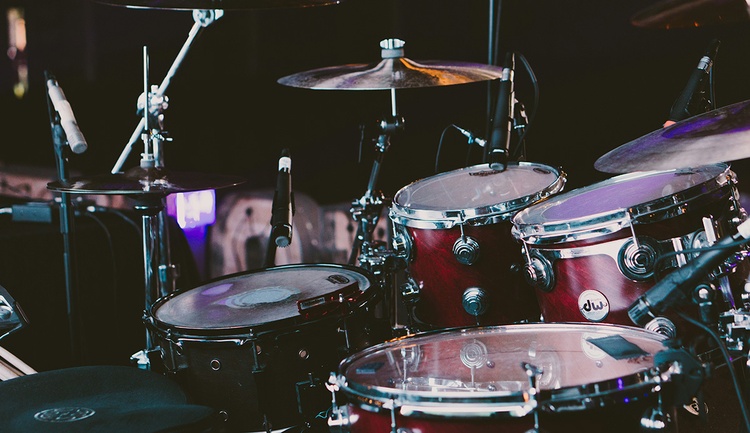
Center stage, slightly elevated, gleaming under dramatic lighting: the drum kit. A constellation of chrome hardware, resonant toms, a commanding bass drum, and shimmering cymbals arranged in a sweeping arc that catches every beam of stage light. Sticks flash. Heads vibrate. Cymbals crash like metallic halos. Nothing else on the platform commands the visual field quite like it — not the guitars, not the keyboards, not even the worship leader standing at the front.
This is not an accident. It is a design — the product of decades of deliberate choices about what Christian worship should look like, sound like, and feel like. And for most evangelical churches in the Phoenix metro area, as in most contemporary evangelical churches across the country, those choices have produced a remarkably consistent answer.
At East Valley International Church, where the great majority of those who gather each Sunday are Filipino, the question takes on additional weight. What follows is not an attack on drummers or a nostalgic appeal to a vanished era. It is something more pointed: an honest case for why a drum kit, however skillfully played, does not belong at the center of our musical life — and why our congregation, given its cultural inheritance and pastoral calling, has both reason and resources to choose differently.
Is the drum kit serving the worship — or has the worship begun serving the drum kit?
❦ ❦ ❦
A Brief History of Drum Sets in Christian Worship
The modern drum kit — snare, bass, toms, hi-hat, ride — is a twentieth-century invention. While percussion appears throughout Scripture, the multi-piece kit was not born in churches. It was assembled in the secular entertainment venues of urban America, made possible by the bass drum foot pedal patented around 1909, refined through the 1920s and 1930s in jazz and big-band performance, and crowned as a popular icon by the rock-and-roll era that followed.
Drums entered some Christian worship spaces earlier than the standard narrative suggests — appearing in African-American Pentecostal, Holiness, and Baptist congregations in the 1940s and 1950s. But the broad evangelical adoption came with the Jesus Movement of the late 1960s and 1970s, which sought to reach young people through the idioms of rock. By the 1980s, charismatic and non-denominational congregations had adopted the kit as standard worship equipment. The 1990s — driven by Hillsong, the Vineyard movement, and the rise of the megachurch — installed full rock-concert production values in countless Sunday services.
One clarification matters before this conversation can proceed honestly. The claim that “most churches” have adopted drum kits is an overstatement when measured against the global Christian church. Roman Catholic, Lutheran, Presbyterian, Methodist, Episcopal, Reformed, Anglican, and most liturgical traditions have not. Drum kits remain primarily the instrument of non-denominational, evangelical, charismatic, and Pentecostal congregations. The majority of the world’s Christian worshippers on any given Sunday do not hear a drum kit during their service.
That global fact is worth holding in view, because the local picture looks dramatically different — and it is the local picture East Valley International Church inhabits. Among traditional Bible-believing evangelical congregations across Chandler, Gilbert, and Mesa, the drum kit has become so universal that its absence is the rare exception. After many years of attending, visiting, and ministering in this region, I know of only one such ministry in the entire East Valley that still gathers for Sunday worship without a drum kit on the platform: Tri-City Baptist Church in Chandler, where I once attended.
One church. That is the local reality. A congregation searching the Chandler-Gilbert-Mesa corridor for evangelical worship that does not place a drum kit at the visual and acoustic center of the room has, by my count, two options.
That fact deserves to be sat with. It does not prove drum kits are wrong. It does, however, expose how thoroughly a single model of contemporary worship has saturated our region — to the point that what is genuinely unusual in the broader Christian church now feels, to anyone formed only in the East Valley, like the only option Christians ever had. It is not. It never was. And the fact that we must look hard to find a single counterexample in our own neighborhood should give us pause before assuming our local arrangement is somehow normal, universal, or inevitable.
❦ ❦ ❦
The Purpose of Christian Worship
Christian worship exists to glorify God and edify believers. Hebrews 12:28 instructs us to “offer to God acceptable worship, with reverence and awe.” Music in the gathered assembly is not entertainment, not energy production, not crowd management. It is a means of directing hearts and minds toward God.
“Many Christians are so saturated with the world’s music that they are not offended by its sound because it is so familiar. The unnaturally loud beat, always on the off-beat, the repetition, the sensual nature of it, has inundated our world in so many areas that we are blissfully unaware of its power.”
— Philosophy of Music, Vickie Garrison, MusicAndPraise.com, (Dennis’s sister)
That blunt assessment is worth sitting with. The widespread adoption of the drum kit in evangelical worship over the past five decades is a case study in cultural accommodation. Beginning with the Jesus Movement, Christian musicians borrowed extensively from rock and pop, importing not only musical styles but the assumptions about what music is for. The drum kit, as the rhythmic engine of rock, did not arrive theologically neutral. It carried with it cultural associations — energy, excitement, audience response — that are entirely appropriate in their native context but deserve careful evaluation when imported into the gathered worship of the church.
Reformed theologian David Wells, in No Place for Truth and God in the Wasteland, described what he called the “weightlessness of God” in contemporary evangelicalism — a diminished sense of divine majesty that makes worship increasingly indistinguishable from entertainment. Sociologists Christian Smith and Melinda Lundquist Denton, in Soul Searching (2005), identified Moralistic Therapeutic Deism as the functional religion of a generation formed largely in contemporary worship environments — a god who exists primarily to make people feel affirmed. Researcher George Barna has documented the same drift from a different angle: the rise of consumer-minded congregants who evaluate church by personal satisfaction rather than biblical fidelity.
None of these scholars argues that the drum kit alone produced these conditions. All of them describe a cultural atmosphere in which a platform-centered, band-driven, production-intensive worship model fits perfectly — which is itself a reason for sustained, honest reflection. At East Valley International Church, we cannot afford the luxury of unreflective adoption. The instruments we bring into the presence of God are not merely aesthetic choices. They are liturgical ones.
❦ ❦ ❦
The Distracting Nature of Modern Drum Sets
Drums, by nature, draw both auditory and visual attention. The kit is physically prominent on the platform and acoustically capable of dominating any room — and when a drummer employs frequent improvisational fills or plays at high volume, congregational focus shifts from the words being sung to the performance being witnessed. This is not a theoretical concern. It is the reported experience of countless worshippers in countless churches.
“Without great care, the beat can overwhelm the singers. I have been in services where the volume of the drums and amplified guitars was so deafening that I could not hear those singing next to me. This smacks of a return to the Dark Ages, when the joy of fellowship in song was taken from the congregation and replaced with a performance by the ‘professionals.’”
— Wordwise Bible Studies, “Drums in Worship: Are They Appropriate?”
The professional worship drumming community itself teaches that excessive fills are inappropriate in a congregational context — that the drummer’s primary calling is to serve the song, not showcase technique. The concern, then, is not with percussion as such but with a particular style: high-energy, fill-heavy, volume-intensive playing that turns a worship band into a performance ensemble. The instrument does not determine the outcome; the musicianship and the theology behind it do. But the instrument does shape probabilities. And in most evangelical settings, the probability tilts heavily toward distraction.
The tension becomes most acute during confession, intercessory prayer, the public reading of Scripture, and quiet meditation — moments where a driving rhythmic pulse is contextually at odds with what the congregation is being asked to do. The biblical anchor here is not Psalm 46:10, frequently misapplied in this debate, but Paul’s instruction in 1 Corinthians 14:26: “What then, brothers? When you come together, each one has a hymn, a lesson, a revelation, a tongue, or an interpretation. Let all things be done for building up.” If the volume, the fills, or the rhythmic dominance of the kit consistently competes with the lyrical content, the concern is not stylistic. It is theological.
❦ ❦ ❦
Drums as the Focus of Worship
Beyond distraction lies a deeper issue: the drum kit, when prominently placed, often becomes the visual focal point of the service. Elevated, shielded behind plexiglass, surrounded by hardware, it implicitly elevates the drummer’s role and recasts the music as a performance rather than a communal act of worship.
“The melody, harmony, and rhythm should be balanced. These relate to the Christian’s spirit, mind, and body. Just as the Christian puts his spirit first, then his mind, and last his body, our music should echo this. Music needs a beat, but it should flow as naturally as a heartbeat and should not overpower. The melody should dominate the music just as the spirit is to dominate the Christian.”
— Philosophy of Music, Vickie Garrison, MusicAndPraise.com
Unlike a keyboard or an acoustic guitar, a drum kit cannot lead congregational singing independently. It carries no melody, supplies no harmonic context, and cannot, on its own, guide a congregation through a single verse of a hymn. The practical consequence is real: a drum-dependent worship model requires a full band, a PA system, sound engineers, rehearsed arrangements, and ongoing technical coordination. What a single keyboard accomplishes naturally on a Sunday morning becomes a small production. For smaller and mid-sized congregations — including ours — this raises legitimate questions about stewardship, accessibility, and whether the model being imported actually fits the community attempting to adopt it.
“When the drum set finally appeared on the platform, I believe the church reached the steepest and most dangerous part of the slope. More than any other instrument, a drum set is the key instrument of contemporary music styles.”
— Dan Lucarini, Why I Left the Contemporary Christian Music Movement, p. 121
❦ ❦ ❦
A Filipino Voice in This Conversation
Approximately ninety percent of our congregation is Filipino, and that fact is not incidental. It is a cultural inheritance with direct bearing on the question before us.
Filipino musical heritage is among the richest and most varied in Asia. It encompasses two great streams. The first is the indigenous tradition of the southern and highland regions — the kulintang ensemble of Mindanao with its row of tuned bronze gongs, the gangsa of the Cordillera, the bamboo idiophones, and the kudyapi lute. The second, born of three centuries of Spanish presence and a half-century of American influence, is the rondalla — the beloved string ensemble of bandurria, laud, octavina, guitar, and bajo de uñas that has carried Filipino voices through harana, kundiman, Christmas carols, and church.
“The Philippine bandurria is no ordinary string instrument. A descendant of the Spanish instrument of the same name, the local variation boasts 14 strings, one more pair than the traditional 12-stringed instrument… It is a key component of the Philippine rondalla, an ensemble of stringed guitar-like instruments frequently used in folk music.”
— Tatler Asia, “Do You Know These 6 Traditional Filipino Instruments?” — tatlerasia.com
What these instrumental traditions share is a particular musical demeanor — restrained, melodically rich, harmonically interwoven, and deeply collective. Even where percussion is present, as in the dabakan goblet drum of the kulintang ensemble or the discreet hand drum tucked behind the rondalla, it functions in service to melody and rhythm, never as the dominating voice of the room. The aesthetic is one of integration, not domination. It values mahalaga — that which is precious, weighty, dignified — over spectacle.
The same restraint runs through traditional Filipino church music. From the Pasyon chants of Lent to the Tagalog Marian hymns sung across the islands, from the rondalla-accompanied Christmas masses of Filipino-American parishes to the unembellished four-part harmony of small evangelical congregations in the provinces, Filipino sacred music has historically favored intelligibility, harmony, and reverence over rhythmic intensity.
“My sense is that churches who have congregations that are fairly new in the faith will take to contemporary music readily. But people who grew up in the faith tend to look in traditional or newly composed hymnody lyrics that are more substantial and which have a timeless appeal.”
— Joel Navarro, in “A Brief (Selective) Overview of Filipino Church Music,” Calvin Institute of Christian Worship
Filipino church musician Joel Navarro and his wife Amy, interviewed by the Calvin Institute, were ambivalent about the wholesale importation of American megachurch worship into Philippine Christianity — describing an “unfiltered adoption” that reaches even small provincial churches. That ambivalence is worth our attention. When Filipino believers settle in the Phoenix metropolitan area and seek out a church home, what they often hunger for is not the American stage show they could find on any FM radio station. They are looking for a place where the melody comes first, where the lyrics can be heard, where the congregation actually sings together, and where the demeanor of the music matches the dignity of the faith.
A drum kit on the platform, however skillfully operated, sends a different signal. It announces: this room aspires to the production values of contemporary American evangelicalism. For a Filipino visitor weighing whether to return next Sunday, that signal is not always welcome. For older Filipino believers raised on hymns, choral singing, and rondalla — for those whose sense of sacred music was formed long before Hillsong reached Manila — it can register as a barrier rather than an invitation.
We have at East Valley International Church a rare opportunity. Our cultural inheritance equips us to model a worship that is melodically rich, harmonically full, lyrically intelligible, and acoustically inviting — without ever placing a drum kit at the center of the stage. We can honor what is most distinctively Filipino in our musical heritage and most distinctively Christian in our worship calling at the same time. That alignment is not a compromise. It is a gift.
❦ ❦ ❦
Historical and Biblical Perspectives
The historical trajectory of Christian worship reveals a consistent concern for the intelligibility of the Word. The early church was largely non-instrumental for its first several centuries — not on musicological grounds but on theological ones, distancing itself from the pagan Roman entertainment with which instruments were then associated. Church fathers, including John Chrysostom and Augustine, favored the human voice above all other instruments. Their concern was that instrumental music could displace attention from the words being sung — a pastoral instinct worth examining in every generation.
The Reformation intensified this concern. Luther embraced congregational singing with instrumental support; Calvin’s Geneva worshipped with unaccompanied psalms; Zwingli physically removed organs from the churches of Zurich. What united these Reformers was the conviction that the congregation must hear, understand, and participate in what is being sung — that worship must engage the rational mind, not merely the emotions.
“The danger lies in the potential for these elements to become the focus of worship, rather than directing the hearts and minds of the congregation towards the reverence and adoration of God.”
— Open Christian University, “Is the Use of Drums and Dance in Church Worship Biblically Justified?”
Psalm 150 is exuberant; the biblical authors were not embarrassed by volume or rhythmic energy. But the unifying biblical principle is found in Colossians 3:16 — that congregational singing serves the mutual task of teaching and admonishing one another, which requires that the words be heard and processed. Paul insists in 1 Corinthians 14:15 that he will sing with both spirit and understanding. Those two texts establish the standard. Every instrument, every volume level, every arrangement is measured against them — not by whether the congregation felt the presence of God, but by whether the worship was genuinely directed toward Him.
❦ ❦ ❦
Practical Considerations at East Valley International Church
For our congregation specifically, several practical concerns weigh against the drum kit.
The Acoustic Question
A common objection to drum kits in contemporary worship focuses on the amplification infrastructure they require — the PA system, the sound technician, the technical coordination. That concern does not apply to East Valley International. Our worship center is a small room. We do not need a sound engineer to fill it.
What does apply, with unusual force precisely because the room is small, is the simple acoustic weight of a drum kit and the two or three musicians who typically play alongside it. A full kit — bass drum, snare, toms, hi-hat, ride, crash — is not a quiet instrument by design. In a large sanctuary, that energy dissipates into the volume of the room. In a small room, there is nowhere for it to go. It bounces from wall to wall, gathers in the corners, and arrives at every seat with very little of the softening that distance ordinarily provides.
Add a guitar and a keyboard alongside, and the room is operating at concert-floor volume without anyone having intended that result. A drum kit in a small room is not the same proposition as a drum kit in a fifteen-hundred-seat sanctuary with engineered acoustics. It is louder, harder to control, and more difficult to subordinate to the singing, without any of the offsetting benefits the larger venue at least theoretically provides. The smaller the room, the smaller the case for the kit.
The Skill Barrier
Dynamic control on a drum kit — the ability to play with restraint, sensitivity, and musical subordination — requires significant training. A modestly skilled drummer is immediately and disruptively obvious to the entire room in a way that a modestly skilled pianist or guitarist is not. Churches that place undertrained drummers behind a kit in the name of inclusion often produce the opposite of what they intended. Recent memory will serve to support this claim.
The Participation Question
When a worship service requires a full band, professional-grade sound reinforcement, and rehearsed arrangements simply to function, the model has shifted — whether intentionally or not — from one in which the congregation is the primary actor to one in which the congregation is primarily an audience. Colossians 3:16 grounds singing in the mutual task of teaching and admonishing one another. That vision is participatory at its core.
Our resources align differently. A skilled keyboard player, a guitar, perhaps a string section drawing on rondalla heritage, voices trained to sing in real harmony, and the people in the pews who actually open their mouths — this is the worship architecture our congregation can sustain with excellence. It honors who we are. It serves who we want to become.
❦ ❦ ❦
The Entertainment Paradigm vs. The Worship Paradigm
The deepest concern about the drum kit in worship is not acoustic but theological. Entertainment and worship are not the same thing.
Entertainment seeks to please an audience. Worship seeks to honor God. Entertainment measures success by emotional response. Worship measures faithfulness by biblical obedience. Entertainment positions skilled performers on a stage and rewards passive consumption. Worship calls the entire body of believers into active, word-formed, God-directed participation. These are theological distinctions, not aesthetic preferences. And any honest evaluation of contemporary worship practice must reckon with how completely the entertainment model has been absorbed into evangelical church culture over the past four decades.
“Since worship is for God’s glory, the volume, style, and placement of drums in a service should not overshadow the congregation’s focus on the Lord.”
— BibleHub.com, “Practical Guidelines for Modern Gatherings”
The question beneath every drumbeat is always the same: Who is this for? When the answer — honestly examined — tilts consistently toward the congregation’s emotional experience rather than God’s glory, the problem is not the instrument. It is the theology behind the room. The instrument simply makes the theology audible.
“It would be wrong to have drums in church if those drums are the focus of attention rather than the One to whom the songs are addressed. If the beat is so overpowering that it draws attention to itself, then drums may be detracting from rather than adding to the worship experience.”
— GotQuestions.org, “Is it wrong to have drums in church?”
❦ ❦ ❦
Conclusion: A Call to East Valley International
This essay does not pretend that drums are universally forbidden in Christian worship. It argues something more specific: that for East Valley International Church, given our cultural composition, our congregational scale, our pastoral calling, and the theological framework Scripture sets before us, the drum kit is not a fit.
We are not a congregation lacking in musical capability. We have, in Kuya Sam and those who serve faithfully alongside him, real talent and a steadier kind of dedication — the dedication that shows up Sunday after Sunday, that learns the songs, that arrives prepared, that places its gifts at the disposal of the worship of God rather than the showcase of self. That is no small thing. It is, in fact, the foundation on which everything else here is built.
And the foundation is broader still. We have the melodic and harmonic richness of Filipino musical heritage — a tradition that knows how to braid voice and string together into something more than the sum of its parts. We have voices that know how to sing in parts, an inheritance that many American congregations have quietly lost and would give much to recover. We have the patience and the patience-formed reverence of a people whose sacred music tradition reaches back through Spanish hymnody, Pasyon chant, kundiman, and rondalla — centuries of devotion sung, not performed.
We have, in Pastor Joey and our deacons and elder, men willing to ask hard questions about what worship is actually for, and humble enough to let the answers reshape what we do. That willingness is the rarest gift on this list, and the one that matters most.
We do not need to import a model of worship from elsewhere. We need only to take seriously what the Lord has already placed in this room and let it serve Him as it was meant to.
Paul’s instruction in Romans 14:19 — “Let us therefore make every effort to do what leads to peace and to mutual edification” — applies with particular force here. If a significant portion of faithful congregants find their worship hindered rather than helped by the sonic environment a drum kit creates, love requires that leadership take that seriously. The question is not whether drums can theoretically be used in worship somewhere. The question is whether they should be used in this congregation, with these people, at this stage of our life together.
Worship has always been most enduring when it is most accessible — when the congregation can sing, hear, understand, and participate without a production apparatus standing between them and the act of praise. That principle does not write the drum kit out of every story. It does write it out of ours.
May the music of East Valley International Church remain melodically clear, harmonically rich, lyrically intelligible, theologically sober, and culturally honest. May our worship sound like the people we are, offered to the God who made us. And may that be enough — because it is.
❦ ❦ ❦