
EARLY MORMON PERSONALITIES — INSTALLMENT XII
Restoration’s Quiet Architect: A Christian Reckoning With Wilford Woodruff
A Door Opens at Benbow Farm
On the cool English morning of March 5, 1840, a thin, bearded American walked up the lane to a prosperous Herefordshire estate called Hill Farm and knocked on the door. He had not slept well. He had not been invited. He had, in fact, only days before abandoned a thriving missionary field in the Staffordshire Potteries because, while a congregation sang the opening hymn of an evening service, he had felt as if a voice had told him to leave. He had obeyed, traveled south by coach, walked the last several miles on foot, and arrived at the door of a stranger named John Benbow with no introduction other than the certainty that God had sent him.
His name was Wilford Woodruff. He was thirty-three years old. He had been an Apostle in The Church of Jesus Christ of Latter-day Saints for less than a year. Within forty-eight hours of that knock, he would baptize John Benbow, his wife Jane, and four lay preachers of a breakaway Wesleyan revival movement called the United Brethren; within a few months, he and his companions would baptize more than fifteen hundred souls, and most of the six hundred members of the United Brethren would follow their pastors into the waters. It was the most concentrated harvest of converts in nineteenth-century Mormon history. Wilford Woodruff scarcely recovered his composure for the rest of his life.
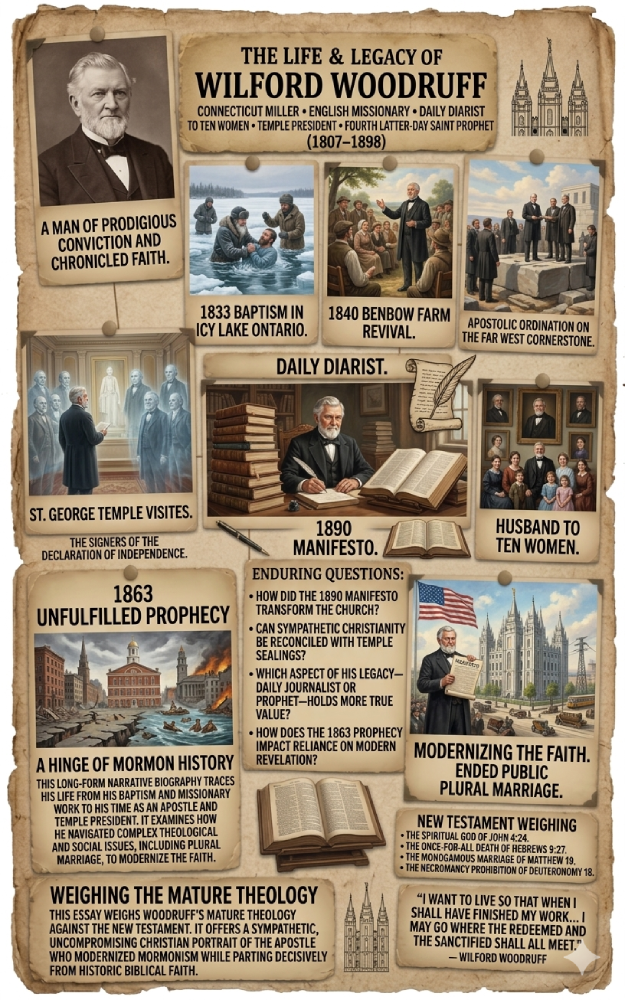
That image — the diary-keeping, miller-trained, accident-prone country boy from Connecticut who knocks on a stranger’s door and walks away with a parish — is the picture mainstream Latter-day Saints still treasure of their fourth president. The fuller picture is more complicated. By the time he died in 1898, on a borrowed bed in San Francisco after a failed bladder operation, Woodruff had been husband to ten women, father to thirty-four children (fourteen of whom preceded him in death), Church Historian for more than three decades, the man who personally implemented vicarious endowments for the dead, the prophet who claimed the spirits of George Washington and the signers of the Declaration of Independence had besieged him in the St. George Temple, the seer who foretold that New York would be destroyed by an earthquake and Boston swept into the sea, the fugitive who wore a sunbonnet through the streets of southern Utah to evade federal marshals, and the executive who finally signed the Manifesto that ended public plural marriage and dragged Mormonism, blinking, into the twentieth century.
He is the hinge. To understand Wilford Woodruff is to understand the precise moment when frontier Mormonism — apocalyptic, polygamous, isolated, theocratic — turned the corner toward Americanism, statehood, and respectability. To understand him is also to understand how a man can be at once sincerely devout, deeply self-disciplined, prodigiously productive, and the public face of a system of doctrine that historic Christianity has always recognized as a sharp departure from the gospel of the New Testament. This essay attempts to hold both pictures in view at once.
❦ ❦ ❦
A Miller of Connecticut: Roots, Rupture, and Religious Hunger
Wilford Woodruff was born on March 1, 1807, in the Farmington River village of Avon, Connecticut, then called Northington. He was the third son of Aphek and Beulah Thompson Woodruff. Beulah died of spotted fever before he had reached his second birthday; his father remarried, and the boy grew up in the household of his stepmother, Azubah Hart. The family was solid New England stock — millers, mostly — and Wilford, in time, inherited both the trade and a Yankee aptitude for patient labor. He attended common school until the unusually late age of eighteen, survived typhus, and walked away from a long series of misfortunes — falls, broken bones, near-drownings, runaway horses — that he later compiled, in characteristically literal Woodruff fashion, into a list. He believed God had preserved him for a purpose. The Wilford Woodruff Papers Foundation now publishes that list under the title “A Miraculously Preserved Life,” a phrase taken straight from his own pen.
At twenty, he left home to manage his aunt’s flour mill, and from there bounced through several mill jobs until, in 1832, he and his brother Azmon purchased land and a mill on Grindstone Creek in Richland, New York, near Lake Ontario. By that time, he was a serious, brooding young man who read the Bible at night, distrusted the established denominations, and was profoundly shaped by an elderly neighbor in Connecticut, a Presbyterian-Congregationalist named Robert Mason whom Woodruff later called “Father Mason.” Mason was a Restorationist — a man convinced that the apostolic gifts had vanished from the visible church and would one day be restored. He told the young Wilford that he would not live to see the restoration, but Wilford would; he prayed his pupil into a posture of expectation.
That posture mattered. By the early 1830s, the burned-over district of upstate New York, where Wilford was now living, had become the most religiously volatile region in America. Charles Grandison Finney’s revivals had passed through; Adventist William Miller was preaching imminent return; the Campbellite Restorationists, the Universalists, the Shakers, the Spiritualists, and Joseph Smith’s young Church of Christ were all jostling for converts within a fifty-mile radius of where Woodruff ground flour. He had had himself baptized once already by a local Baptist minister, Mr. Phippen — but without joining the congregation. He was, in the language of revival, ripe.
❦ ❦ ❦
An Empty Pulpit and a Knock at the Door: Conversion in the Wilderness
On December 29, 1833, two Mormon missionaries named Zerah Pulsipher and Elijah Cheney rode through deep snow into Richland and asked to preach. The local schoolhouse was opened; Wilford and his brother went. When the missionaries finished, they invited the congregation to speak for or against the message. Woodruff stood up first. He said the Spirit of God had urged him to bear witness that what they had heard was true. The next day, December 31, he was baptized in a hole cut through Lake Ontario ice. He was twenty-six years old. Three days later, he was confirmed; within a fortnight, he was thinking of nothing else.
What had he embraced? In December 1833, the new movement had no Quorum of the Twelve, no temple, no plural marriage, no priesthood adoption, no King Follett discourse, no doctrine of eternal progression. Joseph Smith had translated the Book of Mormon, gathered a few hundred followers in Kirtland, Ohio, and was preaching restoration, gifts of the Spirit, and the imminent gathering of Zion. Woodruff was attracted, by his own account, by three things: the missionaries preached without pay, they laid hands on the sick and the sick recovered, and they claimed continuing revelation. Each of these moved him because each was the answer to Father Mason’s prophecy. A people had appeared who claimed exactly what the old man had said would one day reappear.
In April 1834, Mormon recruiters arrived in Richland again to enlist marchers for Zion’s Camp — Joseph Smith’s quixotic paramilitary expedition to relieve persecuted Mormons in Jackson County, Missouri. Wilford went, leaving the mill, his family, his old life. He met Joseph Smith for the first time at Kirtland, marched on Missouri, contracted the cholera that decimated the camp, watched comrades buried in shallow Missouri graves, and returned a hardened believer. From that point until his death sixty-four years later, his loyalty to the Restoration was, by every available account, unwavering.
❦ ❦ ❦
The Apostle Forged on a Mississippi Riverbank
In July 1838, while Wilford was preaching in the Fox Islands off the coast of Maine, Joseph Smith received the revelation now canonized as Doctrine and Covenants 118, naming him to the Quorum of the Twelve Apostles. The revelation contained an awkward stipulation: the new apostles were to gather at the temple site at Far West, Missouri, on April 26, 1839, and lay the foundation stones for a temple of the Lord before departing on a mission to Great Britain. By the time the appointed day approached, however, Missouri’s Governor Lilburn Boggs had issued his infamous Extermination Order, more than ten thousand Saints had been driven from the state, the Apostle David W. Patten was dead, and Joseph Smith was imprisoned in Liberty Jail. Senior Mormon counselors begged the apostles to abandon the temple ceremony. The Lord, they said, would take the will for the deed.
The apostles refused. Brigham Young led them across hostile Missouri at night, arrived at Far West before dawn on April 26, laid the southeast cornerstone, and ordained the new men. Wilford Woodruff and George A. Smith were ordained Apostles standing at the corner of that stone. The little band then turned around and rode back across Missouri to Illinois. The fact that they survived the round trip became, in Mormon memory, evidence that the journey itself had been protected by God.
Within weeks, Wilford was lying on the ground at Montrose, Iowa, racked with malaria, watching the Prophet Joseph walk along the riverbank healing the sick by name. According to Woodruff’s later memoir, Joseph turned to him at the end of the day, on the muddy bank of the Mississippi, as he waited for a ferry, handed him a red silk handkerchief, and told him to ride two miles to the home of a sick child and heal twin five-month-olds by wiping their faces with it. Wilford did as instructed; the children, he reported, were healed. Three days later, he was so ill he could barely sit up, but he climbed into a canoe with Brigham Young, was paddled across to Nauvoo, and started on foot for Liverpool. He had no money. His wife and child were prostrate with fever in a one-room cabin behind him.
Yes, but I feel and look more like a subject for the dissecting room than a missionary.
— Wilford Woodruff to Joseph Smith, August 8, 1839, on departing for England — Leaves From My Journal
Joseph reportedly answered: “Get up, and go along; all will be right with you!” It is the kind of scene that hagiography is built upon, and Mormon hagiography has duly built upon it. What it also captures, however, is the iron of Woodruff’s temperament. He was not a charismatic orator. He was not a theologian. He was a man who, once persuaded that God had spoken, did what he had been told and kept walking until he could no longer stand.
❦ ❦ ❦
The Benbow Pond Miracle: A Diary’s Brightest Page
The English mission of 1840–41 is the page of Woodruff’s life that almost everyone, Latter-day Saint and skeptic alike, agrees was extraordinary. Arriving in Liverpool on January 11, 1840, he labored briefly in the Staffordshire Potteries, then on his thirty-third birthday — March 1, 1840 — felt impressed during a hymn to leave his successful work and travel south. He took a coach to Wolverhampton, walked to Castle Frome in Herefordshire, and met John Benbow, a wealthy farmer who had been seeking a restored apostolic Christianity. The Benbows belonged to a body of about six hundred dissenters who had broken from the Wesleyan Methodists and named themselves the United Brethren. They were lay preachers, prayer-meeting Christians, men and women who knelt in plowed fields and asked God to send them more light.
Woodruff preached in the Benbow farmhouse on the evening of March 5. He baptized the Benbows and four of their preachers two nights later in a pond he had personally cleared of leaves and mud. Within months, the great bulk of the United Brethren had followed. In some weeks, Wilford baptized constables sent to arrest him and Anglican clerks dispatched to disrupt his preaching. By August of 1840, in a region the established church had considered settled Protestant ground for three centuries, there were roughly eight hundred Latter-day Saints; by the time Woodruff sailed for America in April 1841, he was leading a party of one hundred forty British converts to gather with the Saints in Illinois.
Several observations are worth pausing on. The first is that the United Brethren were not pagans, atheists, or even Catholics; they were earnest, evangelical, Bible-reading Christians who had already separated from a denominational church in pursuit of greater scriptural fidelity. They were precisely the kind of Restorationist seekers Mormonism specialized in absorbing.
And here one must pause and ask the uncomfortable question: how does this happen? These were not spiritually illiterate people. They knew their Bibles. They had already demonstrated the courage to break from institutional religion when they believed Scripture demanded it. What was it, then, that made them so vulnerable to a message that would carry them so far from the very Word they had staked everything on? Was it the exhausting hunger of the Restorationist spirit — always seeking, never quite settled — that left them perpetually open to the next claim of “more light”? Was it the emotional power of Woodruff’s testimony, or the intoxicating promise of a living prophet in an age when so many felt heaven had gone silent? Whatever the mechanism, the tragedy is that their very virtue — their refusal to stop seeking — became the door through which they walked away from what they already held.
Woodruff’s message did not call them out of irreligion; it called them out of one form of biblical Christianity into a movement that, by the time of his death, would teach the plurality of gods, eternal progression, baptism for the dead, sealing of multiple wives, and the literal materiality of God the Father. That migration from Wesleyan revivalism to Latter-day Saint temple worship is the spiritual journey, in miniature, of nineteenth-century British Mormonism — and Wilford Woodruff is the man who set it in motion.
The second observation is that no other Latter-day Saint missionary, before or since, has duplicated this result on this scale. Woodruff would later describe the Herefordshire harvest as evidence of God’s direct intervention. Critics have offered alternative explanations — the readiness of the United Brethren, the desperate poverty of the agricultural Midlands, the appeal of an emigration outlet to the American West — but no honest historian denies that the event happened, that thousands of people followed Woodruff’s preaching, or that he himself walked through it with both feet planted firmly in the conviction that the very voice of God had told him to leave Hanley on March 1.
❦ ❦ ❦
Steward of Memory: The Chronicler of Mormonism
What truly distinguished Woodruff from the other early Mormon apostles was not his preaching, his administration, or even his missionary success. It was his pen. Beginning with his first mission to the South in 1835 and continuing every day for the next sixty-three years, he wrote in a journal. By the time he died, those journals filled nine published volumes; alongside them, he produced more than twelve thousand letters, often keeping a copy. His diaries are now the indispensable archive of nineteenth-century Mormonism. Without Wilford Woodruff, much of what we know about the King Follett discourse, the daily life of the Quorum of the Twelve, the proceedings of the Council of Fifty, the day-by-day events of Winter Quarters, and the Mormon trek, and the inside conversation of Brigham Young’s presidency would be irretrievably lost.
He served as Assistant Church Historian from 1856 and Church Historian from 1883 until he assumed the presidency in 1889. He was, in B. H. Roberts’s grateful judgment, “perhaps, the best chronicler of events in all the history of the Church.” The compiler Susan Staker, less reverentially, has called the journals “public, official — and ultimately very male,” a reminder that even Woodruff’s prodigious record cannot recover the inner lives of the wives, daughters, and converted servant girls who populated the margins.
For the Christian reader, the journals deserve close attention precisely because they are honest. Woodruff was not a polemicist. He wrote down what he believed and did, including details a more cautious memoirist would have buried. It is from his own diary, for example, that we learn that on August 22, 1863, in the open bowery at Wellsville, Cache Valley, he stood before the assembled saints and uttered the apocalyptic prophecy that we will examine below. It is from his diary that we learn the precise sequence of his sealings, his temple work for the eminent dead, and his explanations to family members during the polygamy crisis. The very candor that makes Woodruff a treasure to faithful Mormon historiography also leaves him exposed to the historical questions a Christian apologist is honor-bound to ask.
❦ ❦ ❦
St. George and the Spirits of the Dead
In 1877, Brigham Young, by then visibly failing, called Wilford Woodruff to preside over the newly dedicated St. George Temple in southwestern Utah. The St. George Temple was the first temple of the Restoration in which the full endowment ceremony was performed for the dead as well as the living. As temple president, Woodruff stood at the operational center of one of the most consequential doctrinal developments in Mormon history: the systematization of vicarious ordinances for the deceased. He helped John D. T. McAllister write parts of the temple ceremony itself. He standardized the proxy procedures. He compiled lists of “eminent” men and women for whom temple work should be performed.
The most arresting episode of his temple presidency, however, was reported by Woodruff himself in a discourse delivered in Salt Lake City on September 16, 1877, and again in still more detail on April 10, 1898 — eight weeks before his death. He said that during two days in St. George, the spirits of the signers of the Declaration of Independence had appeared to him in the temple and pleaded with him to attend to their ordinances. He named some of them. He said they remained with him for two days and two nights. He responded by entering the baptismal font and being baptized vicariously for fifty-six American founders, for John Wesley, for Christopher Columbus, and for every deceased president of the United States save Martin Van Buren and James Buchanan, whom he excluded because of their actions against the Saints. He then directed Sister Lucy Bigelow Young to be baptized for seventy eminent women, including Martha Washington, Marie Antoinette, Charlotte Corday, Jane Austen, Charlotte Brontë, and Elizabeth Barrett Browning.
They called upon us, knowing that we held the keys and power to redeem them.
— Wilford Woodruff, Discourse at Salt Lake City, September 16, 1877 (Journal of Discourses 19:229) — wilfordwoodruffpapers.org
This single episode crystallizes several theological problems that historic Christianity has always identified at the heart of the Restorationist project. The first is the doctrine of baptism for the dead itself. Latter-day Saint theology rests heavily on a single isolated verse, 1 Corinthians 15:29 — “Else what shall they do which are baptized for the dead, if the dead rise not at all?” — and reads it as an apostolic endorsement of the practice. The verse is, in fact, obscure, almost certainly refers to a custom Paul is criticizing rather than commending, and finds no warrant anywhere else in the New Testament. Hebrews 9:27 declares it is appointed unto men once to die, and after this the judgment. Luke 16:26 records the parable of the great gulf fixed between the saved and the damned, across which none may pass. The whole of New Testament soteriology assumes that the decisive transaction occurs in this life, not the next.
The second is the question of necromancy. Whatever Joseph Smith intended, the practice of speaking with departed spirits in temple settings — soliciting their requests, accepting their visitations, performing rituals to liberate them — falls under the express prohibitions of Deuteronomy 18:9–12 and Isaiah 8:19. Faithful Latter-day Saints will object that what they engage in is not divination but revelation. Faithful Christians answer that the line is precisely the one the Old Testament drew with the strongest possible warning. Woodruff’s narrative — spirits gathering around him for two days and two nights, demanding ordinances, expressing emotion, instructing the living about what to do for them — is not the apocalyptic vision-language of biblical prophecy but the language of necromantic intercourse.
The third is a theological problem of universalism. Woodruff’s vision presumed that George Washington, Christopher Columbus, John Wesley, and Marie Antoinette were all in the same eternal posture, all awaiting baptism, all candidates for the celestial kingdom upon completion of proxy ordinances. Such an arrangement collapses every distinction the New Testament draws between those who in this life embrace Christ and those who reject Him. It is, finally, a doctrine of second chance — the very thing Hebrews 6:4–6 and Hebrews 10:26–27 most explicitly deny.
❦ ❦ ❦
A House of Many Households: Polygamy and Personal Cost
Wilford Woodruff was married to ten women in the course of his life, though not all at once. His first wife, Phebe Whittemore Carter of Maine, whom he married in Kirtland on April 13, 1837, was his closest companion for almost half a century until she died in 1885. Phebe is reported to have said, on first hearing the doctrine of plural marriage in Nauvoo, that she considered it “the most wicked thing I ever heard of”; like many first wives, she eventually accepted it as a matter of obedience.
The chronicle of Wilford’s other marriages is a study in the human strain that the system produced. Mary Ann Jackson was sealed to him in 1846 and bore him a son named James; the marriage ended in divorce in 1848. He was simultaneously sealed in August 1846 to two very young women — Sarah Elinor Brown, then nineteen, and Mary Caroline Barton, then seventeen — both of whom divorced him after three weeks when they began dating young men their own age. Mary Meek Giles Webster was sealed to him in March 1852 and died seven months later. Clarissa Henrietta Hardy was sealed to him in April 1852 and divorced him a year later. On March 13, 1853, he was sealed to two more women on the same day: Sarah Brown, age nineteen, and Emma Smith, a fifteen-year-old niece of Abraham O. Smoot, the apostle Woodruff had traveled to Kirtland with sixteen years earlier. Wilford was forty-six. Emma did not bear a child until she was nineteen. In 1857, he was sealed to Sarah Delight Stocking, then eighteen. In 1877, he was sealed to Eudora Lovina Young Dunford, Brigham Young’s daughter; their only child died within hours of birth, and Eudora divorced him in 1879.
It is necessary to say plainly what the dates record. A man of fifteen, of nineteen, of fifty, may all marry honorably under the laws of his time. A man of forty-six who marries a girl of fifteen, even within a religious system that sanctions the act, has crossed a line that the larger conscience of Christendom has always understood to be dangerous. The Latter-day Saint tradition has, over the past two decades, begun candidly to acknowledge these marriages on its own historical pages. But honesty about them remains uneven, and Christian readers must look the chronology in the eye.
From these unions, Woodruff fathered thirty-four children. Fourteen predeceased him. Three of his wives died before he did. He lived simultaneously, at various points, with as many as five wives in separate households scattered across Salt Lake City, Provo, Fort Harriman, and Randolph, Utah. After Phebe’s death, only Emma Smith Woodruff — the wife he had married at age fifteen — appeared with him at official functions. The diary record of his correspondence with the children of his ten wives shows that he attempted, with limited success, to be a present father; it also shows that he frankly favored Phebe’s and Emma’s children with letters, advice, and gifts. He sent money to all of them, including the divorced Mary Ann Jackson, when she fell on hard times.
The doctrinal question raised by Wilford Woodruff’s domestic arrangements is not finally one of personal hypocrisy or cruelty — by the standards of his own community, he appears to have done his duty. The question is whether plural marriage as practiced by nineteenth-century Latter-day Saints can be reconciled with the New Testament’s clear teaching that a bishop must be “the husband of one wife” (1 Timothy 3:2), that a deacon likewise (1 Timothy 3:12), and that the marriage union from the beginning was monogamous (Matthew 19:4–6). The Old Testament tolerates polygamy in the patriarchs without commending it, and uniformly portrays its consequences as ruinous — Sarah and Hagar, Leah and Rachel, the wives of David, the harem of Solomon — but no apostle of the New Covenant ever commands what Wilford Woodruff lived.
❦ ❦ ❦
New York, Boston, and Albany: The Cataclysm That Never Came
On August 22, 1863, in the small frontier settlement of Wellsville in Utah’s Cache Valley, Wilford Woodruff stood up at Brigham Young’s request and addressed a congregation that included the entire First Presidency, the senior apostles, and a gathering of young people. He spoke directly to the young. He told them they would live to see the building of a glorious temple on the Logan bench. He told them they would gather in that temple’s tower and look across a valley filled with cities and tens of thousands of Saints. And he told them that as they stood there, they would remember the day they had been gathered at Wellsville — because that day, he said, would have been before three cataclysmic events.
That was before New York was destroyed by an Earthquake. It was before Boston was swept into the sea by the sea heaving itself beyond its bounds. It was before Albany was destroyed By fire.
— Wilford Woodruff’s Journal, August 22, 1863 (Kenny ed., vol. 8, pp. 246–248) — fairlatterdaysaints.org
Brigham Young rose immediately after Woodruff and stated, for the record and in the congregation’s hearing, that what Brother Woodruff had said was a revelation and would be fulfilled. The Logan Temple was completed in 1884, and its tower was indeed built. The young people who heard the prophecy all grew old; some of them did indeed stand in the tower and look across a valley filled with cities and Saints. But New York City was not destroyed by an earthquake. Boston was not swept into the sea. Albany was not destroyed by fire. Today, more than 160 years later, those cities are still standing. Every man, woman, and child who heard Wilford Woodruff prophesy in 1863 is dead. The prophecy is, by the plainest test the Bible provides for evaluating a prophet (Deuteronomy 18:21–22), unfulfilled.
Modern Latter-day Saint apologists, particularly FAIR Latter-day Saints, defend the prophecy by arguing that Woodruff did not specify a timeframe and that the cataclysms can still occur during the Millennium. This is not an interpretation Woodruff’s audience that day would have recognized; the rhetorical force of the prophecy required, and Brigham Young’s amen presupposed, near-term fulfillment within the lifetimes of the young listeners. The defense is also vulnerable to a more basic question: if any prophet’s prediction can be deferred indefinitely into a future eschatological age, what falsifiable claim has the prophet actually made? Deuteronomy’s test is meaningful only because biblical prophecy was specific, datable, and verifiable. The Restorationist movement, by retreating from those criteria, has effectively neutralized the Old Testament test of a prophet.
Woodruff’s August 1863 prophecy was not isolated. Throughout his life, he expressed his settled conviction that the Second Coming was imminent, that the United States would dissolve by 1890, and that the enemies of the Church would be destroyed before the millennial reign. He preached this in 1880 in what is now remembered as the “Wilderness Revelation.” The dates have all passed. The Christian reader, taught by the New Testament to expect at least sober prophets if not infallible ones, is forced to a difficult conclusion: the man Brigham Young publicly affirmed as a prophet of God uttered specific predictions, in the name of the Lord, that did not come to pass.
❦ ❦ ❦
An Angel, Then the Father and the Son: A Drifting Testimony
In a tabernacle discourse delivered in Salt Lake City on March 3, 1855, Wilford Woodruff offered an account of how the gospel had been restored in the latter days. The Church organization had been re-established, he said, “by the ministering of an holy angel from God” who held converse with man and revealed the darkness of the world. The angel, he continued, “taught Joseph Smith those principles which are necessary for the salvation of the world.” The Lord, separately, then gave Joseph commandments and sealed upon him the priesthood. The architecture of Woodruff’s 1855 narrative is the angel-first architecture — a heavenly messenger as the primary actor — and that architecture matches what most Latter-day Saint apostles in the first two decades of the movement actually preached when they recounted Joseph Smith’s beginning vision.
By 1890, Woodruff was teaching something else. In sermons in that year and again in 1892 and 1894, he stated forthrightly that “the Father and the Son both appeared to the Prophet Joseph in answer to his prayer.” The shift is significant. The canonical First Vision narrative in Joseph Smith — History 1:17, which describes two personages appearing to the fourteen-year-old Joseph in the Sacred Grove, was not produced until 1838 and not canonized as scripture until 1880. Woodruff, who served as superintendent of the Times and Seasons print shop in 1842 when Joseph Smith first published a Father-and-Son version, was certainly exposed to it. But his own preaching in 1855 still leaned heavily on the older angel-first formulation.
FAIR Latter-day Saints argues that critics who quote the 1855 sermon selectively miss internal cues distinguishing the angel from “the Lord” elsewhere in the discourse. That defense is plausible at one level — Woodruff’s 1855 paragraph is genuinely composite — but it does not erase the historical point. Multiple senior Latter-day Saint leaders during the 1840s and 1850s, including John Taylor, Orson Pratt, and Brigham Young himself, sometimes referred to a single angelic visitation rather than a Father-and-Son theophany at the founding of the Church. The unified Father-and-Son canonical First Vision narrative settled into Latter-day Saint preaching only gradually, and Wilford Woodruff’s own teachings track that evolution. From a Christian perspective, the development is not so much sinister as revealing: the doctrine of the visible, embodied Father whom mortals can see face to face was not present in the earliest preaching of Mormonism in its mature form, and its consolidation reflects the gradual hardening of a distinctive doctrine of God that historic Christianity has consistently identified as a departure from biblical monotheism.
❦ ❦ ❦
The Manifesto: Revelation, Retreat, or Both?
By the late 1880s, the federal government had reduced the Latter-day Saint Church to a state of legal and financial siege. The Edmunds Act of 1882 had criminalized unlawful cohabitation; the Edmunds–Tucker Act of 1887 had disincorporated the Church, confiscated property worth more than three million dollars, dissolved the Perpetual Emigrating Fund, and put the temple block, the Gardo House, and other holy sites under federal receivership. Polygamous men, including Woodruff himself, were in hiding or in prison. Female suffrage in Utah had been revoked. The Latter-day Saint People’s Party was losing political control of the territory. By May of 1890, the U.S. Supreme Court had upheld every key provision of the Edmunds–Tucker Act, and the threat to seize the temples themselves was no longer theoretical.
In April 1889, Wilford Woodruff had become the fourth president of the Church. By October of 1889, he was publicly stating that the Church intended to obey the laws against polygamy. On September 23, 1890, after several days of fasting and prayer, he later said, he received a revelation that the Church must cease the practice of plural marriage. The following morning, he placed a hand-written draft on a table; George Reynolds, Charles Penrose, and John R. Winder polished its language; on September 25, it was published in the Deseret Weekly; on October 6, a special general conference accepted it “as authoritative and binding” — though, as historians now acknowledge, perhaps a majority of the conference abstained from voting. The text of what is now Official Declaration 1 in the Doctrine and Covenants reads, in part:
Inasmuch as laws have been enacted by Congress forbidding plural marriages, … I hereby declare my intention to submit to those laws, and to use my influence with the members of the Church over which I preside to have them do likewise.
— President Wilford Woodruff, Official Declaration 1, September 24, 1890 — en.wikipedia.org/wiki/1890_Manifesto
The Manifesto did not — as Woodruff explained at the October 1890 conference — dissolve existing plural marriages; it claimed only to refer to future marriages. Both Woodruff’s own behavior after 1890 and the documentary record assembled by historians such as D. Michael Quinn, B. Carmon Hardy, and Kenneth L. Cannon II show that the Church privately continued to sanction a small but real stream of plural sealings for at least fourteen years afterward — in Mexico, in Canada, occasionally in the United States, even on the high seas. The figure most often cited is roughly 250 post-Manifesto plural marriages performed under apostolic authority. By 1904, the scandal had reached the United States Senate’s Reed Smoot hearings, and Joseph F. Smith was compelled to issue a Second Manifesto in which polygamists were threatened with excommunication.
How should the Christian historian assess the original 1890 Manifesto? Three observations are necessary. First, Wilford Woodruff was facing the genuine possibility that the Church would be financially destroyed and its temples seized. The Manifesto was, in plain terms, a strategic survival document; even a sympathetic biographer like Thomas G. Alexander frankly characterizes Woodruff’s broader pivot as a movement “from isolation to assimilation, from extremism to respectability.” That language is not Christian polemic; it is mainstream Latter-day Saint historiography. Second, when the Manifesto was issued, neither Woodruff nor any other contemporary leader claimed that it constituted a divine revelation. Woodruff began making that claim about a year later, and the Church’s framing of the document as the product of revelation hardened only after he died in 1898. Third, even granting that Woodruff received some kind of spiritual confirmation that the change must be made, the underlying doctrinal problem remains: a sacred practice canonized by Joseph Smith as Doctrine and Covenants 132, taught for decades as essential to exaltation, was withdrawn under federal pressure. Either plural marriage was always wrong — in which case Joseph Smith’s revelation was false — or it was always right — in which case Wilford Woodruff capitulated to the secular state on a matter of revealed truth. The Latter-day Saint Church has chosen a third path, treating both Doctrine and Covenants 132 and Official Declaration 1 as inspired, but the logical tension has never been fully resolved.
❦ ❦ ❦
Theological Departures From Biblical Christianity
A faithful biographical assessment must include an honest survey of where Wilford Woodruff’s mature theology stood in relation to the historic Christian faith. He believed and taught a God who is an exalted man of flesh and bones, a doctrine flatly at odds with John 4:24 (“God is a Spirit”) and with two thousand years of Christian creedal confession that God is uncreated, eternal, immaterial, and absolutely unique in essence. He believed and taught the literal pre-mortal existence of human spirits, a doctrine the New Testament nowhere asserts and consistently contradicts (Genesis 2:7; Hebrews 9:27; 1 Corinthians 15:45–47). He believed and taught that exalted men become gods themselves, a doctrine flatly excluded by Isaiah 43:10 (“before me there was no God formed, neither shall there be after me”) and Isaiah 44:6 (“beside me there is no God”).
He believed and taught vicarious baptism for the dead, a doctrine that rests on an idiosyncratic reading of a single obscure verse and that contradicts the New Testament’s uniform witness that judgment follows death and that faith is the response of the living to the gospel preached in this life. He believed and taught that the spirits of the deceased could be consulted in temples — a practice Deuteronomy 18 expressly forbids and that the Apostle Paul never countenances. He believed and taught a doctrine of priesthood authority claiming exclusive access to saving ordinances, in tension with the New Testament’s universal priesthood of all believers (1 Peter 2:9; Revelation 1:6). He believed and taught plural marriage as essential to exaltation until federal pressure obliged him to withdraw it.
None of these positions is the consequence of personal malice. Woodruff did not invent the doctrines; he received them from Joseph Smith, defended them, lived them, taught them, and faithfully passed them on. The Christian critique is not of his sincerity. It is part of the system. By 1 Peter 3:15, the ordinary Christian is obliged to be ready always to give an answer to every man for the hope that is in him, with meekness and fear. That hope, the New Testament insists everywhere, is grounded in a God who is one in essence and three in persons, in a Christ who is the sole mediator between God and men, in a salvation that is by grace through faith and not of works (Ephesians 2:8–9), and in a final judgment after which there is no second chance. Wilford Woodruff’s mature theology, beautiful in many of its instincts toward holiness and service, parted ways with each of these landmark commitments. To honor him without acknowledging this would not be charity; it would be a failure of clarity.
❦ ❦ ❦
How Official LDS Memory Has Smoothed the Edges
Modern Latter-day Saint biographical resources — the Church’s official manual, Teachings of Presidents of the Church: Wilford Woodruff; the Wilford Woodruff Papers Foundation; the BYU Religious Studies Center volumes — present Woodruff as a man of unbroken faith, miraculous protection, and unwavering vision. The narrative is not false; it is selective. Among the materials that the official memory tends to soften or omit, the following deserve mention. The 1855 angel-first sermon is rarely cited; when it is, the surrounding context is supplied to neutralize its weight. The Cache Valley prophecy about the three cities is acknowledged but reframed as a Millennial-era prediction. The post-Manifesto polygamous sealings performed during Woodruff’s last eight years are minimized or treated as the unauthorized work of subordinates. The sealing of fifteen-year-old Emma Smith to a forty-six-year-old Apostle is mentioned in passing and without comment. The three-week marriages to teenage brides in 1846 are usually omitted altogether. The strain on Phebe, who is reported in early correspondence to have considered plural marriage “the most wicked thing” she had ever heard of, is recharacterized as growth in faith.
None of this is unusual. Every religious tradition curates its founders. Catholic hagiographies smooth out Augustine. Lutheran ones smooth Luther. Evangelical ones smooth Whitefield. But the curation has theological consequences, particularly when the figure in question is held to be a prophet of God, and his teachings are canonized as scripture. The Christian apologist working with Latter-day Saint friends and neighbors does not gain anything by impugning Woodruff’s character; he was, by every honest measure, a man of unusual personal discipline, deep affection for his family, and tireless industry on behalf of his people. What the apologist gains by working with the unsmoothed record is the freedom to discuss the man as he actually was — a sincere, devout, often heroic believer who nevertheless taught and practiced a system that diverges, at decisive points, from the gospel of the New Testament.
❦ ❦ ❦
A Christian Assessment: The Measure of the Man
To stand in 1898, the year Wilford Woodruff died, and look back across his life is to see a study in contradictions held together by sheer steadiness of will. The miller’s son from Avon walked four thousand miles in Britain on foot. The chronicler kept his diary every day for sixty-three years. The polygamist who married a fifteen-year-old preached to congregations on the dignity of women. The apostle who once preached that an angel had restored the gospel ended his life teaching that the Father and the Son had appeared to Joseph Smith in 1820. The fugitive who hid from federal marshals in a sunbonnet ended his life writing the Manifesto that brought his people back into the American mainstream. The prophet who declared that New York would be destroyed by an earthquake lived to see New York still standing and never explained the discrepancy.
What the Christian reader takes from such a life, in the end, is not the comfort of moral judgment but the seriousness of theological discernment. Wilford Woodruff was, on the personal level, almost certainly a better man than most of his evangelical contemporaries — more disciplined, more diligent, more sincere in his devotions, more sober in his daily walk. But personal goodness does not validate doctrine. A sincere prophet of false doctrine is more dangerous than an obvious charlatan, precisely because his goodness disarms the critical faculties of his hearers. The proper Christian response is the one Paul commended to the Bereans in Acts 17:11: to receive the word with all readiness of mind and then to search the Scriptures daily to see whether those things are so.
Wilford Woodruff’s life, weighed in the balance of the Scriptures, returns a mixed verdict. The personal disciplines — daily diary, daily prayer, daily labor, daily love of family — are sober and exemplary. The doctrinal claims — embodied God, eternal progression, baptism for the dead, plural sealing, communion with the eminent spirits of the founding fathers, predictions of imminent national catastrophe — are not supported by the Bible and in several places are flatly opposed to it. The institutional legacy — the genealogical project, the temple system, the survival of the Church through statehood — is impressive on any worldly measure. The eternal legacy belongs to God, who alone weighs the secrets of the heart.
❦ ❦ ❦
Legacy
Wilford Woodruff’s most durable contribution to the Restoration movement was not preaching, not administration, not even the Manifesto. It was the architecture of memory. Through his journals, his correspondence, his historical work, and his standardization of temple ordinances, he gave the Latter-day Saint Church the tools to outlive its founders. Joseph Smith dictated the doctrine; Brigham Young led the trek, but Wilford Woodruff filed the cabinet drawers, dated the entries, sealed the records, and built the genealogical infrastructure on which every subsequent generation of Latter-day Saint identity has rested. The Family Search project of the twenty-first century is, in its deepest historical roots, the institutional descendant of Wilford Woodruff’s 1894 conference address on generational sealings and his founding of the Genealogical Society of Utah.
For the historic Christian observer, that legacy ought to be approached with both respect and caution. The same conscientious record-keeping that preserved nineteenth-century Mormon history has also made it possible — uniquely possible — to test the prophetic claims of the movement against its own documentary record. Wilford Woodruff is in many ways the most thoroughly documented Latter-day Saint prophet of the nineteenth century, and that documentation, faithfully read, neither exonerates the prophet’s claims nor vilifies the man. It leaves him standing in his sunbonnet and his apostolic dignity, his diary in one hand and his ten wives behind him, a witness to a system he served with all his strength and which still asks the visitor at the door of every Latter-day Saint home: are these the marks, biblical and apostolic, of the Church that Jesus Christ founded?
The answer to that question — answered always in love, always with meekness, always grounded in 1 Peter 3:15 — is not finally a verdict on Wilford Woodruff. It is the verdict the Scriptures themselves render upon the gospel he proclaimed.
❦ ❦ ❦
Primary Sources Consulted
• Wikipedia — Wilford Woodruff https://en.wikipedia.org/wiki/Wilford_Woodruff
• Church of Jesus Christ — Wilford Woodruff https://www.churchofjesuschrist.org/study/history/topics/wilford-woodruff?lang=eng
• Wilford Woodruff Papers Foundation https://wilfordwoodruffpapers.org/wilford-woodruff
• Teachings of Presidents — Wilford Woodruff https://www.churchofjesuschrist.org/study/manual/teachings-wilford-woodruff/the-life-and-ministry-of-wilford-woodruff?lang=eng
• BYU RSC — Prophets and Apostles https://rsc.byu.edu/prophets-apostles-last-dispensation/wilford-woodruff
• WW Papers — Mission of Elijah Video https://wilfordwoodruffpapers.org/media/videos/wilford-woodruff-and-the-mission-of-elijah
• Doctrine and Covenants Central — Woodruff https://doctrineandcovenantscentral.org/history/wilford-woodruff/
• From the Desk — Who was Wilford Woodruff? https://fromthedesk.org/who-was-wilford-woodruff/
• Meridian — A House Built upon a Rock https://latterdaysaintmag.com/wilford-woodruff-a-house-built-upon-a-rock-of-faith/
• BYU RSC — Odyssey of a Latter-day Prophet https://rsc.byu.edu/banner-gospel-wilford-woodruff/odyssey-latter-day-prophet
• WW Papers — 1890 Manifesto https://wilfordwoodruffpapers.org/1890-manifesto
• FAIR — Woodruff and “an angel” https://www.fairlatterdaysaints.org/answers/Multiple_accounts_of_the_First_Vision/Wilford_Woodruff_spoke_of_an_%22angel%22
• Wikipedia — 1890 Manifesto https://en.wikipedia.org/wiki/1890_Manifesto
• Life After Ministry — Lies in St. George https://lifeafterministry.com/2015/09/lies-of-wilford-woodruff-in-the-st-george-temple/
• Journal of Discourses 22:21 (Woodruff) https://journalofdiscourses.com/22/21
• JSF — Liberty of Conscience (Woodruff) https://www.josephsmithfoundation.org/journalofdiscourses/speakers/wilford-woodruff/liberty-of-conscience-man-accountable-to-god-the-fall-of-adam-and-eve-preordained-redemption-and-resurrection-the-gospel-in-ancient/
• BYU RSC — Historical Conscience https://rsc.byu.edu/preserving-history-latter-day-saints/developing-historical-conscience-wilford-woodruff-preservation-church-history
• Journal of Discourses 25:2 (Woodruff) https://journalofdiscourses.com/25/2
• FAIR — NY/Boston/Albany prophecy https://www.fairlatterdaysaints.org/answers/Question:_Did_Wilford_Woodruff_prophesy_that_New_York_would_be_destroyed_by_earthquake,_Boston_by_flood,_and_Albany_by_fire%3F
• Reddit — Woodruff on the destruction https://www.reddit.com/r/mormon/comments/1h4b7z5/wilford_woodruff_tells_congregation_about_the/
• From the Desk — 10 Questions Boatright https://fromthedesk.org/10-questions-gary-boatright/
• WW Papers — Founding Fathers Vision https://wilfordwoodruffpapers.org/wilford-woodruff-founding-fathers
• JS Foundation — Eminent Spirits https://josephsmithfoundation.org/wiki/eminent-spirits-appear-to-wilford-woodruff/
• LDS Awake — A Vision https://ldsawake.com/a-vision/
❦ ❦ ❦
COLOPHON
This essay is part of The Righteous Cause’s ongoing Early Mormon Personalities Series, produced by Dennis Robbins. The author employs Claude (Anthropic) as a research and drafting assistant to assemble primary sources, draft and revise prose under his direction, and prepare publication-ready manuscripts. All editorial judgments, source selection, theological positions, biblical exegesis, and final wording reflect the author’s intent and conviction. Quotations are restricted to short excerpts under fair-use review, with attribution provided in-line and in the Primary Sources list above. Scripture references follow the Authorized (King James) Version unless otherwise noted. Comments, corrections, and constructive engagement are warmly invited at novus2.com/righteouscause.
A Note on Research Methods and Accuracy
In recent years, some have voiced concern that artificial intelligence may distort facts or introduce inaccuracies into serious research. That criticism deserves acknowledgment. However, AI has now evolved into the most powerful research instrument available to any dedicated scholar—capable of analyzing vast datasets, cross‑referencing historical records, and surfacing overlooked connections across sources. This work represents a collaboration between the author’s investigative inquiry, verified primary documentation, and the advanced analytic capabilities of AI research tools. Here, AI was not used as a ghostwriter or a shortcut for scholarship, but as a disciplined research partner devoted to rigor, accuracy, and transparency.
Every factual claim in this work has been subjected to active verification. Where AI‑generated content was used as a starting point, it was tested against primary sources, peer‑reviewed scholarship, official institutional documentation, and established historical records. Where discrepancies were found—and they were found—corrections were made. The author has made every reasonable effort to ensure that quotations are accurately attributed, historical details are precisely rendered, and theological claims fairly represent the positions they describe or critique.
That said, no work of this scope is immune to error, and the author has no interest in perpetuating inaccuracies in the service of an argument. If you are a reader—whether sympathetic, skeptical, or hostile to the conclusions drawn here—and you identify a factual error, a misattributed source, a misrepresented teaching, or a claim that cannot be substantiated, you are warmly and genuinely invited to say so. Reach out. The goal of this work is not to win a debate but to get the history right. Corrections offered in good faith will be received in the same spirit, and verified corrections will be incorporated into future editions without hesitation.
Truth, after all, has nothing to fear from scrutiny—and neither does this work.