
Nice try, but no cigar (and its popular variation, “close, but no cigar”) is an American idiom that originated in early 20th-century carnivals. Fairground barkers handed out real cigars as prizes for winning games of skill. If a participant failed to win, the barker would declare they were close but missed out on the prize.
Today, the phrase means that someone has almost achieved a goal or given a good answer, but has ultimately fallen short of actual success. It is used casually to acknowledge an effort while pointing out that it wasn’t quite good enough to win the prize or get the result right.
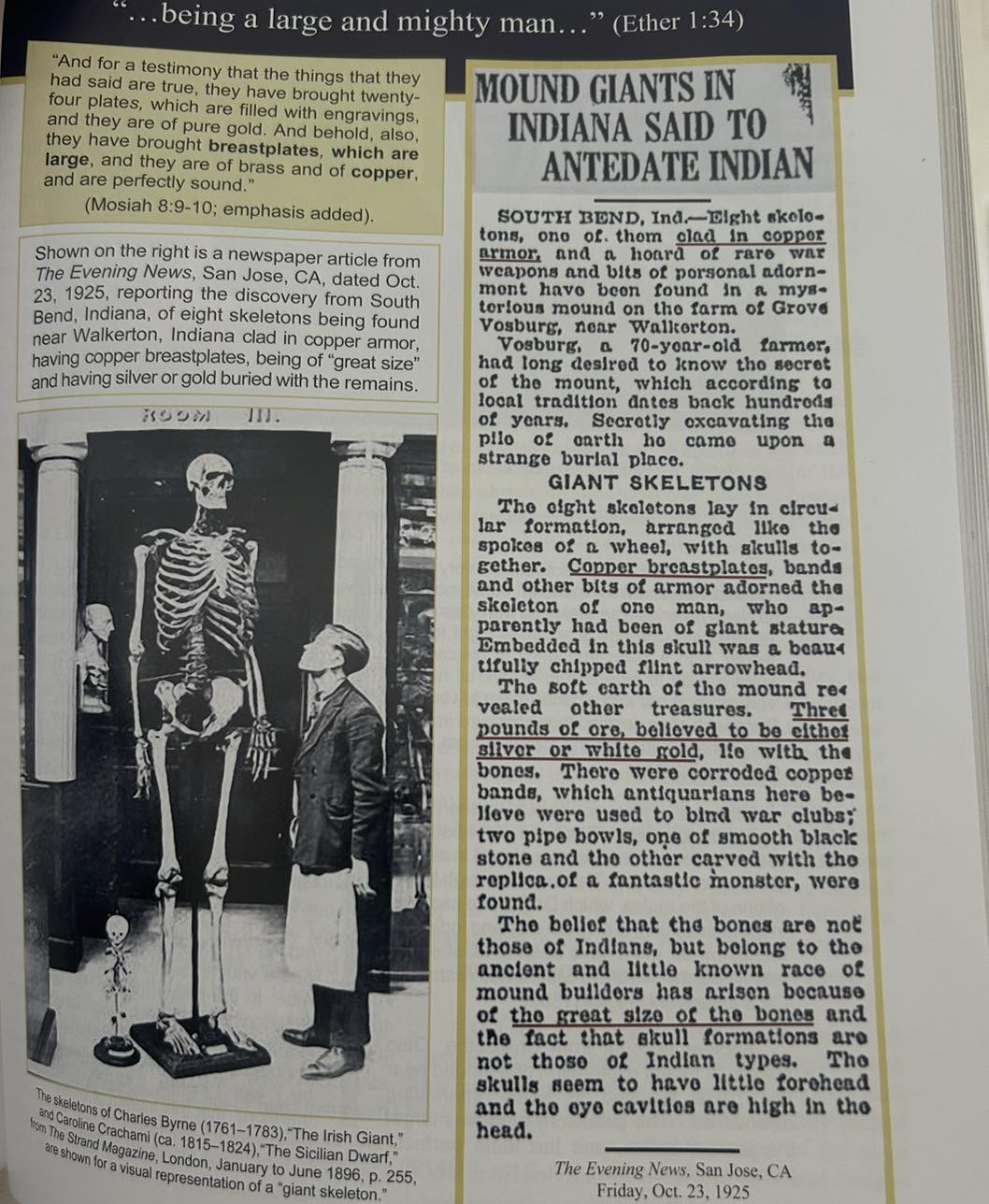
A 1925 Newspaper Clipping Proves Nothing About the Book of Mormon.
This argument has several serious problems that compound each other.
The Source Is Not Evidence
A 1925 newspaper report from a California paper covering an Indiana farm discovery is not peer-reviewed archaeology. The 19th and early 20th centuries were filled with sensationalized “giant skeleton” and “mound builder” stories — many of which were exaggerated, misidentified, or outright fabricated for newspaper readership. The claim of “silver or white gold” in the same mound should already raise a flag — that is not how legitimate archaeological reporting reads.
The Mound Builder Evidence Actually Cuts Against the Book of Mormon:
What archaeology does confirm about the Hopewell and Adena cultures — the actual mound builders of the Ohio and Indiana region — is that they used copper extensively for ornamental and ceremonial purposes. This is well-documented. But these cultures show zero evidence of the things the Book of Mormon describes: no steel swords, no chariots, no horses, no wheat, no barley, no massive military civilizations of millions. Finding copper ornaments on a skeleton proves those cultures used copper — nothing more.
Cherry-Picking One Artifact Doesn’t Validate a Text:
The Book of Mormon describes breastplates of brass and copper, and the LDS member treats any copper artifact found in North America as confirmation. But by that logic, every copper discovery anywhere in the ancient world “confirms” the Book of Mormon. This is confirmation bias, not evidence. The standard of proof for a claimed historical record requires that the complete material culture described matches the archaeological record, not that one item on a checklist can be loosely correlated.
The “Giant Stature” Claim Is Folkloric, Not Scientific:
The 1925 article speculates the skeleton was of “giant stature” — a common embellishment in mound builder mythology of that era. No verified, peer-reviewed skeletal analysis of North American mound builder remains has produced giants. The Smithsonian’s National Museum of Natural History, which holds thousands of such remains, has never confirmed an anomalous giant population. The “giant” narrative is a persistent 19th-century myth that fed both anti-establishment folklore and early Mormon apologetics simultaneously.
The Short Answer:
A century-old newspaper story about copper artifacts on a skeleton in Indiana does not validate a 19th-century American religious text’s claims about ancient Israelite civilizations with steel, horses, chariots, and millions of inhabitants — especially when professional archaeology has spent 150 years excavating the relevant regions and found none of the Book of Mormon’s defining cultural markers.