
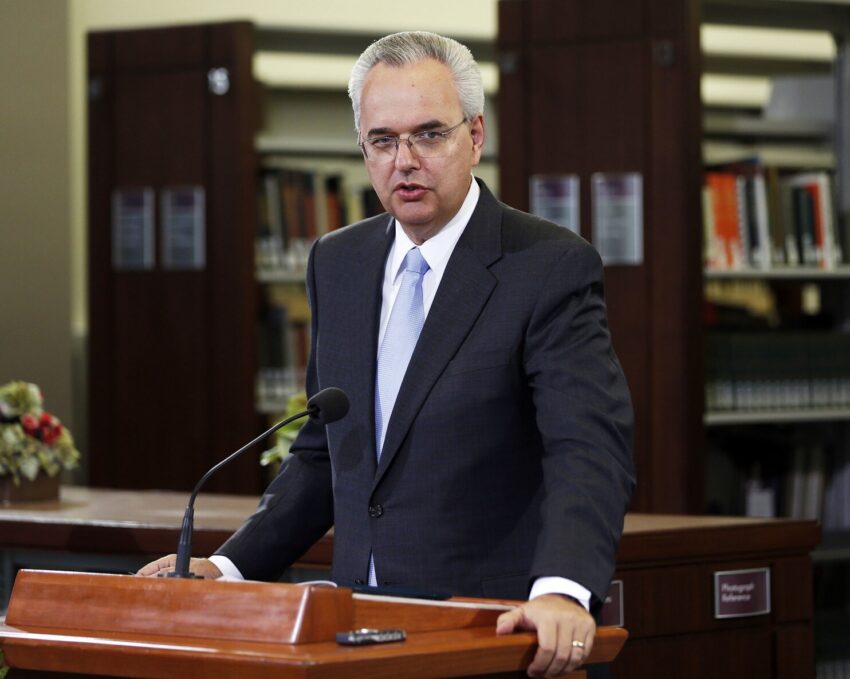
A Shockwave Through the Hierarchy
On August 8, 2017, The Church of Jesus Christ of Latter-day Saints issued a brief, carefully worded statement: James J. Hamula had been “released as a General Authority Seventy… following church disciplinary action by the First Presidency and Quorum of the Twelve Apostles.” That sentence — understated and clinical — detonated like a theological bomb across the Mormon world. In a faith where General Authorities are treated with a reverence approaching the sacred, the news was almost incomprehensible. Not since 1989, when George P. Lee was removed for “apostasy and other conduct unbecoming a member of the Church,” had a General Authority been excommunicated — a gap of 28 years. And unlike Lee, whose apostasy charge at least gave onlookers a theological category to understand, Hamula’s case was stripped of even that. Church officials went out of their way to confirm one thing and one thing only: it was not apostasy. That single qualifier, meant perhaps to reassure, instead opened a Pandora’s box of speculation that has never fully closed.
This article is speculative by necessity. The Church of Jesus Christ of Latter-day Saints has an established policy of not disclosing the specific findings of disciplinary councils, citing respect for the individual and their family. What follows is a rigorous examination of the known facts, the contextual clues embedded in Hamula’s career, the patterns of Mormon church discipline, and the most credible theories circulating among scholars, journalists, and former members — all in service of understanding one of the most significant and enigmatic institutional moments in modern LDS history.
Who Was James J. Hamula?
To understand why the excommunication was so jarring, one must first understand who Hamula was within the LDS power structure. He was not a fringe figure or a marginal administrator. James J. Hamula graduated magna cum laude from Brigham Young University in 1981 with a degree in political science and philosophy — an intellectual pedigree rare among General Authorities, who more typically come from business or law. His ascent through the hierarchy was a study in consistent institutional trust: Stake President, Mission President in Washington D.C., Area Seventy, Pacific Area President (overseeing operations in New Zealand and surrounding regions), Assistant Executive Director of the Church History Department, and finally, in 2016, Executive Director of the Correlation Department.
That final appointment is arguably the most significant detail in the entire case. The Correlation Department is not glamorous, but it is extraordinarily powerful. It is the bureaucratic nerve center responsible for ensuring doctrinal, structural, and procedural unity across a global church of nearly 16 million members. It operates directly under the supervision of the First Presidency and Quorum of the Twelve Apostles, reviewing curriculum, publications, programs, and policies before they reach members worldwide. In other words, Hamula was not just a traveling ecclesiastical diplomat — he was the gatekeeper of what the Church officially taught and how it officially operated. He held this position for less than two years before his excommunication.
He was 59 years old at the time. By every external marker, he was a trusted insider at the summit of a vast institutional machine. Which makes the fall all the more baffling — and the Church’s silence all the more conspicuous.
The Language of the Statement: Reading Between the Lines
Institutional statements, especially from tightly managed organizations like the LDS Church, are rarely accidental in their phrasing. The official release on August 8, 2017, contained two operative facts: (1) that disciplinary action had been taken, and (2) that it was not due to apostasy or disillusionment. The choice to proactively disavow apostasy was, as commentator John Dehlin observed, strategically motivated — the Church did not want members inferring that a senior leader had lost his faith, which would have been spiritually destabilizing at a moment of heightened scrutiny over Mormon truth claims.
But that clarification cuts both ways. By ruling out apostasy, the Church effectively narrowed the field of possible causes to what Mormon disciplinary tradition recognizes as the other major categories of action warranting excommunication: sexual misconduct (including adultery or other serious moral transgressions), financial fraud or abuse of institutional resources, and in rarer cases, violent or criminal behavior. The Church’s own Handbook of Instructions at the time specified that membership councils were mandatory for certain offenses, including “apostasy, serious transgression by a prominent Church leader, [and] pattern of predatory conduct.” The phrase “serious transgression by a prominent Church leader” aligns precisely with the Hamula case’s public framing.
Crucially, the statement noted that in “rare cases,” the decision of a disciplinary council “may be shared publicly to prevent others from being harmed through misinformation.” The Church chose not to share details. The most charitable reading of that choice is privacy protection. A more skeptical reading is that full disclosure would have been institutionally damaging — either because of what it revealed about Hamula specifically, or about structures and people around him.
Theory One: Sexual Misconduct
The most widely circulated and, statistically speaking, most probable theory is that Hamula’s excommunication stemmed from serious sexual misconduct. This is not idle gossip — it reflects the documented statistical reality of Mormon disciplinary councils. As one analysis of LDS excommunications noted, the three primary triggers are sexual misconduct, apostasy, and financial issues, with sexual transgressions accounting for the overwhelming majority of cases at every level of the hierarchy.
Several circumstantial details add weight to this theory. First, Hamula was confirmed to have divorced his wife in the summer following his excommunication — a personal rupture that, while not proof of anything, is consistent with a domestic crisis triggered by the revelation of serious marital betrayal. Second, the Church’s decision to conduct the disciplinary council at the highest possible level — involving both the First Presidency and the Quorum of the Twelve Apostles simultaneously — suggests the matter was considered not just serious, but potentially touching on multiple parties or involving a breach of pastoral trust. Ordinary adultery, while grounds for excommunication, would not typically require the two supreme governing bodies of the Church to convene jointly.
If the misconduct involved someone in a power-subordinate relationship — such as a woman under his ecclesiastical care, a mission companion, or a Church employee — the threshold for that elevated response would be readily met. Mission presidents, Area Presidents, and Correlation executives all operate in environments with significant power differentials over those they serve. In that context, Hamula’s extraordinary scope of institutional authority over the years — from Washington D.C. missions to Pacific Area presidency to the Correlation Department — would have given him access to many people in positions of vulnerability.
There is a darker sub-theory here that has circulated in ex-Mormon communities: that the misconduct may have involved a minor. This is entirely unconfirmed and should be treated as speculation at the most serious level. However, it would explain the totality of the Church’s response — the near-instant elevation to the highest councils, the lifetime excommunication with no public statement offering Hamula any path forward in the announcement, and his own subsequent and conspicuous public silence. Fox 13 News investigated and found no criminal record in either Utah or Arizona, only a minor traffic violation. But absence of criminal record is not absence of misconduct — it reflects only what law enforcement pursued, and ecclesiastical matters frequently never enter the criminal justice system, particularly when institutional pressure encourages quiet resolution.
Theory Two: Financial Misconduct or Abuse of Resources
A second prominent theory centers on financial impropriety. The LDS Church is, by any reasonable accounting, one of the wealthiest religious institutions on earth. At the time of Hamula’s excommunication, internal financial practices at the Church were already drawing scrutiny, and the subsequent 2019 whistleblower complaint — which alleged that Ensign Peak Advisors, the Church’s investment arm, held approximately $100 billion in assets — had not yet broken publicly.
Hamula’s position as Executive Director of the Correlation Department placed him in proximity to significant institutional resources. While the Correlation Department is primarily doctrinal and editorial rather than financial, the broader administrative apparatus of the Church involves substantial budgets for curriculum development, publication, media production, and global distribution. An executive director of that rank would have administrative authority over departmental spending and, depending on how Church finances were compartmentalized, potentially broader access.
The financial theory gains traction from a behavioral angle: Hamula has been extraordinarily silent since his excommunication. No interviews, no book, no public statements, no whistle-blowing. Some observers in ex-Mormon forums have speculated that this silence is not merely a product of personal dignity — it may be the product of a non-disclosure agreement tied to a financial settlement. If Hamula had leveraged knowledge of internal Church operations in exchange for favorable separation terms, or if the Church had settled a financial matter quietly, a binding NDA would neatly explain his continued silence in an era when nearly every other high-profile LDS departure has been accompanied by public commentary.
This theory, however, has a significant weakness: it doesn’t obviously explain why the First Presidency and Quorum of the Twelve jointly convened. Financial misconduct by a Church employee, even a senior one, would more typically be handled through legal or HR mechanisms before escalating to ecclesiastical ones. The summit-level response suggests a transgression with a moral or spiritual dimension, not merely an administrative one.
Theory Three: Corruption of Institutional Power — A Hybrid Scenario
Perhaps the most intellectually satisfying theory — though also the most speculative — is a hybrid: that Hamula’s transgression involved a combination of power abuse, personal moral failure, and potential institutional complicity that made clean disclosure impossible. Consider his role at the intersection of two extraordinarily sensitive departments: the Church History Department and the Correlation Department.
The Church History Department is the custodian of original documents, diaries, manuscripts, and artifacts that bear on the truth claims of Mormonism. The Correlation Department is the body that determines what members are taught — which histories are included, which are omitted, how doctrine is framed globally. Hamula served in both of these roles sequentially, from 2014 to 2016 in Church History, then from 2016 until his 2017 excommunication in Correlation.
This has prompted speculation in some corners that Hamula may have encountered information — perhaps through his Church History role — that disturbed his faith or led him to use privileged knowledge inappropriately. One Reddit thread from 2017 raised the possibility that he had grown disillusioned with “the whitewashing” of Church history and was on the verge of going public, and that the Church moved first to remove him before he could act. Another raised the possibility that he had leaked sensitive documents to platforms like MormonLeaks, which was actively publishing internal Church materials at the time.
The Church’s specific disclaimer of apostasy argues against the first scenario — and it would be strange for the Church to publicly clear him of apostasy while privately disciplining him for it. But the document leak theory is harder to dismiss. If Hamula had provided internal materials to outside critics — whether out of disillusionment, personal vendetta, or misuse of institutional access — that could constitute a “serious transgression” that was neither apostasy nor a strictly personal moral failing, but a profound breach of institutional trust. Such a scenario would also explain why the Church would want to keep the specifics private: naming document leaks as the cause would simultaneously validate whatever had been leaked.
The Silence of James Hamula: The Most Telling Detail of All
In the years since August 2017, James J. Hamula has said nothing publicly. Not a blog post, not an interview, not a social media account, not a book. In the current era of Mormon transparency, where former bishops, mission presidents, and even lower-ranking authorities regularly write memoirs, launch podcasts, or give interviews, Hamula’s absolute silence is remarkable.
Consider the contrast with other high-profile LDS disciplinary cases. Kate Kelly, excommunicated for advocating female ordination, gave extensive press interviews. John Dehlin, excommunicated and later reinstated in some capacity, became a prominent podcaster. Even George P. Lee, whose excommunication was for apostasy, provided letters to the media defending himself. Hamula has done none of these things. He has not defended himself, not expressed grievance, not sought public sympathy, and not provided alternative framing of his own story.
There are several possible explanations. One is simple: genuine shame and a sincere desire to repair his life quietly. Mormon cultural shame around excommunication is profound, and a 59-year-old man with a lifetime of institutional identity suddenly stripped from him might simply retreat. A second possibility is that the terms of his departure — whether formal NDA or informal agreement — prohibit him from speaking. A third, more cynical possibility is that speaking would either confirm or expand the scope of what is known, and that whatever he knows about his own situation (or about the Church’s internal workings) is best left undisclosed for reasons that protect multiple parties.
The silence also cuts against the idea that his excommunication was unjust or politically motivated — because people who believe they have been wronged by a powerful institution usually eventually say so. Hamula’s restraint suggests either genuine culpability, genuine agreement, or both.
Comparing to George P. Lee: What the Precedent Reveals
The only modern precedent for Hamula’s excommunication is George P. Lee, removed in 1989. The comparison is instructive. Lee was a Navajo Native American who had been a celebrated General Authority and was excommunicated publicly for “apostasy and other conduct unbecoming a member.” The Church disclosed the apostasy charge partly because Lee himself went public with his complaints. Years later, Lee was convicted of child sexual abuse — the “other conduct unbecoming” referenced in his excommunication.
This precedent is sobering. In Lee’s case, the Church knew about or suspected sexual misconduct with a minor but publicly foregrounded the apostasy charge, possibly because it was doctrinally cleaner and easier to announce. The “other conduct unbecoming” phrasing served as a catch-all that concealed the most serious allegation until criminal proceedings made it unavoidable.
If the Lee precedent is instructive, it raises the question of whether Hamula’s case follows a similar pattern — but inverted. The Church was at pains to deny apostasy this time, perhaps because the Mormon information environment of 2017 was radically different from 1989 and any suggestion of doctrinal wavering in a senior leader would have fueled the already-raging faith crisis debate. By foregrounding what the transgression was not, the Church implicitly directed attention toward personal moral failure — which, whatever its nature, is framed as an individual failing rather than an institutional one.
What the Church’s Process Itself Reveals
One underappreciated aspect of the Hamula case is the process by which his excommunication was carried out. LDS disciplinary councils for ordinary members are conducted at the local level, typically by a bishop’s council of twelve men. For higher-level leaders, the councils escalate accordingly. For a General Authority of the First Quorum of the Seventy, the council was conducted by the two supreme governing bodies of the entire Church: the First Presidency and the Quorum of the Twelve Apostles.
This means that fifteen of the most senior men in global Mormonism — including President Thomas S. Monson at the time, his counselors, and the twelve apostles — personally presided over or participated in the disciplinary action. The gravity of that convening cannot be overstated. These are men who manage a $100+ billion institution, oversee 16 million members in 180 countries, and operate on schedules of extraordinary density. They would not jointly convene for a matter they considered minor or ambiguous.
Moreover, the rapidity of the process — from whatever triggered the investigation to the August 8 announcement — suggests that the evidence before the council was not contested or ambiguous. Prolonged disciplinary processes in the LDS Church often drag on for months as evidence is gathered and the accused is counseled and allowed to repent. The fact that Hamula’s case appears to have moved relatively quickly through the senior councils suggests either a clear confession, incontrovertible evidence, or both.
The Institutional Stakes: Why This Case Matters Beyond the Individual
Whatever the specific cause of Hamula’s excommunication, the case carries institutional implications that extend far beyond one man’s personal failing. As Executive Director of the Correlation Department, Hamula was the ecclesiastical overseer of the body that literally shapes what 16 million Latter-day Saints believe, read, and practice. Any suggestion that the person at the helm of that body was himself living in severe contradiction to its standards raises uncomfortable questions about institutional integrity.
More broadly, the Hamula case exposed the structural vulnerability of a system built on the premise of prophetic leadership. The LDS Church teaches that General Authorities are sustained by common consent as inspired leaders — men set apart by God to guide the Church. When one of those men is removed not for a difference of opinion but for a “serious transgression,” the cognitive dissonance for ordinary members is acute. It challenges the implicit theology that sustained leaders are spiritually protected from serious personal failure by virtue of their calling.
The Church navigated this by leaning on the Mormon theological principle that leadership calling does not confer personal immunity from sin — a sound and defensible position, but one that the institutional machinery had not previously been required to articulate at this level of visibility in nearly three decades.
A Legacy Defined by Silence
Nearly nine years after August 8, 2017, James J. Hamula remains one of the most consequential enigmas in modern Mormon institutional history. The man who once stood at General Conference and delivered sermons on the Sacrament and the Atonement — the very mechanisms by which Latter-day Saints believe sins are forgiven — vanished from public life as thoroughly as if he had never existed.
What we know with certainty is limited: he was excommunicated, the cause was serious enough to warrant the Church’s two highest councils, the cause was not apostasy or doctrinal disillusionment, and he has chosen a complete silence that is itself one of the most striking features of the case. Everything beyond those facts is inference, pattern recognition, and the application of precedent to ambiguity.
The most probable scenario, weighed against the evidence, is that Hamula committed a serious act of sexual or moral misconduct — possibly involving a power dynamic given his extensive supervisory authority over decades of Church service. The hybrid theory involving institutional knowledge and its potential misuse cannot be fully dismissed, particularly given his unique dual tenure in Church History and Correlation. The financial misconduct theory is the weakest, though not impossible.
What the case ultimately reveals is not one man’s character so much as the architecture of institutional secrecy that the LDS Church has constructed around its own governance. George P. Lee’s case, where the undisclosed “other conduct unbecoming” turned out to be child sexual abuse, suggests that ecclesiastical privacy policies can serve as shields for serious harm rather than merely as instruments of pastoral compassion. The Hamula case, still officially sealed, carries that shadow over it — not as an accusation, but as an unanswered question.
Until James Hamula speaks, or until the Church’s records are opened, the verdict remains what the Church issued on August 8, 2017: brief, definitive, and deliberately incomplete.
This article is speculative and analytical in nature. All conclusions regarding the specific cause of James J. Hamula’s excommunication are the author’s reasoned inferences based on publicly available information. No claims of fact are made regarding undisclosed details of his disciplinary council.