

Image: An AI-generated image imagines the LDS theology of premortal existence, where spirits before birth were in the presence of God, where they developed character, exercised agency, and prepared for mortality.
A Theological Essay from a Traditional Christian Perspective
Introduction: A Different Starting Point
When Elder Ronald M. Barcellos addressed BYU–Hawaii students in February 2026, he began with a claim that would sound extraordinary in almost any other Christian setting: before we were born on earth, we had already lived together in a premortal world, witnessed a heavenly conflict, and chosen sides in a cosmic war. His opening was not a rhetorical flourish alone; it was a direct restatement of a central LDS doctrine that the Church teaches as part of its larger plan of salvation. In LDS theology, that war is understood as the conflict in heaven that followed the presentation of God’s plan, the rebellion of Lucifer, and the casting out of those who followed him.
“Even though we are just meeting today, I would like to begin my remarks by talking about another time when we all lived together. In fact, during that time, you and I witnessed the greatest war anyone has ever known. That war occurred before any of us were born on this earth.”
— Elder Ronald M. Barcellos, Address to Latter-day Saint Students
This doctrine is commonly called premortal existence or premortality. The Church teaches that human beings are beloved spirit sons and daughters of heavenly parents, that we existed before mortality as “intelligence” or spirit children, and that premortal life included learning, agency, foreordination, and participation in the heavenly council. The official LDS framing also teaches that in that premortal setting, Jesus Christ was chosen as the Savior, Lucifer rebelled, and a war in heaven ensued, with those who followed God overcoming “by the blood of the Lamb, and by the word of their testimony.”
For faithful Latter-day Saints, this is not a peripheral speculation. Church teaching presents premortality as a key to understanding identity, suffering, divine justice, and eternal progression. In the same vein, Elder Boyd K. Packer taught that life only becomes intelligible when viewed through the doctrine of premortal existence. That claim shows how deeply the idea is woven into LDS spiritual anthropology and salvation history.
“There is no way to make sense out of life without a knowledge of the doctrine of premortal life. … When we understand the doctrine of premortal life, then things fit together and make sense.”
— Elder Boyd K. Packer, “The Mystery of Life,” Ensign, November 1983, 18; cited in “The Fulness of the Gospel: Life before Birth,” Ensign, February 2006
From a historic Protestant or evangelical perspective, the concept of premortal existence is considered a significant theological innovation that lacks explicit biblical support and fundamentally alters traditional understandings of God and humanity. The New Testament does not explicitly teach that all humans lived as spirit persons with God before birth, and it is argued that LDS readings of passages such as Jeremiah 1:5 or Job 38 are better understood as statements of divine foreknowledge, calling, or poetic imagery rather than proof of literal pre-earth life. On that reading, the doctrine is not a recovery of biblical Christianity but a major reconfiguration of the doctrines of God, human nature, and salvation.
This essay examines the doctrine of premortal existence as taught and practiced within LDS theology, assesses its historical emergence and internal inconsistencies, and evaluates its biblical legitimacy from a traditional Protestant perspective. Throughout, we engage the doctrine with charity and scholarly rigor, while acknowledging that many LDS believers will likely prefer faith commitments over careful documentation, biblical evidence, and plain logic; still, we seek to present the matter as honestly and fairly as possible.
I. The Doctrine Defined: What the LDS Church Teaches About Premortal Life
The Church of Jesus Christ of Latter-day Saints offers a comprehensive account of premortal existence that has developed through nearly two centuries of prophetic teaching, scriptural interpretation, theological elaboration, and institutional codification. The Church’s own Gospel Topics page defines premortality in essentially the terms you quoted: life before birth on earth, existence with Heavenly Father as spirit children, and a premortal council in which the plan of happiness was presented.
The doctrine is presented within a larger cosmological framework. LDS teaching says that before mortal birth, human beings lived as spirit children of Heavenly Father and, in some LDS explanations, Heavenly Mother, and that their premortal lives included learning, development, and the exercise of agency. The Church also teaches that “intelligence, or the light of truth, was not created or made,” and that intelligence is eternal, though LDS writers do not all interpret the relation between intelligence and spirit embodiment in the same way. That last point matters because the Church has not always spoken with complete uniformity on whether “intelligences” existed as distinct persons before spirit birth or were organized into spirit children from eternal material.
The Grand Council in Heaven is also accurately described in your draft. In official LDS materials, Heavenly Father presents the plan of happiness, Jesus Christ volunteers as the premortal Firstborn and Savior, Lucifer rebels, and those who follow God are permitted to come to earth and receive mortal bodies. LDS teaching further states that Lucifer and his followers were denied the privilege of mortality, which is one reason the premortal conflict is so central to the Church’s account of human destiny.
“Premortality refers to our life before we were born on this earth. In our pre-earth life, we lived in the presence of our Heavenly Father as His spirit children. We did not have a physical body. In this premortal existence, we attended a council with Heavenly Father’s other spirit children. At that council, Heavenly Father presented His great plan of happiness.”
— “Premortality,” Topics and Questions, The Church of Jesus Christ of Latter-day Saints“Intelligence, or the light of truth, is eternal and has always existed… We lived as spirit children of God in a premortal existence… God the Father provided the plan of salvation whereby his spirit children could eventually become like him.”
— “Chapter 6: Our Premortal Life,” Doctrines of the Gospel Teacher Manual, The Church of Jesus Christ of Latter-day Saints
Elder Neil L. Andersen’s “birth certificate” image is also substantially accurate, though it comes from LDS Living’s presentation of his teaching rather than from a standalone conference address in that exact wording. In that article, Andersen says we lived before the day of birth recorded by our earthly birth certificate and that, if such a document existed, it would list God as the Father of our spirits. That language functions devotionally: it reinforces divine identity, belonging, and spiritual continuity between premortal and mortal life.
“We lived before the day of birth documented by our earthly birth certificate. Our individual identity is stamped in us forever. If such a document existed, our premortal birth certificate would have listed God the Eternal Father as the Father of our spirits.”
— Elder Neil L. Andersen, “How the Premortal Existence Builds Our Faith Today,” LDS Living, February 2020
Barcellos’ remarks fit the same theological pattern. In LDS teaching, testimony of Christ is not merely an earthly acquisition but something remembered or recovered from premortal reality, and the war in heaven is framed as the context in which that loyalty was first expressed. His rhetorical move is significant because it binds present faith to a prior cosmological biography, making testimony feel less like conversion from outside and more like recognition of an identity already possessed.
“Long before you were born, each one of you here today had a testimony of Jesus Christ and His atoning sacrifice — an atonement that was yet to happen — and of His power to bring you back to your celestial home. You relied on that testimony during the great war in heaven. It helped you choose the Father’s plan and stay by His side.”
— Elder Ronald M. Barcellos, Address to Latter-day Saint Students
From a theological standpoint, that move does more than motivate discipleship. It frames human identity as premortal, divine, and developmental, with mortal life functioning as a continuation of a story that began before birth. That is one reason the doctrine is so powerful within LDS spirituality: it offers meaning, nobility, and purpose by situating each person within a pre-earth drama of eternal significance. At the same time, it also introduces a cosmology that sits far outside historic Christian teaching and depends on scriptural interpretations that tranditional Christian doctrine categorically rejects.
II. Historical Emergence: A Doctrine Born in the Nineteenth Century
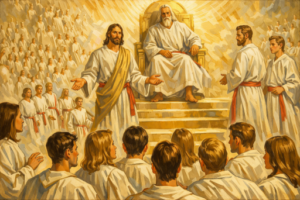
It is essential to situate the Latter-day Saint doctrine of premortality within its historical and theological context. In LDS thought, this teaching did not arise merely from isolated proof-texting or from a straightforward exegesis of the biblical canon as received by historic Christianity; rather, it developed through Joseph Smith’s revelations and teachings and was later refined through institutional instruction and canonized scripture.
The doctrine was not fully systematized in the earliest years of the movement. The Book of Mormon, published in 1830, does not present an explicit and sustained doctrine of human premortal existence. By contrast, later LDS texts—particularly the Doctrine and Covenants and the Book of Abraham—provide the most direct and expansive scriptural articulation of premortality, including the ideas of premortal identity, divine council, foreordination, and the “first estate.” According to Abraham 3:26, those who kept their first estate were to be ‘added upon,’ and LDS interpretation commonly understands this as including the opportunity to enter mortality and receive a physical body. Those who keep their second estate, by contrast, are promised that ‘glory’ will be added upon them forever.
The Book of Abraham occupies a central place in this development. Although Joseph Smith claimed to translate the text from Egyptian papyri acquired in 1835, the work is now treated in Latter-day Saint theology as a foundational witness to premortal life. In its most influential passages, the text presents a premortal council, the organization of intelligences, and the distinction between those who were “noble and great” and those who were not. The result is a comprehensive cosmology in which mortal life is understood as a continuation of a prior heavenly existence rather than humanity’s first appearance before God. For a critical examination of the Book of Abraham’s historical claims and theological significance, see the author’s study, EXPOSING JOSEPH SMITH’S DECEPTION: The Book of Abraham’s Fictional Genesis, which argues that the text is best understood in its nineteenth-century context rather than as an authentic ancient record.
Randy L. Bott, writing in Brigham Young University’s Religious Studies Center volume Joseph Smith and the Doctrinal Restoration, presents Joseph Smith’s revelations on premortality as a sweeping theological clarification rather than a speculative novelty:
“The great Jehovah contemplated the whole of the events connected with the earth, about the plan of salvation, before it rolled into existence, or ever ‘the morning starts sang together’ for joy; the past, the present, and the future were and are, with Him, one eternal ‘now.’”
— Joseph Smith, as cited in Randy L. Bott, “Joseph Smith’s Expansion of Our Understanding of the Premortal Life and Our Relationship to God”
Bott’s argument is significant because it reflects a broader LDS interpretive pattern: premortality is not treated as a marginal idea, but as a doctrinal key that helps explain divine purpose, human identity, moral agency, and the structure of salvation history. In this framework, premortal existence is not merely antecedent to mortality; it is part of the logic by which mortality itself becomes intelligible.
The historical setting of Joseph Smith’s America is also relevant. The early nineteenth century was shaped by revivalism, restorationist impulses, and a widespread dissatisfaction with inherited ecclesial authority. Within that intellectual and religious environment, a doctrine that offered cosmic origin, divine purpose, and an eternal explanation for human inequality would have possessed considerable imaginative force.
It is also important to note that ideas of preexistence were not unique to Mormonism. Variants of preexistent-soul speculation circulated in earlier philosophical, religious, and literary traditions, and LDS scholars themselves have acknowledged those broader antecedents. That said, the strongest historical claim is not that Joseph Smith simply borrowed a single source, but that he articulated a distinctive restorationist version of a much older conceptual possibility. In that sense, the doctrine should be read as both historically situated and theologically innovative.
From the standpoint of historic Protestant Christianity, however, the decisive question is not whether the doctrine fits a broader intellectual pattern, but whether it can be demonstrated from the canonical Scriptures themselves. That issue remains central: does premortality emerge from the biblical text on its own terms, or is a later cosmological framework being read back into the text?
III. The Problem of Internal Inconsistency: Competing LDS Accounts
One of the significant challenges facing any careful reader of LDS premortal theology is the internal diversity — and in some cases contradiction — between different official and unofficial accounts of what premortal life actually involved.
A. Intelligences vs. Spirit Children: A Permanent Ambiguity
The LDS doctrine distinguishes between intelligences, which are self-existent and uncreated, and spirit children, who are presented as the beloved offspring of heavenly parents. Doctrine and Covenants 93:29 states that “Intelligence, or the light of truth, was not created or made, neither indeed can be,” while the Church’s Gospel Topics essay on a Mother in Heaven teaches that “all human beings, male and female, are beloved spirit children of heavenly parents, a Heavenly Father and a Heavenly Mother.” The transition between those two conditions is often described as spirit birth, but the exact metaphysical relationship between the two remains unclear in official LDS teaching.
Yet the Church’s own materials acknowledge significant ambiguity at precisely this point. Norman W. Gardner’s What We Know about Premortal Life says:
“Each of us ‘is a beloved spirit son or daughter of heavenly parents’ with ‘a divine nature and destiny.’ Before our spirit bodies were created, we each existed as ‘intelligence,’ which ‘had no beginning, neither will it have an end.’”
— Norman W. Gardner, “What We Know about Premortal Life,” New Era, February 2015
That statement affirms both eternal preexistence and divine parentage, but it stops short of explaining what intelligence is, how it becomes a spirit person, or whether spirit birth is a literal act of procreation, organization, or something else entirely.
This unresolved point creates a doctrinal tension. If intelligences are eternal and uncreated in a robust personal sense, then human beings are not ultimately created by God out of nothing or even out of preexisting divine material; rather, they simply undergo a change of state within an eternal reality. That view weakens the classic Christian Creator-creature distinction, since creatures in the biblical sense are wholly dependent on God for their being. If, on the other hand, spirit birth is the decisive moment at which an intelligence becomes an actual person-child of God, then the earlier claim of personal eternal existence becomes much harder to define with precision.
The Church of Jesus Christ of Latter-day Saints has historically allowed more than one way of describing this relationship. Some Latter-day Saint writers have treated intelligence as an individual, self-conscious eternal entity; others have described it more cautiously as a principle, attribute, or “light of truth” that is eternal but not fully explained. That internal range of interpretation helps explain why the doctrine can sound definite in devotional settings while remaining surprisingly open-ended in philosophical terms.
From the standpoint of historic Christian theology, this ambiguity is significant because it disrupts the sharp ontological distinction between the uncreated God and all contingent creatures. LDS premortality, by contrast, appears to relocate something essential to human personhood into a pre-mortal state and thereby grounds identity in a prior heavenly existence rather than in an exclusively creative act of God. When this framework is combined with doctrines of exaltation and divine parentage, it also raises difficult metaphysical questions about the origin of deity itself and the possibility of an infinite regress of gods. These concerns are not peripheral; they strike at the coherence of the system as a whole.
Several further questions follow naturally from that framework:
• If intelligences are eternal and uncreated, in what sense are they truly “begotten” as spirit children?
• If spirit birth is a real act of generation, what distinguishes that act from creation in any meaningful theological sense?
• If God organized preexisting intelligences rather than creating persons outright, does that limit divine sovereignty?
• If exaltation entails becoming like God, what prevents an endless succession of gods without a first divine source?
• If there is no first divine being, how does LDS theology avoid an infinite regress that never arrives at ultimate explanation?
• If human beings existed before mortality, how should traditional doctrines of sin, grace, and accountability be redefined?
• If premortal choices determine mortal circumstances, how is divine justice preserved in the face of unequal earthly conditions?
• If the canon leaves these matters underdefined, is the ambiguity a feature of the theology or a sign of unresolved conceptual tension?
B. What Did We Actually Know or Choose?
Elder Barcellos’s address presupposes meaningful premortal knowledge, including the claim that “long before you were born, each one of you here today had a testimony of Jesus Christ and His atoning sacrifice.” At the same time, LDS teaching consistently affirms that mortality is marked by a “veil of forgetfulness” that obscures memory of premortal existence, so that earthly life functions as a genuine probationary test. The Church’s Gospel Topics essay on premortality states that “throughout our premortal life, we developed our identity and increased our spiritual capabilities,” and that “blessed with the gift of agency, we made important decisions,” including the decision to follow Heavenly Father’s plan.
“The Veil of Forgetfulness: Upon coming to earth, a ‘veil’ of forgetfulness was placed over our minds, so we would not remember our premortal life. This is necessary so that we can ‘walk by faith and not by sight’ and fully exercise our agency.”
— H. Craig Petersen, “You Mormons Are All Ignoramuses: Appreciating the Doctrine of Pre-Mortal Life,” Latter-day Saint Magazine (Meridian Magazine), October 2025
This creates a genuine epistemological tension. On the one hand, LDS theology insists that premortal choices were real and consequential, since they affected mortal assignments, foreordination, and the circumstances of earthly birth. On the other hand, the same tradition insists that mortal life must proceed without direct memory of those choices, because the veil is said to preserve the integrity of faith and agency in mortality. The result is that the premortal self is invoked as morally decisive, even though the mortal self is structurally prevented from verifying, recalling, or consciously integrating that prior agency.
The difficulty is not simply that memory has been removed, but that the doctrine appears to require two different standards of agency. Premortal agency is treated as fully valid despite the absence of mortal limitation, uncertainty, and embodied testing; mortal agency, by contrast, is said to require precisely those conditions to be meaningful. Some LDS writers resolve this by arguing that direct knowledge of God does not eliminate freedom, while others maintain that the veil is necessary only for mortality, not for premortality. Even so, the theological question remains: if a choice is genuinely free in a context of near-complete divine presence and recollection, why would the same framework require forgetfulness later for agency to count? This raises a further philosophical problem: what substantive moral good is accomplished by premortal intelligence and spiritual development if those capacities must be eclipsed in mortality before agency can function in the form LDS theology considers decisive?
A more exact formulation, then, would be that LDS theology simultaneously affirms premortal agency, mortal forgetfulness, and postmortal restoration of memory, but does not fully explain how those three states cohere into a single theory of moral responsibility. That is not necessarily a formal contradiction, but it is a substantial unresolved tension in the system.
C. Valiance, Foreordination, and the Shadow of Racial Theology
At some point, the doctrine of premortal “valiance” stops sounding like theology and starts sounding like a metaphysical laundering of injustice. Abraham 3:22–23 may speak of “noble and great ones” and of God appointing rulers among premortal intelligences, but the text never honestly explains what made those spirits noble, great, or fit to rule. That vagueness has been a gift to LDS speculation, because once the system is allowed to imply premortal ranking, nearly any earthly inequality can be baptized as the afterimage of a heavenly hierarchy.
And that is exactly what happened. For decades, Latter-day Saint leaders and teachers used the language of premortal faithfulness, lesser valiance, and prior spiritual performance to explain why Black members were denied the priesthood and temple blessings. In other words, a doctrine that supposedly reveals divine justice became a mechanism for rationalizing racial exclusion. The Church now disavows those explanations, but the damage is not erased simply because the official story has changed. The logic still sits there in the architecture of the belief system: if one group is born into privilege and another into deprivation, premortal merit is always available as the cleanest possible excuse.
This is not a harmless theological quirk. It is a doctrinal machine for moral deflection. Once you tell people that mortal conditions reflect premortal worthiness, you have handed them a ready-made explanation for suffering, inequality, and exclusion that sounds spiritual while doing the work of prejudice. That is what makes the history so corrosive: it did not merely coexist with racism; it helped sacralize it. LDS premortal theology does not merely permit explanations of inequality; it invites them, sanctifies them, and, in its racial history, has already demonstrated how easily they can become instruments of theological cruelty.
IV. The Biblical Examination: What the Scripture Actually Says
The most decisive question for Christians evaluating any theological claim is not whether it is emotionally compelling, cosmologically elegant, or culturally intelligible. It is whether it is rooted in and consistent with the authoritative revelation of Scripture. On the question of premortal human existence, the biblical witness is clear and consistent: human beings do not preexist their birth.
A. The Passages LDS Theology Invokes — and What They Actually Mean
LDS theologians and apologists regularly appeal to a constellation of biblical passages to support the premortal doctrine. A careful reading of each reveals a systematic pattern of eisegesis — the process of interpreting a text by reading one’s own ideas, biases, or assumptions into it, rather than drawing meaning out of it.
1. Jeremiah 1:5
LDS apologists regularly appeal to a small set of biblical passages to support premortal existence, and Jeremiah 1:5 is among the most frequently cited. The verse states: “Before I formed you in the womb I knew you, before you were born I set you apart; I appointed you as a prophet to the nations.” Latter-day Saint interpreters often read this as evidence that Jeremiah existed and was known by God before birth, whereas evangelical interpreters generally understand it as a statement of divine foreknowledge and prophetic appointment rather than personal preexistence.
The evangelical counter-reading is straightforward and contextually plausible. The verse does not say that Jeremiah knew God before birth, only that God knew Jeremiah; in that setting, “knew” functions as language of prior divine knowledge, choice, and consecration. That is consistent with the broader biblical use of divine knowing as covenantal election, as in Amos 3:2, where “You only have I known” is commonly understood to mean “You only have I chosen” or set apart.
The Talking to Mormons evangelical resource engages this passage directly:
“The proper interpretation is this: God knows everything there is to know, past, present and future. The verse is saying that God knew He was going to create Jeremiah before Jeremiah was formed in mother’s womb. And that God had a special work planned for Jeremiah to do while he lived. The verse does not say that Jeremiah knew God or had done anything before his earthly conception or birth.”
— Talking to Mormons, “Pre-mortality?“
That reading reflects standard evangelical exegesis: Jeremiah 1:5 is about God’s sovereign purpose, not Jeremiah’s premortal consciousness. The point is reinforced by the Hebrew verb yada (“to know”), which can denote an intimate relationship, covenantal choice, or knowledge in a general sense, depending on context. In this passage, the strongest argument is that God’s prior knowledge is in view; the text itself does not explicitly describe a pre-earth existence, a premortal council, or an earlier phase of Jeremiah’s agency.
A broader biblical context strengthens that conclusion. Elsewhere, Scripture regularly presents divine calling as before birth without implying literal premortal personal existence: John the Baptist is said to be filled with the Holy Spirit from his mother’s womb, and Paul describes being set apart “before I was born,” language that most readers do not take to imply conscious existence before conception. These kinds of passages show that biblical election language can be temporal in reference while remaining wholly compatible with a non-LDS anthropology.
The deeper issue, then, is methodological. LDS readings of Jeremiah 1:5 depend on importing a premortal framework already established elsewhere in Mormon theology, and then treating the verse as confirmation of that framework. Critics argue that this is eisegesis: the doctrine is brought to the text rather than derived from it. On that reading, Jeremiah 1:5 is best understood not as a proof of preexistence, but as a clear example of God’s foreordaining knowledge and prophetic appointment.
2. Job 38:4-7 and Creation
A second text often pressed into service is Job 38:4–7, especially the line that “the morning stars sang together and all the sons of God shouted for joy” when God laid the earth’s foundations. Latter-day Saint readers often cite this as evidence that human spirits were already present to witness creation, and the Church’s own New Era essay explicitly connects the verse to premortal life, stating that in premortality “the rest of God’s children shouted for joy because they could come to earth and because Jesus Christ was chosen to overcome sin and death.” That interpretive move, however, is far from compelled by the text itself.
“God steps in and asks Job some probing questions like — Where was he when all this happened? Where was Job when God laid the foundation of the earth? Meaning, Job you weren’t even around then, you didn’t even exist as a spirit. So, who was he to instruct the Lord? And the ‘morning stars’ and the ‘sons of God’ shouting for joy refer to angelic creations and the hosts of heaven which were among the first order of God’s creations in the universe.”
— Talking to Mormons, “Pre-mortality?“
The rhetorical force of Job 38 is precisely the opposite of what the LDS reading requires. God is rebuking Job by contrasting divine creative wisdom with human finitude: Job was not present when the earth was founded, and therefore has no standing to litigate God’s governance of the world. The passage functions as a reminder of creaturely limitation, not as an invitation to reconstruct a premortal biography.
The phrase “morning stars” and the expression “sons of God” are best understood, in context, as poetic language for the heavenly host. That is the standard evangelical reading, and it fits the literary setting much better than a claim about universal human preexistence. If the text is speaking of angelic witnesses celebrating creation, then the passage says nothing about Job’s own pre-earth existence, much less about the premortal state of all humanity.
More importantly, the LDS appeal to Job 38:7 depends on an inference that the passage does not actually make. The text does not say that the “sons of God” were human spirits, nor does it identify the singers as all future human beings. It simply places a heavenly chorus at the moment of creation, reinforcing the grandeur of God’s act and the smallness of Job’s perspective. To treat that as proof of premortal human existence is therefore to press poetic imagery into theological service beyond what the passage can bear.
3. Proverbs 8:22-31
Some LDS teachers have appealed to Proverbs 8:22–31 as a proof text for premortal spirit children, reading the passage as if it described literal beings existing with God before the creation of the world. That reading is not sustained by the literary context. Proverbs 1–9 consistently presents “Wisdom” as a personified figure, often depicted as a woman who speaks, calls, and instructs, rather than as a class of premortal human spirits. The most natural reading of Proverbs 8 is therefore not anthropological but poetic: wisdom itself is portrayed as present with God in creation.
“The subject of Proverbs chapters 1-9 is wisdom. In fact, wisdom is treated as a woman from the first chapter right through chapter 9… Throughout Proverbs 8 it is wisdom personified who speaks, not Heavenly Father’s spirit children. It is wisdom who was from the beginning, wisdom who was present when the heavens were prepared, wisdom who was God’s daily delight. If the Larsons intended to say this passage of scripture supports the idea that spirit children were ‘brought forth’ before the hills were formed, they have severely misused it.”
— Sharon Lindbloom, “Proverbs 8 and the Mormon Doctrine of Preexistence,” Mormonism Research Ministry, September 2011
This matters because the passage belongs to the biblical wisdom tradition, where personification is a standard literary device. Wisdom “cries out” in the streets, “dwells” with God, and is depicted in relational terms to communicate the value and order of wisdom in creation and life. In other words, the text is not giving a cosmological history of human souls; it is offering theological poetry about the primacy of divine wisdom. Reading it as a narrative of premortal spirits requires importing a premortal framework into a passage that does not itself supply one.
A more precise way to state the evangelical critique, then, is that Proverbs 8 does not describe preexistent human beings at all. It personifies wisdom as co-present with God in creation, and its imagery should be read as rhetorical and literary rather than literal and anthropological. Once that distinction is kept in view, the LDS proof-texting collapses under the weight of the passage’s own genre and context.
4. Romans 8:16 and Hebrews 12:9
LDS theology frequently cites Romans 8:16, “The Spirit itself beareth witness with our spirit, that we are the children of God,” and Hebrews 12:9, which refers to God as “the Father of spirits,” as support for literal divine parentage in a premortal sense. Latter-day Saint interpreters often read these passages as evidence that human beings are God’s spirit offspring, rather than merely his adopted children by grace.
“We are not born sons and daughters of God. We are God’s creations. John 1:12-13 declares, ‘But as many as receive him, to them gave he the power to BECOME the sons of God, even to them that believe on his name.’ We become sons and daughters of God through adoption, through our faith in believing on his name.”
— Talking to Mormons, “Pre-mortality?“
The broader New Testament context, however, points in a different direction. In Paul, divine sonship is ordinarily presented as a relational status conferred through union with Christ, regeneration, adoption, and the witness of the Holy Spirit, not as a metaphysical fact grounded in a premortal biological origin. Romans 8, in particular, places sonship in the setting of adoption and inheritance: believers receive “the Spirit of adoption,” cry “Abba, Father,” and are thus assured that they are children and heirs of God.
That same adoption framework appears elsewhere in the New Testament. John 1:12–13 says that those who receive Christ are given the right to become children of God, and this sonship is associated with divine birth “not of blood, nor of the will of the flesh, nor of the will of man, but of God.” Taken on its own terms, the passage describes a gracious new status bestowed in salvation, not a return to a prior ontological family relationship in a premortal world.
Hebrews 12:9 is also better read in a theological and relational sense than in a literal procreative one. In context, the phrase “Father of spirits” contrasts God’s discipline with that of earthly fathers and emphasizes his authority, transcendence, and rightful lordship over the whole spiritual realm. Many Christian commentators understand the phrase to mean that God is the creator and sustainer of spirits, not their biological progenitor through spirit conception.
This matters because the LDS reading depends on collapsing several distinct biblical categories into one: creation, adoption, regeneration, and sonship. The New Testament distinguishes them. Believers are not said to be God’s children because they existed as premortal spirits in a heavenly family; rather, they become children of God through saving union with Christ. That distinction is not incidental. It is foundational to the Christian doctrine of grace, in which sonship is a gift, not an inheritance from a prior metaphysical state.
A more precise conclusion, then, is that Romans 8:16 and Hebrews 12:9 speak powerfully about assurance, adoption, and divine fatherhood, but they do not explicitly teach premortal spirit birth. To read them that way requires a doctrinal framework already assumed from outside the immediate text.
5. John 1:18, John 6:46, and John 8:23, Jesus’ Unique Origin
Perhaps the strongest biblical counter-evidence to a universal premortal existence comes not from an isolated proof-text, but from the way the Gospel of John distinguishes Jesus from everyone else. In John’s Christology, Jesus does not merely share a heavenly past with humanity; rather, He alone speaks of coming “from above” and “down from heaven,” while His hearers are described as belonging “from below” and “of this world.” That contrast is not incidental. It is integral to John’s presentation of Jesus’ divine identity and mission.
In John 8:23, Jesus says, “You are from below; I am from above. You are of this world; I am not of this world.” In the surrounding context, the point is not simply spatial but theological: Jesus is exposing the spiritual separation between Himself and His opponents, and He does so by appealing to His origin and nature. Likewise, in John 6, Jesus repeatedly says that He has “come down from heaven,” language that the Gospel uses to describe His unique descent in the incarnation and His mission as the sent Son. John 1:18 reinforces the same exclusivity by presenting Christ as the one who uniquely reveals the unseen Father; no one else occupies that role or shares that intimacy in the same way.
“Jesus again declared in John 8:23 ‘And he said unto them, Ye are from beneath; I am from above: ye are of this world; I am not of this world.’ Very clearly Jesus confirms that all humans are from the earth — and He is the only One who came down from above.”
— Talking to Mormons, “Pre-mortality?“
That reading captures an important part of the argument: if all human beings had already lived with God in a premortal state, then Jesus’ contrast between “from above” and “from below” loses much of its force. The Gospel’s point is not merely that Jesus preexisted, but that He preexisted in a category qualitatively distinct from ordinary humanity. He is not presented as one more premortal spirit among many; He is the eternal Son, the one who alone is from the Father in the fullest sense and the only one who can reveal the Father perfectly.
A wider Johannine context supports that interpretation. John 3:13 speaks of the Son of Man who “came down from heaven,” and John 6:38 says, “I came down from heaven, not to do my own will but the will of him who sent me.” These statements function as Christological claims about incarnation, mission, and authority, not as evidence that all humans share Christ’s heavenly origin. Likewise, John 6:46 emphasizes that “not that anyone has seen the Father except he who is from God; he has seen the Father,” underscoring Jesus’ singular access to divine reality.
From an evangelical perspective, therefore, John’s Gospel does not simply present Jesus as the first of a class of premortal beings. It presents Him as the unique heavenly One whose origin, knowledge, and authority distinguish Him absolutely from the rest of humanity. To collapse that distinction by claiming that everyone also came “from above” would flatten one of the clearest Christological contrasts in the New Testament.
B. Paul’s Direct Contradiction of Spiritual Preexistence
A frequently overlooked biblical counterpoint to LDS premortal theology appears in 1 Corinthians 15:46: “However, the spiritual is not first, but the natural, and afterward the spiritual.” In context, Paul is discussing the resurrection and the contrast between Adamic mortality and resurrected embodiment, not laying out a detailed anthropology of premortal existence. Even so, the order he states is significant: the natural life comes first, and the spiritual transformation follows. Read straightforwardly, that sequence sits uneasily with any doctrine that places a prior spiritual human existence before mortal birth.
The Talking to Mormons resource presses this point directly in response to LDS appeals to the Book of Moses, where spiritual creation is treated as preceding physical creation:
“So, according to the Apostle Paul the natural was first, then the spiritual. This begs the question: how could we have pre-existed in a spiritual state if the spiritual did not come first?”
— Talking to Mormons, “Pre-mortality?“
That objection is not merely rhetorical. It reflects a larger Pauline pattern in which human life begins in a natural, mortal condition and is later transformed by divine action. Paul’s broader argument in 1 Corinthians 15 emphasizes the sequence from the earthly man to the heavenly man, from mortality to immortality, and from corruption to incorruption. In that framework, the spiritual is not the pre-earth starting point of the human person; it is the eschatological outcome of resurrection.
For that reason, 1 Corinthians 15:46 presents a serious challenge to LDS premortality. The passage does not prove the doctrine false on its own, but it does force the question of whether LDS theology is reading a premortal spiritual state into a text that more naturally describes the progression from mortal life to resurrected glory. On a plain reading, Paul’s sequence runs in the opposite direction from LDS anthropology: natural first, spiritual afterward.
C. The Biblical Doctrine of Divine Creation and Creatio Ex Nihilo
The biblical account of creation, taken as a whole, presents God as the unique, uncreated source of all that exists. Genesis opens with the declaration that “In the beginning God created the heavens and the earth,” and the New Testament reinforces that same cosmological claim by describing all things as created through and for Christ. Colossians 1:16 states that “by him all things were created: things in heaven and on earth, visible and invisible,” while Revelation 4:11 grounds all reality in God’s will and power as Creator. Read together, these texts support the classical Christian conviction that God is not one being among many but the absolute Creator upon whom everything else depends.
LDS theology explicitly departs from this doctrine by rejecting creation ex nihilo. Latter-day Saint writers often argue that this rejection avoids the idea of a distant, purely transcendental deity and instead preserves a more relational account of divine action. On that view, God works with preexisting intelligences or eternal elements rather than bringing all things into being from nothing. Whatever one thinks of that proposal, it is important to note that it does not merely revise a technical point of metaphysics; it substantially alters the biblical doctrine of God by changing the relation between the Creator and everything else.
From a classical monotheistic standpoint, this is not a minor adjustment. If intelligences are eternal and self-existent alongside God, then God is no longer the only uncreated reality. He becomes one eternal being within a wider metaphysical order rather than the sole source of all being. That shift is difficult to reconcile with the Bible’s repeated insistence that God alone is sovereign, independent, and the maker of all that exists. The issue, then, is not simply whether creation occurred through preexisting material or “intelligences,” but whether such a framework can still preserve the biblical distinction between the Creator and the created.
Some LDS apologists have argued that creation ex nihilo is a later philosophical development rather than a biblical necessity. But both the biblical data and the early Christian tradition point in the opposite direction. Scripture portrays God not as a craftsman shaping an eternal substrate, but as the one from whom all things derive their being; in that sense, creation is not merely fabrication but the giving of existence itself. Classical Christian theology, therefore, treated creation from nothing as the natural implication of monotheism: if God alone is eternal and uncaused, then nothing else can share that status with him.
Historically, the doctrine also appears early in Christian reflection. While the precise terminology became more explicit over time, the basic claim that all reality depends wholly on God is deeply rooted in patristic thought and was used to safeguard the distinction between Creator and creation. That historical trajectory matters because it shows that ex nihilo was not a late attempt to import Greek metaphysics into Christianity; rather, it became a formal way of expressing a biblical conviction already present at the heart of Jewish and Christian monotheism.
The consequence is significant. Once eternal intelligences are placed alongside God as uncreated realities, the doctrine of God no longer presents a single, absolute Creator standing over against everything else that exists. Instead, it suggests a layered universe in which divine life, spiritual personhood, and human origins belong to the same broad continuum of eternal reality. In simpler terms, God is no longer the only uncaused being; he becomes the highest or most advanced being within a larger order of everlasting beings.
That is why the issue is more than a disagreement about where human souls came from. In biblical creation theology, God is radically distinct from creation: he speaks the universe into existence, and everything else depends on him for being. In the LDS model, by contrast, there are eternal intelligences or coeternal realities that already exist in some form before God’s organizing work begins.

That means the universe is not ultimately explained by one self-existent Creator alone, but by a system of eternal entities with different degrees of development and glory.
The practical difference is this: the Bible’s view says, “God alone is eternal, and everything else is dependent.” The LDS framework more nearly says, “God is supreme, but not the only eternal reality.” That shift changes the whole structure of theology. It moves the discussion away from a strict Creator-creature relationship and toward a more complex cosmos in which divinity appears graduated, relational, and potentially open-ended rather than uniquely absolute. In that respect, the LDS conception of God can resemble an automotive RestoMod: it retains recognizable outward features from the original model, but the internal machinery, performance, and capabilities have been so extensively reworked that the finished product is no longer functioning in the same category. It may still be called by the same name, but the theological engine, frame, and operating system have been so heavily modified that what emerges is no longer the God of biblical monotheism in anything like the traditional sense.
That is why critics describe the LDS model as closer to emanationist or quasi-Neoplatonic patterns. In those systems, reality is often understood as flowing outward from a divine source in layers or stages rather than being created outright by a transcendent God. The result is not just a different story about origins, but a different picture of what God is, what humans are, and how the two relate.
V. Premortality and Its Relationship to Reincarnation
One of the more suggestive comparisons for LDS premortal doctrine is not reincarnation in the strict Hindu or Buddhist sense, but the broader idea of preexistent souls whose earthly life is preceded by a prior state. Latter-day Saint apologist H. Craig Petersen himself points readers beyond Christianity in discussing parallels from Plato and Islam, arguing that some non-Christian traditions preserve intuitions about pre-earth knowledge and a loss of memory at birth. That admission is important because it confirms that LDS premortality belongs in a wider family of ideas about human existence before birth, even if the LDS version differs sharply from classical reincarnation.
“Some of the more accurate understandings come from outside Christianity. Plato taught that we lived in a world where we knew everything, but that our knowledge was lost at birth. A belief of Islam is that we were all created at the same time as Adam, but, like Plato taught, our knowledge was taken at birth.”
— H. Craig Petersen, “You Mormons Are All Ignoramuses: Appreciating the Doctrine of Pre-Mortal Life,” Latter-day Saint Magazine
The structural comparison deserves careful attention. In reincarnation systems, the self or soul is understood to exist before birth and to enter a body without memory of prior life, with present circumstances shaped by moral causation carried over from previous existences. LDS premortality is not reincarnation in that strict sense, since it does not teach repeated earthly lives or a cycle of rebirth. Even so, it shares several formal features: pre-earth existence, mortal embodiment, memory loss, moral differentiation, and a future destiny conditioned by what occurred before birth.
That is why the analogy is useful, though limited. In LDS theology, the “intelligence” or spirit exists before mortality, enters earthly life under a veil of forgetfulness, and moves forward through a single mortal probation toward exaltation rather than escape from the material realm. The differences are real: reincarnation assumes cyclical rebirth, karma, and eventual release into nirvana or a comparable transcendent state, whereas LDS teaching envisions resurrection, embodied exaltation, and eternal familial progression. Still, the shared logic is striking enough to justify comparison: both frameworks explain earthly life by reference to a prior state of existence and both make present identity intelligible only through a pre-birth horizon.
Biblically, this comparison becomes even more interesting. The Bible does not teach reincarnation, and passages often invoked in the discussion—such as Hebrews 9:27, which says that humans die once and then face judgment—cut against any doctrine of repeated lives. Likewise, the New Testament repeatedly presents this life as the arena of repentance, faith, and judgment, not as one stage in an endless sequence of returns. At the same time, LDS interpreters often appeal to texts such as John 9:1–2, where the disciples ask whether a man was born blind because of sin, and to Jeremiah 1:5, where God says, “Before I formed thee in the belly I knew thee,” as suggestive of pre-earth existence. Traditional Christian interpretation, however, usually reads those verses in terms of divine foreknowledge, calling, or providence rather than literal pre-mortal biography.
The Great Apostasy?
Traditional Christianity does not deny that the post-apostolic church experienced conflict, error, and doctrinal disputes. What it denies is the much larger LDS claim that these difficulties amounted to a total collapse of the Christian faith, leaving the Bible and early Christianity fundamentally unreliable. That is the real burden of the “Great Apostasy” narrative, and it is one that LDS apologetics repeatedly asserts far more confidently than it can establish. The irony is hard to miss: a tradition that explains away ancient Christianity as fractured and unreliable has itself produced a long history of documented schisms, rival claimants, and doctrinal splintering.
First, the New Testament itself does not present the church as failing in the sense LDS writers require. It warns of false teachers, yes, but it also presents the apostles as authoritative guardians of the faith, the gospel as publicly proclaimed and preserved, and the church as the body of Christ under divine protection. A church that contains error is not the same thing as a church that has lost Christianity altogether. The LDS argument repeatedly trades on that false equivalence.
The LDS movement itself did not preserve a pristine, seamless unity after Joseph Smith’s death. It fractured almost immediately in the 1844 succession crisis, when multiple leaders and factions claimed authority, producing permanent divisions that remain visible to this day. The Church’s own historical materials acknowledge that after the failure of the Kirtland Safety Society in 1837, some Saints broke with Joseph Smith, founded separate groups, and still claimed to be restoring Christ’s gospel. In other words, when LDS history is examined on its own terms, it does not present a church immune from schism; it presents a movement that has repeatedly splintered over leadership, authority, and doctrine. James Strang’s Beaver Island kingdom is a perfect Mormon parallel: after Joseph Smith’s death, Strang drew thousands of followers, established a separatist community in northern Lake Michigan, and even crowned himself king, demonstrating that schism, competing authority, and doctrinal fracture are recurring features of Mormon history rather than anomalies.
That matters because the “Great Apostasy” argument often relies on treating Christian disagreement as proof of total collapse. But if disagreement, leadership conflict, and doctrinal variation are enough to disqualify a religious body, then the LDS movement would be in serious trouble on its own terms. The same historical pattern that LDS writers point to in ancient Christianity—division, competing authorities, and theological drift—appears plainly in Mormon history itself. The difference is that LDS apologists treat ancient schism as evidence of apostasy while treating modern Mormon schism as a regrettable but manageable historical complication.
The problem, then, is not that Christianity had no disputes. The problem is that LDS polemics confuse dispute with disappearance. The New Testament itself does not present the church as failing in the sense LDS writers require. It warns of false teachers, yes, but it also presents the apostles as authoritative guardians of the faith, the gospel as publicly proclaimed and preserved, and the church as the body of Christ under divine protection. A church that contains error is not the same thing as a church that has lost Christianity altogether. The LDS argument repeatedly trades on that false equivalence.
So the comparison cuts both ways. If LDS historians insist that ancient Christianity’s disagreements prove apostasy, they must also explain why the documented schisms of the Restoration do not prove the same thing about Mormonism. The answer, of course, is that the apostasy narrative is not a neutral historical conclusion; it is a theological necessity. It must portray the early church as ruined in order to justify the restoration. But once that standard is applied consistently, LDS history becomes a mirror rather than a refutation.
Second, the existence of early doctrinal disagreement proves far less than LDS polemics suggest. Christians debated Christology, ecclesiology, sacramental theology, and the interpretation of difficult passages, but disagreement is not apostasy. A family argument is not the death of the family. The early church remained recognizably Christian because it continued to confess one God, Jesus Christ as Lord, the reality of sin, repentance, baptism, resurrection, and final judgment. Those are not fringe survivals; they are the backbone of the faith.
Third, LDS claims about total apostasy create a self-defeating epistemological problem. If the Bible and early Christian sources are so corrupted that they cannot be trusted to preserve the apostolic witness, then on what basis does LDS theology know that an apostasy occurred at all? The answer is obvious: it relies on the very sources it dismisses. LDS apologetics cannot simultaneously indict the early church as hopelessly unreliable and then selectively appeal to that same history whenever it serves restorationist claims.
Fourth, the apostasy narrative routinely confuses institutional imperfection with doctrinal extinction. Christianity does not teach that every bishop, council, or local congregation would be flawless. It teaches that God preserves his truth through Scripture, apostolic proclamation, and the continuing life of the church, even amid serious conflict and error. The early church fathers themselves repeatedly recognized false teaching, named it, and answered it forcefully. Irenaeus exposed Gnosticism by appealing to the public rule of faith and apostolic succession. Tertullian attacked heretical speculation by insisting that Scripture belongs within the church’s apostolic boundaries. Athanasius defended the deity of Christ against Arianism with relentless clarity, and Augustine later argued against Pelagianism in the same spirit of doctrinal preservation. Their work shows not a church in doctrinal ruin, but a church actively preserving biblical truth against distortion. That is precisely what the Great Apostasy narrative must deny in order to function.
The LDS model, by contrast, requires a catastrophic failure so total that Christ’s church allegedly disappeared from the earth for centuries. That is not a small doctrinal adjustment. It is a denial of Christ’s ability to preserve what he said he would build. The New Testament presents the church as vulnerable, yes, but not abandoned. It is chastened, corrected, and contested — not erased. The difference matters, because “the church had problems” is a very different claim from “the church ceased to exist in any meaningful Christian sense.”
The early fathers therefore cut against the LDS story at two points at once. First, they show that doctrinal dispute is not evidence of apostasy, since the ancient church openly fought heresy while remaining recognizably Christian. Second, they show that the apostles’ teaching was treated as a real, living standard by which error could be rejected. In other words, the church did not lose the truth simply because it had to defend it. That is the opposite of what the Great Apostasy theory requires.
Fifth, the “Great Apostasy” argument often functions less as a historical conclusion than as a theological necessity for Mormonism itself. Without a universal collapse of Christianity, there is no need for Joseph Smith’s restoration. That means the apostasy narrative is not just descriptive; it is apologetically indispensable. It must be assumed in advance in order for the restoration story to work. But a conclusion that is required before the evidence is weighed is not a neutral historical judgment.
So when LDS apologists speak as though the Bible and early Christianity are unreliable because of apostasy, the response is simple: they have overstated the case, confused disagreement with disappearance, and turned a history of real but limited conflict into a tale of total ruin. The early church was not perfect, but it was not lost. It remained the church of Jesus Christ enough to preserve the gospel it had received, and that continuity is precisely what the LDS restoration narrative must deny in order to exist.
The historical question also matters. Petersen’s own account appeals to the Second Council of Constantinople in 553 CE, where one of the Origenist anathemas condemned the “fabulous pre-existence of souls.” That history is more nuanced than popular polemics sometimes suggest, but the basic point remains: the early church rejected preexistent-soul speculation because it judged such ideas incompatible with the biblical doctrine of creation and with the uniqueness of Christ’s incarnation. In that sense, the Christian objection to LDS premortality is not merely that it sounds like reincarnation, but that it places human beings in a pre-birth metaphysical framework the New Testament never requires and often seems to resist.
A more precise conclusion, then, is that LDS premortality resembles reincarnation and related preexistence doctrines at the level of structure, but not at the level of ultimate destination. The comparison is still revealing, because it shows that Mormonism’s account of human origins does not simply extend biblical anthropology; it participates in a broader religious pattern in which the self is imagined as older than birth, morally conditioned by a prior realm, and carried forward into mortality with no conscious memory of where it came from.
VI. What Is at Stake: The Gospel and the Nature of Grace
It may appear that the doctrine of premortality is a cosmological curiosity — interesting to debate, but not touching the heart of the gospel. This impression is mistaken. The LDS doctrine of premortal existence fundamentally restructures what sin is, what salvation means, and what grace accomplishes.
A. Original Sin vs. Premortal Valiance
Biblical Christianity begins with the doctrines of creation and fall: God created human beings good (Genesis 1:31), but through Adam’s transgression, sin entered the world and spread to all (Romans 5:12). Every human being enters the world not from a prior state of spiritual nobility but as a descendant of Adam, bearing the reality of a nature bent away from God (Psalm 51:5; Ephesians 2:1-3).
The LDS account inverts this starting point. Humans enter the world not as fallen creatures needing a new birth, but as forgetful spirits from a noble celestial origin who need to remember who they are. Barcellos tells his audience: “You were chosen by God to come to earth in these latter days because you were valiant in your testimony in the pre-mortal life.”
The contrast with the biblical gospel could not be sharper. The apostle Paul does not address his hearers as noble pre-existent spirits who have temporarily forgotten their celestial heritage. He addresses them as people “dead in trespasses and sins” (Ephesians 2:1), who need to be “born again” (John 3:3-7), who need the alien righteousness of Christ imputed to them through faith (Philippians 3:9; Romans 4:5). Salvation in the biblical account is not a recovery of lost nobility. It is a death-and-resurrection transaction in which the sinner is given a standing before God that they never had before, even in a premortal existence.
B. The Unique Mediatorial Position of Christ
Central to the LDS premortal framework is the claim that Jesus Christ was the Firstborn spirit child of Heavenly Father — our elder brother who volunteered for a role and excelled at it. While this represents for LDS believers a deeply personal and relational Christology, it effectively denies what the New Testament presents as the absolute ontological distinction between Christ and all created beings.
The prologue of John’s Gospel is unambiguous: “In the beginning was the Word, and the Word was with God, and the Word was God” (John 1:1). The Greek term logos here does not describe a spirit child. It is describing the eternal, self-existent divine Word, identical in nature with the Father (John 10:30), who was not created or born in any sense before His incarnation. Colossians 1:15-17 describes Christ as the “firstborn over all creation” — a phrase indicating His primacy and lordship over creation, not His membership within it.
“He is the image of the invisible God, the firstborn of all creation. For by him all things were created, in heaven and on earth, visible and invisible, whether thrones or dominions or rulers or authorities — all things were created through him and for him. And he is before all things, and in him all things hold together.”
– Colossians 1:15-17
When Christ becomes merely the eldest and most valiant among God’s spirit children rather than the eternally self-existent Son who shares the divine nature (Philippians 2:6), the entire architecture of atonement changes. The LDS atonement — accomplished by a being who became divine through obedient progression — cannot bear the weight that the New Testament places upon it: the infinite satisfaction of divine justice by the infinite God-man who was both fully God and fully human.
VII. A Charitable Assessment: What LDS Premortality Gets Right — and Wrong
It would be uncharitable and intellectually dishonest to deny that the LDS doctrine of premortality addresses real questions and carries genuine pastoral power. The sense that human life has cosmic significance, that we are more than biological accidents, that our existence is embedded in a purposeful story larger than ourselves — these are deep and valid human intuitions. They are also answered, more fully and more safely, by the biblical gospel.
The biblical doctrine of creation teaches that every human being is made in the image of God (Genesis 1:26-27) — not because of premortal valiance, but by divine creative act. This imago Dei is the ontological dignity of every person, regardless of earthly circumstance, without any differential merit based on spiritual performance before birth. It is egalitarian in a way that LDS premortality, with its graduated levels of foreordination and foreordained mission, cannot fully be.
The biblical gospel teaches that God’s love for humanity is not a reward for premortal loyalty but an expression of His nature and grace toward those who deserve nothing of the kind (Romans 5:8: “But God demonstrates his own love for us in this: While we were still sinners, Christ died for us”). The biblical narrative is not about recovering a forgotten celestial identity. It is about sinners being reconciled to a holy God through the once-for-all sacrifice of His eternal Son.
The Ensign’s February 2006 teaching states that of all major Christian churches, only the LDS Church teaches a premortal existence, and presents this uniqueness as evidence of restored truth. The traditional Christian reads the same data differently: when a doctrine is absent from two millennia of Christian exegesis across multiple traditions, cultures, and languages, the simplest explanation is that the doctrine is not in the text.
“Of all the major Christian churches, only The Church of Jesus Christ of Latter-day Saints teaches that the human race lived in a premortal existence with God the Father and His Son, Jesus Christ.”
— “The Fulness of the Gospel: Life before Birth,” Ensign, February 2006, The Church of Jesus Christ of Latter-day Saints
That this distinctiveness is claimed as a mark of authenticity rather than a warning sign illustrates the fundamental epistemological divide between LDS theology and historic Christianity. In the LDS framework, continuing prophetic revelation supersedes and can override prior scriptural testimony. In the historic Christian framework, the canonical Scriptures constitute the closed and final rule of faith, against which all subsequent claims must be measured.
VIII. Conclusion: Before Abraham Was, I AM
Elder Barcellos concluded his address with a warm invitation: “I want to invite you to recommit to Jesus Christ and make Him and His gospel the highest priority in your life.” No Christian can quarrel with that invitation in isolation. Where the traditional Christian must part ways is with the framework in which that invitation is embedded.
When Jesus confronted those who claimed spiritual identity through Abraham, He did not say: “Before Abraham was, your spirit lived with God.” He said, “Before Abraham was, I AM” (John 8:58). The pre-existence that matters in biblical theology is not ours. It is Christ’s. It is His eternal and self-sufficient existence as the Second Person of the Trinity that makes the gospel possible, that grounds the atonement, and that answers the question of human origins and destiny — not by positing a prior spiritual existence for human souls, but by declaring that the eternal God became flesh and dwelt among us (John 1:14) to save those who had no prior claim on His grace.
Barcellos’s students were told they had already committed to Christ in a premortal life, that they had won a heavenly war by the blood of the Lamb and the word of their testimony, that their present testimony is merely a recovery of what they once knew, and that their valiance in that earlier existence helped secure the privilege of birth. But that raises an obvious conundrum: if the decisive commitment was already made in a prior, apparently more immediate encounter with God, then why does mortal life suddenly become burdened with so many covenantal demands, warnings, tests, and corrective disciplines? If the verdict was already known, and the allegiance already established, then the present life starts to look less like a genuine arena of decision and more like a ceremonial replay of a conclusion reached long ago.
That is precisely where the model begins to unravel under philosophical pressure. What, exactly, is the point of a probationary mortal life if the soul has already “chosen” rightly in a premortal setting? Why the exhaustive system of ordinances, covenants, temple worthiness, repentance cycles, and ecclesiastical supervision if the deepest commitment has already been settled? The answer cannot simply be that mortality is a test, because the test appears to be testing what was supposedly proven before the test even began. That is not merely a tension; it is the kind of circularity that makes the doctrine feel less like revelation and more like metaphysical overengineering.
The New Testament, by contrast, presents human life as the urgent moment of decision, not the echo of a decision already made in heaven. It calls sinners to repentance now, faith now, obedience now, and perseverance now because the stakes are real precisely because the outcome is not pre-scripted by a prior heavenly biography. That is why the premortal-commitment framework feels so unstable: it imports the language of grace and testimony, but drains them of their existential force by relocating the decisive “yes” to a forgotten pre-earth past.
The New Testament gospel does not invite people to remember their premortal loyalty. It confronts them with the fact of their present moral failure (Romans 3:23) and announces the gift of justification in Christ Jesus (Romans 3:24). It does not ground personal worth in premortal merit but in the incarnate love of the Son of God who gave Himself for sinners (Galatians 2:20). It does not present human spiritual development as the rediscovery of a celestial biography but as the new creation brought about by the Spirit of God (2 Corinthians 5:17).
“I have been crucified with Christ. It is no longer I who live, but Christ who lives in me. And the life I now live in the flesh I live by faith in the Son of God, who loved me and gave himself for me.”
– Galatians 2:20
Galatians 2:20 sharpens the contrast even further, because it centers salvation not in an abstract moral ascent but in the self-giving death of Christ: “the Son of God, who loved me and gave himself for me.” That language points the reader to the cross as the decisive saving act, where atonement was accomplished through the death of Christ for sinners. In that light, the traditional Christian claim remains essential: the atonement was made on Calvary, not in Gethsemane. The Garden is not denied as part of Christ’s suffering, but the cross is where the sacrifice was completed, sin was dealt with, and redemption was publicly secured.
If Christ had already fully atoned for sin in the Garden, then the crucifixion becomes difficult to explain as more than a tragic aftermath. But the New Testament presents the cross as the climactic act of redemption: Jesus gives his life as a ransom, sheds his blood for many, and obtains eternal redemption through death. That is why traditional Christian theology insists that the atonement was accomplished on Golgotha, with Gethsemane understood as the beginning of his sorrow, not the completion of the sacrifice.
That is the gospel. And it is a richer, more radical, and more hope-filled story than even the grandest premortal narrative can provide.
Primary Sources and References
The following primary sources were consulted in the preparation of this essay:
1. “Chapter 6: Our Premortal Life,” Doctrines of the Gospel Teacher Manual, The Church of Jesus Christ of Latter-day Saints. https://www.churchofjesuschrist.org/study/manual/doctrines-of-the-gospel/chapter-6?lang=eng
2. “The Fulness of the Gospel: Life before Birth,” Ensign, February 2006. The Church of Jesus Christ of Latter-day Saints. https://www.churchofjesuschrist.org/study/ensign/2006/02/the-fulness-of-the-gospel-life-before-birth?lang=eng
3. “Premortality,” Topics and Questions, The Church of Jesus Christ of Latter-day Saints. https://www.churchofjesuschrist.org/study/manual/gospel-topics/premortality?lang=eng
4. Gardner, Norman W. “What We Know about Premortal Life,” New Era, February 2015. https://www.churchofjesuschrist.org/study/new-era/2015/02/what-we-know-about-premortal-life?lang=eng
5. Bott, Randy L. “Joseph Smith’s Expansion of Our Understanding of the Premortal Life and Our Relationship to God.” Joseph Smith and the Doctrinal Restoration. Brigham Young University Religious Studies Center, 2005. https://rsc.byu.edu/joseph-smith-doctrinal-restoration/joseph-smiths-expansion-our-understanding-premortal-life-our-relationship-god
6. Andersen, Neil L. “How the Premortal Existence Builds Our Faith Today.” LDS Living, February 2020. https://www.ldsliving.com/how-the-premortal-existence-builds-our-faith-today/s/92315
7. “A Response to Uncorrelated Mormonism’s Blunder on Premortal Life.” The Random Mormon Guy. https://www.therandomormonguy.org/response_um_pre_existence/
8. Petersen, H. Craig. “You Mormons Are All Ignoramuses: Appreciating the Doctrine of Pre-Mortal Life.” Latter-day Saint Magazine (Meridian Magazine), October 2025. https://latterdaysaintmag.com/you-mormons-are-all-ignoramuses-appreciating-the-doctrine-of-pre-mortal-life/
9. “Pre-mortality?” Talking to Mormons. https://talkingtomormons.com/pre-mortality/
10. Lindbloom, Sharon. “Proverbs 8 and the Mormon Doctrine of Preexistence.” Mormonism Research Ministry, September 2011. https://mrm.org/proverbs-8-and-the-mormon-doctrine-of-pre-existence
A Note on Research Methods and Accuracy
In recent years, some have voiced concern that artificial intelligence may distort facts or introduce inaccuracies into serious research. That criticism deserves acknowledgment. However, AI has now evolved into the most powerful research instrument available to any dedicated scholar—capable of analyzing vast datasets, cross‑referencing historical records, and surfacing overlooked connections across sources. This work represents a collaboration between the author’s investigative inquiry, verified primary documentation, and the advanced analytic capabilities of AI research tools. Here, AI was not used as a ghostwriter or a shortcut for scholarship, but as a disciplined research partner devoted to rigor, accuracy, and transparency.
Every factual claim in this work has been subjected to active verification. Where AI‑generated content was used as a starting point, it was tested against primary sources, peer‑reviewed scholarship, official institutional documentation, and established historical records. Where discrepancies were found—and they were found—corrections were made. The author has made every reasonable effort to ensure that quotations are accurately attributed, historical details are precisely rendered, and theological claims fairly represent the positions they describe or critique.
That said, no work of this scope is immune to error, and the author has no interest in perpetuating inaccuracies in the service of an argument. If you are a reader—whether sympathetic, skeptical, or hostile to the conclusions drawn here—and you identify a factual error, a misattributed source, a misrepresented teaching, or a claim that cannot be substantiated, you are warmly and genuinely invited to say so. Reach out. The goal of this work is not to win a debate but to get the history right. Corrections offered in good faith will be received in the same spirit, and verified corrections will be incorporated into future editions without hesitation.
Truth, after all, has nothing to fear from scrutiny—and neither does this work.