
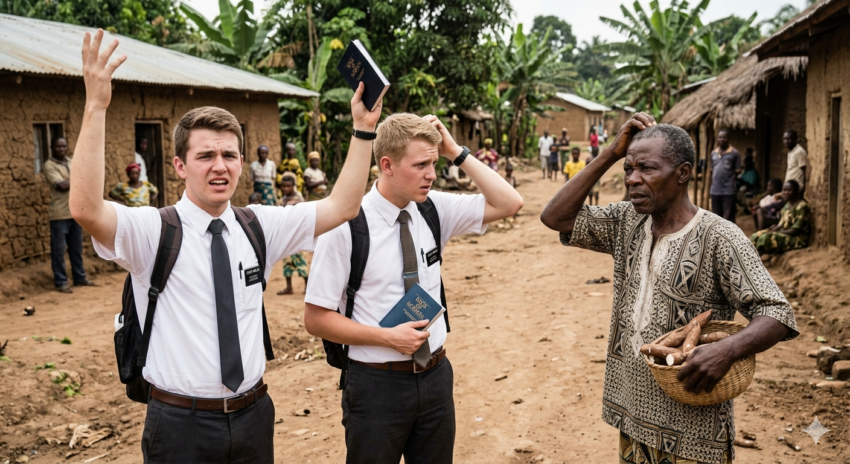
Image: An AI-generated image imagines two LDS missionaries struggling to understand the actual language of daily life, such as Lingala, Igbo, Hausa, or any of the hundreds of other dialects for which no MTC teaching materials exist.
Sent Before They Are Ready: The Hidden Psychological Toll of the LDS Mission System
A Theological, Historical, and Sociological Analysis
Introduction: A Walking Press Release and the Reality Behind It
Every year, roughly 65,000 to 70,000 young men and women don white shirts, dark trousers, or modest skirts, pin a nameplate bearing the words “Elder” or “Sister” over a declaration of the Church of Jesus Christ of Latter-day Saints, and walk out the door of their family home — many of them for the first time alone in a foreign country, speaking a language barely mastered in a six-to-twelve-week residential training course. They range from eighteen to twenty-five years of age. A significant proportion have never held a sustained full-time job, navigated a foreign city independently, managed their own finances, or developed the kind of emotional resilience that comes only through accumulated life experience.
The official LDS Church narrative surrounding these missionaries is uniformly triumphant. The Church’s newsroom describes them in language that invites trust and admiration:
Missionaries for the Church of Jesus Christ of Latter-day Saints serve around the world voluntarily, at their own expense. These missionaries bring with them a wide variety of backgrounds, experiences, and perspectives. They make a great difference in the lives of the people they serve.
— Church of Jesus Christ of Latter-day Saints, Official Newsroom Description
This statement is a model of institutional reassurance. The problem is that it does not survive contact with the documentary record. The claim that these young people possess a “wide variety of backgrounds, experiences, and perspectives” is, for the vast majority, a fiction — not because they are inadequate human beings, but because the LDS faith community from which they are drawn is, by design, a carefully managed theological environment. They have been reared inside a high-demand religious culture that actively filters external perspectives, discourages doctrinal uncertainty, and frames every major life milestone — marriage, career, education, social identity — in terms of institutional loyalty and Church participation. They are, in the most accurate sociological sense, theological novices dispatched into circumstances for which no six-to-twelve-week training program could adequately prepare them.
This essay examines the LDS full-time mission system from a traditional Christian perspective — not with contempt for LDS believers, many of whom are sincere followers of Jesus as they understand Him, but with the theological rigor and pastoral concern that the evidence demands. We will examine the historical origins of the mission structure, the documented psychological costs it imposes on young missionaries, the realities they are never warned about, the institutional incentives that perpetuate a system increasingly recognized as harmful by its own researchers, and a comparative contrast with how traditional Christian missionary organizations approach preparation, training, support, and deployment. The weight of the evidence leads to a conclusion that is uncomfortable but necessary: the LDS full-time mission program, as currently structured, serves institutional growth needs more effectively than it serves the missionaries it deploys or the communities it targets.
Part One: Historical Origins — The Mission System as Institutional DNA
From Nauvoo to the MTC: A Brief History of LDS Missionary Culture
The roots of LDS missionary culture extend to the earliest decades of the movement. Joseph Smith dispatched the original Quorum of the Twelve Apostles on missions to England in 1837 and 1839, producing one of the most dramatic early membership surges in Church history. Tens of thousands of British converts emigrated to America throughout the 1840s and 1850s, fueling the growth of the early Utah settlements. From its inception, the LDS mission was not primarily a spiritual formation exercise — it was an engine of institutional expansion.
The systematic deployment of young men specifically was formalized across the latter nineteenth century, as Brigham Young and subsequent Church presidents embedded the mission call so deeply into LDS male identity that, by the twentieth century, opting out carried genuine social and marital consequences. Young women were permitted, though not formally expected, to serve shorter missions at a minimum age of twenty-one — later lowered to nineteen (then eighteen for women and eighteen for men) in 2012, a change President Thomas S. Monson announced that immediately produced a dramatic surge of female missionaries and a corresponding spike in early-return cases, as younger women with less life experience than their predecessors encountered the field realities that had always existed.
The Missionary Training Center in Provo, Utah — which grew from earlier Language Training Mission facilities — now processes thousands of missionaries per year through an intensive but brief residential program of language instruction, proselytizing technique, and spiritual preparation. The standard MTC stay runs from three to twelve weeks, depending on language assignment. Critics have long noted that the MTC curriculum is optimized for evangelistic memorization and doctrinal presentation rather than cross-cultural competency, emotional resilience, conflict resolution, or the kind of mature theological reflection that genuine cross-cultural ministry demands.
The Numbers Game: What the Mission Is Actually For
The official LDS position holds that the mission serves a dual purpose: bringing souls to the restored gospel, and converting the missionary himself or herself through the experience of service. The latter point — the notion that the primary beneficiary of the mission is the missionary — deserves considerably more scrutiny than it typically receives in institutional literature.
S. Richard Bellrock, a philosopher and psychologist writing in Sunstone magazine, noted with unusual directness the internal acknowledgment from Church leadership that missionary conversion is the primary intended outcome:
Elder Jeffrey R. Holland said it right out loud at the Provo Utah Missionary Training Center on 15 January 2013. The purpose of Preach My Gospel is, in his words, first “to convert you, then help you to convert the [individual] investigators.”
— S. Richard Bellrock, “The LDS Proselytizing Mission as Hazing,” Sunstone Magazine, May 2022
Bellrock further notes that physician and amateur LDS statistician David Stewart found that the most important conversion a missionary makes may be himself: “the most important number of conversions per proselytizer may be one: the person the missionary sees in the mirror every day.” The implication is profound. If the mission’s actual primary function is to ensure that eighteen-year-olds remain committed to the institution for the rest of their lives, then the tens of thousands of missionaries currently in the field are not primarily a global evangelistic force. They are a sophisticated retention mechanism dressed in white shirts and ties — and the baptism count is largely incidental to the real institutional transaction.
This interpretation is reinforced by the statistical reality of LDS missionary conversion. Wilfried Decoo, writing at Times and Seasons and discussed at length in the Wheat and Tares forum, observed that convert retention is abysmally low in many mission fields, suggesting that in some Northern European contexts, perhaps one in one hundred baptisms produces a member who remains active until death. President Gordon B. Hinckley himself acknowledged the severity of this gap, suggesting that inactive members might be considered “harmed” by the process that brought them in. If the institutional goal were genuinely the long-term spiritual transformation of investigators, the mission system would look very different. The emphasis would be on depth of relationship and sustained discipleship rather than baptism tallies. It does not reveal the institutional priority.
Part Two: The Unprepared Sent — What the Training Doesn’t Cover
Six Weeks to Save the World: The Training Gap
The LDS Missionary Training Center has produced extensive testimonial literature about its effectiveness, and there is no question that some missionaries emerge with genuine linguistic competence and deep personal commitment to their faith. What the MTC cannot produce in an abbreviated residential program is the range of preparation that the realities of the mission field demand. The gap between what missionaries are prepared for and what they actually encounter is not a marginal discrepancy — it is structural, and it is predictable.
Consider what a young missionary — eighteen years old, possibly never having traveled internationally, rarely separated from family for extended periods — will encounter within weeks of arriving in a foreign field assignment. The language challenges alone in African mission fields are severe. Missionaries trained in standard French or English arrive in the DRC or Nigeria to find that the actual language of daily life is Lingala, Igbo, Hausa, or any of hundreds of other dialects for which no MTC teaching materials exist. They rely on local translators, losing theological nuance in translation. They teach communities whose social and economic vulnerability may produce baptism commitments that are social rather than spiritual decisions. The AI overview compiled for this essay describes the field challenge concisely: missionaries often master a standard form of a language in the MTC but struggle to understand the “heavily modified or localized pidginized forms” actually spoken on the street.
And the preparation gap extends well beyond language. Former mission president Boyd Hoglund, speaking to BYU Daily Universe, identified the core structural failure with unusual candor:
The biggest problem, in my estimation, that they face is the social pressure that they have failed and leaving with those issues. There’s such an incredible emphasis and pressure on these young folks to go on a mission. The fact that if you don’t, there’s something wrong with you.
— Boyd Hoglund, former mission president, BYU Daily Universe, September 2016
Hoglund’s observation points to a training problem that no MTC curriculum can solve: the preparation gap is not primarily linguistic or logistical; it is psychological. Young missionaries arrive in the field having been told they are doing the most important work in the world, carrying the restored gospel to a world in spiritual darkness. They arrive without having been told — because the institutional culture actively suppresses such information — that they will face relentless rejection, that the companion they are assigned may be psychologically incompatible, that the poverty and violence they will witness may constitute genuine traumatic exposure, and that the performance pressure of mission culture may trigger or worsen pre-existing mental health vulnerabilities. They are sent ignorant of these realities because an informed missionary might not go.
A Day in the Life: The Structural Stressors of the Mission Schedule
The LDS missionary’s daily schedule is not simply demanding — it is a controlled environment that systematically removes the autonomy mechanisms that human beings use to regulate psychological stress. Missionaries operate under a structured schedule that demands sixty or more hours of ministry work per week. They wake at 6:30 a.m. and follow a regimen that allocates every waking hour: personal prayer and scripture study, companion study, language study, proselytizing, coordination meetings, and mandatory lights-out at 10:30 p.m. They are not permitted to listen to secular music, watch films, read non-approved books, or browse the internet freely. Family contact is restricted to weekly emails and specific call windows (historically Christmas and Mother’s Day, expanded more recently). They are required to remain with their companion at virtually all hours of the day and night.
LDS mission coach Jennie Dildine, who runs a podcast and coaching practice devoted specifically to preparing and supporting missionaries, describes the emotional reality of this structure with notable honesty:
Feelings of shame, disappointment, and fear often fill missionaries who come home earlier than expected.
— Jennie Dildine, LDS Mission Podcast, Episode 96, April 2023
The fact that a coaching industry has grown up around managing missionary psychological responses to the mission itself — before, during, and after — is not incidental. It reflects a demand created by the structural realities of the deployment. Dildine’s podcast offers free video series specifically for returned missionaries experiencing difficulty transitioning home, free strategy sessions, and ten-session coaching packages targeting what she describes as the anxiety surrounding the transition. This is a market. Markets reflect demand. The demand exists because the system produces harm at scale.
The Companion Dynamic: Mandatory Proximity Without Choice
Among the least-discussed structural stressors of the LDS mission is the companion system — the requirement that missionaries remain in near-constant physical proximity of their assigned companion at virtually all hours. The companion is assigned, not chosen. Personalities may be incompatible. Backgrounds may conflict sharply. Coping styles, temperaments, cultural assumptions, and basic habits may clash in ways that generate sustained psychological friction. And yet the missionaries are required to remain together, with no meaningful mechanism for voluntary separation, no genuine privacy, and no exit from the relational pressure.
Missionary Megan Jensen, who served in Birmingham, Alabama, described the compounding effect of this proximity in an environment already saturated with stress:
On the mission, everything is heightened. There’s so much happening and there’s a lot of stress that happens. You’re thinking of others instead of yourself. It’s just a high stress environment and that really heightened it for me.
— Megan Jensen, quoted in BYU Daily Universe, September 2016
Jensen’s anxiety reached a crisis point two weeks into her field assignment when she and her companion received a call that a less-active member they were working with had attempted suicide. The exposure to this kind of acute crisis — with no professional mental health training, no trauma response framework, and no option to remove herself from the situation — produced a panic attack and set in motion the deterioration that eventually led to her early return. Her experience is not unusual. What is unusual is that she was willing to describe it.
What They See in the Field: Exposure Without Preparation
Perhaps the most significant preparation gap is the one between what missionaries are told to expect — conversion opportunities, spiritual growth, meaningful service — and what they actually encounter. Multiple sources confirm that missionaries regularly face levels of poverty, disease, and social dysfunction that constitute genuine traumatic exposure. They are not trained crisis counselors. They are not equipped with psychological frameworks to process vicarious trauma. They are eighteen and nineteen years old, far from home, expected to maintain spiritual enthusiasm and proselytizing effectiveness while walking through environments that would challenge seasoned aid workers.
The Wheat and Tares analysis of missionary harms is particularly pointed on the deficit of preparation for human complexity:
You aren’t really given a lot of training in the human and psychological aspects of dealing with companions and the public. The relentless experience of rejection can also lead to a deep sense of failure, particularly when combined with a mission culture that blames or praises missionaries directly for their results.
— Wheat & Tares, “Do Missionaries Do More Harm or More Good?” June 21, 2023
The culture that “blames or praises missionaries directly for their results” is the cruelest feature of a system that simultaneously demands performance and withholds the resources that would make such performance sustainable. A missionary in a field where the culture is resistant to LDS proselytizing, where the language barrier is prohibitive, where poverty makes religious discussion a low priority, is structurally positioned to fail — and then blamed, culturally and sometimes explicitly, for that failure. The system creates the conditions for disappointment, then assigns personal responsibility for it.
Part Three: The Psychological Toll — A Documented Crisis
The Statistics of Shame: How Many Come Home Early
No analysis of the LDS mission system can proceed honestly without confronting the documented rates of early return and the psychological harm those returns represent. The Church does not publish official figures on early mission releases, but the research record is sufficiently extensive to establish the scope of the problem beyond reasonable dispute.
Estimates from multiple research sources suggest that between 25 and 40 percent of LDS missionaries return home before completing their assigned term. The Next Mormons Survey, conducted in 2018, found that 35 percent of female missionaries and 29 percent of male missionaries in the millennial cohort had returned early. A survey by the Segullah essay cites the Utah Valley University study’s breakdown of reasons: mental health (36%), physical health (34%), previously unresolved transgression (12%), and disobeying mission rules (11%). The study further identified a category of early returnees who don’t fit any of these categories — those who come home because of theological doubt — a population the researcher describes as “the silent ones” and “invisible.”
The 73 percent shame statistic from Kristine Doty-Yells bears repeating, because it is the single most important finding in the literature:
Seventy-three percent of missionaries who come home early feel shame and failure… That’s regardless of the reason they came home. It could be that they came home for knee surgery. It didn’t matter. And here’s the shocker: less than 23 percent came home early for anything related to rule violations or unresolved transgressions. Most are coming home for mental or physical health issues.
— Kristine J. Doty-Yells, PhD, LCSW, BYU Daily Universe, May 2, 2017
The Doty-Yells study, published in the BYU Religious Educator (Vol. 18, No. 3, 2017) under the title “Stopping the Stigma: Lessons from Early Returned Missionaries,” also found that 46 percent of early-returned missionaries did not feel they were “true” returned missionaries — a finding that reveals the identity damage the mission system inflicts on those it considers insufficient. Doty-Yells’s own entry into this research was profoundly personal: she experienced the early return of two sons, on separate occasions, each of which triggered what she describes as grief, shame, and a profound questioning of her own competence as a mother and “in-home missionary trainer.” That a scholar of social work — someone trained to understand and resist internalized shame — still experienced these responses speaks to the power of the cultural environment the institution has constructed.
The Emotional Scar Deeper Than the Physical
Aubrie Orrock, who served in the Washington D.C. South mission and returned early after appendicitis, described the asymmetry between visible and invisible wounds with precision:
People were understanding of the physical aspects of it, and they felt sorry for me, but they didn’t understand the emotional aspects that came with it. Even though I still have physical scars, I feel like the emotional scars are even deeper. Even though you can’t visually see them, they’ve stayed with me far more than the physical scars have. I’ve come to terms with it for the most part. It’s not something that happens overnight, and people need to be compassionate and understanding with that. It almost feels like a death in a sense, like you’re mourning the death of a loved one.
— Aubrie Orrock, BYU Daily Universe, September 2016
The grief metaphor is not incidental. What early-returned missionaries are mourning is not simply an interrupted service project. They are mourning the loss of an identity — the identity of the faithful, completing the missionary that their entire religious formation has promised them they would become. The mission is the capstone of LDS young adult identity. When it ends early, for any reason, the capsstone falls, and the identity structure beneath it is at risk.
Jenny Rollins, writing for the Ensign in July 2016 about her own early return from the California Anaheim Mission after nine months, captures the depth of this identity loss:
Taking off my missionary tag nine months early was the hardest thing I have ever done. I felt like a failure for not finishing my mission.
— Jenny Rollins, “Dealing with Coming Home Early,” Ensign, July 2016
The nameplate is not a minor accessory. In LDS culture, it is a credential — a public declaration of status and faithfulness that confers identity. Removing it involuntarily is experienced not as a medical or logistical adjustment but as a stripping of identity. That the institution has produced a culture in which this is the subjective experience of tens of thousands of young people per year — and then responded primarily with damage-management literature rather than structural reform — is the core institutional failure this essay seeks to document.
The Church’s Own Admission: A Manual Built Around Managed Shame
The LDS Church’s official Counseling Resources manual, under the heading “Missionaries Who Return Home Early,” provides pastoral guidance for Church leaders navigating the fallout of early returns. The document’s existence is itself an institutional admission that the program produces harm significant enough to require official guidance. Among its most telling observations:
Missionaries who return from or complete their missions earlier than anticipated may experience unique challenges… When they return home early for any reason… they may feel disappointed, embarrassed, or discouraged. They may question the inspiration that led them to serve a mission. These returned missionaries may worry how other people view them or even how the Lord views them. They may feel like they have failed or are unworthy and may judge themselves negatively. They may also have feelings of loss and may even pass through various stages of grief.
— Church of Jesus Christ of Latter-day Saints, “Missionaries Who Return Home Early,” Counseling Resources (2020)
The manual further advises that Church leaders and ward members should refer to early returnees as “returned missionaries” rather than “early-returned” or “early-released missionaries” — a linguistic management strategy that acknowledges the stigma is real and damaging enough to require active institutional countermeasures. The BYU Office of Belonging echoes this directly on its resources page for early-returned missionaries, quoting Elder Alec Woodbury’s Ensign appeal:
Don’t ever think that you failed Heavenly Father. Don’t ever think that coming home from your mission was a mistake. It’s not. Heavenly Father has something in mind for you. Now it’s time to move forward to your next mission in life.
— Alec Woodbury, Ensign, July 2019, quoted on the BYU Office of Belonging Resources page
The pastoral warmth of this statement cannot conceal the structural problem it is attempting to remediate. If the institution had not created a cultural environment in which early return was experienced as a failure of divine calling, no such statement would be necessary. The reassurance infrastructure that has grown up around early returns — the Ensign articles, the BYU counseling services, the LDS Living first-person narratives, the mission coaching podcasts, the academic studies — is not evidence of a caring institution responding to an incidental problem. It is evidence of a caring institution responding to a systemic problem it has declined to address at the source.
Mission as Hazing: The Sociological Framework
The most intellectually challenging analysis of the LDS mission system comes from Bellrock’s Sunstone essay, which applies the sociological framework of hazing to understand why the mission produces the commitment it does, regardless of its spiritual truth claims:
LDS missions are perfectly timed and executed to reap all the group-commitment benefits of hazing. The purpose of this article is not to denigrate missions but to show how they function as hazing.
— S. Richard Bellrock, “The LDS Proselytizing Mission as Hazing,” Sunstone Magazine, May 2022
Drawing on psychosocial developmental theory from Erik Erikson and James Marcia, Bellrock notes that missions are deliberately timed to coincide with the identity formation crisis of late adolescence — the developmental stage during which young people are most susceptible to group-identity commitment mechanisms. The combination of high social cost (the stigma of not serving), intense shared hardship (the mission itself), total institutional control (the mission rules and hierarchy), and social reward on completion (the “returned missionary” status and its marriage market implications) produces the same psychological bonding effect that hazing rituals produce in military units, fraternities, and athletic teams.
The troubling implication is this: the mission works not primarily because it is spiritually transformative, but because hardship-based commitment mechanisms work regardless of the truth claims of the institution deploying them. As Bellrock states: “Even if the LDS Church were a complete fraud, the experience of serving a mission would still result in the same increase in dedication.” The mechanism is psychological, not theological. The institution benefits from this mechanism whether it acknowledges it or not.
Part Four: Mental Health, Eating Disorders, and the Silence of Suffering
The Mental Health Crisis That Official Channels Underreport
Mental health concerns represent the single largest category of early missionary return — 36 percent of cases in the UVU study, outpacing physical health, rule violations, and doctrinal conflict combined. The sources of these mental health challenges are structural, predictable, and documented. They include: the relentless experience of rejection and perceived failure; the mandatory proximity of incompatible companion relationships; the removal of normal autonomy and privacy; the performance pressure of mission culture that frames output metrics as spiritual indicators; the exposure to poverty, trauma, and crisis without professional support; and the removal from family and community support networks that would ordinarily buffer psychological distress.
Roots and Branches Wellness, a licensed therapy practice in Utah that has published research specifically on missionary mental health, identifies this as a population-scale clinical concern — significant enough to warrant dedicated professional specialization. Their research from clinical psychologist Madelin Pepper examines stress and mental health outcomes for LDS missionaries as a specific clinical population, reflecting the kind of sustained demand that generates specialized practice development.
Dr. George Komen, who offered expert commentary to BYU Daily Universe, confirmed the prevalence of the underlying conditions: “There’s no question that anxiety and depression are very common in the general population.” The crucial point he adds is the differential between typical adjustment stress and clinical depression — a distinction the mission culture systematically obscures, because admitting clinical distress is experienced as admitting spiritual failure.
Eating Disorders: The Harm No One Wants to Name
Among the most under-discussed forms of mission-related harm is the development or intensification of eating disorders. Utah-based licensed clinical social worker Ashlee Hunt, who specializes in eating disorder treatment, has written directly about the structural connection between LDS missionary culture and disordered eating:
Serving a mission can be one of the most rewarding, and most challenging experiences in a young Latter-day Saint’s life. Missionaries are expected to follow strict routines, manage high levels of stress, and meet spiritual expectations. For some, these pressures can unintentionally trigger or intensify eating disorders. As a therapist who specializes in treating eating disorders, I’ve seen how perfectionism, isolation, and even well-meaning comments about weight or appearance can take root in missionary culture.
— Ashlee Hunt, LCSW, “LDS Missionaries and Eating Disorders: It’s Time to Talk About It,” Maple Canyon Therapy Services
Hunt’s clinical observation is that perfectionism and isolation — twin hallmarks of mission culture — create conditions in which eating disorders not only emerge but are uniquely difficult to identify and address. The mission structure actively discourages the vulnerability that would allow a struggling missionary to seek help, because admitting struggle is, in mission culture, perilously close to admitting faithlessness. The result is that eating disorders on missions go unrecognized and untreated, with consequences that follow missionaries home and require clinical intervention after the fact. This is a harm the institution does not measure, does not report, and does not address structurally.
The Branden Estrada Story: A Template for Cultural Cruelty
No account more clearly illustrates the intersection of institutional failure and cultural cruelty than the story of Branden Estrada, reported by BYU Daily Universe in 2017. Estrada returned home after only eight weeks in the field because of severe depression, anxiety, and suicidal ideation — genuine medical crises by any clinical standard. His family was supportive. His Church community was not:
People would give talks in church and mention me and say something like, “We all have a good feeling that you’ll be going back out.” And that really stunned me because I was really sick.
— Branden Estrada, quoted in BYU Daily Universe, May 2, 2017
The community’s response was not malicious — it was culturally normative. Members who encouraged Estrada to return were expressing what the institutional environment had taught them to express: mission completion is the expected outcome of faith, and deviation from that expectation requires correction. What they had not been taught to express was compassion for medical crisis, or respect for the limits of a human being who had already demonstrated extraordinary courage by attempting the assignment at all. Estrada also reported being told by friends that “God would never bless me again” if he did not return, and that he was “unworthy for blessings.” These statements were made to a young man who had just survived suicidal ideation. They are not aberrations. They are the predictable output of a cultural theology that has merged faithfulness with mission completion.
Part Five: The Baptism Economy — What the Mission Is Actually Producing
Names on a List: The Retention Problem
One of the most persistently ignored questions in discussions of LDS missionary effectiveness is what happens after the baptism. The mission’s institutional success metric is measurable and reported: baptisms recorded, mission goals met or unmet, the Church’s growth figures announced each spring at General Conference. What is not reported — and what the accumulating evidence suggests is deeply troubling — is what proportion of those baptisms represent genuine, sustained life transformation.
The Wheat and Tares discussion of Wilfried Decoo’s analysis is focused on this issue. Decoo observes that the missionary methodology — focused on building a testimony experience and securing baptismal commitment — does not adequately inform investigators of the full scope of LDS membership. The social demands (near-mandatory attendance), financial obligations (tithing), behavioral requirements (Word of Wisdom, law of chastity, temple worthiness standards), doctrinal expectations, and community accountability structures that characterize active LDS membership are not the subject of the standardized missionary discussions. The investigators who say yes at the baptismal interview are agreeing to a version of Latter-day Saint membership that does not fully exist.
The Wheat and Tares analysis identifies several categories of harm the mission produces for investigators, beyond the missionaries themselves:
Lack of full disclosure: “most Mormon converts are baptized without realizing what will come next.” Upheaval in family relationships: “Missionaries trigger tensions, conflicts, and sometimes devastating breaches between converts and other members of their family.” Community disruption: In countries that do not share American assumptions about religious pluralism, the Church’s aims can cause significant social damage.
— Wheat & Tares, summarizing Wilfried Decoo, “Do Missionaries Do More Harm or More Good?” June 21, 2023
The retention data from mission fields in sub-Saharan Africa — where the LDS Church has experienced its most dramatic recent growth — is particularly sobering. High baptism rates in environments characterized by economic vulnerability, limited access to alternative social support structures, and community-based religious decision-making do not necessarily indicate the kind of theologically informed, individually motivated conversion that genuine spiritual transformation requires. They may indicate something considerably more susceptible to social dynamics and institutional provision.
The Cherry-Pick Problem: Success Stories and the Silence of the Rest
The LDS Church’s official communications regarding missionary work exhibit a pattern that deserves direct examination: they feature success stories. The Ensign, the Liahona, and the official Church website publish accounts of missionaries whose faith was strengthened, investigators whose lives were genuinely changed, and early-returned missionaries who grew through their experience and maintained vibrant faith. These accounts are real and not fabricated. But they are selected.
What the official channels do not publish are aggregate data on post-mission faith crisis rates among returned missionaries — a phenomenon well-documented in exit interview research. They do not publish conversion-to-activity ratios from difficult mission fields. They do not prominently feature the twenty-nine to thirty-five percent who came home early, and the seventy-three percent of those who carry shame about it. The official story of the mission is curated to produce a specific institutional outcome: continued parental support for the program, continued social pressure on young people to participate, and continued institutional legitimacy in the eyes of the general membership.
A 2017 narrative on LDS Living, republished from an independent blogger with permission, provides a counterweight: a first-person account of a missionary called to Colombia who returned early, processed the experience over years, and eventually found a way to integrate it. The account is titled “Early Returned Missionary: Not 2nd Class Members” — a title that, in its very framing, acknowledges the hierarchy the culture has created. The author’s experience in Colombia began in a hotel room in Bogotá, without plumbing, in an area of poverty and danger that the MTC had not prepared him for. His story is honest about the dissonance between the institutional narrative and the field reality. It is the kind of story the official channels typically do not publish — at least not without heavy editorial framing.
Part Six: The Foreign Mission Surge and the Age Structure Problem
Africa and the Baptism Economy: Following the Easiest Convert
One of the most significant recent shifts in LDS missionary deployment is the increasing emphasis on mission fields in sub-Saharan Africa, particularly the DRC, Nigeria, Ghana, and broader West and Central African regions. LDS leadership points to this growth as evidence of the gospel’s universal appeal. What receives less institutional attention is the structural context of that growth.
Mission fields in developing nations with high poverty rates, limited alternative social support structures, and community-based religious decision-making have historically proven more susceptible to new religious movements that offer belonging, identity, and practical community. The LDS Church, which provides meeting houses, community structure, and in some cases access to educational and humanitarian resources, offers genuine practical benefits to communities with limited institutional infrastructure. Baptism rates in such environments are measurably higher than in the more theologically saturated and institutionally stable markets of Western Europe or North America.
The language challenges facing young missionaries in these environments compound the preparation gap considerably. The AI overview on Congo and Nigeria mission challenges describes the field reality: missionaries master a standardized language form in the MTC, only to encounter “heavily modified or localized pidginized forms” in the field, alongside hundreds of indigenous dialects for which no teaching materials exist. They teach communities through translators, losing theological nuance with every degree of interpretive separation. They pursue baptism commitments in contexts where the social dynamics of community religious decision-making may produce agreement that does not represent genuine individual theological conviction.
Why Not the Seasoned? The Reluctance to Deploy Experienced Members
A question that Christian observers of the LDS mission system find persistently puzzling is the age structure of the missionary deployment. The LDS Church does deploy older member missionaries — retired couples who serve eighteen-month missions in various capacities, but these represent a small fraction of the total missionary force, and they are typically deployed in support, administrative, or service roles rather than direct proselytizing.
The overwhelming majority of front-line proselytizing is conducted by eighteen-to-twenty-five-year-olds. From a theological and practical standpoint, this makes limited sense as a spiritual strategy. An experienced fifty-five-year-old LDS member with thirty years of personal testimony, professional and life experience, cross-cultural competence, and demonstrated resilience would be a vastly more effective ambassador for the faith than a teenager navigating their first sustained absence from home. The institutional logic for the current structure is not difficult to understand, however. Young missionaries are more cost-effective (their families fund the mission), more controllable under the authority hierarchy of the mission presidency, and — crucially — precisely at the developmental stage where the hardship-based commitment mechanisms Bellrock describes will produce the lifelong institutional loyalty the Church requires for its own sustainability. Deploying seasoned members in larger numbers would not produce these outcomes with the same reliability. It would cost more, exercise less institutional control, and do less to secure the decades of active membership the institution needs from each missionary deployed.
Part Seven: The Parents — Collateral Damage of Institutional Pressure
Families Are Not Prepared Either
The psychological costs of the LDS mission system are not borne by missionaries alone. Parents are subjected to a sustained period of anxiety, powerlessness, and social performance that the LDS cultural environment renders virtually impossible to resist. The expectation that a faithful LDS family will produce sons who complete full missions and daughters who consider mission service creates a social pressure that shapes family decisions years before the mission actually occurs. Parents who save for years to fund a child’s mission — the current suggested contribution from missionaries and families is approximately $500 per month — have made both a financial and an emotional investment that compounds the psychological stakes of any disruption.
Doty-Yells’s personal narrative in the BYU Religious Educator is the most candid parental account in the academic literature:
I was stunned and bewildered, and I had no idea what I should do. This is not something I knew how to prepare for. The idea of an early return never occurred to me… I struggled for years with what it meant. Suddenly I felt as though my competence as a mother, and in-home missionary trainer, was called into question.
— Kristine J. Doty-Yells, PhD, LCSW, “Stopping the Stigma: Lessons from Early Returned Missionaries,” BYU Religious Educator, Vol. 18, No. 3, 2017
No religious organization should structure its programs in such a way that a parent feels personally implicated in their child’s medical crisis. The shame Doty-Yells describes — and she is, again, a trained social scientist who understands shame dynamics professionally — is a direct product of the cultural environment the institution has created and sustains. The Segullah essay about the mother whose missionary son was sent home for refusing to testify to a belief he honestly did not hold adds another dimension: the institutional overreach into family life that the mission system enables. The stake president’s visit to the family home, the pressure on parents to instruct their child to affirm a testimony he did not possess, the framing of theological honesty as a problem to be managed rather than a faith journey to be supported — all of this represents an institutional claim on the family that exceeds any appropriate boundary.
They are those who feel torn teaching doctrines or ideas that they don’t believe in and are sent home. They are the silent ones. They are invisible.
— Anonymous author, “The Lost Percent: Early Returning Missionaries,” Segullah, April 2019
Part Eight: The Stigma Industry — When the Institution Creates Its Own Remediation Market
A Shadow Economy Built on Managed Damage
The volume of online and professional infrastructure devoted to the early-returned missionary phenomenon is, in itself, a form of documentation. A search of the relevant LDS ecosystem reveals a landscape populated with resources aimed at managing, ameliorating, and normalizing a problem the institution created but has not resolved structurally.
Consider the infrastructure documented across the sources assembled for this essay: BYU’s Office of Belonging maintains a dedicated resources page for early-returned missionaries listing on-campus counseling services, a Mission Inclusivity Club, Women’s Services fact sheets, and curated Church resources specifically for this population. BYU’s Counseling and Psychological Services offers individual therapy for early-returned missionaries, supplemented by digital mental health platforms. The LDS Church’s own Counseling Resources manual contains a full section on the phenomenon with pastoral guidance for bishops and stake presidents. The Ensign and Liahona have both published multiple first-person accounts and guidance articles addressing early returns. LDS Living has published extensively on the topic. KUTV, Utah’s CBS affiliate, has reported on the phenomenon as a local news story. BYU Daily Universe has published multiple investigative pieces. The BYU Religious Educator has published peer-reviewed academic studies. Sunstone has published philosophical analyses. Mission coaching businesses like Jennie Dildine’s practice offer pre-mission, in-mission, and post-mission coaching specifically targeting the psychological demands of the experience. Licensed therapy practices like Maple Canyon Therapy Services and Roots and Branches Wellness have developed clinical specializations in the population. The exmormon.org forum and Reddit communities host thousands of first-person accounts.
This is not the infrastructure of a minor, manageable problem. This is the infrastructure of a population-scale institutional failure. The Latter-day Saint Mission Prep website, devoted to helping missionaries prepare for and succeed in the field, includes an entire article on understanding and helping early-returned missionaries — because the site’s audience knows, through community experience, that early returns are a predictable and common outcome of the program it supports. Elder Holland himself has produced a dedicated video address to missionaries who returned early, counseling them not to apologize for their service:
I want you to take the dignity and the strength and the faith that came from your four months and cherish that forever. I don’t want you to apologize for coming home. When someone asks you if you have served a mission, you say yes. You do not need to follow that up with, “But it was only four months.” Just forget that part and say yes you served a mission, and be proud of the time that you spent.
— Elder Jeffrey R. Holland, video message to early-returned missionaries, March 2016, quoted in BYU Daily Universe, May 2017
Elder Holland’s pastoral instinct is right. The shame that requires such reassurance should not exist. But it does exist, and it exists because the institution has built and sustained the cultural environment that produces it. The video is an emergency response to a wound the institution inflicted. That it requires a member of the Quorum of the Twelve Apostles to personally address the shame of returned missionaries in a dedicated video suggests the institutional leadership understands, at some level, the severity of what the program produces. What it has not done is restructure the program to stop producing it.
Part Nine: How Traditional Christianity Approaches Mission
The Sent-Ones: Biblical Foundations of Christian Missionary Practice
Traditional Christian missionary practice, rooted in the Great Commission of Matthew 28:18-20 and developed through nearly two millennia of church history, provides a useful point of comparison for evaluating the LDS mission system. The differences in preparation, training, support structure, and institutional philosophy are instructive.
To Every Tribe, a missionary training and sending organization that reflects current evangelical mission theology, defines the missionary vocation in terms that immediately distinguish it from the LDS approach:
A missionary is a “sent-one,” specifically commissioned by the Spirit through a local church to cross cultural boundaries for the primary purpose of proclaiming the Gospel and establishing indigenous, reproducing churches among unreached peoples.
— To Every Tribe, “What is a Missionary? Definition and Strategy,” January 2026
Several elements of this definition contrast sharply with the LDS model. First, the missionary is “commissioned by the Spirit through a local church” — the calling is confirmed by both spiritual discernment and the assessment of a mature faith community, not assigned by institutional bureaucracy based primarily on age eligibility and a worthiness interview. Second, the goal is explicitly not baptism tallies but the establishment of “indigenous, reproducing churches” — self-governing, self-supporting communities that can sustain themselves without ongoing external dependence. Third, the method follows a deliberate eight-phase relational framework that begins with arrival and trust-building and concludes only when local leadership has been affirmed and the missionary’s direct involvement is no longer necessary. The endpoint is the missionary working themselves out of a job. The LDS endpoint is the missionary completing a fixed institutional term and returning home.
Preparation, Training, and Support: A Study in Contrasts
Traditional evangelical missionary organizations typically require preparation timelines that dwarf the LDS MTC model. Organizations like Wycliffe Bible Translators, SIM (Society for International Ministries), and Mission to the World routinely require two to four years of formal preparation and training before deployment. Candidates undergo assessment not only for theological knowledge but for emotional health, interpersonal skills, conflict resolution capacity, cultural adaptability, and professional competency relevant to their ministry context. Many organizations require candidates to demonstrate cross-cultural experience before a formal application.
The For the Church essay on the twenty-first-century missionary, published by Midwestern Baptist Theological Seminary, describes the missionary vocation in terms of deep cultural investment over time: years of language study, cultural research, relationship building, and genuine engagement with the host community’s own history, spirituality, and identity. Robin D. Hadaway’s account of missionary service in East Africa and Tanzania illustrates the kind of formation that genuine cross-cultural ministry requires — a formation measured in years, not weeks, and sustained by the kind of sending church relationship that the LDS mission structure does not replicate.
The AI overview on traditional Christian missionary life captures the ethos with appropriate emphasis: “Missionary life is generally a calling to serve in anonymity, aiming to love a community in the name of God.” The contrast with the LDS mission — in which missionaries wear identifying institutional badges, operate under visible corporate branding, and pursue an explicit proselytizing agenda linked to Church membership growth — could not be more instructive. The traditional Christian missionary’s success is measured by community transformation. The LDS missionary’s success is measured, at least in institutional practice, by baptism numbers.
Support Structures and Accountability
Support structures in traditional evangelical missions are substantially more robust than the LDS model. Missionaries are formally connected to a sending church that provides ongoing financial support, pastoral oversight, regular communication, and genuine relational accountability — not the institutional control of a mission president hierarchy, but a genuine relationship. They are not isolated from family contact by institutional communication policies. They are not evaluated primarily by conversion metrics. They have established channels for reporting personal distress, requesting reassignment, or seeking pastoral care, all without those requests being filtered through the same institutional hierarchy that evaluates their performance.
The Ask A Missionary resource, which collects responses from traditional Christian missionaries about daily life and vocational realities, emphasizes the enormous variability of missionary experience based on calling, context, and ministry type. This variability is a feature, not a bug — it reflects the organic, Spirit-directed nature of genuine missionary vocation, in which the needs of the specific context shape the specific response. The LDS mission system’s rigid uniformity — same schedule, same discussions, same institutional brand, same fixed term — reflects a different kind of program entirely: one designed for scalability and institutional consistency, not organic, responsive ministry.
Conclusion: The Institutional Inertia of an Outdated System
What This Is Really About
The LDS full-time mission program is one of the most ambitious youth deployment systems in the history of organized religion. It has produced genuinely transformed lives — missionaries who found deep faith through service, investigators who found genuine community through conversion, and families who experienced real growth through the sacrifice of participating. These outcomes are real, and they deserve acknowledgment.
But the weight of evidence assembled across the twenty-plus sources examined in this essay — from the Church’s own counseling manuals to BYU academic journals to clinical therapy practices to investigative news reports to first-person narratives — converges on a conclusion that the institution has been reluctant to state plainly: the LDS mission system, as currently structured, serves institutional needs more reliably than it serves the missionaries it deploys or the communities it targets. The psychological harm it generates is not a manageable side effect. It is the system’s predictable output, given the structural gap between what the institution demands and what the individuals it deploys are prepared for, supported through, or protected from.
The mission system continues not because its human costs have been carefully weighed and found acceptable. It continues because it is embedded in LDS cultural identity so deeply that questioning it feels, within that culture, like questioning the faith itself. It continues because the institutional momentum of 190 years of practice is not easily redirected. And it continues, most consequentially, because it works for the institution — even when it fails the individual missionary. Young people deployed in the field generate baptisms that become membership statistics. Those membership statistics become tithing revenue. That revenue funds buildings, programs, investments, and the institutional infrastructure of a global religious organization that must demonstrate growth to maintain its claim to be the one true Church of Jesus Christ.
This is not a conspiracy. It is institutional inertia — the drift of a system whose original design parameters (institutional growth, membership expansion, formation of lifetime loyalty in young members) have never been formally interrogated against the human cost they impose. The leaders who maintain this system are not villains. They are administrators of an inherited program who lack the institutional will, or perhaps the institutional permission, to ask whether the program’s benefits to the institution are worth the damage it inflicts on the individuals it processes.
A Final Note to Those Who Have Served
To any returned missionary — full-term or early-returned — who reads this: the critique offered here is of a system, not a person. The young people who answered the mission call did so with sincere hearts. The courage required to ring a stranger’s doorbell in a foreign language, in a country far from home, carrying a message you genuinely believe, is not nothing. It should be honored. The shame imposed on those whose health, honesty, or circumstances brought them home early is not yours to carry. It belongs to a system that prioritized its own metrics over your well-being.
The Apostle Paul, writing to the church at Corinth, reminded them that genuine spiritual gifts are diverse and that the body requires all of its parts. He did not say that only those who completed a designated term of service belonged to the body of Christ. The gospel the missionaries believe they are carrying is larger and more generous than the institution that sends them. That is worth remembering — by the missionaries, by their families, and by the institution itself.
Primary Sources and References
Official LDS Church Sources
• LDS Counseling Resources: Missionaries Who Return Home Early: https://www.churchofjesuschrist.org/study/manual/counseling-resources/early-returned-missionaries?lang=eng
• Ensign 2019: I Returned Early — Did I Ruin God’s Plan?: https://www.churchofjesuschrist.org/study/ensign/2019/07/young-adults/i-returned-early-from-my-mission-did-i-ruin-gods-plan-for-me?lang=eng
• Ensign 2016: Dealing with Coming Home Early (Jenny Rollins): https://www.churchofjesuschrist.org/study/ensign/2016/07/young-adults/dealing-with-coming-home-early?lang=eng
• Liahona 2021: Finding My New Normal After My Mission: https://www.churchofjesuschrist.org/study/liahona/2021/02/digital-only-young-adults/finding-my-new-normal-after-my-mission?lang=eng
Academic and Research Sources
• BYU Religious Educator: Stopping the Stigma (Doty-Yells, PhD, LCSW): https://rsc.byu.edu/vol-18-no-3-2017/stopping-stigma-lessons-early-returned-missionaries
• BYU Daily Universe: Mormon Culture Contributes to Feelings of Failure: https://universe.byu.edu/2017/05/02/mormon-culture-contributes-to-early-returned-missionaries-feelings-of-failure/
• BYU Daily Universe: Missionaries Struggle to Transition After Returning Home Early: https://universe.byu.edu/2016/09/22/lds-missionaries-struggle-to-transition-after-returning-home-early1/
• BYU Office of Belonging: Resources for Early Returned Missionaries: https://belonging.byu.edu/resources-for-early-returned-missionaries
• Roots and Branches Wellness: New Research on Stress and Mental Health in LDS Missionaries: https://www.rootsbrancheswellness.com/blog/when-the-mission-takes-a-toll-new-research-on-stress-and-mental-health-in-lds-missionaries
Clinical and Therapeutic Sources
• Maple Canyon Therapy: LDS Missionaries and Eating Disorders: https://www.maplecanyontherapy.com/blog/3wj5n1pdq02fmi5laayb3s65d6z018
• Jennie Dildine, LDS Mission Coach: Episode 96 — Early Returned Missionaries: https://jenniedildine.com/96-early-returned-missionaries/
• Latter-day Saint Mission Prep: Understanding and Helping Early Returned Missionaries: https://latterdaysaintmissionprep.com/motivating-missionaries/understanding-and-helping-early-returned-missionaries/
Critical and Independent Analysis
• Sunstone: The LDS Proselytizing Mission as Hazing (S. Richard Bellrock): https://sunstone.org/mission-as-hazing/
• Wheat & Tares: Do Missionaries Do More Harm or More Good?: https://wheatandtares.org/2023/06/21/do-missionaries-do-more-harm-or-more-good/
• Segullah: The Lost Percent — Early Returning Missionaries: https://segullah.org/the-lost-percent-early-returning-missionaries
• KUTV: Missionaries Thinking of Coming Home Early Have Another Option: https://kutv.com/news/local/missionaries-thinking-of-coming-home-early-have-another-little-known-option
• LDS Living: Early Returned Missionary Shares Brutally Honest Story: https://www.ldsliving.com/early-returned-missionary-shares-brutally-honest-story-powerful-message-missionaries-who-return-early-are-not-2nd-class-members/s/86270
• Quora: What percent of LDS missionaries come home early?: https://www.quora.com/What-percent-of-LDS-missionaries-come-home-early
• Add Faith: Early RM — Eliminating Stigma: https://addfaith.org/blog/uncategorized/early-rm-eliminating-stigma/
• ExMormon.org: Mormon Missionaries Coming Home Early: https://www.exmormon.org/d6/drupal/Mormon-missionaries-coming-home-early
• Reddit ExMormon: A Story of a Missionary Sent Home Early: https://www.reddit.com/r/exmormon/comments/l2fd7b/a_story_of_a_missionary_who_got_sent_home_early/
• Medium: The Arizona Tucson Mission Disaster — An LDS Church Cover-Up: https://medium.com/@ACallForReform/the-arizona-tucson-mission-disaster-an-lds-church-cover-up-716d36097ab3
• Facebook: The Rise in Missionaries Returning Home Early: https://www.facebook.com/mormonholic/photos/the-rise-in-missionaries-returning-home-early/1351493020347193/
Traditional Christian Missionary Sources
• To Every Tribe: Defining the Missionary and Church Planting Strategy: https://toeverytribe.org/blog/defining-the-missionary-church-planting-strategy/
• For The Church: The 21st Century Missionary (Robin D. Hadaway): https://ftc.co/resource-library/blog-entries/the-21st-century-missionary/
• Ask A Missionary: A Typical Day for a Missionary: https://askamissionary.com/missionaries-typical-day/
A Note on Research Methods and Accuracy
This work represents a collaboration among the author’s theological and historical research, primary-source documentation, and the emerging capabilities of artificial intelligence research tools. AI assistance was employed throughout the investigative process—not as a ghostwriter or a substitute for scholarship, but as a rigorous research partner: surfacing sources, cross‑referencing claims, identifying scholarly consensus, and flagging potential errors before they could reach the page.
Every factual claim in this work has been subjected to active verification. Where AI‑generated content was used as a starting point, it was tested against primary sources, peer‑reviewed scholarship, official institutional documentation, and established historical records. Where discrepancies were found—and they were found—corrections were made. The author has made every reasonable effort to ensure that quotations are accurately attributed, historical details are precisely rendered, and theological claims fairly represent the positions they describe or critique.
That said, no work of this scope is immune to error, and the author has no interest in perpetuating inaccuracies in the service of an argument. If you are a reader—whether sympathetic, skeptical, or hostile to the conclusions drawn here—and you identify a factual error, a misattributed source, a misrepresented teaching, or a claim that cannot be substantiated, you are warmly and genuinely invited to say so. Reach out. The goal of this work is not to win a debate but to get the history right. Corrections offered in good faith will be received in the same spirit, and verified corrections will be incorporated into future editions without hesitation.
Truth, after all, has nothing to fear from scrutiny—and neither does this work.