
The LDS Church claims to be the only true restoration of Christianity,
Yet it can’t stop borrowing from the very traditions it condemns.
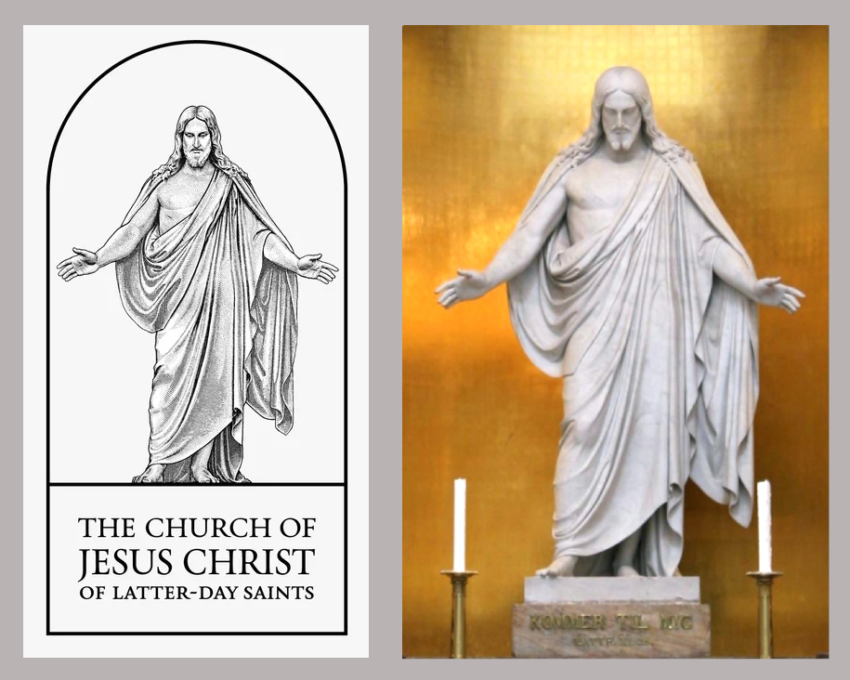
Image: Side‑by‑side, it’s hard to miss! If this is a uniquely “restored” church,
why does its official emblem look like a line‑drawing photocopy of a
19th‑century Lutheran statue? When your restored church needs Christian credibility,
apparently, you don’t draw your own Christ—you borrow from the Lutherans.
Under the banner “Restoration or Appropriation? How Mormonism Borrows Its Bible, Its Art, and Its Credibility from ‘Apostate’ Churches,” this discussion asks a simple but unsettling question: if the LDS movement truly restored a lost Christianity, why does it lean so heavily on the very traditions it claims went off the rails? From its ongoing use of the King James Bible as official English scripture—down to a church‑produced KJV edition and public celebrations of its translators—to its decision to place a stylized image of Thorvaldsen’s Lutheran Christus at the center of its worldwide logo, the supposedly “restored” church keeps reaching back into what early leaders labeled the “great and abominable” system to look and sound credibly Christian. This piece follows that trail of dependence, arguing that Mormonism’s borrowed Bible, borrowed art, and borrowed respectability raise serious questions about the sincerity and coherence of its restoration claims.
The new LDS Logo of Jesus is nearly an exact representation of a sculpture owned by the Evangelical Lutheran Church in Denmark.
The LDS church’s new symbol is explicitly based on Christus, the marble statue by Bertel Thorvaldsen that stands in the Church of Our Lady, an Evangelical Lutheran church in Copenhagen, Denmark. The LDS Church itself says the center of its symbol is “a representation of Thorvaldsen’s marble statue, the Christus,” and that the design was introduced in 2020 to emphasize Jesus Christ as the center of the church.
What does that mean? The resemblance is not accidental or merely “nearly exact” by coincidence; the LDS symbol intentionally uses a likeness of the Thorvaldsen statue as its central image. The original statue was created in the 1800s for the Lutheran cathedral in Copenhagen, and the LDS Church later adopted replicas of it as a devotional image, then incorporated it into the official symbol.
Why it looks so familiar. Thorvaldsen’s Christus shows the resurrected Jesus with outstretched arms and visible nail wounds, a very distinctive pose that makes the LDS symbol immediately recognizable as derived from that work. Because the church’s emblem centers on that same figure, the visual connection is strong and easy to spot.
Important nuance. It’s more precise to say the LDS logo is a deliberate adaptation of the Christus statue than a copy of a church-owned artwork in a legal or secretive sense. The LDS Church has publicly acknowledged the source and has described the image as representing Christ at the center of its faith.
The history of Bertel Thorvaldsen’s Christus statue.
The LDS Church embraced replicas from the 1950s, notably via Elder Stephen L. Richards, placing one in Temple Square and later its 2020 logo. Thorvaldsen, not notably devout, crafted it amid neoclassical ideals blending classical sculpture with Christian iconography.
Commission and Creation. The statue originated after the Evangelical Lutheran Church of Our Lady in Copenhagen was destroyed by British bombardment in 1807 during the Napoleonic Wars. Rebuilt in the neoclassical style by 1829, it prompted Danish sculptor Bertel Thorvaldsen—then Europe’s leading neoclassicist—to receive the commission in 1819 or 1820 for Christ and 12 apostles (replacing Judas with Paul).
Thorvaldsen, based in Rome, worked on clay models around 1821, with legends of inspiration: one friend’s sympathetic arm gesture, another’s slumped clay model overnight, or divine insight. A plaster version appeared at the church’s 1829 dedication; the marble original was installed in 1833 and consecrated in 1839.
Early Fame and Copies. Housed permanently in Copenhagen’s cathedral, plaster casts and replicas proliferated by the mid-19th century—porcelain, metal, even street-vended miniatures—as symbols of cultured piety. The original plaster model resides in the Thorvaldsen Museum.
LDS Adoption. The LDS Church embraced replicas from the 1950s, notably via Elder Stephen L. Richards, placing one in Temple Square and later its 2020 logo. Thorvaldsen, not notably devout, crafted it amid neoclassical ideals blending classical sculpture with Christian iconography.
Why does Thorvaldsen’s Christus resonate so deeply with LDS leaders despite its Lutheran origins and neoclassical style?
Thorvaldsen’s Christus resonates with LDS leaders because its imagery perfectly serves several deep needs at once: it projects an unmistakably Christian identity, visually embodies key Latter‑day Saint doctrines about the resurrected, embodied Christ, and does so in a gentle, inviting style that avoids the crucifix while still centering the Savior.
Clarifying Christian identity. By the mid‑20th century, senior leaders worried that visitors to Temple Square saw very little that said: “these people are Christians.” Elder Richard L. Evans reportedly remarked that “the world thinks we’re not Christians because they see no evidence of Christ on this square,” which led Elder Marion D. Hanks to propose a large replica of Thorvaldsen’s Christus as a public, visual answer to that problem.
When a replica was installed in the visitors’ center, leaders explicitly framed it as a way for outsiders to “understand something about your faith” and see that Latter‑day Saints “love the Lord Jesus Christ” and “rejoice in Christ.” Official materials later said the Church commissioned the replica “to communicate the Latter-day Saints’ faith in Jesus Christ,” and that the statue has become a global visual declaration of that devotion.
Fitting LDS doctrine about a living, embodied Christ. The original Christus depicts the resurrected Jesus with outstretched arms, visible nail wounds in hands, feet, and side—an image of a glorified but still fully physical Christ. LDS sources repeatedly stress that Thorvaldsen’s composition proclaims that Jesus “was and still is the Son of God and the Redeemer of the world,” which dovetails almost perfectly with Latter‑day Saint emphasis on the risen, embodied Savior who continues to act now.
LDS explanations of the statue routinely link it to Matthew 11:28 (“Come unto me, all ye that labour and are heavy laden”), echoing the Danish inscription “Kommer til mig” on the original base and interpreting the pose as Christ beckoning all to come. That open‑armed, inviting posture directly reinforces core LDS themes of universal invitation, personal access to Christ, and His ongoing ministry to the weary and burdened.
A non‑crucifix symbol that still centers Jesus. Historically, Latter‑day Saints have been uneasy with traditional Christian iconography, especially the cross, and have generally avoided using it as a primary symbol. Commentators within the Church explicitly note this “cultural uneasiness” with the cross and early reluctance toward religious statuary, which makes the Christus stand out as a unique compromise: it is clearly Christian but focuses on the risen Lord, not His moment of torture.
As a result, the statue offers leaders a theologically comfortable focal point—Christ after the resurrection, welcoming and merciful—rather than an image of suffering that might clash with LDS emphases on agency, joy, and the living Christ. The 2020 official Church symbol, which incorporates a representation of the Christus, was explained by President Nelson as a way to “identify the restored gospel with the living, resurrected Christ,” explicitly tying the sculptural image to that doctrinal focus.
This theological calculus surrounding the Christus is inseparable from a broader and well-documented LDS aversion to the cross itself—an aversion that sets the Church apart from virtually every other tradition claiming the name of Christ. As we explore at length in our post “Embracing the Cross: A Challenge to the LDS Church’s Symbolic Reluctance,” LDS reluctance toward cross iconography is neither accidental nor merely aesthetic. Church leaders have historically framed the cross as a morbid fixation on death rather than a celebration of resurrection, with Gordon B. Hinckley famously asking why one would want to wear an emblem of execution as a symbol of faith. This reasoning, however theologically tidy, severs the LDS tradition from two millennia of Christian reflection on the cross as the decisive, redemptive act of God—the event Paul called the very center of his preaching (1 Corinthians 2:2). The Christus, then, is not simply an artistic choice; it functions as a deliberate theological substitute, allowing the Church to project a Christ-centered identity while quietly stepping around the emblem that historic Christianity has always regarded as the heart of the gospel.
The LDS reluctance to embrace the cross is intimately connected to a distinctive doctrinal development: the emphasis on Gethsemane rather than Calvary as the primary location of the atonement. This theological shift represents a significant departure from biblical Christianity and helps explain why the cross holds diminished significance in Mormon thought.
A Brigham Young University study asked students where “the Atonement of Christ mostly took place.” The results were striking: 88 percent answered “In the Garden of Gethsemane.” Only 12 percent chose “On the Cross at Calvary.” This reveals a fundamental soteriological difference between LDS theology and historic Christianity.
The Encyclopedia of Mormonism, drawing on multiple twentieth-century LDS church leaders, explicitly states: “For Latter-day Saints, Gethsemane was the scene of Jesus’s greatest agony, even surpassing that which he suffered on the cross.” According to this heterodox view, Jesus “suffered the pains of all men… principally in Gethsemane,” thereby relocating the center of Christian soteriology from Calvary to the Garden.
This teaching finds no support in Scripture. The Garden of Gethsemane is mentioned in only two Gospel accounts (Matthew 26:36-46; Mark 14:32-42), and neither passage attributes atoning significance to Jesus’ suffering there. While Mormon commentators frequently appeal to Luke’s description of Jesus sweating “great drops of blood” (Luke 22:44), the New Testament nowhere suggests this phenomenon bore redemptive significance. The sweating of blood—medically known as hematidrosis—was a physiological manifestation of extreme psychological and spiritual distress, not a mechanism of redemption or substitutionary atonement.
Orthodox Christian theology has always understood Gethsemane as revealing the genuine humanity of Christ in his incarnation. There, Jesus experienced profound human anguish as he contemplated the cup of divine wrath he would bear on behalf of sinners. His prayer—“Father, if you are willing, remove this cup from me. Nevertheless, not my will, but yours, be done” (Luke 22:42)—demonstrates his full human nature shrinking from suffering while his divine will remained perfectly aligned with the Father’s redemptive plan. This is the mystery of the hypostatic union: Jesus, fully God and fully man, experienced authentic human emotion and temptation without sin.
Interestingly, careful research reveals that the Gethsemane emphasis is a relatively late development in LDS theology, not something traceable to Joseph Smith himself. According to research published by BYU’s Religious Studies Center:
“With respect to the teachings and writings of Joseph Smith there is one reference to the Savior in Gethsemane (although not about his atoning for our sins) and thirty-four references to Christ’s Crucifixion, nine of which refer to its saving power. The purpose of this research is not to undermine the importance or significance of Christ’s experience in Gethsemane but rather to shed light on what Joseph Smith taught regarding Christ’s sufferings in Gethsemane and his death on Calvary. In contrast with the statement from the Encyclopedia of Mormonism cited in the introduction, the teachings and revelations of Joseph Smith give Christ’s death on the cross the primary locus of soteriological significance.”
— BYU Religious Studies CenterThis finding is remarkable: even by LDS standards, the emphasis on Gethsemane over the cross appears to be a development that came after Joseph Smith, not something he established. The cross taboo and the garden atonement theology emerged together in the early to mid twentieth century, coinciding with growing anti-Catholic sentiment and the desire for Mormon distinctiveness. These were later theological innovations, not founding principles.
Emotional tone and devotional aesthetics. Thorvaldsen’s Christ is serene, approachable, and slightly idealized in a way that fits 19th‑ and 20th‑century sentimental Christian art more than stark Baroque or medieval crucifixion imagery. LDS writers and leaders have called both the statue and its creator “inspired,” saying, for example, that “the man who created these statues was surely inspired of the Lord,” and that the work captures “the way the Savior would stand before my eyes, knowing my failures and shortcomings.”
Church and visitors’ center materials describe people feeling reverence and comfort as they look “into the loving face of Jesus” in the Christus and contemplate “the transforming power of Christ’s love,” which aligns closely with modern LDS devotional language about a gentle, compassionate Savior. This emotional register—warm, consoling, optimistic—maps well onto how LDS leaders want members and visitors to experience Christ and the Church.
Institutional memory and global reproducibility. The way the first Temple Square replica arrived—through Elder Stephen L. Richards’ powerful personal experience in Copenhagen and his donation of a marble copy—gave the statue a kind of founding‑story aura among leaders. From the 1960s on, copies were installed in major visitors’ centers worldwide, and apostles like Dallin H. Oaks used the statue in teaching moments, recounting how non‑LDS visitors finally “understood” LDS faith after standing before the Christus.
Over time, that repeated use made the Christus not just a borrowed Lutheran artwork but an internal LDS symbol, woven into missionary presentations, Church media, and now the official logo. Leaders who grew up and served their ministries in spaces dominated by that image understandably feel a deep attachment to it—it has become, for them, the visual shorthand for “we are Christ-centered” in a way nothing homegrown ever quite achieved.
Despite Lutheran and neoclassical origins, LDS sources openly acknowledge that the original stands in a Lutheran cathedral in Copenhagen and that it was not created by a Latter‑day Saint artist. Rather than seeing that as disqualifying, multiple leaders have framed Thorvaldsen as an instrument of divine inspiration, consistent with the LDS idea that truth and light can be found outside the institutional Church. What makes this all the more jarring is Joseph Smith’s own claim that, in the First Vision, he was told to “join none of them, for they were all wrong,” and that “all their creeds were an abomination in his sight” (Joseph Smith–History 1:19). Yet instead of treating historic Christendom’s theology and worship as off‑limits on those terms, multiple LDS leaders have gone on to frame Thorvaldsen—an artist working squarely within that supposedly “abominable” creedal world—as an instrument of divine inspiration, a vessel of light whose Lutheran Christ can now serve as the official face of the restored Church.
Because the statue so effectively communicates themes LDS leaders care about—resurrected Christ, universal invitation, gentle mercy—they treat its Lutheran and neoclassical pedigree as providential rather than problematic. In that sense, the Christus functions for them as a ready‑made, theologically compatible icon that lets the Church “speak Christian” visually, without having to break its own longstanding reticence about inventing new religious images.
The theological context that observes LDS belief that Jesus is the spirit brother of Lucifer.
In Latter‑day Saint theology, the idea that Jesus and Lucifer are “spirit brothers” flows directly from a larger framework about premortal existence and divine parentage, not from an attempt to minimize Christ’s deity.
Premortal spirit family. LDS doctrine teaches that before this life, all humans existed as literal spirit children of Heavenly Father, living in His presence in a premortal realm. In that setting, Jesus Christ (Jehovah) is described as the Firstborn spirit Son of the Father and the greatest of all His spirit offspring, chosen and foreordained as the Savior in a grand premortal council.
At that same council, “Lucifer, another spirit son of God,” rejected the Father’s plan, sought to destroy human agency, and proposed that the glory go to himself; he and those who followed him were cast out and became Satan and his angels. Because both Christ and Lucifer are called “spirit sons of God” within this system, LDS manuals and Gospel Topics essays can say that Satan “is a spirit son of God who was once an angel in authority in the presence of God,” while also affirming that Jesus is the Father’s Firstborn and Chosen from the beginning.
How “spirit brother” language arises. From that framework, Latter‑day Saints reason that all of Heavenly Father’s spirit children—including humans, Christ, and the being who became Satan—are “spirit siblings” in a broad sense. Classic LDS authors (James Talmage, Milton R. Hunter, Bruce R. McConkie) describe a premortal scene in which “Christ and Satan, together with the hosts of the spirit‑children of God, existed as intelligent individuals” and where “the appointment of Jesus to be the Savior of the world was contested by one of the other sons of God … this spirit‑brother of Jesus.”
Modern official exposition prefers to emphasize roles rather than the sibling metaphor: Christ as the uniquely Firstborn, Beloved, and divine Son; Lucifer as a fallen “spirit son of God” who rebelled and now works to destroy the Father’s plan. But the underlying premise—that both originated as spirit offspring of the same Heavenly Father—remains, which is why outside critics and some LDS explainer pieces can accurately say that in LDS cosmology, Jesus and Lucifer are “spirit brothers,” even though their current natures and destinies are understood to be utterly opposed.
The historical and scriptural traditional Christian version.
From a historic, Nicene‑confessional Christian standpoint, the claim that Jesus and Satan are “spirit brothers” is ruled out at the most basic level: Jesus is the eternal, uncreated Son and Creator; Satan is a created, fallen angelic being.
Christ as Creator, not a fellow creature. John 1:1–3 (ESV) describes “the Word” as existing in the beginning, in fellowship with God, and as truly God, and then adds that all things came into being through Him, and without Him nothing that exists came into being. Colossians 1:15–17 (ESV) similarly says Christ is the visible image of the invisible God and that by Him all things were created—in heaven and on earth, visible and invisible, including thrones, dominions, rulers, and authorities—and that all things were created through Him and for Him.
This means Satan, whatever his original glory, belongs on the “all things created” side of the line, not alongside Christ as a peer. Historic Christian exegesis, therefore, insists: if every power and principality was made through the Son, then Satan is one of the beings Christ Himself created, not a sibling sharing common origin. Hebrews 1:2–3 (ESV) reinforces this by teaching that God created the world through the Son and that the Son “upholds the universe by the word of his power,” placing Christ uniquely on the Creator’s side of the Creator–creature divide
Eternal Son: “Begotten, not made.” The early Church confronted a structurally similar error in Arianism, which treated the Son as the highest created being. In response, the Council of Nicaea (325) confessed that the Son is “God from God, Light from Light, true God from true God, begotten, not made, of one substance (homoousios) with the Father,” precisely to deny that Christ is a creature among creatures.
This Nicene formula—“begotten, not made, consubstantial with the Father”—became the bedrock of orthodox Christology across Catholic, Orthodox, and classical Protestant traditions. It canonizes what the New Testament already implies: the Son is eternally from the Father in a unique way (John’s language of “only‑begotten” / monogenēs), but He is not a being who comes into existence within a family of spirits. To place Jesus and Lucifer side‑by‑side as spirit sons of a higher deity simply reintroduces, in a new costume, the very Arian move Nicea condemned.
Satan as a fallen, created angel. Within this same framework, Satan is not a quasi‑divine sibling but a rebel angel. Jude 6 (ESV) speaks of angels who did not stay within their proper domain but left their assigned position and are kept in chains for judgment, and 2 Peter 2:4 (ESV) says that God did not spare angels when they sinned but cast them into gloomy darkness to await judgment. Traditional Christian theology has consistently read Satan as the leader of that angelic rebellion, a powerful but created spirit who exalted himself and fell.
Revelation 12:7–9 (ESV) depicts a war in heaven in which Michael and his angels fight the dragon, identified as “that ancient serpent, called the devil and Satan,” who is cast down to earth with his angels. There is, notably, no hint that Christ and Satan are of the same order of being; rather, Revelation shows the Lamb who was slain conquering Satan and finally throwing him into the lake of fire (Revelation 20:10, ESV), underscoring the absolute superiority of Christ over this creaturely adversary.
Unique Sonship vs. adopted children. The New Testament does speak of believers as “children of God,” but it carefully distinguishes between Christ as Son by nature and humans as children by grace and adoption. John 3:16 (ESV) calls Jesus God’s “only” or “only‑begotten” Son, marking Him as uniquely related to the Father in a way no other being shares. Romans 8:15–17 and Galatians 4:4–7 (ESV) explain that we receive “the Spirit of adoption” and so become sons and daughters of God, co‑heirs with Christ by grace, not by nature.
In this classical view, sonship language is not a statement that God has a brood of ontologically similar spirit‑offspring, one of whom falls and one of whom succeeds. Instead, it affirms that the eternal Son assumes human nature and, by union with Him, creatures are graciously brought into a filial relationship they did not naturally possess. Angels are sometimes called “sons of God” in the Old Testament, but this is a metaphor of status within creation, not a sharing in the Son’s divine nature. Nowhere does Scripture present Satan as God’s child in the salvific, familial sense, still less as a brother to the eternal Son.
Historical theology: why the Church rejects “spirit‑brother” Christology. Patristic and later orthodox theology read the biblical data in a way that jealously guards the uniqueness of Christ’s person and work. The Nicene and Constantinopolitan creeds explicitly confess that through the Son “all things came to be, both in heaven and on earth,” leaving no ontological room for a higher class of “spirit siblings” outside His creative act.
As mainstream theologians and apologists regularly point out, the notion that Jesus and Satan share a common heavenly parent and differ only by choice places Christ and Lucifer on the same side of the Creator–creature divide, making Christ at most a super‑angel. This contradicts the apostolic witness that in Christ the whole fullness of deity dwells bodily (Colossians 2:9, ESV paraphrased) and that to see Him is to see the Father (John 14:9, ESV paraphrased). Historically, the Church has labeled such “high creature” Christologies as heretical because they dissolve the full deity of the Son and thus undercut the gospel itself.
Theological and pastoral conclusion. From a traditional Christian perspective, then, to call Jesus and Lucifer “spirit brothers” is to misidentify both: it demotes Christ from Creator to creature, and it elevates Satan from fallen angel to quasi‑divine peer. Scripture instead presents Christ as the eternal Word through whom Satan himself was made, the incarnate Son who came “to destroy the works of the devil” (1 John 3:8, ESV paraphrased), and the risen Lord who will finally judge and condemn him.
In historic orthodoxy, the right confession is not “Jesus, the spirit brother of Lucifer,” but “Jesus Christ, true God and true man, eternally begotten of the Father, through whom and for whom all things—including the rebellious angels—were created.” Any scheme that places Christ and Satan in a shared family of preexistent spirits is therefore rejected as incompatible with the biblical witness and the Church’s settled, conciliar teaching.
A Tradition of Xerox Copies.
In my blog post, “King James Copycat? The Truth Behind Joseph Smith’s “Translation” of the Bible,”as an additional argument that the LDS Church has consistently drawn on the “Church of the devil,” as early leaders called it, to provide itself with the mantle of Christianity.
One more angle underscores the pattern you exposed in “King James Copycat?”—the LDS Church does not merely borrow Protestant Bible translations and commentaries while denouncing “apostate” Christianity; it also borrows Christianity’s visual capital, including Thorvaldsen’s Lutheran Christus, to cloak itself in the very tradition it insists has fallen away. In the article, it is demonstrated how Joseph Smith’s “New Translation” of the Bible is framed as a prophetic restoration of “plain and precious” truths supposedly stripped out by the “great and abominable church,” even while the actual work consists largely of revising the 1769 King James text and, in many places, quietly tracking the suggestions of Adam Clarke’s Methodist commentary. The result is that the prophet of the Restoration leans heavily on the very Protestant Bible and scholarly apparatus that his own narrative portrays as corrupted by the “church of the devil.”
The Christus‑logo episode follows the same script at the level of religious imagery. The modern LDS Church presents Thorvaldsen’s statue—commissioned for a Lutheran cathedral in Copenhagen—as the centerpiece of its visual identity, now stylized into the official Church “symbol” precisely to signal that Latter‑day Saints are fully, recognizably Christian. Yet this image comes from the very stream of historic Christendom that the Book of Mormon depicts as having taken the Bible, passed it through “the hands of the great and abominable church,” and stripped it of its fullness. Just as the JST wraps itself in the language and cadence of the King James Bible while claiming to correct it, the LDS logo wraps itself in a cherished Lutheran representation of the risen Christ while insisting that Lutheranism itself is part of the apostate system that had to be “restored” from the ground up.
Seen together, the textual and visual patterns tell the same story. When the LDS Church needs credibility, legitimacy, and the recognizability of “Christian” faith, it reaches not to uniquely revealed, self‑authenticating Mormon symbols, but to the very churches and traditions its own scripture brands as “great and abominable”—borrowing their Bible, echoing their commentaries, and now tracing their art. Far from demonstrating a clean break from the “church of the devil,” this strategy suggests a movement that depends on the historic Church’s canon, scholarship, and iconography to manufacture the appearance of continuity with biblical Christianity, even as its underlying theology pulls in a very different direction.
A Note on Research Methods and Accuracy
This work represents a collaboration among the author’s theological and historical research, primary-source documentation, and the emerging capabilities of artificial intelligence research tools. AI assistance was employed throughout the investigative process—not as a ghostwriter or a substitute for scholarship, but as a rigorous research partner: surfacing sources, cross‑referencing claims, identifying scholarly consensus, and flagging potential errors before they could reach the page.
Every factual claim in this work has been subjected to active verification. Where AI‑generated content was used as a starting point, it was tested against primary sources, peer‑reviewed scholarship, official institutional documentation, and established historical records. Where discrepancies were found—and they were found—corrections were made. The author has made every reasonable effort to ensure that quotations are accurately attributed, historical details are precisely rendered, and theological claims fairly represent the positions they describe or critique.
That said, no work of this scope is immune to error, and the author has no interest in perpetuating inaccuracies in the service of an argument. If you are a reader—whether sympathetic, skeptical, or hostile to the conclusions drawn here—and you identify a factual error, a misattributed source, a misrepresented teaching, or a claim that cannot be substantiated, you are warmly and genuinely invited to say so. Reach out. The goal of this work is not to win a debate but to get the history right. Corrections offered in good faith will be received in the same spirit, and verified corrections will be incorporated into future editions without hesitation.
Truth, after all, has nothing to fear from scrutiny—and neither does this work.