
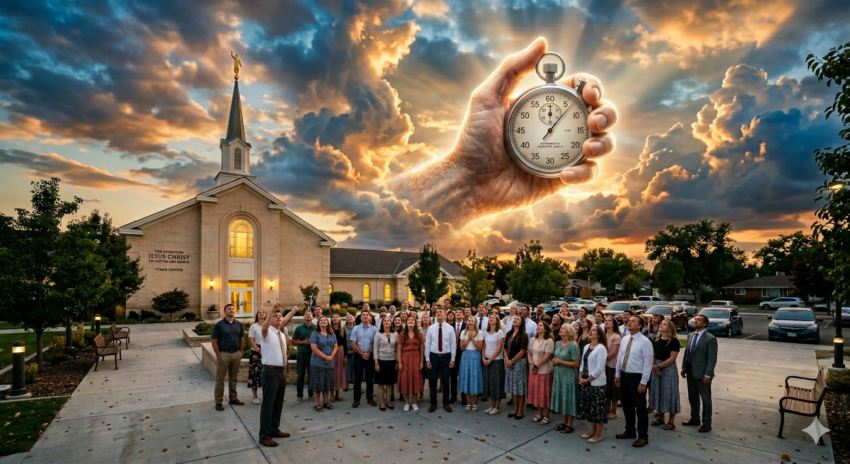
Image: An AI-generated image imagines a large heavenly hand emerging from the clouds holding a stopwatch, and below a group of people gathered outside a local Church of Jesus Christ of Latter-day Saints, looking up expectantly.
The Unparalleled Organizational Architecture of LDS Sunday Worship — A Comparative Theological Inquiry
Introduction: A Revelation Arrives with a Stopwatch
Imagine receiving a letter from your denomination’s highest governing body informing you that, beginning on a specific date, your congregation’s Sunday School class will be precisely twenty-five minutes long. Not approximately twenty-five minutes. Not roughly half an hour. Twenty-five minutes. And that this directive will apply simultaneously to every congregation of your faith on every continent of the globe.
On March 29, 2026, the LDS Church’s First Presidency issued a formal announcement restructuring its Sunday worship schedule — again — effective September 6, 2026. This is not a minor adjustment. It represents the second major overhaul in less than eight years, following the 2018 announcement that reduced services from three hours to two hours, which itself followed decades of prior schedule revisions. The new format prescribes:
• 60 minutes — Sacrament Meeting
• 5 minutes — Transition
• 25 minutes — Sunday School
• 5 minutes — Transition
• 25 minutes — Priesthood quorum / Relief Society / Young Women meeting
• 55 minutes — Primary (for children)
Down to the minute. Globally. For every congregation on the planet.
No other religion on earth operates this way. And for traditional, orthodox Christians, this extraordinary level of institutional control over corporate worship is not merely an organizational curiosity — it is a profound theological statement about the nature of this institution and what it believes worship actually is.
For the outside observer—particularly one rooted in the traditions of historic, orthodox Christianity—this moment invites a profound comparative question: What does it mean, theologically and sociologically, that a single religious institution exercises this degree of centralized, minutiae-level authority over the corporate worship of more than seventeen million souls across 196 nations? And how did the Latter-day Saints arrive at a place where such governance is not merely accepted, but celebrated?
This essay examines that question with scholarly care, intellectual respect, and evangelical conviction. It traces the organizational architecture of the LDS Church from its tumultuous frontier origins to its present-day status as arguably the most precisely administered religious corporation on earth. Along the way, it asks what this extraordinary organizational apparatus reveals about the nature of LDS theology—and what it illuminates, by contrast, about the far simpler polity of the New Testament church.
The Frontier Crucible — Organizational Necessity in the Early Latter-day Saint Movement
A Church Born in Chaos
To understand the LDS Church’s present organizational thoroughness, one must begin in its extraordinarily turbulent early decades. The Church of Christ—as it was originally named—was formally organized on April 6, 1830, in western New York, in the home of Peter Whitmer, during the incandescent religious ferment of the Second Great Awakening. The region, famously dubbed the “burned-over district” by historian Whitney Cross, was a landscape of competing revival movements, prophetic claims, and utopian experiments. Into this combustible atmosphere stepped Joseph Smith, declaring himself a latter-day prophet in possession of a restored gospel.
The early Saints faced conditions that would have shattered a less cohesive movement. Within a decade of the church’s founding, the community had been driven from New York to Ohio, from Ohio to Missouri (where Governor Lilburn Boggs issued an Extermination Order against them in 1838), and from Missouri to the swamplands of Commerce, Illinois, which Smith renamed Nauvoo. Each expulsion—each season of persecution, economic collapse, and violent upheaval—produced a predictable institutional response: tighter organization, more clearly defined authority structures, and expanded ecclesiastical frameworks.
“The long-standing objective of the Church is to assist all members to increase their faith in our Lord Jesus Christ and in His Atonement, to assist them in making and keeping their covenants with God and to strengthen and seal their families.”
— President Russell M. Nelson, October 2018 General Conference | LDSLiving.com
This was not mere administrative convenience. For the early Saints, organizational structure was itself a theological statement. Joseph Smith and his successors understood the restoration of priesthood authority as inseparable from the restoration of church organization. Offices, quorums, presidencies, councils—these were not bureaucratic additions to a spiritual core. They were understood as the very skeleton of the restored gospel, revealed line by line through prophetic command.
The Doctrine and Covenants: A Blueprint for Management
The Doctrine and Covenants, the primary collection of Joseph Smith’s revelations, stands without parallel among world religious scriptures in its administrative specificity. While the Bible describes the organization of the early church in general terms, and while the Quran concerns itself primarily with theology and law, the Doctrine and Covenants is in many respects an organizational handbook clothed in the language of revelation. Section 20 outlines the duties of elders, priests, teachers, and deacons. Section 107 delineates the structure and relative authority of the Melchizedek and Aaronic Priesthoods in elaborate detail. Section 84 specifies conditions for the oath and covenant of the priesthood. The Kirtland Temple’s interior, as recorded in early church history, even featured a remarkable architectural expression of this layered authority: two series of four-tiered pulpits on each end of the assembly rooms to seat the presidencies of both priesthoods.
This revelatory specificity set the trajectory for everything that would follow. If God himself had specified the organizational structure through a living prophet, then subsequent prophets were equally empowered—indeed obligated—to refine and adjust that structure as circumstances required. The precedent for prophetic governance of meeting schedules was not an innovation of the twentieth century. It was baked into the theological DNA of the movement from its earliest days.
The Nauvoo Period: Organizational Apex of the Smith Era
By the time Joseph Smith had established Nauvoo, Illinois, as the LDS headquarters in 1839, he had created one of the most comprehensively organized religious societies in American history. The Relief Society (organized March 17, 1842) brought women under a formal auxiliary structure with its own presidency and proceedings. The Nauvoo Legion operated as a quasi-military arm of the ecclesiastical community. The temple endowment, first presented on May 4, 1842, introduced a system of covenant rituals accessible only to the organizationally faithful. And the Council of Fifty—organized March 11, 1844—represented Smith’s vision of a full theocratic governance structure, described as a body intended to “establish the kingdom of God on the earth to govern men in civil matters.”
Even Smith’s assassination in June 1844 did not unravel this organizational fabric. Under Brigham Young’s iron-willed leadership, the exodus to the Salt Lake Valley became one of the most remarkable feats of organized mass migration in American history—a logistical achievement only possible because the church had already developed the institutional machinery to accomplish it. Organization was not a byproduct of LDS theology. It was its most visible and durable fruit.
The Architecture of Managed Worship — From Three Hours to Twenty-Five Minutes
The Pre-Consolidated Era: A Patchwork of Meetings
To appreciate the significance of the 2026 announcement, one must understand the remarkable evolution of the LDS Sunday schedule across nearly two centuries. In the earliest decades of the church, Sunday meetings were held in whatever structures were available—log homes, schoolhouses, and open fields. Primary, Sunday School, Relief Society, and Priesthood meetings occurred throughout the week, while the Sacrament meeting anchored Sunday afternoons. There was no single block, no centrally mandated duration, and no global uniformity.
As the church expanded through the late nineteenth and early twentieth centuries, and as meetinghouses replaced frontier improvisation, Sunday worship evolved into a multi-meeting phenomenon of considerable temporal demand. Faithful members in mid-century America might attend a Priesthood meeting at 8 a.m., followed by Sunday School, followed by the main Sacrament meeting in the afternoon. The aggregate time commitment exceeded what most Protestant or Catholic congregations expected of their most devoted members on a typical Sunday.
The Three-Hour Block: The 1980 Consolidation
The modern era of managed LDS worship time began in March 1980, when the First Presidency sent a letter to stake presidencies and bishoprics announcing a consolidated three-hour Sunday block. The move had been under study since at least 1973, when the American energy crisis had made multiple weekly trips to meetinghouses economically burdensome. Pilot studies had shown that consolidation increased attendance rates—a data point that would recur in subsequent reform discussions. The official rationale was simultaneously practical and theological:
“The purpose of the consolidated meeting schedule is to re-emphasize personal and family responsibility for learning, living and teaching the gospel and to allow church members more time for personal gospel study, for service to others and for meaningful activities.”
— LDS First Presidency Letter, March 1980 | Deseret News
For nearly forty years, the three-hour block defined LDS Sunday experience worldwide: sixty to seventy minutes of Sacrament meeting, followed by fifty minutes of Sunday School, followed by fifty minutes of gender and age-specific quorum and auxiliary meetings. The structure was so uniform, so globally standardized, that a Latter-day Saint visiting a ward in Seoul, São Paulo, or Salzburg would encounter the identical sequence. This uniformity was not accidental. It was the organizational architecture expressing itself in its most mature form.
The 2018 Revelation: The Two-Hour Reformation
In October 2018, at the 188th Semiannual General Conference, President Russell M. Nelson announced what many observers called the most significant structural change in LDS worship in nearly four decades. The three-hour block was to be reduced to two hours, effective January 2019. The Sacrament meeting was shortened from seventy to sixty minutes. The second hour would alternate weekly between Sunday School and quorum or class meetings.
“As Latter-day Saints, we have become accustomed to thinking of ‘church’ as something that happens in our meetinghouses, supported by what happens at home. We need an adjustment to this pattern. It is time for a home-centered Church, supported by what takes place inside our branch, ward, and stake buildings.”
— President Russell M. Nelson, October 2018 General Conference | MormonWiki
The theological framing was significant. The reduction of meetinghouse time was not presented as a concession to modernity or a capitulation to the demands of busy schedules. It was framed as a prophetically directed rebalancing—a shift of gospel learning weight toward the home, anchored by a new curriculum resource, “Come, Follow Me,” designed to harmonize home study with Sunday instruction. The church was not merely adjusting a clock. It was repositioning the center of gravity of spiritual formation.
The 2026 Announcement: Twenty-Five Minutes, Globally
The official LDS Church Newsroom framed the 2026 schedule change in characteristically pastoral language:
“The adjustments will strengthen gospel learning in homes and congregations throughout the world. Members across the world have embraced these changes with faith and enthusiasm.”
— LDS Church Newsroom, “Changes to the Sunday Class Meeting Schedule,” March 29, 2026
Sunday School General President Paul V. Johnson added:
“Gathering weekly in every class helps deepen gospel learning by connecting it more closely to personal and family study. It also enhances the spiritual support that members get. Though the schedule looks different, the amount of time spent learning together remains the same.”
— President Paul V. Johnson, LDS Church Newsroom, March 29, 2026
The careful corporate framing here is instructive. Notice what is not said: there is no appeal to Scripture, no invocation of the leading of the Holy Spirit, no reference to the gathered body of believers discerning together how to worship. The justification is organizational — “strengthening gospel learning,” connecting to “personal and family study,” supporting “lifelong disciples.” These are HR talking points, not theological convictions.
Fox 13 News reported the specifics plainly:
“On Monday, the church announced that starting Sept. 6, local wards will hold both Sunday School and the above-mentioned meetings every week, but for just 25 minutes each. Sacrament Meetings will continue to be one hour long… There will now be a 5-minute break between the three different meetings.”
— Fox 13 News, March 30, 2026
The detail worth pausing on: even the transition breaks between meetings are specified — 5 minutes each. The transition is mandated. The clock governs even the walking from room to room.
“Gathering weekly in every class helps deepen gospel learning by connecting it more closely to personal and family study. It also enhances the spiritual support that members get. Though the schedule looks different, the amount of time spent learning together remains the same.”
— President Paul V. Johnson, Sunday School General President | LDS Church Newsroom, March 30, 2026
The intellectual honesty of President Johnson’s statement is worth pausing on: “the amount of time spent learning together remains the same.” He is saying, in essence, that this is a reorganization of time, not a reduction. The organizational mind of the church has determined that twenty-five focused minutes of weekly connection produces equivalent or superior spiritual results to fifty alternating minutes of biweekly connection. Whether or not one accepts the theological premise, the confidence with which that calculation is made—and imposed globally—speaks volumes about the nature of LDS institutional authority.
The Comparative Lens — No Other Religion on Earth Does This
Roman Catholicism has its Liturgy of the Hours and the Mass, governed by the Roman Missal — but local parishes, diocese by diocese, operate within enormous pastoral discretion. A Low Mass may run 30 minutes; a High Mass with choir may run two hours. No Vatican edict specifies the minute length of each liturgical segment for every parish globally.
Eastern Orthodoxy operates in liturgical traditions whose services can run anywhere from 90 minutes to four hours depending on feast days, monastic context, or parish custom. The faithful pray until the liturgy is complete — not until the buzzer sounds.
Protestant and Evangelical Christianity, in its thousands of expressions, may be the clearest contrast. Baptist, Presbyterian, Methodist, Pentecostal, and Anglican — each tradition entrusts worship duration and structure to the local congregation, the pastor, or at most, a regional denominational body. No central authority in Geneva, Nashville, or Colorado Springs issues minute-by-minute global worship mandates.
Islam structures its five daily prayers with prescribed rakʿahs (cycles), but the length of a Friday Jumu’ah sermon is culturally and locally determined. There is no global headquarters issuing an edict that the Khutbah must be precisely 25 minutes.
Judaism in its various streams observes Shabbat services whose length is determined by tradition, rabbi, and congregation — not a corporate headquarters.
Buddhism, Hinduism, Sikhism — none of these traditions has a central bureaucratic authority issuing globally binding timed worship schedules for their congregants.
The LDS Church is sui generis in this regard. No other major religious institution on earth centrally manages the minute-by-minute worship schedule of its worldwide membership and revises that schedule every few years as organizational priorities shift.
The LDS Church: A Category of Its Own
The Church of Jesus Christ of Latter-day Saints stands in a category of its own precisely because its theology of continuous prophetic revelation does what no other tradition’s theology can do: it justifies global, binding, minute-level governance of corporate worship as an act of divine direction. When the First Presidency issues a letter to stake presidents and bishops specifying that Sunday School will be twenty-five minutes long beginning September 6, 2026, this is not experienced by faithful Latter-day Saints as institutional overreach. It is experienced as the voice of a living prophet, speaking in real time.
The General Handbook of The Church of Jesus Christ of Latter-day Saints—a comprehensive policy and practice guide prepared by the First Presidency and Quorum of the Twelve Apostles and made publicly available online—spans dozens of chapters and encompasses guidance on everything from the administration of temples to the proper management of ward finances, from policies on artificial insemination to the handling of lost temple recommends. Its August 2024 update included specific new guidelines for worship services on Easter and Christmas, added direction about which youth officers should welcome visitors to Sacrament meeting, and simplified instructions for streaming and virtual meetings. The handbook is updated regularly in response to ongoing prophetic direction.
“The Church of Jesus Christ believes in ongoing revelation to prophets and apostles. The digital format of the handbook allows these leaders to more easily adjust policies to address questions and provide clarity to leaders who are administering the Church around the world.”
— LDS Church Newsroom, August 2024 General Handbook Update
No other religious institution on earth maintains an equivalent instrument. The Catechism of the Catholic Church is a theological document, not an administrative handbook. The Westminster Confession of Faith governs Reformed doctrine, not the duration of Sunday School. The Book of Church Order of the Presbyterian Church in America addresses the structure and authority of church courts, not the time allocation of weekly meetings. The closest analogs in the corporate world would be something like a global franchise operations manual—the kind of document that specifies, to the minute, the service model at every location. That the Latter-day Saints have constructed this infrastructure in the name of revealed religion is a phenomenon without peer in Christian history.
A Theological Reflection — What Scripture Says About Church Governance
The New Testament Model: Simplicity and Spirit-Direction
The contrast between the LDS organizational model and the New Testament pattern of church life is, from an evangelical perspective, both theologically illuminating and pastorally significant. The church described in the pages of the New Testament is a remarkably unencumbered organism. The epistles of Paul, Peter, James, and John contain no meeting schedules, no centrally mandated time allocations for corporate gatherings, and no administrative directives to churches in different cities specifying the structure of their Sunday assemblies.
What the New Testament does provide are theological principles for gathered worship: the breaking of bread (Acts 2:42), the reading of Scripture (1 Timothy 4:13), the singing of psalms, hymns, and spiritual songs (Ephesians 5:19; Colossians 3:16), the exercise of spiritual gifts (1 Corinthians 12–14), prayer (1 Timothy 2:1–2), and the mutual edification of believers (Hebrews 10:24–25). The early church met in homes, in synagogues, in open spaces, and eventually in basilicas. Its worship was anchored in word and sacrament, shaped by the presence of the Holy Spirit, and governed at the local level by elders whose qualifications are described in 1 Timothy 3 and Titus 1.
The New Testament’s closest approach to organizational prescription is the Pauline description of church officers in Ephesians 4:11–12—apostles, prophets, evangelists, pastors, and teachers—given “for the equipping of the saints for the work of service, to the building up of the body of Christ.” Even here, the emphasis is on function and purpose, not on administrative structure or temporal management.
The Doctrine and Covenants vs. The New Testament: A Study in Contrasts
The contrast with the Doctrine and Covenants could hardly be more pronounced. Where the New Testament describes the church organically and theologically, the Doctrine and Covenants describes it mechanically and administratively. The D&C specifies the number of members required to constitute a quorum (Section 107), the relative authority of various priesthood officers (Section 107), the conditions under which a bishop may be tried (Section 107), and the proper procedure for ordaining church officers (Section 20). It is a document of organizational architecture in the guise of sacred scripture.
This is not to say that the Doctrine and Covenants lacks theological content—it contains profound statements on the nature of God, the afterlife, priesthood, and covenant. But its organizational density is without parallel in any recognized biblical canon, and it has produced, over nearly two centuries, an institutional culture in which governance and revelation are virtually indistinguishable.
Temple Attendance as Compliance Incentive
One of the most distinctive features of the LDS organizational system—from a comparative ecclesiastical perspective—is the mechanism by which participation is incentivized. The church links access to its most sacred ritual spaces (temples) to a periodic interview process in which members must demonstrate compliance with church standards, including regular Sunday attendance. Members who do not meet these standards are not issued a “temple recommend” and are therefore excluded from temple worship, including the most sacred covenantal ordinances of the faith.
“Members in the church are encouraged to attend church each and every Sunday for the full meeting time and regular attendance is typically a requirement for members to participate in temple services and in certain ordinances.”
— ABC4 News | abc4.com/news/religion/lds-church-changes-sunday-services
This creates an organizational feedback loop of remarkable efficiency: the theological importance of temple ordinances motivates Sunday attendance, and Sunday attendance is the institutional gateway to temple participation. No other Christian tradition—indeed, no other religion on earth—has devised a mechanism quite like this to sustain regular corporate worship participation. It is organizationally brilliant and theologically distinctive.
The Evangelical Perspective: Freedom vs. Formation
From the perspective of orthodox, evangelical Christianity, the LDS organizational model raises a fundamental question about the relationship between ecclesial structure and spiritual freedom. The New Testament church is governed not by an administrative handbook but by the indwelling Holy Spirit, who distributes gifts as He wills (1 Corinthians 12:11) and leads the community in ways that may be locally specific, culturally adaptive, and seasonally variable. The Spirit’s work in the church is, by definition, not reducible to a twenty-five-minute window on a globally synchronized schedule.
This is not an argument for organizational chaos. Paul’s instruction that “all things should be done decently and in order” (1 Corinthians 14:40) establishes the principle of orderly corporate worship. The Pastoral Epistles describe a church with recognized leaders, defined qualifications for office, and clear expectations for congregational conduct. Protestant church history has produced a rich tradition of church polity—episcopal, presbyterian, and congregational—each offering a biblical rationale for its approach to ecclesiastical governance.
But there is a significant difference between order and optimization. The LDS Church has moved steadily from the former toward the latter—from a church organized to function to a church managed to perform. The 2026 announcement, with its precise twenty-five-minute allocations, represents the logical endpoint of a theological trajectory in which prophetic authority, organizational discipline, and institutional efficiency converge. The question for evangelical observers is not whether the LDS Church is well-organized. It manifestly is. The question is whether an organization this thoroughly managed leaves sufficient room for the sovereign work of the Spirit—for the unexpected move of God, the extended prayer that cannot be scheduled, the sermon that must go longer because the congregation is weeping.
The Sociological Dimension — What Managed Time Produces
The Power of Shared Temporal Experience
Sociologists of religion have long observed that shared ritual time is one of the most powerful cohesion mechanisms available to religious communities. Emile Durkheim’s concept of “collective effervescence”—the heightened sense of belonging and transcendence that emerges when people participate in synchronized ritual—remains one of the most durable frameworks for understanding why religious communities gather. The LDS Church has, whether by theological design or organizational intuition, maximized this effect through global temporal synchronization.
When every Latter-day Saint on earth is simultaneously sitting in a twenty-five-minute Sunday School class on the same day, with the same curriculum (“Come, Follow Me”), following the same schedule issued by the same First Presidency, the collective identity produced is extraordinary. A Latter-day Saint who relocates from Salt Lake City to Singapore or from Mesa to Milan does not merely join a new ward that shares their theological convictions. They join a community that shares their exact temporal experience of corporate worship. The schedule is itself a sacramental act of belonging.
Activity Rates and the Institutional Imperative
The organizational pressure to refine the meeting schedule also reflects the church’s acute awareness of its own activity rate challenges. The LDS Church does not release official statistics on attendance, but independent research suggests that approximately forty percent of its recorded membership in the United States and perhaps thirty percent worldwide regularly attend weekly Sunday worship services. A 2016 survey found that a majority of millennials raised in the church had disaffiliated. The adolescent and young adult cohort—precisely the age group most likely to be lost—is the segment toward which much of the 2026 restructuring (particularly the adoption of the new “For the Strength of Youth” curriculum for teenage quorums and classes) is most directly targeted.
This institutional self-awareness—the willingness to restructure meeting schedules in response to demographic data and retention challenges—is itself remarkable. It reflects an organizational agility that most mainline Protestant denominations, increasingly hampered by conciliar governance processes and theological diversity, cannot match. When the First Presidency issues a letter, every bishop in every ward on every continent implements the change. There is no committee process, no synodical vote, no congregational discussion period.
Relief Society and the Weekly Gathering: An Organizational Theology of Community
The 2026 announcement’s emphasis on weekly—rather than alternating—Relief Society and Elders Quorum meetings reflects a sophisticated theology of community that deserves recognition. The Relief Society’s General President articulated the principle with characteristic clarity:
“There is additive strength that comes when we meet each week to counsel, learn, and support one another. When we gather in His name, the Spirit is there to teach us, testimonies are strengthened, and we lift each other in discipleship. This weekly time for connection will help us draw closer to the Savior and each other.”
— President Camille N. Johnson, Relief Society General President | LDS Church Newsroom, March 30, 2026
From a traditional Christian perspective, this sentiment is entirely commendable. The epistle to the Hebrews exhorts believers not to forsake the assembling of themselves together (Hebrews 10:25), and the New Testament consistently portrays the gathered community as the arena of mutual edification, accountability, and spiritual growth. The LDS emphasis on weekly gathering is, in its pastoral intention, entirely consonant with the New Testament vision.
What remains distinctive is the mechanism of its enforcement. In most Christian traditions, the exhortation not to forsake gathering is precisely that—an exhortation, a moral appeal, a pastoral encouragement. In the LDS context, the same principle is implemented through organizational mandate, global scheduling coordination, and the institutional weight of prophetic authority.
The Deeper Problem: Who Holds Authority?
The minute-mandate phenomenon reveals something fundamental about where authority actually resides in Mormonism. In biblical Christianity, authority in worship flows from:
- Scripture — as the inspired, sufficient Word of God (2 Timothy 3:16–17)
- The Holy Spirit — who indwells and leads the gathered community (John 16:13)
- Christ — as the sole Head of the Church (Ephesians 5:23; Colossians 1:18)
In LDS ecclesiology, authority flows from a very different source: the First Presidency and the Quorum of the Twelve Apostles in Salt Lake City, Utah, whose word is binding on every congregation of the church globally. This is not just a governance difference — it is a fundamentally different theology of the church.
When the First Presidency can alter how long children sing on Sunday mornings in Brazil, New Zealand, Nigeria, and Norway with a single press release — and when those millions of members worldwide are expected to comply not because they have searched the Scriptures but because the institutional authority has spoken — this is a model of religious authority that has far more in common with a multinational corporation than with the New Testament church.
Jesus said:
“Where two or three gather in my name, there am I with them.”
— Matthew 18:20
He did not say: “Where two or three gather according to the current First Presidency schedule, there am I with them.”
The Corporate Fingerprint
One cannot help but notice that the language surrounding these schedule changes sounds strikingly like corporate communications — quarterly adjustments to optimize employee engagement and productivity. “Enhance learning.” “Strengthen spiritual support.” “Home-centered and Church-supported.” These are the phrases of a management consultancy, not the language of a shepherd tending his flock.
The LDS institution is, in fact, one of the most organizationally sophisticated religious bodies in the world — with a centralized structure that includes a correlated curriculum system, global financial management, real estate holdings valued in the tens of billions of dollars, and a communications apparatus that manages its brand with remarkable precision. It is a remarkable human achievement of organizational design.
But that is precisely the problem. When the organizational machine becomes the instrument through which God’s people experience worship — when the machine’s efficiency metrics determine the shape of the gathered community’s life before God — something profoundly important has been lost.
The traditional Christian word for this loss is legalism: the replacement of genuine spiritual life with compliance to human-made regulations. The Pharisees were consummate schedulers. They tithed even their garden herbs. They knew precisely how far a man could walk on the Sabbath. Their religious life was meticulous, comprehensive, and managed. And Jesus said to them:
“Woe to you, teachers of the law and Pharisees, you hypocrites! You give a tenth of your spices — mint, dill and cumin. But you have neglected the more important matters of the law — justice, mercy and faithfulness.”
— Matthew 23:23
Conclusion: What the Stopwatch Cannot Measure
The LDS Church’s 2026 Sunday schedule mandate is, on its surface, a minor administrative adjustment. Sacrament Meeting: 60 minutes. Sunday School: 25 minutes. Quorum meetings: 25 minutes. Primary: 55 minutes. Transitions: 5 minutes. Total: approximately 2 hours.
But underneath the timetable lies a worldview — a theology of the church, of worship, of authority, and of spiritual life — that is categorically different from the historic Christian faith. In biblical Christianity, the gathered assembly of believers is the Body of Christ — living, breathing, Spirit-indwelt, locally rooted, and responsive to the living God. It is not a franchise location receiving updated operational protocols from a corporate mothership.
The stopwatch cannot measure the presence of God. The policy memo cannot generate genuine worship. And no First Presidency bulletin, however well-intentioned, can substitute for the dynamic, free, Spirit-led gathering of those who have been ransomed by Christ and who come before Him — not because the schedule says 60 minutes, but because they cannot stay away.
The question every Latter-day Saint ought to ask is a simple one: Who, or what, actually governs your worship?
For the biblical Christian, the answer is clear: Christ alone, through His Word and Spirit. For the observant Latter-day Saint, that question is considerably more complicated — and the answer, tucked into the latest press release from Salt Lake City, should give every sincere soul serious pause.
Primary and Secondary Sources
1. Changes to the Sunday Class Meeting Schedule — LDS Church Newsroom, March 30, 2026. newsroom.churchofjesuschrist.org/article/changes-sunday-meeting-schedule
2. Church Announces Change to Sunday Meeting Schedule, Focuses on Home Gospel Study — LDS Living, based on October 2018 General Conference. ldsliving.com/church-announces-change-to-sunday-meeting-schedule
3. Church Meeting Schedules Will Change in 2019: A Short History of Past Schedules — Deseret News, William G. Hartley. deseret.com/2018/10/6/20655341/church-meeting-schedules-will-change-in-2019
4. Sacrament Meeting — Wikipedia. en.wikipedia.org/wiki/Sacrament_meeting
5. General Handbook: Serving in The Church of Jesus Christ of Latter-day Saints — The Church of Jesus Christ of Latter-day Saints. churchofjesuschrist.org/study/manual/general-handbook
6. August 2024 Update to the General Handbook — LDS Church Newsroom. newsroom.churchofjesuschrist.org/article/august-2024-general-handbook-update
7. Contemporary Organization — Lee Tom Perry, Paul M. Bons, Alan L. Wilkins. BYU Religious Studies Center. rsc.byu.edu/latter-day-saint-essentials/contemporary-organization
8. Ecclesiastical Organizational Charts, 1830–1839 — The Joseph Smith Papers. josephsmithpapers.org/back/ecclesiastical-organizational-charts-1830-1839
9. The Church of Jesus Christ of Latter-day Saints — Wikipedia (for historical and statistical context). en.wikipedia.org/wiki/The_Church_of_Jesus_Christ_of_Latter-day_Saints
10. Sunday Class Meeting Schedule Adjustments Announced — Church News (The Church News), March 30, 2026. thechurchnews.com/members/2026/03/30/sunday-second-hour-adjustment-class-meeting-schedules
11. Meetings for Members of The Church of Jesus Christ of Latter-day Saints — MormonWiki. mormonwiki.com/Meetings_for_Members_of_The_Church_of_Jesus_Christ_of_Latter-day_Saints
12. Kirtland Temple — LDS Church History Topics. churchofjesuschrist.org/study/history/topics/kirtland-temple
A Note on Research Methods and Accuracy
This work represents a collaboration among the author’s theological and historical research, primary-source documentation, and the emerging capabilities of artificial intelligence research tools. AI assistance was employed throughout the investigative process—not as a ghostwriter or a substitute for scholarship, but as a rigorous research partner: surfacing sources, cross‑referencing claims, identifying scholarly consensus, and flagging potential errors before they could reach the page.
Every factual claim in this work has been subjected to active verification. Where AI‑generated content was used as a starting point, it was tested against primary sources, peer‑reviewed scholarship, official institutional documentation, and established historical records. Where discrepancies were found—and they were found—corrections were made. The author has made every reasonable effort to ensure that quotations are accurately attributed, historical details are precisely rendered, and theological claims fairly represent the positions they describe or critique.
That said, no work of this scope is immune to error, and the author has no interest in perpetuating inaccuracies in the service of an argument. If you are a reader—whether sympathetic, skeptical, or hostile to the conclusions drawn here—and you identify a factual error, a misattributed source, a misrepresented teaching, or a claim that cannot be substantiated, you are warmly and genuinely invited to say so. Reach out. The goal of this work is not to win a debate but to get the history right. Corrections offered in good faith will be received in the same spirit, and verified corrections will be incorporated into future editions without hesitation.
Truth, after all, has nothing to fear from scrutiny—and neither does this work.