
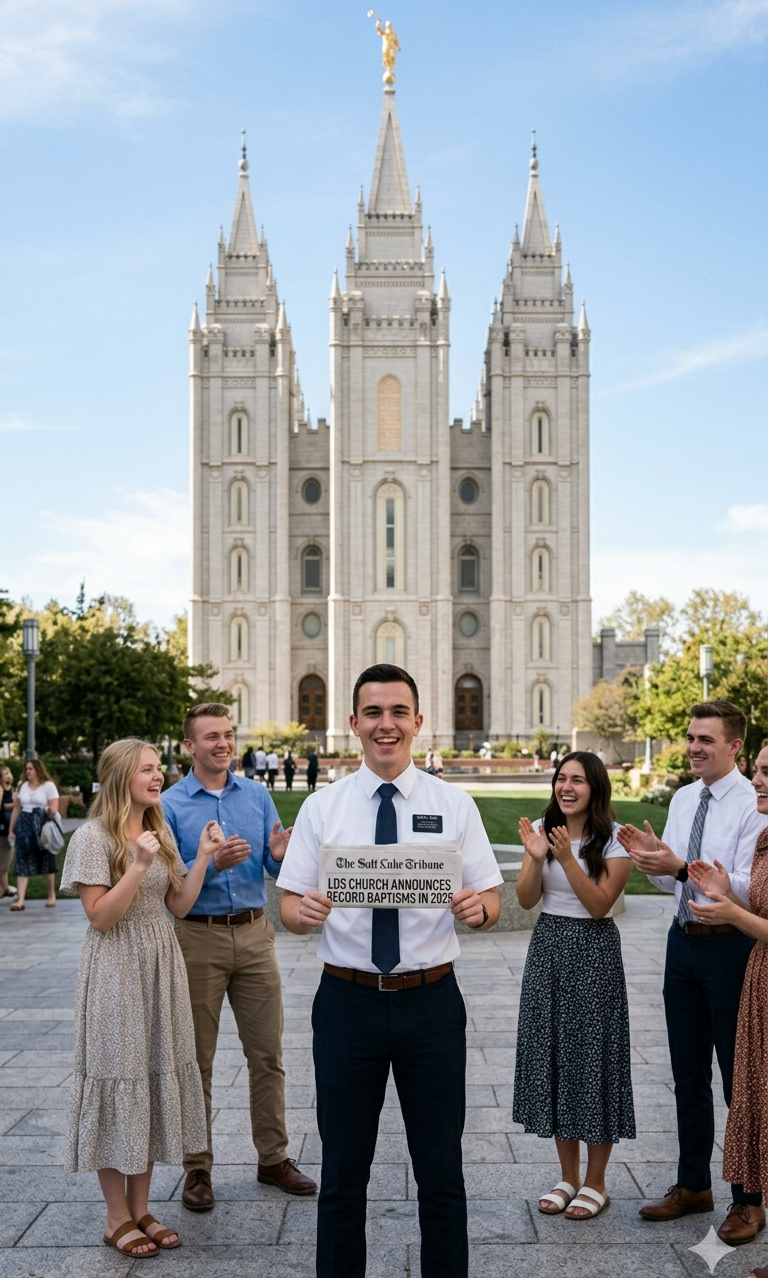
The LDS Church announced 385,490 convert baptisms in 2025 — eclipsing the previous record of 330,877 set in 1990 and representing a nearly 25% leap over the 308,682 recorded in 2024. The Salt Lake Tribune. General Conference treated this as a prophetic milestone, and by raw numerical standards, it is. But headline statistics rarely tell the whole story. When you press past the triumphalism and examine the structural dynamics driving these numbers, serious questions emerge — not about whether growth is occurring, but about what kind of growth it actually is.
Where the Growth Is Coming From
The LDS Church does not break down its baptism figures by country and region in its annual statistical report, which is itself a telling omission. What we do know from independent researchers and church leaders is that the engine of this growth is overwhelmingly in the Global South. While Mormonism historically drew most of its converts from Western nations in Britain and Scandinavia, it now has far greater success in Africa, the Pacific Islands, and much of Latin America. Salt Lake Tribune. These are regions where Christian religious identity is culturally normalized, institutional trust runs high, and the social benefits of belonging to an organized, well-resourced church are tangible and immediate — factors that have little to do with informed doctrinal commitment.
The Church highlighted a single-day mass baptism of 120 people in Moriba Town, Sierra Leone, and another event where 107 people stepped into the Bangoho River in Papua New Guinea to be baptized. The Church News. These are striking images of mass religious mobilization — but they are precisely the conditions least likely to produce informed theological converts. The speed and scale of such events make sustained pre-baptism catechesis nearly impossible.
The Retention Problem: A Long and Documented History
The LDS Church has been here before. The previous baptism record was set in 1990, during an era of aggressive missionary quota-driven expansion. What happened to those converts? The record is not encouraging. BYU Newsnet quoted senior missionary Dave Brinsfield acknowledging that of 49,000 converts who joined the church in the Philippines in 2001 and 2002, only 1,000 remained active. Cumorah. That is a retention rate hovering near two percent. Former Brazilian mission president Brad Shepherd described missionaries spending significant time on reactivation, admitting it was “a mixed bag.” President Gordon B. Hinckley himself, visiting Chile in 1999, told missionaries the days of baptizing hundreds of thousands only to watch them drift away were over, adding that he was “almost driven to tears over the terrible losses” the church had suffered in that nation.
Independent LDS researcher Matt Martinich, while encouraged by the current surge, cautioned that “retention five to ten years after baptism has historically — and continues to — remain a major challenge,” and warned that many of the convert booms of the 1990s “did not result in sustained activity or stake viability.” He added that the future impact of the current growth will likely depend on “improvements in post-baptism support and doctrinal engagement.”
The Sociological Mechanism: Cultural Milestone, Not Theological Commitment
LDS sociologist Armand Mauss observed that for the past fifty years, the church has “tended to focus much more on baptisms than on conversions,” with missionaries seeking commitment to baptismal dates from the earliest contacts, and only weeks typically elapsing between first contact and the actual baptism. Would-be converts are “rarely required to make the kinds of investments and sacrifices for their new religion across a timespan that would really test their commitments.” His assessed dropout rate for new converts: approximately 75 percent within the first year.
This is not incidental — it is structural. In communities where the LDS church arrives with material resources, social solidarity, and a coherent community framework, baptism becomes a socially rational choice long before it becomes a theologically informed one. Converts in rural Sierra Leone or Papua New Guinea are not weighing the claims of Joseph Smith against the historical scholarship of B.H. Roberts. They are responding to community, to the warmth of young missionaries, and to the pull of belonging. That is not a criticism of their sincerity — it is an observation about the conditions under which sincere but uninformed commitments are made.
What Converts Are Rarely Told
LDS baptism is not the same act as Christian baptism in the historic, orthodox sense. In historic Christianity, baptism is a public declaration of faith in the atoning work of Jesus Christ — full stop. In LDS theology, baptism is the gateway into a system with extraordinary additional claims: that God the Father has a physical, exalted body; that humans may progress to become gods; that the priesthood authority was lost from the earth and restored through Joseph Smith; that proxy ordinances performed in temples can posthumously redeem the dead; and that salvation in the highest sense is unavailable to those outside the LDS covenant structure.
Reports from multiple missions document missionaries approving baptisms for converts who had not attended even a single sacrament meeting, despite the Preach My Gospel manual cautioning that converts should have attended “several” services, internalized teachings on the Law of Chastity and the Word of Wisdom, and met with the bishop before baptism. Extreme cases in Brazil have involved missionaries baptizing converts the same day they began receiving lessons. When this is the catechetical standard being applied to mass baptism events in West Africa or the South Pacific, the notion that converts have grasped LDS-specific soteriology — let alone embraced it — is implausible.
The Underlying Issue: Numbers as Validation
The LDS Church, from its founding, has treated numerical growth as theological proof. President Nelson’s phrase “the best is yet to come,” echoed in General Conference, carries an implicit argument: God is vindicating this church through its expansion. But institutional growth is not doctrinal validation. Islam, Pentecostalism, and numerous heterodox movements have each experienced explosive growth in the Global South through similar social dynamics — rapid mobilization, tangible community benefits, and minimal theological barriers to entry.
Even internal analysis acknowledges that LDS member activity rates in most countries remain at only 15 to 25 percent of nominal membership, meaning that on any given Sunday, three out of four people on the rolls are absent. When gross baptism numbers far outpace net membership growth, the gap represents not harvest but churn.
The Evangelical Response
For the Christian apologist engaged with LDS neighbors, this data should sharpen both concern and compassion. The hundreds of thousands being baptized into the LDS system each year deserve to encounter the full weight of what they are committing to — and the genuine biblical alternative. Baptism in the New Testament is the result of repentance, faith, and understanding (Acts 2:38; Matthew 28:19-20). It is not a cultural rite of passage administered by young missionaries on quota. The Great Commission was never to baptize millions and lose them. It was to make disciples — people formed by the Word, sustained by community, and grounded in the finished work of Christ.
Record numbers are not the same as a record harvest. They are a call to ask harder questions — and to ensure that when people do encounter the living Christ, they encounter Him whole.
I served my 1961-1963 mission in the Southern States Mission (So. Carolina, Alabama & Georgia), 22 months in S.C. & 2 in Alabama. My companions and I quickly learned that door knocking got nowhere and the adult members would not invite their acquaintances to church or meet with us. So we used the church youth programs. We helped the MIA & Primary leaders and youth with weekly fun activities. The church youth were happy to invite their friends. We had a rule that they had to introduce their friends to the missionaries. When they did that, we asked their friends if they we having a good time. They all said “Yes.”. We then asked them if they would like to come to other activities. All said something like “Can we?”. Our answer was always “No, not unless we meet your parents and tell them who we are and what we do.” That gave us an intro to their family. They either gave permission or didn’t for their kids to come to the activities. This approach led to them agreeing (sooner or later) to take the missionary discussions as a family and learn about the Church. Some parents allowed their kids to keep coming to activities, some took the discussions and attended church also. Our approach was Friendship then Teach then gain a testimony then join. As the families and youth joined the Church, we made sure the church members continued to fellowship the families and we included their youth in our MIA & Primary Youth Missionary Committees. This engaged them as active members and continued our success. This process was adopted by the entire Mission as the Mission produced a Youth Missionary Handbook. The 3 State mission wide results was a 10-fold increase in monthly convert baptisms, going from 30 per month to 300 per month. There was also a mission wide increase in missionary success and joy.
Thank you for taking the time to write this out. That is more detail than most readers offer, and it deserves a serious answer rather than a polite nod, so let me give you one.
The sequence you describe—friendship, then teaching, then testimony, then joining—is precisely the dynamic the article was written to examine. Belonging came first, doctrine came later, and conviction was expected to follow from both. That can be an effective social method, and I have no doubt you believed in it wholeheartedly. But notice that Acts 2 presents a different narrative order. At Pentecost, Peter preached Christ crucified and risen; his hearers were cut to the heart; he called them to repentance and baptism; and afterward those who received his word devoted themselves to the apostles’ teaching and fellowship (Acts 2:37–42). I recognize that Christians may draw different theological conclusions from that passage, but it does raise a serious question: when belonging precedes instruction and conviction, what exactly has a person agreed to?
Your dates are also worth noting. The years 1961 to 1963 fall within the peak—and then the curtailment—of the LDS youth-baptism era associated with Henry D. Moyle. In various missions, the approach acquired names such as the baseball, basketball, or beach-party program. Activities and sports were used to bring young people into contact with missionaries, and in its more troubling forms baptism could become, in effect, the price of joining a team or continuing to participate.
The rule you describe—that a child could not return until missionaries had met the parents—sounds like an effort to observe an important safeguard: parental knowledge and permission for the baptism of minors. That deserves credit. The problem, historically, was not that every missionary or mission ignored such safeguards. It was that the safeguards were not consistently observed, and in some places they were bypassed amid pressure to produce baptismal results. By the early 1960s, Church leaders were moving to curb these excesses, placing greater emphasis on parental permission, teaching families rather than merely recruiting children, and discontinuing the most problematic forms of the activity-centered program.
That does not mean every young person baptized through such efforts was insincere, nor that none remained active. Some undoubtedly did. But the program generated serious concerns about whether baptismal totals represented durable conversion, and later record-clearing efforts removed large numbers of inactive or improperly recorded names from Church membership records. The surviving evidence does not permit a precise claim that an overwhelming majority of all youth-program converts were removed from the rolls. It does, however, justify caution about treating a dramatic rise in baptisms as proof of spiritual depth.
Which brings me to the question I would honestly like you to answer, because you are in a position to know and I am not: what became of those families? Not simply in 1963, but in 1973, 1983, and 1993. By your account, monthly baptisms rose from roughly thirty to roughly three hundred. That is an input figure. Retention is not the only measure that matters; informed consent, adequate instruction, and sustained participation matter as well. But retention is a crucial outcome measure. It is one of the few ways to distinguish a lasting harvest from a revolving door.
And beneath that is the question I care about most. Somewhere in that process—the activities, the introductions, the discussions, and the fellowshipping—at what point did anyone hear that he was a sinner who could not save himself, and that the finished work of Christ was sufficient for him, entirely apart from any program, any community, or any testimony acquired after the fact?
That is asked in earnest, and I would welcome your reply.