
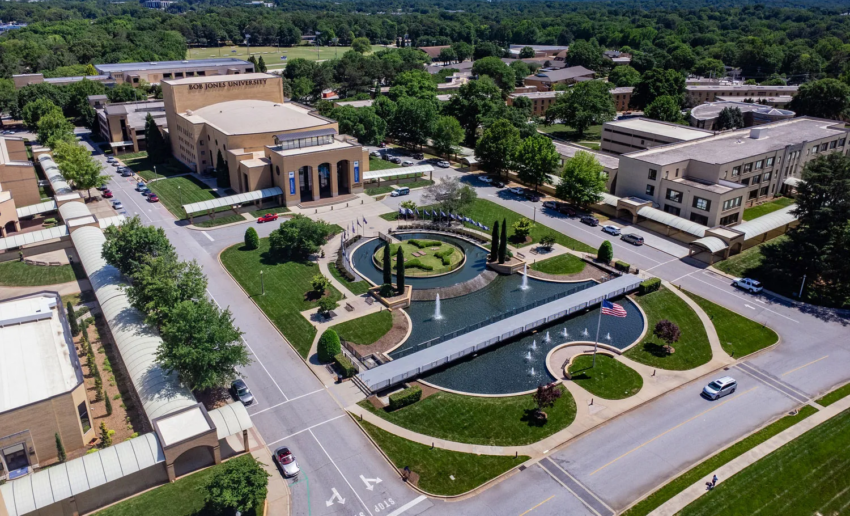
Image: Via Britannica. Bob Jones University, the main entrance of Bob Jones University,
a conservative Christian university in Greenville, South Carolina, in 2022.
NAVIGATING THE STORM
Leadership, Legacy, and An Uncertain Future of
“The World’s Most Unusual University”
Introduction: A Returning Graduate’s Perspective
Certain places shape a life in ways that cannot be fully articulated — institutions that leave their mark not only on a résumé but on a soul. For me, Bob Jones University in Greenville, South Carolina, is one such place. I arrived on its campus in the fall of 1966 and departed in 1970 with a degree in Business Management, a minor in English, and something else that proved far more enduring: a profound, faith-shaping education that I have never regretted. Four years that I look back on with genuine gratitude and more than a few fond memories. It was, by any measure, an outstanding and thoroughly enjoyable chapter of my life.
It was also at Bob Jones University that I met Debbie — the woman who would become my wife. She crossed my path during my Senior year, one of those unhurried campus encounters that takes on dimensions you cannot fully appreciate at the time. A couple of years after my graduation, we were married. For more than four decades, she was the companion of my life’s journey — through personal ministry, through writing, through every season that followed those four years in Greenville. The University had shaped my intellectual and spiritual formation; Debbie completed something the curriculum could not reach. I lost her to cancer in 2017, and not a day passes that I do not feel the weight of that absence.
I owe Bob Jones University something for both gifts — the formation of my mind, and the introduction to the woman who shaped my heart. That debt is part of why I cannot write about this institution with indifference. It gave me too much.
That personal history makes the events of the past two years at Bob Jones University deeply personal for me. The school I attended is, in several ways, not the same institution it was in 1970 — nor should we expect it to be. The world has changed, the evangelical landscape has shifted dramatically, and institutions that refuse to adapt often perish. But there is a difference between principled adaptation and institutional crisis, and what has unfolded at BJU since 2023 falls uncomfortably close to the latter. Three presidents in approximately three years. A public board confrontation. A contentious resignation. Alumni signing petitions by the thousands. A lawsuit-adjacent standoff over Title IX governance. And now, a seventh president is installed in the seat once occupied by the founding Jones family for more than three-quarters of a century.
This article is my attempt, as a lay theologian, part-time biblical scholar, and longtime student of evangelical higher education, to understand what has happened at Bob Jones University — and why it matters not only to its alumni and students, but to the broader Christian academy. I write not as a polemicist but as someone who loves the institution, believes in its founding mission, and wants to understand whether it can find its footing before its centennial arrives in 2027.
Part I: A University Like No Other — Founding, Vision, and the Jones Dynasty
The Man Behind the Mission: Bob Jones, Sr.
Bob Jones University bears the unmistakable imprint of the man who founded it — an evangelist of remarkable energy and unusual theological conviction whose biographical arc reads less like a curriculum vitae and more like a revival meeting. Robert Reynolds Jones, Sr. was born on October 30, 1883, in Skipperville, Alabama, the eleventh of twelve children in a farming family. His father had fought for the Confederacy and bore a wound from the Battle of Chickamauga Creek; his mother was a Primitive Baptist. The combination of hard rural life, evangelical piety, and a remarkable gift for oratory produced one of the most prolific evangelists of the early twentieth century.
“Bob Jones, Sr. was a prominent American evangelist and the founder of Bob Jones University (BJU), a conservative Christian liberal arts university in South Carolina. Jones was known for his unwavering commitment to Christian fundamentalism and for his strong stance against liberal and modernist theology and ecumenism.”
— Encyclopaedia Britannica, britannica.com/biography/Bob-Jones-Sr
Jones was converted at age eleven and, by twelve, had already conducted his first week-long revival meeting — reportedly with sixty conversions. By fifteen, he was licensed as a circuit preacher for the Alabama Methodist Conference. By his mid-twenties, he had left college entirely to devote himself to full-time evangelism. By 1923, at forty years of age, Bob Jones Sr. had preached 12,000 sermons in thirty countries to more than fifteen million people face-to-face, without amplification. He had an estimated 300,000 recorded conversions. He was not an intellectual in the formal sense; he was something rarer: a man absolutely consumed by a singular calling.
His aphorisms, relentlessly quoted by generations of BJU students, reveal both his directness and his populist genius. “It is never right to do wrong in order to get a chance to do right.” “The test of your character is what it takes to stop you.” “Don’t sacrifice the permanent on the altar of the immediate.” These sayings were not platitudes to Jones — they were operational principles by which he measured himself and everyone around him. The man who would found a university never lost the soul of an Alabama farm boy with a Bible in his hand.
“The discipline and strict social life which have marked this institution from its foundation are based upon clear biblical teachings and can never be softened, bent, or weakened without undermining Bob Jones University totally and destroying its effectiveness. Should Bob Jones University ever cease to be what Bob Jones University has always been and fail to stand for those things for which it has always stood, then there is no need for Bob Jones University.”
– Bob Jones, Jr., Cornbread and Caviar (1985), pp. 217, 220 — cited in David Cloud, Way of Life Literature, wayoflife.org
The Founding Impulse: Protecting Young Faith in a Skeptical Age
The impetus for founding a Christian college grew directly out of Jones’s experience as an evangelist. Everywhere he traveled across America, parents told him of children whose faith had been destroyed by liberal higher education. The growing influence of Darwinism in state and denominational colleges, the spread of higher biblical criticism, and the evident drift of mainline Protestant institutions toward theological modernism convinced Jones that a new kind of institution was needed — one that would take the Bible seriously as the foundation of all learning and provide a protected environment where young Christians could be educated without losing their faith.
David Cloud, writing for Way of Life Literature, records that the final catalyst for Jones’s decision came from an unexpected source:
“In 1924, William Jennings Bryan leaned over to him at a Bible conference and said, ‘If schools do not quit teaching evolution as a fact, we are going to become a nation of atheists.'”
— David Cloud, Way of Life Literature, wayoflife.org/reports/bob_jones_university_past_and_present.php
The Scopes Trial of 1925 sealed his resolve. Though the creationists prevailed in the courtroom, they were routed in the court of public opinion by a national press sympathetic to evolutionary naturalism. Jones told his startled wife he intended to found a Christian school. “Robert, are you crazy?” she reportedly replied. “You don’t know anything about a school. You’re not an educator. You can’t found a school.” His answer — “I know I can’t. But God can.” — captures in miniature the faith-driven audacity that would define the institution for the next century.
Bob Jones College opened its doors in September 1927 in Lynn Haven, Florida, on St. Andrew Bay in the Florida panhandle, with 88 students. Florida’s collapsed real estate bubble had made property affordable. The school’s early catalog announced its purpose clearly: to provide a Christian liberal arts education grounded in Scripture, combining academic rigor with spiritual formation and a strict code of personal conduct.
From Florida to Greenville: The University Takes Shape
The institution did not remain in Florida long. A hurricane in 1928 and the deepening economic collapse of the Great Depression strained the Florida campus severely. The school relocated to Cleveland, Tennessee, in 1933, where it gained increasing prominence and expanded its academic offerings. In 1947, following sustained growth and in search of a more suitable permanent home, the institution moved again — this time to Greenville, South Carolina, where it has remained ever since. It was in Greenville that the school received its university charter and became, officially, Bob Jones University.
The three presidents who bore the family name — Bob Jones Sr. (1927–1947), Bob Jones Jr. (1947–1971), and Bob Jones III (1971–2005) — presided over an institution that combined genuine academic seriousness with a cultural insularity that was deliberate and unapologetic. By the time Bob Jones III passed the presidency to his son Stephen Jones in 2005, BJU had grown to enroll more than 4,000 students, offered graduate and doctoral programs, maintained a significant publishing arm (BJU Press), and had produced a remarkable range of alumni in ministry, education, law, medicine, and the arts.
“Evangelist Bob Jones Sr. founded Bob Jones University out of concern with the secularization of higher education. BJU has had seven presidents: Bob Jones Sr. (1927–1947); Bob Jones Jr. (1947–1971); Bob Jones III (1971–2005); Stephen Jones (2005–2014); Steve Pettit (2014–2023); Joshua Crockett (2024–2025); and Bruce McAllister (2025–present).”
— History of Bob Jones University, Wikipedia — en.wikipedia.org/wiki/History_of_Bob_Jones_University
Fundamentalist Identity and the Billy Graham Controversy
No account of BJU’s institutional identity can overlook its famous and prolonged rupture with Billy Graham, which became something of a defining episode in postwar American fundamentalism. Graham had briefly attended Bob Jones College and even received an honorary degree from the university in 1948. But as the 1950s unfolded, Graham’s approach to evangelism — notably his willingness to seek broad ecumenical sponsorship and share platforms with theologically liberal clergy — put him on a collision course with the separatist principles that the Jones family regarded as non-negotiable.
Bob Jones Sr. argued that Graham’s acceptance of sponsors who denied the Virgin Birth and the deity of Christ violated 2 John 9–11. By the time Graham held his only American campaign of 1966 in Greenville — which must have seemed a deliberate provocation to the Jones leadership — BJU students were under penalty of expulsion if they attended. Bob Jones Jr. condemned Graham’s “ecumenical evangelism” as “heretical.” Graham’s father-in-law, L. Nelson Bell, responded with a ten-page letter accusing Jones of “hatred, distortions, jealousies, envying, malice, false witnessing, and untruthfulness.” The feud left lasting scars on BJU’s public image, even as it reinforced among its constituency the university’s reputation as an institution willing to pay a high social price for its convictions.
Part II: The Supreme Court, Race, and the Question of Tax Exemption
A Landmark Legal Confrontation
If the Graham controversy defined BJU’s theological identity in the postwar decades, the Supreme Court case of Bob Jones University v. United States (1983) defined its legal and social identity for a generation — and its reverberations continue to shape evangelical debates about religious liberty and government accommodation to this day.
The background of the case is well documented. Until 1970, the Internal Revenue Service extended tax-exempt status to all private educational institutions regardless of their racial admissions policies. In July 1970, however, the IRS announced that it could no longer justify extending that benefit to institutions that practiced racial discrimination. The IRS formally notified Bob Jones University on November 30, 1970, of its intention to challenge the university’s tax-exempt status. BJU had begun admitting Black students in 1971, but maintained a policy prohibiting interracial dating and marriage. Students who violated the policy were subject to expulsion.
“Bob Jones University, while permitting unmarried Negroes to enroll as students, denies admission to applicants engaged in an interracial marriage or known to advocate interracial marriage or dating. Because of this admissions policy, the IRS revoked the University’s tax-exempt status.”
Bob Jones University v. United States, 461 U.S. 574 (1983) — supreme.justia.com/cases/federal/us/461/574/
On May 24, 1983, the Supreme Court ruled eight to one that the IRS had acted properly in revoking BJU’s tax-exempt status. Chief Justice Warren Burger, writing for the majority, held that tax-exempt institutions must serve a public purpose through practices not contrary to public policy. An institution whose purpose clashed with the public conscience — in this case, the government’s overriding interest in eradicating racial discrimination — could not be deemed to confer a true public benefit. The Court applied a strict scrutiny analysis and concluded:
“The Government has a fundamental, overriding interest in eradicating racial discrimination in education… which substantially outweighs whatever burden denial of tax benefits places on petitioners’ exercise of their religious beliefs.”
— Bob Jones University v. United States, 461 U.S. 574 (1983)
The Columbia Law School’s scholarship on the case, authored by Professor Olatunde C. Johnson, frames the legal and political significance of the ruling with particular clarity: the case revealed the dynamic interaction among a Supreme Court wrestling with the limits of religious liberty, a Congress divided on the question, and an executive branch at war with itself. President Reagan’s administration had initially moved to restore BJU’s tax exemption — a decision that triggered significant public backlash and was ultimately reversed before the Court issued its ruling.
The implications of the decision extended well beyond BJU’s finances. It established a precedent — still debated and regularly invoked in contemporary religious liberty litigation — that government may deny tax-exempt status to religious institutions whose practices are contrary to a compelling government interest. In recent years, as debates over LGBTQ+ policies and religious school accreditation have intensified, Bob Jones v. United States has been regularly cited by both sides as a foundational text.
Restoration and Reckoning
Bob Jones University did not quietly accept its loss of tax-exempt status. Bob Jones III publicly criticized the decision, and the University continued to operate as a private institution, funding itself entirely without federal or state aid or the financial benefit of tax exemption. It was not until the university under Steve Pettit’s leadership voluntarily abandoned its interracial dating policy in 2000 — with Bob Jones III apologizing publicly on CNN’s Larry King Live for the pain the policy had caused — that the long process of normalization could begin. The IRS formally restored BJU’s nonprofit status in 2017, seventeen years after the policy was rescinded.
The racial history of Bob Jones University is a painful chapter that the institution has acknowledged, however imperfectly. It is also impossible to understand the school’s current existential struggles without understanding the decades of reputational damage that history inflicted — damage that persisted long after the policy itself was abandoned.
Part III: The Pettit Years — Reformation, Rupture, and Resignation
A Watershed Presidency
The appointment of Steve Pettit as president of Bob Jones University in 2014 marked a significant departure in the institution’s history: for the first time since Bob Jones Sr. opened his college in 1927, the university was led by someone outside the Jones family. Pettit assumed the role of a respected BJU alumnus and longtime evangelist with firmly fundamentalist credentials, having conducted hundreds of evangelistic campaigns across the United States and internationally. His presidency was initially welcomed by much of the university’s constituency.
Over nearly nine years, however, Pettit presided over a series of changes that many observers—both supportive and critical—saw as reshaping the institution’s direction. Among the most consequential developments were two long-sought institutional milestones. In June 2017, BJU was granted regional accreditation by the Southern Association of Colleges and Schools Commission on Colleges, marking the first time in its history that it held standard regional accreditation. As Pettit himself noted at the time, the achievement represented a major institutional milestone. The accreditation process, however, had been initiated in 2011 under his predecessor, Stephen Jones, and reflected ongoing efforts to strengthen academic governance and program standards; Pettit inherited and brought that process to completion.
Earlier that same year, in February 2017, the Internal Revenue Service restored the university’s federal tax-exempt status, which it had lost in the 1970s in connection with its interracial dating policy, a position ultimately upheld in Bob Jones University v. United States. Although the policy had been rescinded in 2000 and formally repudiated in 2008, restoration of tax-exempt status did not occur until Pettit’s administration. Under his leadership, the university undertook the necessary legal and financial steps to secure reinstatement, bringing to completion a process that had not been realized before.
Taken together, these developments reflected a broader institutional posture under Pettit—one characterized by increased engagement with mainstream academic and regulatory frameworks, in contrast to the more separatist stance that had long defined the university. That shift, welcomed by some constituencies and viewed with concern by others, became an important source of internal tension during the latter part of his presidency and contributed to the challenges surrounding its conclusion.
Pettit also stabilized enrollment following a steep decline that had begun in the mid-2000s. Enrollment leveled at roughly 2,500 students, with freshman classes averaging approximately 720 per year between 2014 and 2022, with a peak of around 785 in 2019. He launched a School of Health Professions and added intercollegiate athletic programs. The university began to look, in important respects, more like a mainstream evangelical college and less like the insular fundamentalist enclave it had been for decades.
Doctrinal Tension and the Separatist Fault Line
But Pettit’s reforms did not go without challenge. Within the university’s constituency — alumni, pastors, supporters from the strict fundamental-separatist tradition — alarm grew over what critics characterized as a softening of the school’s separatist distinctives. The complaints ranged from approved church lists that had become broader and more inclusive, to music standards, to ministry partnerships with organizations outside the traditional fundamentalist orbit, to what some described as an accommodation of Calvinist-leaning theology in chapel preaching.
The board, under chairman John Lewis, began to tighten the executive committee’s powers in ways Pettit found incompatible with effective presidential leadership. What followed was a prolonged and increasingly bitter standoff that played out simultaneously in internal board communications, student newspaper editorials, alumni social media networks, and eventually the national evangelical press.
Pettit’s March 21, 2023, letter to the board framed the conflict in starkly personal terms. He accused board chairman John Lewis of operating in “secrecy and hostility,” moving sensitive board records off-site, relocating executive meetings off-campus, hiring an outside attorney who advised only the chair and a narrow executive committee group, and actively obstructing a Title IX investigation into a trustee’s comments regarding female students’ clothing and athletic uniforms. He issued what amounted to an ultimatum: remove Lewis as chair by the end of the month, or he would resign, calling the board-president relationship “dysfunctional” and “irreparably broken.”
“On March 30, 2023, Pettit announced his resignation as president; the board said it would take effect at the end of the 2022–23 academic year (May 5, 2023). He framed his departure as the Lord’s direction, stressing gratitude for BJU’s students and staff while decrying the internal dysfunction he believed threatened the school’s future.”
— Coverage from Religion News Service and Inside Higher Ed
Alumni Mobilization and Public Controversy
What distinguished the Pettit crisis from typical private university governance disputes was the scale and intensity of the public response it generated. More than 1,000 alumni came to campus in the fall of 2022 — before the contract renewal vote — to signal visible support for Pettit. Students expressed widespread solidarity in campus newspaper coverage. Online coalitions, including a Facebook group calling itself “Positive BJU Grads & Friends,” organized letter-writing campaigns and open petitions defending Pettit and accusing board chair Lewis of conducting a “private campaign” to remove him.
After Pettit’s resignation, more than 2,000 of his supporters signed a petition calling for Lewis’s resignation. Lewis did step down, one week after Pettit’s announcement, and was replaced as chairman by longtime board member Dr. Sam Dawson. But the institutional damage had been done. The episode exposed to public view the deep fault line running through the BJU constituency — between those who saw Pettit’s reforms as necessary modernization and those who regarded them as a betrayal of the university’s separatist heritage.
In the aftermath, observers from across the evangelical spectrum offered assessments of Pettit’s legacy. The broad consensus was that he had left BJU with more stable enrollment and a less isolationist institutional profile, but had simultaneously deepened a theological-cultural fault line that would continue to shape the school’s direction:
“Pettit’s tenure is widely seen as a bridge between old-guard separatist fundamentalism and a more evangelical, accredited institution. After his resignation in 2023, the board-led backlash intensified debates about whether BJU should re-tighten separatist boundaries or keep some of Pettit’s reforms.”
— Summarizing post-resignation alumni commentary
Part IV: Interregnum and the Brief Crockett Presidency
The Interim Period
With Pettit’s departure effective May 5, 2023, Bob Jones University entered an interim period under Dr. Alan Benson, who served as acting CEO. The university conducted a presidential search over the following year. Benson, who had served as a senior administrator, indicated that he would apply for the permanent position but was not selected. The search committee ultimately chose a candidate from outside the institution’s administrative ranks — a decision that, in retrospect, proved to be an arrangement the board itself was not fully prepared to sustain.
Joshua Crockett: Pastor-President
On May 8, 2024, Bob Jones University announced the selection of Dr. Joshua Crockett as its sixth president. Crockett was a 2001 BJU graduate who had served as senior pastor of Morningside Baptist Church in Greenville for nine years immediately before his appointment. His selection was made, the board indicated, with “overwhelming support.” Crockett was warmly received by students and faculty and brought considerable personal gifts to the role — pastoral warmth, evident love for the institution, and a genuine connection to the BJU community.
“Crockett succeeds Alan Benson, who had served as interim president since May 2023, and BJU’s former president Steve Pettit, who stepped down just months after renewing his contract. Crockett said he wants to maintain national accreditation and keep students engaged in the community.”
— The Post and Courier, Greenville, S.C., May 2024 — postandcourier.com
Crockett publicly committed to maintaining SACSCOC accreditation and reaching out to victims identified in the controversial 2014 GRACE Report on the university’s historical handling of sexual abuse cases — a report whose findings had been deeply damaging to the institution’s reputation. He appeared, by most accounts, to bring genuine pastoral seriousness to the role.
A Presidency That Could Not Hold
But the structural tensions of Crockett’s arrangement became apparent within months. Morningside Baptist Church, where Crockett had served for nine years, had not called a permanent replacement pastor. The gravitational pull of his pastoral calling, combined with the extraordinary administrative demands of running a complex university, produced increasing strain. In his fall 2024 address to alumni, Crockett reported significant staffing cuts of at least ten percent and disclosed that BJU Press had been subsidizing the university financially to the tune of $100 million in gross revenue over the preceding five years — a disclosure that underscored the depth of the institution’s financial challenges.
By April 2025, barely eleven months into his presidency, Crockett informed faculty and staff that he was a candidate for senior pastor at Morningside. He proposed, in an address to the BJU community, a division of the presidential office into two roles: a CEO to manage institutional operations, and a campus pastor role that he would fill. He told the student body plainly: “The university is not going to close, and I have not resigned.”
“In April 2025, Crockett announced plans for BJU to divide its presidency into two offices, a CEO and a campus pastor, of which he would serve in the latter role. Crockett told the student body that he had ‘not resigned.’ Nevertheless, in May 2025, the Board named Vice President for Ministry, Bruce McAllister, as the seventh president.”
— Joshua Crockett — Wikipedia, en.wikipedia.org/wiki/Joshua_Crockett
The board moved quickly. Within weeks, they had named Dr. Bruce McAllister as BJU’s seventh president, effective June 1, 2025. Crockett returned to Morningside Baptist Church as senior pastor on July 1, 2025. His time at the helm of Bob Jones University had lasted just under one year.
Part V: Dr. Bruce McAllister and the Question of Continuity
The Selection of a Seventh President
On May 20, 2025, the Bob Jones University Board of Trustees, under the chairmanship of Dr. Sam Dawson, announced the unanimous election of Dr. Bruce McAllister as the university’s seventh president and CEO, effective June 1, 2025. The announcement was significant on multiple levels, not least for what it revealed about the board’s institutional instincts.
“Having spent the last two years on BJU’s executive team, Dr. McAllister knows well both the University’s strengths and challenges. Most recently, McAllister was Vice President for Ministry where he preached and represented the University on and off campus.”
— Dr. Sam Dawson, Chair, BJU Board of Trustees — bju.edu/about/university-leadership/president/
McAllister is, in virtually every meaningful sense, a BJU insider. He graduated from the university in 1977 — the 50th anniversary class — and has been associated with the institution in various capacities for nearly fifty years. Before returning to the executive team, he served four years at GFA Missions as Director of Ministry Relations, assisting with church staffing, church planting, and itinerant preaching and teaching. His appointment was accelerated, board chairman Dawson revealed, because McAllister had been a finalist for the presidency a year earlier when Crockett was selected.
“Bob Jones University graduate and long-time faculty member Bruce McAllister was named the school’s seventh president. Though some have called for fresh ideas and a reboot in leadership for the struggling school, trustees opted unanimously for an insider with close personal ties to Bob Jones III, grandson of the school’s founder and its third president.”
— The Post and Courier, Greenville, S.C., May 20, 2025 — postandcourier.com
McAllister’s Vision and Immediate Priorities
McAllister’s stated priorities upon taking office were operational and aspirational rather than dramatically reformist. He pledged to assemble a strong executive team, strengthen the total student experience, improve organizational and operational structure, and pursue expansion of BJU’s online educational programs. He spoke warmly of the campus and its students with an evangelist’s enthusiasm: “We’re going to make it sparkle again.”
“I am humbled and grateful to be given the responsibility of leading the University I have loved since my first day as a student in 1973. My immediate priorities this summer are putting together a strong executive team that will lead the University forward, working to further strengthen the total student experience, and continuing the emphasis on experiential learning.”
— Dr. Bruce McAllister — bju.edu/about/university-leadership/president/
He also spoke specifically of mobilizing current students as institutional ambassadors — expecting them to speak at area churches each Sunday on behalf of the university — and organizing volunteer work days to improve the campus’s physical appearance ahead of the centennial celebrations scheduled for 2027. McAllister made clear that he sees the centennial as an organizing moment, an opportunity to rally the alumni network and demonstrate that BJU not only survived its recent turbulence but emerged from it with renewed purpose.
“I’m saying this so you can understand why I have not been rattled through the last two years at all,” McAllister told the assembled community. It was the statement of a man who believes that institutional continuity is itself a form of faithfulness.
The Tuition-Free Initiative and Enrollment Strategy
One of the most striking policy announcements to emerge from the period immediately preceding McAllister’s installation was BJU’s decision to offer free tuition to undergraduate students from families with incomes below $100,000. Given that BJU’s enrollment had fallen from a high of 4,228 students in 2007 to approximately 2,900 in 2023, the initiative represented an aggressive attempt to arrest the enrollment decline by removing the financial barrier to attendance for a broad segment of the potential student population.
The measure is both bold and fraught. BJU’s nonprofit arm reported net assets of $203 million in 2017. BJU Press, the university’s publishing subsidiary, has provided substantial revenue to the institutional parent. Whether the financial model is sustainable across multiple enrollment years under a tuition-free arrangement remains, as of this writing, an open question. McAllister has expressed confidence that the centennial fundraising effort, combined with operational efficiencies, will close the gap. Observers are watching carefully.
The Critical Reception: Continuity or Managed Decline?
Not everyone greeted McAllister’s appointment with enthusiasm. The most pointed criticism came from an unexpected source: Michael Pettit, son of former president Steve Pettit and himself a BJU alumnus. His social media response to the announcement was stark:
“Bruce’s appointment is not leadership. It’s managed decline. This is Dr. Bob’s shadow government at work. There was a future. There was a path forward. But it was stripped from you by men clinging to power, legacy, and probable financial gain. This is a tragedy — make no mistake. And unless something changes, it likely ends in closure around the 100th.”
— Michael Pettit, BJU alumnus, social media post — cited in MinistryWatch, ministrywatch.com
The charge of “managed decline” and “shadow government” resonates with a specific reading of the board’s pattern of behavior over the preceding two years: the removal of Steve Pettit (who had sought to modernize the institution’s posture), the brief interlude of Josh Crockett (who proved unable to sustain the dual demands of parish ministry and university leadership), and now the selection of a deeply institutionally-connected insider with close personal ties to the Jones family’s third president. Whether this represents wise stewardship of institutional heritage or a rearguard action by a faction determined to preserve a fundamentalist identity at the expense of institutional viability is a question on which thoughtful BJU observers are sharply divided.
To be fair to the board, the counterargument has its own coherence. Bob Jones University is not simply a private university — it is an institution with a specific theological DNA that its founders embedded deeply in its governance documents, its academic culture, and its community standards. An institution that abandons that DNA in search of enrollment growth is not Bob Jones University in any meaningful sense; it is simply another mid-sized Christian liberal arts college competing in a brutally competitive market. The board may be calculating, not unreasonably, that BJU’s only viable path forward is to be more of what it always was, not less — to serve its natural constituency more faithfully rather than chasing demographic segments that are more naturally drawn to schools like Liberty University, Cedarville, or Taylor.
Part VI: What This Means — Analysis for the Christian Academy
The Governance Problem
The most immediate lesson of the past two years at Bob Jones University is institutional rather than theological: the critical importance of stable, transparent, and accountable board governance in private Christian higher education. The Pettit crisis was, at its core, a governance failure — a breakdown in the fundamental relationship of trust between a board and a president that metastasized, in the absence of clear institutional processes for resolving such disputes, into a public confrontation that damaged all parties and the institution itself.
The concentrated power that a small executive committee faction was able to exercise — moving records off-site, retaining outside legal counsel accountable only to the chair, blocking a Title IX investigation — speaks to governance structures that had not been adequately stress-tested. Lewis’s departure did not resolve the underlying structural questions; it merely removed the most visible flashpoint. The board under Sam Dawson has operated with considerably more transparency, but the institutional work of building governance norms that can withstand the next period of conflict has yet to be completed.
The Identity Question: What Kind of School Is BJU?
Beneath the governance crisis lies a deeper question about institutional identity that Bob Jones University has never fully resolved. Is it a separatist fundamentalist institution in the tradition of its founders, committed to a strict doctrine of ecclesiastical separation from theological compromise? Or is it a broadly evangelical Christian liberal arts university that happens to hold conservative convictions and maintain strict community standards? Steve Pettit’s presidency implicitly answered “the latter.” The board’s trajectory since 2023 suggests a pull toward the former.
The danger of the second option is not merely cultural isolation — it is demographic math. The population of families willing to send their children to a strict separatist institution has been declining for decades. Many of the pastors and denominational networks that historically funneled students to BJU have themselves moderated or disbanded. If BJU narrows its appeal to a constituency that is itself contracting, enrollment decline is not merely possible but predictable.
The danger of the first option is loss of identity — and with it, loss of reason for existence. There is no shortage of broadly evangelical Christian colleges competing for the same students BJU would attract if it abandoned its distinctives. Liberty University, with its enormous online enrollment and its substantial campus in Lynchburg, Virginia, competes ferociously in that space. Cedarville University, Taylor University, and dozens of other institutions offer strong Christian liberal arts education with considerably less cultural regimentation than BJU has historically maintained. If BJU becomes simply another Christian college with stricter dress codes, it may find that students choose competitors who offer fewer restrictions and more brand recognition.
The Accreditation and Financial Realities
Whatever theological and cultural decisions the board makes, BJU’s financial realities are unforgiving. The tuition-free initiative for students from families below the $100,000 income threshold is a significant gamble that requires a compensating increase in enrollment to be revenue-neutral. If enrollment does not respond sufficiently — if the families BJU is trying to attract choose peer institutions even when cost is removed as a barrier — the financial pressure on BJU Press and the institution’s endowment will intensify.
The SACSCOC accreditation, so hard-won under Pettit, is also not a passive achievement. Accreditation requires ongoing compliance with standards for governance, academic freedom, institutional effectiveness, and financial stability. A third presidential transition in three years creates the kind of institutional instability that accrediting bodies monitor closely. McAllister will need to demonstrate to SACSCOC that the university is under stable, effective leadership — a demonstration that will require consistent executive performance over multiple years.
Toward the Centennial: Grounds for Hope
Against this landscape of challenge, there are genuine grounds for hope that Bob Jones University can navigate its current difficulties. The institution’s long history is itself a resource — a century of producing graduates who carry BJU’s distinctive mark into ministry, education, and professional life represents an alumni network of remarkable breadth. McAllister’s instinct to mobilize that network for the centennial is sound, if the mobilization can be sustained and organized effectively.
The tuition-free initiative, whatever its risks, signals that the board is willing to make bold institutional bets rather than simply managing decline. BJU Press continues to generate substantial revenue and contributes meaningfully to institutional stability. The campus in Greenville retains physical assets, academic infrastructure, and name recognition that few institutions of comparable size can match.
More fundamentally, the evangelical landscape of 2026 is one in which the hunger for institutions that take Scripture seriously, maintain genuine community standards, and refuse to chase cultural accommodation is not negligible. The enormous success of certain conservative Christian institutions over the past two decades — Hillsdale College comes to mind, though its context is different — suggests that there is a market for institutions of genuine principle, if they can articulate their mission compellingly and deliver on it effectively.
Conclusion: A Graduate’s Prayer for His Alma Mater
I graduated from Bob Jones University in 1970 with a degree in Business Management and a minor in English. I met my future wife on that campus. I spent four years in an environment that was demanding, intellectually serious, spiritually formative, and, in the ways that matter most, genuinely memorable. I am not a disinterested observer of what has happened to that institution since 2023. I am a son of the house, watching with concern and, yes, with prayer.
What I observe is an institution at a genuine crossroads — one that has survived controversies before (the IRS battle, the Graham rupture, the GRACE Report, the racial history, the long decades without accreditation) and emerged, if not unscarred, then still standing and still committed to its founding mission. Bob Jones University is not the only Christian college in America facing an enrollment crisis, a governance challenge, and an identity question in 2026. It is one of hundreds. But it is one of the few whose history gives it a distinctiveness that, properly understood, is an asset rather than a liability.
Whether Dr. Bruce McAllister and the board that has entrusted him with the institution’s seventh presidency can convert that distinctiveness into a sustainable future will depend on decisions made in the next two to three years. The centennial in 2027 is both a deadline and an opportunity — a moment at which the university can demonstrate to its constituency, its alumni, and the broader Christian world that it has not merely survived its most turbulent decade but has emerged from it with renewed clarity of purpose.
As 1 Peter 3:15 exhorts us to be always ready to give an answer for the hope that is in us, so Bob Jones University must give an answer for its own hope. The answer cannot be simply “we have endured.” It must be, with evidence to support it: “We know who we are, we know what we are called to do, and we are doing it.”
May God grant them wisdom, courage, and the institutional humility to learn from the painful chapters that brought them to this moment. And may the institution that shaped my faith and introduced me to my wife prove, on the occasion of its hundredth year, that the truest fundamentals — faith, scholarship, integrity, and genuine love for students — remain as vital as they were in 1927.
Sources and Further Reading
The following sources were consulted in the preparation of this article. URLs are provided for online sources; readers are encouraged to consult the primary documents directly.
• Bob Jones University Official History — bju.edu/about/history.php
• History of Bob Jones University — en.wikipedia.org/wiki/History_of_Bob_Jones_University
• David Cloud, “Bob Jones University Past and Present,” Way of Life Literature — wayoflife.org/reports/bob_jones_university_past_and_present.php
• Encyclopaedia Britannica: Bob Jones Sr. — britannica.com/biography/Bob-Jones-Sr
• The Collegian (BJU Student Newspaper): BJU Presidential History — collegianonline.com
• Bob Jones University v. United States, 461 U.S. 574 (1983) — supreme.justia.com/cases/federal/us/461/574/
• Bob Jones University Positions — bju.edu/about/positions.php
• Olatunde C. Johnson, “The Story of Bob Jones University v. United States: Race, Religion, and Congress’s Extraordinary Acquiescence,” Columbia Law School Faculty Scholarship — scholarship.law.columbia.edu
• Time Magazine: “Religion: World’s Most Unusual” — time.com/archive/6797200/religion-worlds-most-unusual/
• MinistryWatch: BJU Presidential Succession Coverage — ministrywatch.com
• The Post and Courier (Greenville, S.C.): BJU Coverage, 2023–2025 — postandcourier.com
• The Collegian, BJU Campus Newspaper: McAllister Announcement — collegianonline.com
• Joshua Crockett — en.wikipedia.org/wiki/Joshua_Crockett
Dennis Robbins | The Righteous Cause | novus2.com/righteouscause
This article may be freely shared with attribution.
A Note on Research Methods and Accuracy
In recent years, some have voiced concern that artificial intelligence may distort facts or introduce inaccuracies into serious research. That criticism deserves acknowledgment. However, AI has now evolved into the most powerful research instrument available to any dedicated scholar—capable of analyzing vast datasets, cross‑referencing historical records, and surfacing overlooked connections across sources. This work represents a collaboration between the author’s theological and historical inquiry, verified primary documentation, and the advanced analytic capabilities of AI research tools. Here, AI was not used as a ghostwriter or a shortcut for scholarship, but as a disciplined research partner devoted to rigor, accuracy, and transparency.
Every factual claim in this work has been subjected to active verification. Where AI‑generated content was used as a starting point, it was tested against primary sources, peer‑reviewed scholarship, official institutional documentation, and established historical records. Where discrepancies were found—and they were found—corrections were made. The author has made every reasonable effort to ensure that quotations are accurately attributed, historical details are precisely rendered, and theological claims fairly represent the positions they describe or critique.
That said, no work of this scope is immune to error, and the author has no interest in perpetuating inaccuracies in the service of an argument. If you are a reader—whether sympathetic, skeptical, or hostile to the conclusions drawn here—and you identify a factual error, a misattributed source, a misrepresented teaching, or a claim that cannot be substantiated, you are warmly and genuinely invited to say so. Reach out. The goal of this work is not to win a debate but to get the history right. Corrections offered in good faith will be received in the same spirit, and verified corrections will be incorporated into future editions without hesitation.
Truth, after all, has nothing to fear from scrutiny—and neither does this work.
Dr. Bob III ended the interracial ban well before Pettit was ever president (your article says that the ban ended under Petit’s leadership). Much noise has been made about supposed racism at the university. Many years ago, racism was certainly an issue—not just at BJU but at every university in the USA. BJU, however, has had active positive relationships and outreaches to minority populations in Greenville for decades. It was annoying to hear Pettit talk about race issues as if he were making some radical change in how different races were treated at or by the university. The university actively cultivated positive relationships among students and people in the community of different races long before Pettit became president.
Thanks for the fact-check. Let me know if this revision is more accurate:
“The appointment of Steve Pettit as president of Bob Jones University in 2014 marked a significant departure in the institution’s history: for the first time since Bob Jones Sr. opened his college in 1927, the university was led by someone outside the Jones family. Pettit assumed the role of a respected BJU alumnus and longtime evangelist with firmly fundamentalist credentials, having conducted hundreds of evangelistic campaigns across the United States and internationally. His presidency was initially welcomed by much of the university’s constituency.
Over nearly nine years, however, Pettit presided over a series of changes that many observers—both supportive and critical—saw as reshaping the institution’s direction. Among the most consequential developments were two long-sought institutional milestones. In June 2017, BJU was granted regional accreditation by the Southern Association of Colleges and Schools Commission on Colleges, marking the first time in its history that it held standard regional accreditation. As Pettit himself noted at the time, the achievement represented a major institutional milestone. The accreditation process, however, had been initiated in 2011 under his predecessor, Stephen Jones, and reflected ongoing efforts to strengthen academic governance and program standards; Pettit inherited and brought that process to completion.
Earlier that same year, in February 2017, the Internal Revenue Service restored the university’s federal tax-exempt status, which it had lost in the 1970s in connection with its interracial dating policy, a position ultimately upheld in Bob Jones University v. United States. Although the policy had been rescinded in 2000 and formally repudiated in 2008, restoration of tax-exempt status did not occur until Pettit’s administration. Under his leadership, the university undertook the necessary legal and financial steps to secure reinstatement, bringing to completion a process that had not been realized before.
Taken together, these developments reflected a broader institutional posture under Pettit—one characterized by increased engagement with mainstream academic and regulatory frameworks, in contrast to the more separatist stance that had long defined the university. That shift, welcomed by some constituencies and viewed with concern by others, became an important source of internal tension during the latter part of his presidency and contributed to the challenges surrounding its conclusion.”