
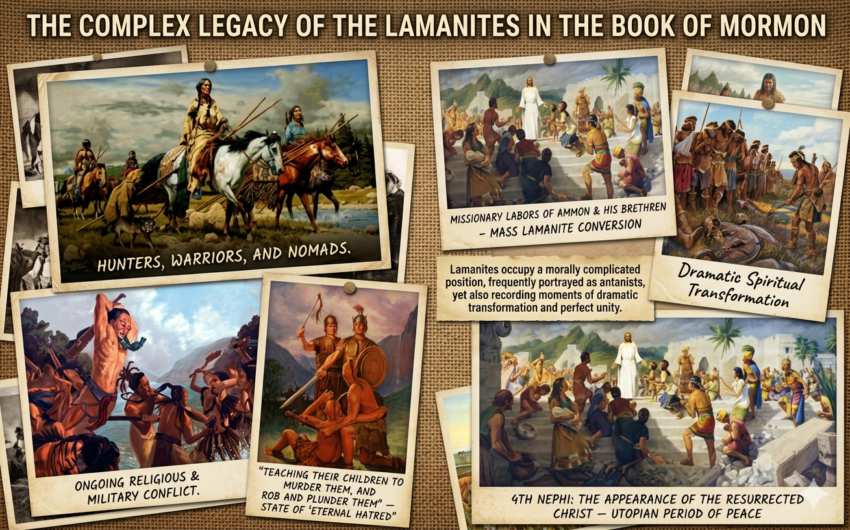
Image: An AI-generated image depicts a corkboard with pinned illustrations and text snippets detailing the complex legacy of the Lamanites in the Book of Mormon. The pinned images visually contrast the narrative’s themes, showing scenes of warfare, hunting, and nomadic life alongside moments of profound spiritual conversion and a utopian period of peace following the appearance of Christ.
The Lamanite Narrative, Andrew Jackson’s America, and the Diagnostic Failure of a Fabricated Scripture
Introduction: A Text That Betrays Its Origins
In the spring of 1830, a twenty-four-year-old man in western New York published a book he claimed had been written by ancient Israelite prophets on golden plates and translated through supernatural means. The Book of Mormon introduced to the American religious landscape an elaborate narrative of migrations, civilizations, wars, and divine judgments — set in the ancient Americas and spanning a period from approximately 600 B.C. to 421 A.D. Among its most theologically consequential claims was an explanation for the origin, identity, and skin color of the Native Americans who had long occupied the lands now being claimed by white European settlers: they were the cursed descendants of rebellious Israelites, marked by God with dark skin as a sign of divine disfavor.
This essay examines that claim — not in the spirit of mockery or contempt for individuals whose faith is pursued with obvious sincerity, but in the spirit of rigorous historical and theological inquiry. The central argument of this essay is straightforward: the racial theology embedded in the Book of Mormon is not an ancient Israelite document that happens to address race; it is a 19th-century American document that cannot escape the racial preoccupations of its era. The Lamanite narrative — with its dark skin curse, its promise of whitening upon conversion, and its identification of Native Americans as fallen Israelites awaiting missionary restoration — is a diagnostic marker of a text produced in Andrew Jackson’s America, not the Levant of Jeremiah’s era.
No genuine Hebrew prophet writing in Jerusalem in 600 B.C. would have constructed a racial theology that maps so precisely onto the preoccupations of 1830s American frontier Protestantism. Ancient Israelites did not categorize humanity by skin color in the biological-racial terms used in the Book of Mormon. They did not develop a theology in which divine punishment manifested as racial darkening and divine favor as racial whitening. They did not identify the indigenous peoples of the Western Hemisphere as their cousins. These are not ancient theological ideas: they are 19th-century American theological ideas dressed in ancient costume.
We will proceed systematically through the Lamanite narrative — its origins in the text, its role in early LDS theology, its relationship to the Curse of Cain misreading from the biblical tradition, the apologist’s attempt to recast skin-color language as merely “symbolic,” the failure of DNA and archaeological evidence to support the Book of Mormon’s historical claims, the chaos of competing LDS theories about Lamanite identity, and the documented racist theology of Brigham Young, who governed this tradition for thirty years after Joseph Smith’s death. We examine each of these subjects with primary sources, scholarly documentation, and the firm conviction that truth — wherever it leads — honors God more than comfortable silence.
A Note on the Narrative Itself: A Work of Remarkable Imagination, but Human Authorship
Before proceeding to the evidentiary examination that forms the substance of this essay, intellectual honesty requires an acknowledgment that is rarely offered in critical treatments of the Book of Mormon: the text is, by any measure, a remarkable imaginative achievement.
Whatever conclusions one reaches about its origins, the Book of Mormon is not a simple document. It sustains a complex multi-generational narrative across more than five hundred pages, maintains internally consistent genealogical lines, introduces dozens of named characters across competing political and religious factions, and constructs an elaborate theology of covenant, apostasy, restoration, and eschatological hope. It contains passages of genuine literary power — the Sermon at the Temple in 3 Nephi, the anguished confessions of Enos, the soaring prophetic poetry of Lehi’s blessing — that have moved sincere readers for nearly two centuries. The wars of the Nephites and Lamanites are narrated with strategic detail. The missionary journeys of Alma and the sons of Mosiah carry dramatic momentum. The apocalyptic finale at Cumorah has the tragic weight of genuine epic.
To dismiss all of this as crude fabrication would be both inaccurate and uncharitable. The Book of Mormon reflects a mind — or minds — of considerable creative capacity, steeped in the cadences of the King James Bible, animated by the religious ferment of the Second Great Awakening, and capable of sustaining an imaginative world across an impressive expanse of narrative territory.
But here is what must also be said, and said plainly: imaginative power is not the same as divine origin. The history of human literature is populated with works of extraordinary narrative complexity — works that construct entire civilizations, sustain vast genealogical and theological architectures, and move their readers to tears — that no one mistakes for the Word of God. Homer built a world. Dante constructed a cosmos. Tolkien imagined languages, histories, and mythologies of breathtaking internal consistency. The capacity to produce a complex and emotionally resonant narrative is a human gift. It is not, by itself, evidence of supernatural authorship.
And this is precisely where the Book of Mormon’s evidentiary failures become so significant. A text claimed to be of genuine ancient divine origin should be verifiable not merely as literature but as history. Its claims about people, places, genetics, and material culture should leave traces in the world — archaeological, genetic, linguistic, and biological. The Bible, for all the challenges it presents to historians, is embedded in a web of verifiable historical realities: confirmed cities, kings, trade routes, languages, and material culture. The archaeological record of the ancient Near East corroborates the biblical world at thousands of points of contact.
The Book of Mormon’s world, by contrast, leaves no such traces. Not a confirmed city. Not a confirmed artifact. Not a confirmed species. Not a confirmed genetic signature. The more closely one examines the evidentiary scaffolding behind the narrative — the DNA record, the archaeological record, the biological record, the linguistic record — the more clearly one sees not the fingerprints of ancient Israelite civilization but the fingerprints of a 19th-century American imagination operating at the outer edge of its considerable reach.
The narrative is impressive. The evidence is absent. And in the end, it is the evidence — not the narrative — that must determine the question of divine authorship. That is what this essay examines.
Section One: Who Are the Lamanites? History, Hierarchy, and the Arc of a Narrative
The Book of Mormon’s Foundational Division
According to the Book of Mormon, the Lamanites are one of four peoples described as having settled the ancient Americas, the others being the Jaredites, the Mulekites, and the Nephites. Their story begins with the family of Lehi, a wealthy Hebrew prophet living in Jerusalem around 600 B.C. — roughly contemporary with the prophet Jeremiah and on the eve of the Babylonian conquest. Lehi receives a divine commission to lead his family away from Jerusalem into the wilderness, eventually constructing a ship and crossing the ocean to reach what the text calls “the promised land.”
The party includes the families of Lehi and Ishmael, along with a man named Zoram. After Lehi’s death, the group fractures. The text identifies two primary factions: the Nephites, who follow Lehi’s younger and more righteous son Nephi, and the Lamanites, who follow Laman and Lemuel, the older and more rebellious sons. This division is portrayed as both political and theological — Laman and Lemuel are characterized as rejecting both the divine authority of Nephi and the religious inheritance of their father.
“After the two groups separated from each other, the rebellious Lamanites were cursed and “cut off from the presence of the Lord.” They received a “skin of blackness” so they would “not be enticing” to the Nephites.”
— Wikipedia, “Lamanites” — https://en.wikipedia.org/wiki/Lamanites
The term “Lamanite” itself evolves significantly over the thousand-year narrative of the Book of Mormon. While initially designating literal lineal descendants of Laman and Lemuel, the category expands to include all who dissent from Nephite religious tradition, regardless of biological ancestry. Researcher Matthew Roper, cited by Scripture Central, explains that the term carries multiple meanings, including “actual descendants of Laman, Lemuel, and the sons of Ishmael” as well as those who ideologically align with opposition to Nephite leadership.
The Lamanites throughout the Book of Mormon narrative occupy a morally complicated position. They are frequently portrayed as the antagonists in an ongoing religious and military conflict with the Nephites — described as hunters, warriors, and nomads, often in a state of “eternal hatred” toward the Nephites, teaching their children to “murder them, and rob and plunder them.” Yet the text also records moments of dramatic spiritual transformation. The missionary labors of Ammon and his brethren in the Book of Alma result in mass Lamanite conversion, and in the narrative’s 4th Nephi account, the distinction between Nephite and Lamanite temporarily disappears entirely in a utopian period of peace following the appearance of the resurrected Christ.
The narrative’s conclusion is decisive: after centuries of conflict, the Lamanites exterminate the Nephite civilization in a series of battles culminating around 385 A.D. The Lamanites survive as the sole inheritors of the land. And here the Book of Mormon’s most consequential historical claim is made — one that would shape American religious and racial policy for generations.
The Identification of Native Americans as Lamanites
From the movement’s earliest days, the identification of Native Americans as the literal descendants of the Lamanites was not a speculative fringe position — it was central LDS doctrine, proclaimed by Joseph Smith and formalized in the Doctrine and Covenants. Oliver Cowdery was sent to teach the gospel to the Lenape people (D&C 28:8), whom Smith and his associates understood to be Lamanites. The 1830 introduction to the Book of Mormon described the Lamanites as “the principal ancestors of the American Indians.”
“Historically, Mormons have identified the Lamanites as the primary ancestors of the North American Native Americans.”
— Wikipedia, “Lamanites” — https://en.wikipedia.org/wiki/Lamanites
This identification intensified under subsequent leadership. Spencer W. Kimball, who later became church president, stated definitively in 1971: “The term Lamanite includes all Indians and Indian mixtures, such as the Polynesians.” The concept was further extended to include Pacific Island peoples when large numbers of Polynesians converted to Mormonism, justified through the scriptural account of a figure named Hagoth who sailed away in ships.
The Lamanite Truth Project, a Native American advocacy effort focused on Mormon missionary practices, documents the ongoing harm of these identifications:
“The Book of Mormon is still being taught to Native Americans and Indigenous peoples as being an accurate historical record of their direct ancestors. Archaeology, DNA, and Indigenous oral history all disprove this claim.”
— The Lamanite Truth Project — https://lamanitetruth.com/the-lamanite-truth-project/
The reach of this identification was geographically unlimited. If Lehi’s descendants were responsible for peopling the entirety of the Americas, as early LDS leaders maintained, then every indigenous nation from the Arctic to Tierra del Fuego carried Lamanite blood. This extraordinary claim — that the millions of indigenous people across two continents were primarily descended from a small family of Israelites who arrived in 600 B.C. — would eventually collide catastrophically with population genetics, archaeology, and the documented history of human migration.
The Evolving Narrative: From “Principal Ancestors” to “Among the Ancestors”
By 2006, the Church of Jesus Christ of Latter-day Saints quietly revised the introduction to the Book of Mormon, replacing the phrase “principal ancestors of the American Indians” with the far more modest claim that the Lamanites were “among the ancestors of the American Indians.” This seemingly minor editorial change represented a significant theological retreat — an acknowledgment, however carefully worded, that the traditional identification could no longer be sustained in the face of modern scientific evidence.
The Church’s 2016 Gospel Topics Essay on “Book of Mormon and DNA Studies” acknowledges what science has established:
“The evidence assembled to date suggests that the majority of Native Americans carry largely Asian DNA. Scientists theorize that in an era that predated Book of Mormon accounts, a relatively small group of people migrated from northeast Asia to the Americas by way of a land bridge that connected Siberia to Alaska.”
— Church of Jesus Christ of Latter-day Saints, “Book of Mormon and DNA Studies,” Gospel Topics Essays — https://www.churchofjesuschrist.org/study/manual/gospel-topics-essays/book-of-mormon-and-dna-studies?lang=eng
We will return to the DNA question at length. But it is essential to note here what this revision represents theologically: the foundational LDS claim that Native Americans are Lamanites — the claim that sent missionaries to the Lenape, that motivated the Lamanite Placement Program, that undergirded a century and a half of LDS Indian affairs — is no longer officially maintained. The retreat is real, even if it is rarely acknowledged from the pulpit.
Section Two: The Racial Theology — The Curse, the Mark, and the 19th-Century Context
What the Text Actually Says
The racial theology of the Book of Mormon is concentrated in a small number of key passages, but their content is unambiguous. The primary locus is 2 Nephi 5:21–23, in which the narrator Nephi describes what happens to Laman and Lemuel and their followers after the family’s division:
“And he had caused the cursing to come upon them, yea, even a sore cursing, because of their iniquity. For behold, they had hardened their hearts against him, that they had become like unto a flint; wherefore, as they were white, and exceedingly fair and delightsome, that they might not be enticing unto my people the Lord God did cause a skin of blackness to come upon them.”
— 2 Nephi 5:21, Book of Mormon
The text continues to make the purpose of the darkening explicit: it is a divine barrier to intermarriage. Verse 23 states that “cursed shall be the seed of him that mixeth with their seed” — a direct theological prohibition against racial mixing, framed as a divine command. The logic is transparent: God darkens the skin of the rebellious so the righteous will not be attracted to them and will not intermarry with them.
This is not ambiguous language requiring sophisticated hermeneutical unpacking. The text says what it says. The Lamanites were “white and exceedingly fair,” and God changed them to have a “skin of blackness.” The purpose was aesthetic repulsion: they should not be “enticing.” And the curse is hereditary — their descendants carry the mark for generations.
The passage in Jacob 3:8–9 reinforces this reading, explicitly contrasting the “fair” Nephites with the “filthiness” of the Lamanites, while also noting — awkwardly — that the Lamanites surpass the Nephites in certain moral qualities. The text’s moral logic is inconsistent, which is itself revealing: the racial marking is applied based on initial rebellion, yet remains even when the Lamanites demonstrate greater righteousness than the Nephites.
The Promise of Whitening Upon Conversion
Perhaps the most theologically damaging element of the Lamanite racial narrative is the text’s promise that conversion and righteousness would reverse the dark skin curse. 3 Nephi 2:15–16 describes converted Lamanites whose “curse was taken from them, and their skin became white like unto the Nephites.” The skin-color change is the outward, physical sign of spiritual restoration.
This promise was not merely a textual abstraction for early LDS leaders — it was a lived expectation. Spencer W. Kimball, then an apostle, reported observing what he believed to be literal skin lightening among Native American members:
“The children in the home placement program in Utah are often lighter than their brothers and sisters in the hogans on the reservation. There was one Navaho family I know… The older ones who are not in the program are much darker than the younger ones who have been in it… These young members of the Church are changing to whiteness and to delightsomeness.”
— Spencer W. Kimball, Conference Report, October 1960, cited in FAIR Latter-day Saints — https://www.fairlatterdaysaints.org/answers/The_Lamanite_curse
Kimball was not a fringe figure making a private observation. He was speaking in a formal ecclesiastical capacity, and he would later become the Church’s twelfth president. The “whitening” expectation was mainstream LDS theology, grounded directly in the Book of Mormon text.
It is also worth noting that the original 1830 text of the Book of Mormon (2 Nephi 30:6) read that Lamanites who received the gospel would become “a white and a delightsome people.” The 1981 edition changed “white” to “pure.” This editorial revision — altering scripture to remove its racial content — was itself a tacit acknowledgment that the original language carried racial meaning that the modern Church wished to distance itself from.
Section Three: The 19th-Century American Context — Manifest Destiny, Race Science, and the Book of Mormon
Andrew Jackson’s America and the Question of Native Identity
To understand why the Book of Mormon’s racial theology is a diagnostic marker of a 19th-century American origin rather than an ancient Israelite document, one must understand the ideological landscape of the early American republic in 1830.
Andrew Jackson was inaugurated as president on March 4, 1829, so he had been in office for about a year when the Book of Mormon was published in March 1830. The Indian Removal Act—which would force the relocation of the Cherokee, Creek, Choctaw, Chickasaw, and Seminole nations from their ancestral homelands—was passed by Congress in May of that same year. The “Indian question” was not an abstract theological puzzle for Americans in 1830; it was a burning political crisis that touched the deepest anxieties about race, land, civilization, and divine destiny.
White Protestant Americans of this era operated with a specific set of assumptions about Native Americans: that they were a degraded people whose degradation was spiritually caused; that they had once been nobler but had “fallen” from a higher state; and that their salvation lay in assimilation into white Protestant civilization. These assumptions were not peripheral—they were central to the ideology of Manifest Destiny, which held that Anglo-Protestant civilization was divinely appointed to spread across the continent, displacing or converting the peoples already there.
The “Lost Tribes of Israel” theory—the idea that Native Americans were descendants of the ten northern tribes of Israel carried into captivity by the Assyrians in 722 B.C.—was a well-established speculation in 18th- and early 19th-century American religious thought, popular decades before the Book of Mormon’s publication. Books such as Elias Boudinot’s A Star in the West (1816) and Ethan Smith’s View of the Hebrews (1823)—published in the same region where Joseph Smith lived—explicitly advanced this theory. The Book of Mormon does not appear in a vacuum; it appears precisely where and when these ideas were already culturally prominent.
Race Science and the Theological Framework of Skin Color
In 1830, the modern science of genetics did not exist. But “race science” — a pseudoscientific framework that categorized human populations by skin color and assigned moral, intellectual, and spiritual qualities to those categories — was thoroughly embedded in American intellectual and religious life. Samuel Morton’s craniometric studies were forthcoming (Crania Americana, 1839), but the ideological infrastructure they would systematize was already operative.
White skin was associated with civilization, righteousness, and divine favor. Dark skin was associated with savagery, spiritual corruption, and divine disfavor. This framework was not universally accepted — abolitionists and many evangelical Christians contested it vigorously — but it was the dominant popular ideology of the era, deployed to justify both the enslavement of African Americans and the dispossession of Native Americans.
The Book of Mormon’s racial theology fits this 19th-century American ideological matrix with remarkable precision. Consider the specific elements:
1. Dark skin as divine punishment for rebellion: The text teaches that God darkens the skin of Laman’s descendants because of their iniquity. This is the theological logic of the Curse of Ham tradition — skin color as a moral marker.
2. White skin as the norm of righteousness: The Nephites are described as “white and exceedingly fair.” Whiteness is the standard from which the Lamanites deviate.
3. Racial mixing as divine prohibition: God darkens the Lamanites specifically so the Nephites will not be attracted to them — a divine barrier to intermarriage. This maps precisely onto the racial-mixing anxieties of 1830s American society.
4. Conversion as whitening: Righteousness restores the light skin. Dark skin is not neutral; it is a spiritual deficit that civilization and Christian conversion can reverse.
5. Native Americans as fallen Israelites: The identification of indigenous peoples as degraded descendants of a higher civilization maps precisely onto Manifest Destiny’s narrative of Indian inferiority and the need for white Christian rescue.
No Hebrew prophet writing in 600 B.C. would have constructed this theological system. Ancient Israelites did not have a racial theology that mapped onto skin color in the biological-racial terms of 19th-century American thought. The ancient world categorized human difference primarily through language, tribe, national origin, and religious practice — not through the color-coded racial hierarchy that the Book of Mormon employs. The specificity of the match between the Book of Mormon’s racial theology and the racial preoccupations of Andrew Jackson’s America is no coincidence. It is evidence of origin.
Section Four: Departing from the Biblical Narrative — The Misreading of the Curse of Cain
What the Bible Actually Teaches
The Book of Mormon’s racial theology draws on widespread 19th-century misreadings of biblical texts like the “Curse of Cain” and “Curse of Ham” traditions, but significantly departs from the original narratives.
Mark of Cain. Genesis 4:15 explicitly states God’s mark on Cain was protective: “the Lord put a mark on Cain so that no one who found him would kill him” — unspecified in form, non-hereditary, and unrelated to skin color. Modern scholars like those at GotQuestions.org and The Gospel Coalition affirm it as a sign of divine mercy, not a racial curse; the dark-skin link emerged post-biblically to justify hierarchies.
Curse of Ham In Genesis 9:20–27, Noah curses Canaan (Ham’s son), not Ham, with no mention of skin color or perpetual racial traits. Scholars such as David M. Goldenberg (The Curse of Ham: Race and Slavery in Early Judaism, Christianity, and Islam) and Sylvester Johnson trace its racist application to Africans as a medieval-to-colonial invention, absent from ancient Jewish or early Christian exegesis, now universally repudiated.
The Book of Mormon’s Theological Innovation
The Book of Mormon, rather than correcting these misreadings, amplifies and systematizes them into a comprehensive racial theology that goes well beyond anything the biblical text supports. The BYU Religious Studies Center’s essay “The Lamanite Mark,” authored by Rodney Turner, attempts to connect the Lamanite curse directly to the Cain narrative:
“The precedent for such a divine judgment dates from the murder of Abel by his brother Cain… Laman also descended into spiritual darkness and the spirit of murder. Both Cain and Laman came out in open rebellion against God. Both were cut off from his righteous influence. Both became marked men.”
— Rodney Turner, “The Lamanite Mark,” BYU Religious Studies Center — https://rsc.byu.edu/book-mormon-second-nephi-doctrinal-structure/lamanite-mark
This connection creates a profound theological problem that LDS apologists have never satisfactorily resolved. If the Lamanites’ dark skin curse is patterned after the Curse of Cain, then the bloodline logic requires that Cain’s curse must have been transmitted through the lineage of Lehi to his descendants, Laman and Lemuel. But this raises an obvious question: why was the curse not placed on Lehi himself?
Lehi is the patriarch of the entire family. If his descendants could receive the Curse of Cain by analogy — “rebellion against God, spiritual darkness, the spirit of murder” — then Lehi, who left Jerusalem and received visions, is conspicuously exempt from a curse that falls on his children for behavior that, in the early narrative, is frankly not dramatically worse than the behavior of many Old Testament figures who faced no such punishment. The selective application of a racial curse to specific descendants while exempting the patriarch is theologically arbitrary. It is the kind of arbitrariness that makes sense if the curse is invented to explain a pre-existing racial condition — namely, the dark skin of Native Americans — but makes no sense as a consistent divine moral principle.
Furthermore, the Curse of Cain tradition in the Bible applies to a lineage that the text presents as ending in the Flood. The only survivors of the Flood are Noah’s family. If the Curse of Cain is hereditary in a racial-genetic sense, it should have been extinguished at the Flood. LDS theology navigated this problem by teaching that Ham’s wife carried the “seed of Cain” — a tradition unsupported by any biblical text but essential to preserving the racial interpretation. The Book of Mormon’s Lamanite curse is simply another iteration of this tradition of invention.
Section Five: The Apologist’s Retreat — “Symbolic and Cultural,” and Why It Fails
The Modern LDS Apologist’s Position
Faced with the obvious racial content of the Book of Mormon’s skin-color passages, LDS apologists have developed several strategies to reframe or neutralize the problem. These strategies deserve careful examination, because while they are often presented with genuine scholarly sophistication, they ultimately fail to account for the full range of evidence.
The FAIR Latter-day Saints organization, the primary LDS apologetic institution, presents the following framework:
“Although the curse of the Lamanites is often associated directly with their skin color, it may be that this was intended in a far more symbolic sense than modern American members traditionally assumed.”
— FAIR Latter-day Saints, “The Lamanite Curse” — https://www.fairlatterdaysaints.org/answers/The_Lamanite_curse
FAIR further distinguishes between the “curse” and the “mark,” arguing that the curse was spiritual separation from God (the withdrawal of the Holy Spirit), while the dark skin was merely the external “mark” — a secondary, possibly symbolic sign. The Interpreter Foundation’s 2023 article by Clifford P. Jones advances a more elaborate version of this argument, proposing that the “skin of blackness” was not a skin-color change at all, but rather an ancient tattoo practice prohibited under Leviticus 19:28:
“The Old Testament refers to a mark that fits this description and has nothing to do with natural skin color. The law of Moses prohibited the Lord’s covenant people from cutting sacrilegious marks (ancient tattoos) into their skin.”
— Clifford P. Jones, “Understanding the Lamanite Mark,” Interpreter Foundation, Vol. 56 (2023) — https://interpreterfoundation.org/journal/understanding-the-lamanite-mark
Why the Symbolic Reinterpretation Fails
These apologetic reframings, while intellectually resourceful, fail on multiple grounds.
First, they are historically anachronistic. The symbolic and tattoo interpretations are modern constructions, developed after DNA evidence and archaeological silence made the literal reading untenable. For 150 years, LDS leaders, including Joseph Smith, Brigham Young, and Spencer W. Kimball, treated the skin-color passages as referring to literal, observable, and reversible racial characteristics. Kimball’s report of watching Native American children become “lighter” in skin tone after joining the Church is not the observation of a man reading a tattoo metaphor. It is the observation of a man reading a literal racial promise.
Second, the text itself resists a purely symbolic reading. The Book of Mormon describes dark skin as producing aesthetic effects on the Nephites — the Lamanites should “not be enticing.” Tattoos could produce this effect, but the text also describes skin becoming “white” when the curse is lifted (3 Nephi 2:15–16). Tattoo removal was not a feature of ancient Nephite life in the Book of Mormon narrative. The most natural reading of skin “becoming white” is a skin-color change, not tattoo removal.
Third, the apologetic reframing depends on a principle of convenience: the text means whatever interpretation avoids the most embarrassment. When skin-of-blackness passages create racial problems, they are “symbolic.” When archaeological problems arise, the Book of Mormon people “intermingled with other populations.” When DNA problems arise, the Book of Mormon “does not claim to describe the predominant inhabitants.” Each apologetic move is a retreat to a smaller and less falsifiable position — not an advance to a more coherent historical account.
Fourth, the Church’s own Gospel Topics Essay disavows “the theories advanced in the past that black skin is a sign of divine disfavor or “curse,” which means the Church itself is now formally distancing itself from the plain reading of its own scriptures. This is not an argument that the text is symbolic; it is an argument that the text’s traditional meaning was wrong. These are very different claims, and the distinction matters enormously.
The Lamanite Truth Project articulates what indigenous people themselves have experienced from this theology:
“Teaching living Native American people that this is the reason for their skin pigmentation, that it is a punishment from God, is deeply offensive. Native Americans should not be told that the pigmentation of their beautiful new babies are the result of ancestral curses.”
— The Lamanite Truth Project — https://lamanitetruth.com/the-lamanite-truth-project/
No degree of apologetic reframing changes the lived experience of people who were taught — by missionaries, by general authorities, by the Introduction to the Book of Mormon itself — that their skin color was a hereditary divine curse awaiting removal through conversion.
Section Six: The DNA Evidence and the Silence of the Genome
What the Science Has Established
The evidentiary case against the Book of Mormon’s historical claims is perhaps nowhere stronger than in the field of population genetics. The question is simple: if millions of Native Americans are descended primarily from a small family of ancient Israelites who arrived around 600 B.C., their genetic signature should be detectable. Ancient Near Eastern populations carry specific genetic markers — haplogroups — that are distinctive and traceable. If the Lamanite narrative is historically true, or even partially true on a demographically significant scale, those markers should appear in Native American DNA.
They do not. The Church’s own Gospel Topics Essay acknowledges this plainly:
“At the present time, scientific consensus holds that the vast majority of Native Americans belong to sub-branches of the Y-chromosome haplogroups C and Q and the mitochondrial DNA haplogroups A, B, C, D, and X, all of which appear to have come to the Americas via migrations from East Asia.”
— Church of Jesus Christ of Latter-day Saints, “Book of Mormon and DNA Studies” — https://www.churchofjesuschrist.org/study/manual/gospel-topics-essays/book-of-mormon-and-dna-studies?lang=eng
The DNA evidence does not merely fail to support the Lamanite hypothesis — it actively supports a contradictory hypothesis. The genetic evidence for an Asian origin of Native Americans via the Bering land bridge is overwhelming, cross-validated by multiple independent lines of evidence (mitochondrial DNA, Y-chromosome analysis, autosomal DNA, and ancient DNA studies), and has been confirmed by dozens of independent research teams over three decades. The absence of Near Eastern genetic markers among pre-Columbian Native Americans is not a gap in the evidence; it is a robust negative finding.
The LDSDiscussions.com DNA overview documentation summarizes the weight of the genetic evidence and notes that the Church’s own response effectively concedes the point while attempting to minimize it:
The “Limited Geography” Escape Hatch
The primary apologetic response to the DNA evidence is the “Limited Geography Model” — the argument that the Book of Mormon people were a small group who intermingled with large pre-existing indigenous populations, making their genetic signature undetectable. The Church’s Gospel Topics Essay deploys this argument:
“The Book of Mormon itself, however, does not claim that the peoples it describes were either the predominant or the exclusive inhabitants of the lands they occupied. In fact, cultural and demographic clues in its text hint at the presence of other groups.”
— Church of Jesus Christ of Latter-day Saints, “Book of Mormon and DNA Studies” — https://www.churchofjesuschrist.org/study/manual/gospel-topics-essays/book-of-mormon-and-dna-studies?lang=eng
This is a remarkable statement when examined carefully. For 175 years, the LDS Church taught that Native Americans were the Lamanites — the primary descendants of Lehi’s family. Missionaries were sent to them on that basis. The Book of Mormon’s introduction identified them as the “principal ancestors” of Native Americans. Spencer W. Kimball’s statements about 60 million Lamanites were made in the General Conference. The “small group who intermingled with existing populations” theory was not the position of the Church; it is the position to which the Church retreated when the evidence made the original position untenable.
Moreover, the “small population” escape hatch creates its own problems. The Times and Seasons blog post “The Tribes That Greeted the Lehites” (2024) attempts to embrace this model constructively:
“There is no official Church position on exactly where Lehi and his family landed when their ship arrived from the Old World into the New. But regardless of where in the Americas the Lehites disembarked, other inhabitants were already not too far away in these lands of many tribes.”
— Times and Seasons, “The Tribes That Greeted the Lehites” — https://timesandseasons.org/index.php/2024/05/the-tribes-that-greeted-the-lehites/
But if Lehi’s family was a small group that quickly intermingled with millions of pre-existing inhabitants, then the Book of Mormon’s narrative — in which the Nephites and Lamanites fight wars, build cities, maintain distinct cultural identities, and represent the dominant civilizational drama of the ancient Americas — is simply implausible as a historical account. The Limited Geography Model trades one problem for another: escaping the DNA problem by making the Book of Mormon peoples demographically irrelevant.
Section Seven: The Archaeological Silence and the Evidentiary Chaos
What Archaeology Has Not Found
The Book of Mormon portrays a highly advanced civilization that mainstream archaeology finds no trace of in the Americas. After extensive digs across pre-Columbian sites, core elements like Hebrew inscriptions, steel tools, and specific Old World species remain unlinked to its narrative.
Described Complexity. The text details cities, temples, steel weapons (e.g., Alma 2:12), horses/chariots (Alma 18:9), wheat/barley (Mosiah 9:9), elephants (Ether 9:19), silk (Alma 1:29), and millions in battles (Mormon 6). Such a society—literate, metallurgical, agrarian—should leave unmistakable remnants comparable to biblical sites like Jericho.
Archaeological Absence. No Hebrew inscriptions, Nephite cities (e.g., Zarahemla), or Near Eastern metallurgy appear in Mesoamerica, Andean, or North American records despite 200 years of exploration from Mexico to Peru. Population scales and warfare imply massive sites, yet none match.
Anachronistic Flora/Fauna. Horses, elephants, and cattle became extinct ~8,000–10,000 BC, absent until the Spanish arrival; no chariot evidence. Wheat Old World only pre-1492; “barley” claims (native Hordeum pusillum) differ from the text’s domesticated grain uses. Silk is unknown natively.
The Book of Mormon Evidence website has attempted to marshal archaeological support for the text’s historical claims, arguing that “Lamanites began in North America” and spread across the Americas. But these claims rest on interpretive frameworks so speculative — connecting vague cultural similarities to specific Book of Mormon passages without any direct evidentiary chain — that they fail to constitute genuine archaeological evidence.
The Chaos of Competing Theories: A Word About Words
It is here that one must pause to note something important about the overall intellectual landscape of LDS apologetics on the Lamanite question. The competing geographical theories catalogued in the Times and Seasons blog post — Great Lakes, Heartland, Mesoamerica, South America, the Isthmus of Darien — are not merely different answers to the same question. They are evidence that no answer grounded in actual evidence exists.
Each theory requires ignoring or reinterpreting different portions of the text. Each requires special pleading about which animals, plants, and materials the text “really” meant. Each requires a different set of pre-existing indigenous peoples to absorb the Lehite demographic problem. Each requires a different set of archaeological sites to serve as candidate Nephite cities, with none of the identifications carrying scholarly peer-reviewed support.
The Lamanite Truth Project makes this observation directly:
“Speculation over “Lamanite” identity needs to cease.”
— The Lamanite Truth Project — https://lamanitetruth.com/the-lamanite-truth-project/
Words are abundant in the LDS apologetic literature on this subject. Volumes have been produced. Conferences have been convened. Websites proliferate. Journals publish. And at the end of this enormous output, what has been established? No confirmed Book of Mormon site. No confirmed Book of Mormon artifact. No confirmed genetic link between ancient Israelites and pre-Columbian Americans. The words multiply; the evidence does not.
This is itself a diagnostic observation. Genuine historical claims tend to generate confirmable evidence over time, as archaeology and science advance. The Book of Mormon’s historical claims have generated, after nearly two centuries of motivated investigation, precisely zero confirmed archaeological or genetic findings. The absence of evidence, in this case, is evidence of absence.
Section Eight: Brigham Young and the Racial Theology in Practice
The Lion Who Preached Darkness
To understand the Lamanite racial theology in its full institutional context, one cannot ignore Brigham Young — the man who governed the LDS Church for thirty years after Joseph Smith’s death, who formalized its racial policies, and who spoke from the pulpit with an authority he claimed was indistinguishable from the voice of God.
John G. Turner, in his definitive biography Brigham Young: Pioneer Prophet (Harvard University Press, 2012), provides the most rigorous scholarly account of Young’s theology and leadership. Turner writes that Young built upon the racial framework inherited from the Book of Mormon and early LDS tradition and systematized it into formal institutional policy. In 1852, Young articulated the priesthood ban against men of Black African descent as an eternal divine principle — not a temporary accommodation but a permanent celestial law.
Young’s statements about race, recorded in the Journal of Discourses, are not ambiguous. On March 8, 1863, Young made a statement about interracial marriage that stands as one of the most shocking pronouncements ever made from an American pulpit:
“Shall I tell you the law of God in regard to the African race? If the white man who belongs to the chosen seed mixes his blood with the seed of Cain, the penalty, under the law of God, is death on the spot. This will always be so.”
— Brigham Young, March 8, 1863, Journal of Discourses, Volume 10, Discourse 25 — https://journalofdiscourses.com/10/25
This was not a statement about the Lamanites specifically — it was a statement about Black Americans — but it illustrates the racial theological framework within which Young operated and which the Lamanite curse narrative inhabited. The same theological structure — dark skin as divine curse, the prohibition of racial mixing, the identification of specific racial groups with pre-mortal or ancestral spiritual failure — ran through both his anti-Black theology and the Book of Mormon’s anti-Lamanite theology. They were expressions of the same system.
The Righteous Cause’s own analysis of Young’s record, published in March 2026, makes a point that bears repeating here:
“A man who insists that his pronouncements carry the authority of God, who declares that he has “never given counsel that is wrong,” and who teaches that rejecting his leadership leads to damnation, has forfeited the right to claim the excuse of cultural limitation. He either speaks for God or he does not.”
— The Righteous Cause (2026): “Blood, Bigotry, and False Prophecy,” — https://novus2.com/righteouscause/2026/03/31/blood-bigotry-and-false-prophecy-why-brigham-young-cannot-be-called-a-man-of-god/
Young on the Lamanites and Native Americans
Young’s views on Native Americans were shaped by the same racial theological framework, though they were expressed differently than his views on Black Americans. Native Americans were Lamanites — cursed, fallen, but potentially redeemable through the LDS gospel. This made them objects of missionary concern rather than theological exclusion, but the underlying racial theology was identical: dark skin as a curse, conversion as potential whitening, the indigenous person as a fallen being awaiting restoration to a higher state.
The wasmormon.org analysis of Young’s racist theology documents that Young taught Black Africans were descendants of Cain and cursed, while simultaneously operating within a Book of Mormon framework that taught Native Americans were descendants of cursed Israelites. Both groups were, within Young’s theological universe, carriers of hereditary divine disfavor expressed in their skin color.
The parallel structures are not coincidental. They reflect the coherence of a single racial theological system — one that placed white Protestant Americans at the apex of divine favor and constructed theological explanations for every group’s distance from that apex. Black Americans were cursed through Cain and Ham. Native Americans were cursed through Laman. Polynesian peoples would eventually be incorporated as distant Lamanite kin. The geography of divine favor was mapped precisely onto the geography of 19th-century American racial hierarchy.
From The Righteous Cause post, “Blood, Bigotry, and False Prophecy: Why Brigham Young Cannot Be Called a Man of God:”
“I Say Go and Kill Them”
When Young arrived in the Salt Lake Valley in 1847 and established a Mormon settlement, his initial posture toward Utah’s native peoples — the Shoshone to the north and the Ute bands to the south and east — was one of cautious restraint. Turner documents that Young initially resisted settler calls for military reprisals against Indians accused of stock theft, arguing that the Indians “are wild, uneducated, naked and destitute, and they mostly steal from necessity and think it no harm.” Measured against the genocidal policies being pursued by the U.S. Army elsewhere on the frontier, this early restraint was at least nominally more humane.
It did not last.
In early 1849, following a report from a Ute leader — Turner identifies him as “Little Chief” — that warned Mormon scouts that inaction against Indian cattle thieves would only breed more theft, Young “dropped his previous inhibitions about killing Indians.” He authorized an early March 1849 military expedition that tracked a group of Ute men and, after they refused to surrender, killed every man in the party except a sixteen-year-old boy.
This was the beginning, not the end. The founding of Fort Utah — later known as Provo — in the spring of 1849 placed Mormon settlers in direct and continuous friction with Ute bands. When Mormon settlers near Fort Utah killed an Indian man who refused to surrender a shirt they claimed had been stolen, then cut open his abdomen, filled it with rocks, and sank his body in the Provo River, Ute reprisals escalated. Settlers wrote Young for authorization of military action. Young’s response, delivered at a January 31, 1850, council meeting after settler leader Isaac Higbee reported that the Indians were saying “the Mormons have no captain,” was immediate and absolute: “I say go and kill them.”
What followed was not a skirmish. It was a military campaign deliberately designed to break Ute resistance in Utah Valley. Young made clear that his militia would show no mercy to the warriors: “We shall have no peace until the men are killed off.” Militia commander Daniel H. Wells issued orders to “take no hostile Indians as prisoners.” On February 13, 1850, Mormon militiamen lured a group of Ute men to Table Point on Utah Lake with assurances of friendly intentions. The militia disarmed them. The following morning — February 14, 1850 — every disarmed male Indian at the site was shot. Women and children connected to eleven warriors killed in a “small skirmish” were left to Wells, who wrote Young asking for instructions on the “disposal” of fifteen to twenty squaws and children. Young’s response, upon receiving Wells’s dispatch, was unambiguous: “Let it be peace with them or extermination.”
The Standard of Deuteronomy 18: Testing the Prophet
Deuteronomy 18:20–22 provides Scripture’s own test for prophetic authenticity: if a prophet speaks in the name of the Lord and the thing does not come to pass, he is a false prophet and should not be feared. By this standard, Brigham Young’s racial theology faces a verdict that the Church has itself rendered, however quietly. Young taught that the priesthood ban was eternal — “this will always be so.” The Church lifted that ban in 1978. Young taught that the blood of Cain made Black individuals permanently ineligible for priestly service. The Church now disavows that teaching. Young taught that interracial marriage carried a divine death penalty. The Church no longer enforces, teaches, or even acknowledges that doctrine.
A prophet who was wrong about race, wrong about the priesthood, wrong about the eternal nature of his own racial policies — while claiming that God directly authorized each of these positions — has failed the prophetic test. This is not an observation hostile to Latter-day Saints as individuals. It is an observation about institutional truth-telling and the authority of prophetic claims.
Section Nine: The Bloodline Problem — Why Wasn’t Lehi Cursed?
One of the most logically damaging inconsistencies in the Lamanite racial theology has received remarkably little attention in the apologetic literature. The curse of dark skin falls on the descendants of Laman and Lemuel because of their rebellion against God. The theological logic connects this curse to the precedent of Cain — rebellion, spiritual darkness, and the mark.
But if the curse follows from rebellion and is transmitted through the bloodline of Lehi, a fundamental question demands an answer: why was the curse not placed on Lehi?
The BYU Religious Studies Center essay by Rodney Turner draws an explicit parallel between Cain and Laman:
“Both Cain and Laman came out in open rebellion against God. Both were cut off from his righteous influence. Both became marked men.”
— Rodney Turner, “The Lamanite Mark,” BYU Religious Studies Center — https://rsc.byu.edu/book-mormon-second-nephi-doctrinal-structure/lamanite-mark
But Cain’s curse, in the Mormon interpretive tradition, is racially transmitted through Cain’s descendants. If the Lamanite curse follows the same logic, it should trace through the bloodline. Laman and Lemuel’s bloodline runs through Lehi. If the curse is genetic-racial in any meaningful sense — and the Book of Mormon’s description of it as visible in their descendants’ skin implies exactly this — then the curse should have been detectable in Lehi, who was their direct ancestor.
Unless the curse is not about bloodline at all, in which case it cannot be a racial curse in the hereditary sense that the text implies. Or unless the curse is purely behavioral — in which case it should have been lifted when individual Lamanites demonstrated righteousness, not just when the entire group converted. The text’s treatment of righteous Lamanites who nonetheless bear the dark skin mark (before their conversion) creates exactly this problem.
The theological incoherence here is not minor. Either the curse is hereditary and racial, in which case Lehi’s exemption is unexplained, or it is behavioral and individual, in which case it should not manifest as a visible, hereditary skin-color change across generations. The Book of Mormon text tries to have it both ways — a curse that is simultaneously divine punishment for specific rebellion and a hereditary racial marker — and the result is a theological system that collapses under examination.
This is precisely the kind of logical inconsistency one would expect from a text composed by a 19th-century human author trying to construct a coherent racial theological narrative within a fictional ancient setting. It is not what one would expect from a coherent divine revelation.
Section Ten: The Convenient Admission — “Not the Predominant Inhabitants”
It is worth dwelling on the remarkable theological maneuver embedded in the Church’s Gospel Topics Essay on DNA and the Book of Mormon. After 175 years of teaching that Native Americans are Lamanites — the principal ancestors of the indigenous peoples of the Americas — the Church’s official essay quietly declares that the Book of Mormon never actually claimed this:
“The Book of Mormon itself, however, does not claim that the peoples it describes were either the predominant or the exclusive inhabitants of the lands they occupied.”
— Church of Jesus Christ of Latter-day Saints, “Book of Mormon and DNA Studies” — https://www.churchofjesuschrist.org/study/manual/gospel-topics-essays/book-of-mormon-and-dna-studies?lang=eng
This is a claim that would have been deeply surprising to Joseph Smith, who sent missionaries to the Lenape because they were Lamanites. It would have surprised Oliver Cowdery, who received a divine call to preach to the Lamanites (D&C 28:8). It would have surprised Parley P. Pratt, who traveled to Missouri to teach what he understood to be Israel’s remnant. It would have surprised Spencer W. Kimball, who counted sixty million Lamanites among the living. It would have surprised the thousands of Native American families whose children participated in the LDS Indian Placement Program on the explicit premise that they were literal descendants of Lehi.
The “we never claimed they were the predominant inhabitants” position is historically false as a description of what the Church actually taught for 175 years. It is the position the Church has been forced into by DNA science. And its convenience — appearing precisely when the evidence makes the traditional claim untenable — is itself diagnostic. This is not a theological refinement; it is a strategic retreat from a falsified claim.
The Times and Seasons blog acknowledges the 2006 revision honestly:
“Claiming that the Lamanites were the “principal ancestors of the American Indians” was replaced by asserting that they were merely “among the ancestors of the American Indians.””
— Times and Seasons, “The Tribes That Greeted the Lehites” — https://timesandseasons.org/index.php/2024/05/the-tribes-that-greeted-the-lehites/
The revision is real and significant. But it does not resolve the problem — it merely shrinks the target. If the Lamanites were “among the ancestors” in the sense of a negligible genetic contribution that cannot be detected, then the entire theological edifice built on that identity — the missionary program, the racial theology of dark skin and whitening, the identification of Native peoples as fallen Israelites — has been built on a historical claim that is, at best, unfalsifiable and, at worst, simply false.
Conclusion: The Verdict of the Evidence
The examination conducted in this essay arrives at a conclusion that the evidence supports clearly and consistently: the racial theology embedded in the Book of Mormon is not an ancient Israelite theological tradition. It is a 19th-century American theological construction, reflecting the racial preoccupations, ideological frameworks, and social anxieties of Andrew Jackson’s America.
Ancient Israelite prophets writing in 600 B.C. did not conceive of racial hierarchy through the lens of skin-color theology. They did not identify the indigenous peoples of the Western Hemisphere as their fallen kin. They did not construct a system in which divine favor manifested as white skin and divine disfavor as dark skin. They did not frame missionary restoration as a process of racial whitening. These are not ancient ideas. They are 19th-century American ideas.
The evidence on multiple fronts converges to the same conclusion:
Genetically: Native Americans carry Asian DNA, not Near Eastern DNA. The Lamanite hypothesis predicts Near Eastern genetic markers among pre-Columbian Americans. The prediction fails.
Archaeologically: No confirmed Book of Mormon site, artifact, or species has been identified in two centuries of motivated investigation. The archaeological silence is total.
Historically: The racial theology of the Book of Mormon maps precisely onto the racial preoccupations of 1830s America, including “Lost Tribes” speculation, Manifest Destiny ideology, and the anxiety about racial mixing. No ancient Near Eastern context produces this specific theological configuration.
Theologically: The Book of Mormon’s racial system is internally inconsistent — the bloodline problem of Lehi’s exemption, the arbitrary application of the curse, the confusion between hereditary and behavioral frameworks — in ways that reflect human authorial limitation, not divine coherence.
Institutionally: The Church has quietly retreated from every major historical claim the Lamanite narrative requires: the “principal ancestors” claim, the literal whitening promise, and the universality of the Lamanite identity. Each retreat follows a scientific finding. No retreat has preceded the evidence.
These concluding remarks indict the LDS model’s foundational claims as incompatible with evidence and biblical standards. The Book of Mormon’s racial theology, anachronisms, and archaeological silence reveal a 19th-century American origin, not ancient revelation—demanding rejection by truth-seekers.
Biblical Tests for Prophecy. Traditional Christianity mandates testing prophets: “test the spirits” (1 John 4:1), judge by fruit (Matthew 7:15–20), and reject revelations contradicting Scripture (Galatians 1:8). The Book of Mormon’s skin-color curses (2 Nephi 5:21), whitening via conversion (3 Nephi 2:15), and Lamanite exterminations fail these, promoting racial hierarchies alien to biblical equity (Galatians 3:28). Its fruits include the LDS Church’s 126-year priesthood/temple ban on Black members (1852–1978), enforced as divine will despite no scriptural basis.
Failed Apologetic Defenses. LDS scholars’ “Limited Geography Models” (e.g., Mesoamerica) and symbolic rereadings (“skin of blackness” as metaphor) collapse under scrutiny: no Hebrew artifacts, extinct horses/elephants, and absent steel/wheat persist as fatal anachronisms. Population millions and continent-wide wars leave zero trace in exhaustive digs from Mayan ruins to Peruvian sites. The Lamanite narrative—dark-skinned “fallen Israelites” redeemed by white Nephites—mirrors Jacksonian race science, not 600 BC prophets.
True Origin Revealed. This is no ancient record but a 1830 Palmyra product: born amid Indian Removal Act debates, Lost Tribes theories (View of the Hebrews), and Manifest Destiny’s racial ideologies. Joseph Smith, steeped in these, crafted a text justifying white Christian supremacy over “degraded” Natives—propagated by a church claiming Christ’s gospel yet enforcing racial exclusion for over a century. Honest evaluation exposes the fraud.
Call to Truth. For evangelicals and truth-committed souls, this verdict compels action: abandon a movement whose “restored gospel” fruit is division, racism, and unverifiable history. Biblical faith stands self-attested; the Book of Mormon crumbles under evidence, urging flight to Christ alone.
Primary Sources and Bibliography
LDS and Apologetic Sources Cited
1. Wikipedia, “Lamanites” — https://en.wikipedia.org/wiki/Lamanites
2. Church of Jesus Christ of Latter-day Saints, “Book of Mormon and DNA Studies,” Gospel Topics Essays — https://www.churchofjesuschrist.org/study/manual/gospel-topics-essays/book-of-mormon-and-dna-studies?lang=eng
3. Church of Jesus Christ of Latter-day Saints, “Lamanite Identity,” History Topics — https://www.churchofjesuschrist.org/study/history/topics/lamanite-identity?lang=eng
4. FAIR Latter-day Saints, “The Lamanite Curse” — https://www.fairlatterdaysaints.org/answers/The_Lamanite_curse
5. Scripture Central, “Who Are the Lamanites?” KnoWhy #486 — https://scripturecentral.org/knowhy/who-are-the-lamanites
6. Rodney Turner, “The Lamanite Mark,” BYU Religious Studies Center — https://rsc.byu.edu/book-mormon-second-nephi-doctrinal-structure/lamanite-mark
7. Clifford P. Jones, “Understanding the Lamanite Mark,” Interpreter Foundation, Vol. 56 (2023) — https://interpreterfoundation.org/journal/understanding-the-lamanite-mark
8. Times and Seasons, “The Tribes That Greeted the Lehites” (May 2024) — https://timesandseasons.org/index.php/2024/05/the-tribes-that-greeted-the-lehites/
9. LDS Discussions, “DNA and the Book of Mormon” — https://www.ldsdiscussions.com/dna
Critical and Scholarly Sources Cited
10. The Lamanite Truth Project — https://lamanitetruth.com/the-lamanite-truth-project/
11. wasmormon.org, “Racist Brigham Young” — https://wasmormon.org/racist-brigham-young/
12. The Righteous Cause: “Blood, Bigotry, and False Prophecy: Why Brigham Young Cannot Be Called a Man of God,” (March 31, 2026) — https://novus2.com/righteouscause/2026/03/31/blood-bigotry-and-false-prophecy-why-brigham-young-cannot-be-called-a-man-of-god/
13. Brigham Young, Journal of Discourses, Volume 10, Discourse 25 (March 8, 1863) — https://journalofdiscourses.com/10/25
Secondary Sources Consulted
14. John G. Turner, Brigham Young: Pioneer Prophet (Belknap Press of Harvard University Press, 2012) — https://novus2.com/righteouscause/wp-content/uploads/2026/02/brigham-young-pioneer-prophet_compress.pdf
15. Ethan Smith, View of the Hebrews (1823)
16. Elias Boudinot, A Star in the West (1816)
A Note on Research Methods and Accuracy
In recent years, some have voiced concern that artificial intelligence may distort facts or introduce inaccuracies into serious research. That criticism deserves acknowledgment. However, AI has now evolved into the most powerful research instrument available to any dedicated scholar—capable of analyzing vast datasets, cross‑referencing historical records, and surfacing overlooked connections across sources. This work represents a collaboration between the author’s theological and historical inquiry, verified primary documentation, and the advanced analytic capabilities of AI research tools. Here, AI was not used as a ghostwriter or a shortcut for scholarship, but as a disciplined research partner devoted to rigor, accuracy, and transparency.
Every factual claim in this work has been subjected to active verification. Where AI‑generated content was used as a starting point, it was tested against primary sources, peer‑reviewed scholarship, official institutional documentation, and established historical records. Where discrepancies were found—and they were found—corrections were made. The author has made every reasonable effort to ensure that quotations are accurately attributed, historical details are precisely rendered, and theological claims fairly represent the positions they describe or critique.
That said, no work of this scope is immune to error, and the author has no interest in perpetuating inaccuracies in the service of an argument. If you are a reader—whether sympathetic, skeptical, or hostile to the conclusions drawn here—and you identify a factual error, a misattributed source, a misrepresented teaching, or a claim that cannot be substantiated, you are warmly and genuinely invited to say so. Reach out. The goal of this work is not to win a debate but to get the history right. Corrections offered in good faith will be received in the same spirit, and verified corrections will be incorporated into future editions without hesitation.
Truth, after all, has nothing to fear from scrutiny—and neither does this work.