
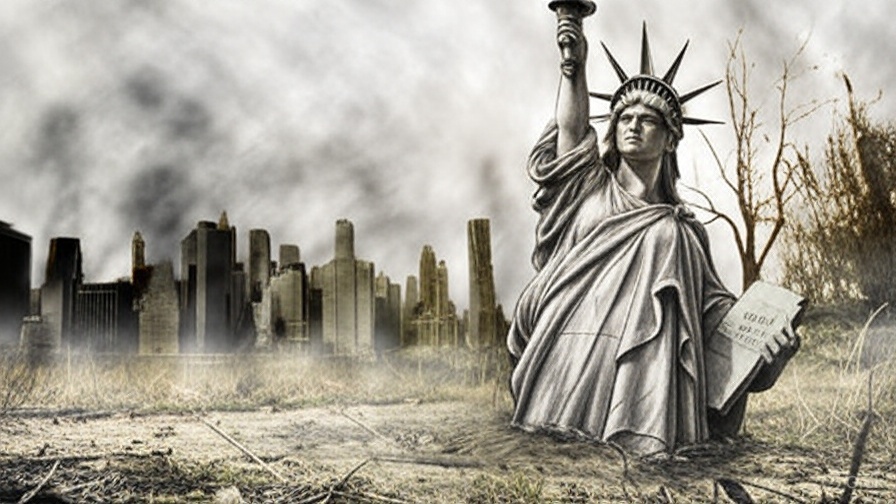
(Narrative summary of Rick Moran’s October 10 PJ Media essay)
PJ Media: Is It Possible to ‘Re-Civilize’ Society?
The assassination of Charlie Kirk laid bare the fact that our society has become unmoored from rationality and has descended into a state of “dis-civilization.”
Our cities can no longer claim to be centers of culture. If they are, it’s a diseased culture that celebrates the worst in humanity rather than the best. The foundations of a civilized society — any society from any epoch, race, or location — require a system of laws that can maintain order. Our laws, as they are interpreted by the left, breed chaos and unhappiness.
Today, most big American cities are livable only if you pretend that the rot all around you is normal and that the fear you experience is manageable as long as you close your eyes to your surroundings. Most people who live in large cities are forced into this fantasy world, where they deny the horrifying reality of drugs, shootings, and homelessness. Living in the fantasy doesn’t require you to do anything about it, even to complain about conditions.
This “dis-civilization” is not only making city life unbearable. As we saw with the reaction on the left to Charlie Kirk’s killing, living with half of our fellow countrymen is becoming harder than it ever has been.
“The path back to a civilized society is long and uncertain, but we have no choice except to begin,” writes City Journal’s Martin Gurri. Indeed, the path we’re on forces us to confront these problems head-on.
But how can we “recivilize” our society when so many are trying to openly destroy it?
It begins with a question that feels almost rhetorical now: Can a society re-civilize itself once it’s come undone? Rick Moran’s latest essay in PJ Media doesn’t offer comfort. Using the shocking assassination of Turning Point USA’s Charlie Kirk as a grim symbol, Moran argues that America has drifted so far from its moral and civic moorings that the word “civilization” itself sounds nostalgic.
He paints a portrait of a culture in retreat — cities that once represented the height of human achievement now decaying into chaos; laws that once preserved order now twisted by politics; and public discourse poisoned by contempt. The civilizing function of law, he suggests, has been hollowed out. “We are living in denial,” he writes, as crime, disorder, and moral confusion metastasize.
The author’s indictment falls most heavily on the modern left, whose ideological fervor, he says, has eroded the very norms that make coexistence possible. Progressives, in his view, no longer simply disagree with opponents — they dehumanize them. But Moran also spares no praise for the broader American public, whom he implies have grown complacent, unwilling to confront what is happening around them.
Still, his piece isn’t a partisan screed so much as a lament. He warns that the Democratic Party — held together mainly by opposition to Donald Trump — may soon fracture, unable to contain the ideological extremes within its own ranks. Yet that potential collapse, far from promising renewal, could deepen the instability.
What Moran calls for is a kind of recivilization — a deliberate effort to restore manners, order, and reasoned restraint. But he’s realistic about the challenge. Hearts and minds are slow to change; perhaps the first step, he concedes, must be behavioral. Before we can believe differently, we must act differently.
It’s an evocative plea, but one that raises more questions than it answers. Who, exactly, will lead this moral revival? Government? The church? Ordinary citizens? And what does “civilized behavior” even mean in a country that can’t agree on the definition of truth? The article stops short of naming a blueprint — or admitting that none may exist.
The implications are bleak. Civilization is not self-repairing; when it frays, it rarely stitches itself back together. The institutions that once enforced decency — law, religion, education, journalism — are mistrusted or hollowed out. The people who might rebuild them no longer share a moral vocabulary.
If Moran is right, we’re past the point where polite conversation or procedural reform can turn the tide. America may still talk about renewal, but its moral infrastructure is rusted through. Re-civilization isn’t just difficult — it may already be out of reach.
We can call for civility, yes. But as things stand, the louder the appeals to restore it, the less civil the nation seems to become.