
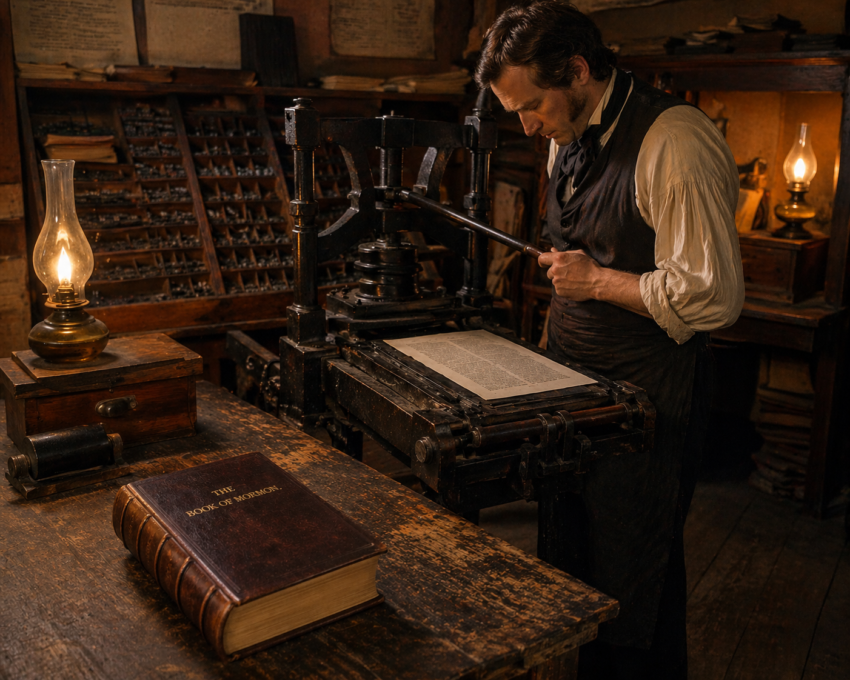
How the Book of Mormon Could Have Been Written Without Plates,
Without Angels, and Without Divine Intervention
A Literary, Historical, and Archaeological Examination
❦ ❦ ❦
Introduction: A Question of Authorship
On a March evening in 1830, the press of Egbert B. Grandin in Palmyra, New York, finished setting type on a 588-page volume bound in leather and titled, with disarming simplicity, The Book of Mormon. The man identified on the title page as its “author and proprietor” was twenty-four years old. He had no college education, no record of literary apprenticeship, no published essays in the local papers, and, according to those who knew his family, only the most modest schooling. Yet between roughly April 7 and the end of June 1829 — a window of approximately sixty-five working days — he had dictated the entire text aloud, almost without revision, to a small handful of scribes seated in the same room.
The story he told about that text was extraordinary. He claimed that an angel named Moroni had revealed to him in 1823 the existence of golden plates buried in a hill near his home. He claimed those plates contained the records of an ancient Hebrew civilization that had migrated to the Americas around 600 B.C., split into warring tribes called the Nephites and Lamanites, witnessed a post-resurrection visit from Jesus Christ, and finally annihilated themselves in cataclysmic battles. He claimed he had translated the plates into English by means of a seer stone placed in the bottom of an upturned hat, dictating the text without reference to any source. And he claimed the plates were then taken back into heaven, leaving no artifact for inspection.
This essay is not concerned with whether that account is theologically true or false. The question of divine inspiration belongs to the faith of Latter-day Saint believers and lies outside the scope of any literary or historical examination. The narrower question this essay takes up is whether the Book of Mormon, as a text, can be plausibly accounted for as the product of a young man working without supernatural assistance. Could a twenty-three-year-old Joseph Smith — granted four years of unsupervised storytelling time before the dictation began, granted the ambient resources of a literate but largely oral frontier culture, granted the imaginative capacity that human beings demonstrably possess — have produced this book?
The argument advanced here is that he could have, and that the literary, historical, and archaeological record offers no evidence requiring any other explanation. The case rests on five pillars. First, the four-year period between Smith’s 1823 vision and his 1827 retrieval of the “plates” provided ample time for a young man of admitted storytelling talent to develop the narrative orally, in the presence of his family, before any dictation began. Second, comparable feats of long, complex composition — including dictation, automatic writing, and orally delivered epics — recur in the literary record of the early nineteenth century and earlier, demonstrating that the dictation timeline is not anomalous. Third, the conceptual and structural materials of the Book of Mormon are pervasively present in the popular literature, oral traditions, biblical knowledge, and frontier folklore of Smith’s immediate environment. Fourth, no independent ancient source — no Mesoamerican codex, no Andean record, no Old World chronicle, no archaeological inscription, no genetic line — has ever surfaced confirming a single name, place, battle, or civilization described in the text. Fifth, virtually all of the documentary support marshalled in defense of the book’s historicity originates from within the Latter-day Saint scholarly community itself.
The argument is not that Joseph Smith was a fraud in the simple, calculating sense often imputed to him. The historical record suggests something more complex: a creative, religiously serious, and imaginatively gifted young man who, working from materials immediately at hand, produced an enormous and internally coherent piece of religious fiction. To call the Book of Mormon a creative achievement of the first order is not an insult. It is, in literary terms, an accurate description of a young author’s most ambitious work.
I. The Sixty-Five Days That Were Really Six Years
Modern Latter-day Saint apologetic discussions frequently highlight the brevity of the Book of Mormon’s English dictation as evidence of extraordinary origin. Russell M. Nelson, for example, has contrasted the approximately 85-day translation period of the Book of Mormon with the seven-year production of the King James Bible by fifty translators, using the speed of production as an implicit argument for divine assistance. That comparison is rhetorically effective, but it can be misleading if it is presented as though the Book of Mormon emerged wholly within that narrow summer window of 1829. A more careful historical analysis must distinguish between the final dictation phase and the broader chronology of the text’s claimed origin.
The translation or dictation period itself was indeed short. Many historical reconstructions place the main productive interval between early April and late June 1829, although the exact number of days varies depending on how one counts interruptions, travel, pauses, and non-translation intervals. Some scholars have suggested that the effective working time may have been closer to the high-50s or low-60s in terms of actual working days. Even so, the brevity of the final dictation should not be confused with the full process by which the Book of Mormon came to be. The claim is not simply that Joseph Smith sat down and produced a finished text in a few weeks; rather, the book emerged at the end of a longer sequence of claimed revelations, expectations, preparations, and social developments.
According to Joseph Smith’s own narrative, the process began years earlier, with the first appearance of the angel Moroni in 1823, when Smith was seventeen years old. That account holds that he was instructed regarding a buried record and required to wait four years before receiving the plates. He then reportedly obtained the plates in 1827 and only later completed the English dictation in 1829. This chronology matters because it means the translation phase was preceded by a substantial period of anticipation and formative experience. During those years, Smith was not a detached observer but a participant in the religious, economic, and social environment of upstate New York and western Pennsylvania. He worked various labor jobs, engaged in treasure-seeking activity, pursued courtship and marriage, and developed the relationships that would later support the production and transmission of the text. In addition, his family’s oral culture and his own repeated claims of revelatory experience likely shaped the conceptual world from which the final dictation emerged.
For that reason, a historically responsible discussion should separate questions of speed from questions of authorship and development. The speed of the final dictation remains notable and deserves explanation. However, the existence of a relatively short dictation period does not, by itself, establish that the text was produced supernaturally. Nor does it prove that the book was composed ex nihilo in the spring of 1829. It simply identifies the final stage of a more extended process whose earlier phases are also relevant to any assessment of origin. In short, the apologetic appeal to brevity is strongest when it is presented as one piece of the larger historical puzzle, not as a standalone argument that settles the question of how the Book of Mormon came into being.
His mother, Lucy Mack Smith, recorded these evening sessions in her own memoir. Her description is, for any literary analyst examining authorship, one of the most consequential pieces of testimony in the entire Mormon historical record.
From this time forth Joseph continued to receive instructions from time to time, and every evening we gathered our children together and gave our time up to the discussion of those things which he instructed to us. … In the course of our evening conversations, Joseph gave us some of the most amusing recitals which could be imagined. He would describe the ancient inhabitants of this continent, their dress, mode of travelling, and the animals upon which they rode; their cities, their buildings, with every particular; their mode of warfare; and also their religious worship. This he would do with as much ease, seemingly, as if he had spent his whole life among them.
— Lucy Mack Smith, Biographical Sketches of Joseph Smith the Prophet (1853)
This is not the description of a young man waiting passively for divine illumination. This is the description of a working storyteller — a young author developing characters, settings, costumes, military tactics, and religious systems in nightly oral performance before an attentive domestic audience. Lucy Smith’s phrase “as if he had spent his whole life among them” is, in literary terms, the highest compliment a fiction writer can receive: she is describing the immersive specificity of a fully imagined secondary world.
The implications for the dictation timeline are significant. By the time Joseph Smith began dictating to Martin Harris in April 1828 (the lost 116 pages) and then to Oliver Cowdery in April 1829, he had spent approximately four years in nightly oral rehearsal of the very narrative he would now produce in written form. He knew the geography. He knew the genealogies. He knew the character arcs. He knew the rhetorical devices he wanted to use, the prophetic set-pieces he wanted to deliver, the climactic battles he wanted to stage. The dictation was not an invention. The dictation was performed.
Lucy Smith’s account also resolves what apologists often present as an insurmountable problem: the alleged impossibility of one young man holding so many narrative details in his head without notes. Brian Hales, writing for the LDS Living website, called Smith’s achievement “simply jaw-dropping.” But the achievement appears far less astonishing once we recognize that the four-year period of so-called “spiritual maturation” was, by his own family’s testimony, also four years of focused, repeated, oral storytelling on the precise themes that would shortly fill the pages of the published book.
There is a striking parallel here with the production of other long oral works. The Homeric epics were composed and transmitted in performance over generations before they were ever written down. The Vedas of ancient India were memorized and recited verbatim across centuries by trained Brahmin reciters. The Quran was held in memory by the early Huffaz, who could recite its 6,000-plus verses and 77,000 words from memory. Avicenna, the tenth-century Persian polymath, memorized the entire Quran by the age of ten. Saint Sabas reportedly memorized the entire Book of Psalms by the age of eight. Modern figures such as Tom Meyer, the so-called “Bible Memory Man,” have memorized over twenty complete books of the Bible. These individuals demonstrate that human memory, when applied with focus and repetition, is far more capacious than modern, screen-saturated readers tend to assume.
Joseph Smith was not memorizing a fixed text. He was doing something almost easier: composing within a narrative framework he himself controlled, repeating and refining the same stories night after night before a family audience that received them with delight. The cognitive load of generating Book of Mormon material was thus distributed across years, not compressed into days. The sixty-five-day dictation marvel dissolves once that distribution is properly accounted for.
The LDS Church itself has, perhaps unintentionally, confirmed that this developmental period was psychologically formative. Its official manual, Church History in the Fulness of Times, notes of these years: “During this period Joseph passed through his mid-teens, a time when sympathetic teachers and a congenial community could have strengthened him.” The phrasing is interesting. The Church reads this as spiritual preparation. A literary analyst reads it as a description of a developing artist coming into his powers.
II. The Nineteenth Century Was Already Writing This Book
One of the most persistent claims of LDS apologetics is that the Book of Mormon stands alone in nineteenth-century American letters — that nothing in Joseph Smith’s environment could have produced it. The historical record contradicts this claim emphatically. The intellectual and literary atmosphere of the 1820s American frontier was saturated with the very themes the Book of Mormon develops: lost tribes of Israel, vanished mound-building civilizations, ancient Hebrew origins for the American Indian, prophetic warnings, sectarian conflict, and apocalyptic revelation. To read this period’s popular literature is to encounter the Book of Mormon’s raw materials lying everywhere on the surface of the culture.
Nor was Smith alone in producing long, ostensibly inspired texts through unconventional means. The nineteenth and early twentieth centuries witnessed numerous figures who produced large bodies of religious or visionary writing under conditions superficially similar to Smith’s — figures whose work has been carefully documented and analyzed by mainstream scholarship and who serve as instructive comparison points without any imputation of fraud or pathology.
The View of the Hebrews
Ethan Smith’s View of the Hebrews was first published in 1823, with a second edition appearing in 1825. In that work, Smith argued that Native Americans were descended from the Lost Tribes of Israel, reflecting a broader early nineteenth-century interest in biblical ethnology and the origins of Indigenous peoples. Some writers have suggested that Oliver Cowdery and his family may have lived in Poultney, Vermont, during the period when Ethan Smith was pastor there, raising the possibility of local familiarity with the book or its ideas, though direct contact cannot be demonstrated with certainty.
The relationship between View of the Hebrews and the Book of Mormon became a subject of significant interest in the twentieth century when B. H. Roberts, a leading LDS scholar and church authority, was asked to study possible literary or conceptual parallels between the two works. Roberts’s analysis identified several thematic correspondences, including claims of Israelite origin, episodes of civilizational decline and conflict, the preservation of sacred records, and expectations of a latter-day gathering. His study, later circulated under the title Studies of the Book of Mormon, was not widely published during his lifetime and has often been cited in discussions of possible environmental influences on the Book of Mormon.
At the same time, parallels do not in themselves establish dependence. Similar themes were common in the religious and intellectual milieu of early nineteenth-century America, and the existence of thematic overlap does not prove direct borrowing or literary derivation. The most accurate conclusion is therefore modest: View of the Hebrews is one of the most frequently discussed possible contextual influences on the Book of Mormon, but the extent of its significance remains a matter of scholarly debate.
It may never be proved that Joseph saw View of the Hebrews before writing the Book of Mormon, but the striking parallelisms between the two books hardly leave a case for mere coincidence.
— Fawn M. Brodie, No Man Knows My History (1945)
Subsequent LDS responses to the View of the Hebrews question have generally taken three forms: that the parallels are superficial and selective; that no documentary evidence places View of the Hebrews in Joseph Smith’s hands; and that the Book of Mormon contains many elements absent from Ethan Smith’s book. These responses, while not without merit, miss the wider point. The argument is not that the Book of Mormon was plagiarized from View of the Hebrews. The argument is that the entire conceptual world the Book of Mormon inhabits — Hebrew Israelites in the New World, mound-building civilizations, lost tribes, latter-day gathering — was a thoroughgoing commonplace of 1820s American religious culture. View of the Hebrews is not unique. It is one of dozens of books, sermons, pamphlets, and newspaper articles articulating these themes during Smith’s formative years. The atmosphere itself was the source.
Even the LDS apologist Tad Callister, in defending the Book of Mormon, acknowledged the central problem this creates for traditional apologetics. Callister observed that the modern critical argument has shifted: where earlier critics dismissed Joseph Smith as too uneducated to have produced such a book, contemporary critics now treat him as a “creative genius” who synthesized View of the Hebrews, The Late War Between the United States and Great Britain, and other surrounding texts. Callister presents this as a fatal contradiction in the critical case. It is not. It is simply the natural maturation of the critical position as more evidence has accumulated. Joseph Smith was not too uneducated to write the Book of Mormon. He was uneducated in the formal sense, but he was creatively gifted, deeply immersed in his cultural environment, and possessed of an extraordinary religious imagination.
The Late War, the Mound-Builder Myth, and the King James Bible
Beyond View of the Hebrews, several other 1820s American works show striking textual and conceptual overlap with the Book of Mormon. Gilbert Hunt’s The Late War Between the United States and Great Britain (1816), a children’s history textbook written in deliberate imitation of King James Bible cadence, supplies an extraordinary number of distinctive phrases that reappear in the Book of Mormon — including the very “and it came to pass” constructions, military formations, fortification language, and Indian conflict descriptions for which the Book of Mormon is so well known. The phrase “and it came to pass” is commonly counted at 1,165 occurrences in the Book of Mormon in one widely cited count, with some broader counts of all “came to pass” forms reaching about 1,381 to 1,494 depending on how variants are tallied. The book was widely used in early-republic schools precisely as a primer for both literacy and patriotism.
The so-called “Mound-Builder” myth dominated American popular discourse during Smith’s youth. Across the Ohio Valley and the Northeast, settlers were unearthing earthen mounds containing skeletal remains, copper artifacts, and stone tablets. The dominant explanatory framework — endorsed by President Andrew Jackson’s contemporaries, by amateur antiquarians, and by clergymen alike — held that these mounds were the relics of a vanished, advanced “civilized” race that had been destroyed by the “savage” ancestors of the modern American Indian. Newspapers reported regularly on supposed ancient battles between these races. The conceptual framework of the Book of Mormon — a fair, civilized, record-keeping people destroyed by their darker, less civilized brethren — fits this mound-builder narrative with such precision that it is difficult to read the Book of Mormon’s closing chapters without recognizing the genre they belong to.
Then there is the King James Bible itself. The Book of Mormon contains roughly 478 verses quoted from the KJV Isaiah, often word-for-word. Long sections of 1 Nephi 20–21 and 2 Nephi 7–8 and 12–24 reproduce Isaiah 48:1–52:2 and 2:2–14:32 with near-perfect fidelity to the 1611 KJV translation. Three Nephi 12–14 reproduces the Sermon on the Mount from Matthew 5–7. Three Nephi 24–25 reproduces Malachi 3–4. Mosiah 14 reproduces Isaiah 53. Three Nephi 22 reproduces Isaiah 54.
These are not loose paraphrases. They are direct reproductions. And they reproduce not merely the underlying Hebrew or Greek meaning, but the specific stylistic peculiarities of the 1611 English translation, including italicized words supplied by KJV translators where the underlying language had no equivalent. As LDS scholar Royal Skousen has acknowledged, the base text for these passages “is indeed the King James Version of the Bible.” On any naturalistic reading, this is not surprising: the KJV was the only Bible Joseph Smith and his family owned, and he had been steeped in its rhythms from childhood. On a supernatural reading, however, it raises an awkward question — why would an inspired translation of an ancient text reproduce, verbatim, the stylistic idiosyncrasies of a seventeenth-century English Protestant rendering, italics and all?
John Bunyan and the Power of Memorized Narrative
Some critics and literary analysts have argued that John Bunyan’s The Pilgrim’s Progress may have shaped parts of the Book of Mormon’s narrative world, especially its martyrdom and allegorical language. Bunyan was enormously influential in English-speaking Protestant culture, and The Pilgrim’s Progress was widely read and memorized in early America, so it is historically plausible that Joseph Smith or his circle could have absorbed some of its narrative patterns indirectly. The strongest version of the argument is not that Smith copied Bunyan line for line, but that he operated within a Protestant literary environment already saturated with Bunyan-like martyr and pilgrimage templates.
The most commonly discussed comparison is between the Book of Mormon account of Abinadi and the Pilgrim’s Progress account of Faithful’s martyrdom in Vanity Fair. Both stories involve a righteous figure entering a corrupt community, provoking public disturbance, being arrested, tried by hostile authorities, refusing to recant, and dying as a witness. Some comparative studies list a large number of narrative correspondences, though the exact count depends heavily on how broadly one defines a “parallel” and whether one is counting plot structure, wording, or theological function.
That said, the evidence does not justify a strong claim of direct borrowing in the narrow sense. Similar martyr narratives also appear in the Bible and in John Foxe’s Book of Martyrs, which Bunyan himself drew upon heavily. That makes the direction of influence harder to establish with confidence. The more cautious academic conclusion is that the Book of Mormon and Bunyan share overlapping Protestant narrative conventions, and that Bunyan may be one contextual source among several, but the case for direct dependence remains suggestive rather than decisive.
III. Other Hands, Other Voices
The traditional Latter-day Saint narrative presents the Book of Mormon dictation as a revelatory process centered on Joseph Smith and a scribe, but the historical setting was wider and more socially embedded than that simplified model suggests. Oliver Cowdery was indeed the principal scribe for much of the 1829 dictation, and he was a highly significant participant in the earliest movement, serving as one of the Three Witnesses and later as Assistant President and Second Elder in the Church. That said, the claim that Cowdery’s family connection to Ethan Smith’s Poultney congregation directly proves exposure to View of the Hebrews is too strong; historians associated with both LDS and non-LDS perspectives note that the documentary evidence does not establish a direct link between Cowdery and Ethan Smith. The more defensible point is narrower: Cowdery lived in the same Vermont town where Ethan Smith ministered and published View of the Hebrews, so a contextual relationship is possible, but not demonstrable.
Cowdery was also not a passive transcription machine. He was briefly permitted to attempt translation, he became a central witness figure, and he later occupied a major leadership role in the early Church. Those facts make it reasonable to say that the Book of Mormon emerged within a collaborative religious environment rather than in total isolation. But collaboration in the sense of witness, scribing, editing, and later institutional development is not the same as proving joint authorship of the text itself. The evidence supports influence and participation; it does not prove that Cowdery co-wrote the Book of Mormon.
The Sidney Rigdon theory is similarly best handled with caution. The older Spalding-Rigdon hypothesis has not gained traction in mainstream scholarship because the documentary record places Rigdon’s contact with the Book of Mormon and with Joseph Smith after the book’s publication. It is fair to say that Rigdon became an important theological architect in the post-Book of Mormon Latter-day Saint movement, but it is not historically responsible to describe him as a likely co-author of the text.
A broader contextual argument is stronger than any single-cause theory. Joseph Smith grew up in a family and culture saturated with visions, dreams, restorationist speculation, folk religion, Bible reading, and apocalyptic expectation. Joseph Smith Sr.’s tree-of-life dream is especially noteworthy because of its similarity to Lehi’s dream in 1 Nephi 8, and LDS and non-LDS scholars alike have discussed that parallel as one of several possible influences on the Book of Mormon’s imagery. Lucy Mack Smith’s memoirs show a family skilled in narrative recollection, and the broader “burned-over district” environment supplied many of the religious motifs later visible in the text. In that sense, the Book of Mormon can be read as the product of a gifted religious innovator working within an unusually rich cultural and familial matrix, even if the precise mechanism of composition remains debated.
IV. Oral Histories and the Storyteller’s Inheritance
Joseph Smith grew up in an intensely oral culture, and that matters because the Book of Mormon emerged from a world in which people learned, remembered, argued, and entertained through speech rather than through modern media. Frontier America lacked television, radio, and recorded sound, so evenings were shaped by reading aloud, Bible recitation, songs, sermons, and storytelling; in that environment, a person’s ability to narrate well was not a minor social skill but a major cultural asset. Multiple contemporary and later sources describe Joseph Smith as a gifted storyteller, and even critics who reject the supernatural claims often concede that he had unusual rhetorical and narrative talent.
The most important narrative streams around Smith were biblical, revivalist, patriotic, and antiquarian. The King James Bible provided a ready-made register of elevated diction, parallelism, and sacred history; revival preaching supplied dramatic conversion, judgment, and apocalypse; patriotic memory linked American identity to providence and conflict; and the popular literature of the period was full of mound-builder speculation, lost tribes, and ancient civilizations. These were not isolated influences but overlapping cultural currents that could be recombined into a single narrative voice.
Native American traditions also circulated in distorted form through white American print culture, especially in accounts that romanticized Indigenous origins, ancient migrations, and “white-bearded” or civilizing figures. Those reports are not reliable evidence for or against the Book of Mormon’s historicity, and they should not be treated as if they were straightforward Indigenous testimony. But they did contribute to the imaginative environment in which Joseph Smith lived, supplying motifs that could be folded into a story of ancient American record-keeping, destruction, and restoration.
That broader context strengthens a naturalistic reading without requiring direct plagiarism or conscious borrowing from every source. A persuasive historical argument does not need Joseph Smith to have copied a specific book line by line; it only needs to show that he worked within a culture dense with the exact kinds of stories, symbols, and explanatory frameworks that the Book of Mormon later crystallized. In that sense, the Book of Mormon can be read as the product of a highly capable storyteller assembling inherited materials from the religious and literary world around him into a new, unified composition.
V. Altered States, Automatic Writing, and the Nineteenth-Century Visionary
One naturalistic theory sometimes invoked to explain the Book of Mormon is automatic writing—the production of extended text in an altered or dissociative state, where the writer later reports little or no conscious authorship and the words seem to arrive from an internal or external source. Related terms include trance writing, spirit writing, channeling, psychography, and motor automatism. Because automatic writing is often discussed alongside claims of unusual literary productivity, some writers also point to figures like L. Ron Hubbard, whose prolific output has prompted speculation about whether portions of his material may have involved highly rapid drafting, self-hypnosis, or other altered-state writing practices; however, that is a theory, not a fact.
Jon Atack: Hubbard and the Occult
In 1984, a former close colleague of Hubbard’s told me that thirty years before when asked how he had managed to write Dianetics: The Modern Science Of Mental Health in just three weeks, Hubbard had replied that it had been automatic writing. He said that the book had been dictated by “the Empress”. At the time, I had no idea who or what “the Empress” might be. Later, I noticed that in an article printed immediately prior to the book Dianetics, Hubbard had openly admitted to his use of “automatic writing, speaking and clairvoyance”. However, it took several years to understand this tantalising reference to the Empress.
The phenomenon itself has been discussed in older medical and psychological literature and in modern scholarship, but the strongest versions of the claim should be stated cautiously. Ian Stevenson defined automatic writing as writing done without conscious awareness of the content, and later scholars have examined comparable phenomena in laboratory and historical contexts. Still, citing the existence of automatic writing does not by itself explain the Book of Mormon; it only shows that unusual dictation or dissociative writing has been reported in other settings.
The Phenomenon and Its Limits
The most discussed nineteenth and twentieth-century examples include the prose-poet James Macpherson’s production of the Ossian poems (later exposed as Macpherson’s own composition), Helene Smith’s automatic-written “Martian” language, the prolific dictations of Pearl Curran, who produced the lengthy historical novel A Sorry Tale through an alleged spirit communicator named “Patience Worth,” and the case of Geraldine Cummins, whose “Cleophas” narratives reportedly came at speeds Mr. Curran’s scribe could barely follow.
These cases demonstrate, beyond any reasonable doubt, that some human beings are capable of producing very long, internally coherent, stylistically distinctive texts at high speeds, with little conscious revision, in states they themselves perceive as non-volitional or as receptive to an external source. The literary quality varies. The New York Times, reviewing Pearl Curran’s A Sorry Tale, called it “a wonderful, a beautiful, and a noble book.” Other critics, including BYU professor Richard L. Anderson, found it less compelling. The point is not the relative quality of these works. The point is the existence of the phenomenon.
Why Automatic Writing Alone Cannot Account for the Book of Mormon
It must be said clearly: automatic writing as a complete theory of Book of Mormon authorship faces real difficulties. The most thorough recent treatment, by Brian C. Hales in the Summer 2019 issue of Dialogue: A Journal of Mormon Thought, raises pointed objections. Joseph Smith was reportedly conscious during the dictation, conversed normally with his scribes, took breaks for meals, and resumed at the precise word where he had stopped. He did not exhibit the trance-state behaviors described in the classical automatic-writing literature. The complexity of the Book of Mormon’s nested narrative structure, its long-range internal references, and its sustained thematic development all exceed what laboratory studies of automatic writing have produced.
Hales’s argument is sound on its own terms. But the conclusion he draws — that the failure of automatic writing as a complete theory therefore strengthens the supernatural account — does not follow. The relevant naturalistic alternative is not automatic writing in isolation. It is automatic writing as one component of a richer naturalistic account that also includes: years of prior oral rehearsal, deep cultural immersion in the source materials, an unusually capacious and well-trained narrative memory, the ongoing collaboration of an intelligent scribe, and the presence of altered or focused states of attention during the dictation itself.
What recent psychological and cognitive research has clarified is that human beings routinely produce sustained creative output in states of focused attention that fall short of full trance but exceed ordinary consciousness. Athletes call this “flow.” Musicians call it “the zone.” Novelists describe characters who “take over” the writing. Composers report melodies arriving fully formed. The mechanism, as far as cognitive science can describe it, involves the temporary suppression of conscious editorial monitoring in favor of more automatic, well-practiced cognitive routines. For a young man who had spent four years internalizing his narrative, the dictation may well have proceeded in just such a state — not as supernatural revelation, and not as classical trance writing, but as the focused performance of an artist who had already done his preparation.
Joseph Smith’s use of the seer stone in the bottom of an upturned hat is, in this light, particularly revealing. The hat blocked external visual stimuli. The stone provided a focal point. The posture induced a quasi-meditative state. The reports of his conversational alertness are entirely consistent with the “open” awareness that experienced practitioners of focused-attention techniques routinely describe. The mechanism does not require the supernatural. It requires only an artist’s practiced capacity to enter the state in which long-rehearsed material can flow.
VI. The Silence of the World
We come now to what is, in the judgment of this analysis, the single most consequential historical and archaeological observation that bears on Book of Mormon authorship. The argument can be stated very simply.
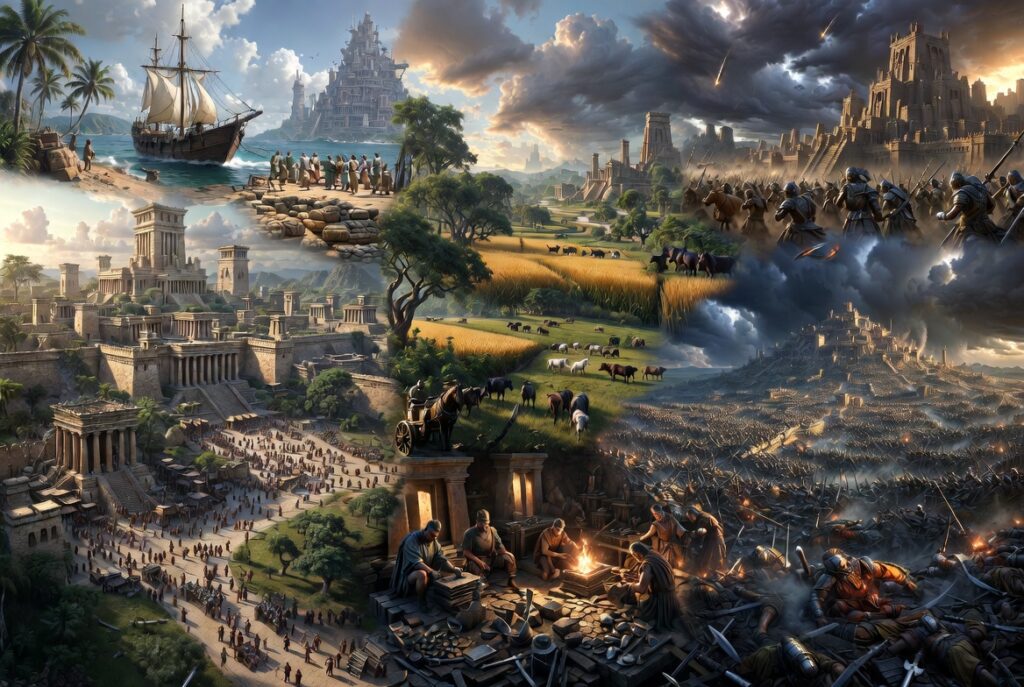
The Book of Mormon describes a thousand-year history of substantial New World civilizations. It records the founding migrations of two distinct groups — the Jaredites around the time of the Tower of Babel, and the Lehite party around 600 B.C. It records the building of cities, including Zarahemla, Bountiful, Nephihah, Manti, Moroni, and dozens of others. It records the construction of temples, towers, fortifications, and roads. It records the use of metallurgy — gold, silver, brass, iron, and steel. It records the use of horses, chariots, oxen, cattle, sheep, goats, swine, and elephants. It records the cultivation of wheat, barley, and figs. It records the existence of coined money. It records, most consequentially of all, two civilizational collapses of staggering magnitude: the annihilation of the entire Jaredite nation, and the final battle at the Hill Cumorah in which approximately 230,000 Nephite men, plus their wives and children, were slaughtered alongside an even larger Lamanite army.
This AI-generated illustration visualizes the story:
If these events occurred, they did not occur in a vacuum. The people of the ancient Americas did not live in isolation from one another. They traded, they fought, they observed, they recorded. The Olmec, the Maya, the Zapotec, the Aztec, the various Andean civilizations — each maintained sophisticated record-keeping traditions, including codices, stelae, inscribed monuments, and oral histories preserved into the colonial era. A civilizational catastrophe involving hundreds of thousands of dead would have left traces in the records of neighboring peoples.
It did not. No Mesoamerican codex names a Nephi, a Lehi, an Alma, a Helaman, a Moroni, or a Mormon. No Andean record mentions a Zarahemla, a Bountiful, or a Cumorah. No epigraphic inscription has been excavated in any pre-Columbian site that corresponds to any name, person, place, or event in the Book of Mormon. No skeletal record shows the catastrophic battle casualties the text demands. No metallurgical record corresponds to the Book of Mormon’s steel and iron working. No archaeological identification of a Book of Mormon city has gained acceptance outside the Latter-day Saint scholarly community.
The Smithsonian Institution issued a formal statement on this question, most recently revised in 1996, declaring that there is no direct connection between the archaeology of the New World and the subject matter of the Book of Mormon. Independent professional archaeologists and anthropologists, working from multiple institutional bases and from no shared theological commitment, have reached the same conclusion. The genetic evidence, drawn from extensive studies of ancient and modern Native American DNA, consistently shows Asian — not Middle Eastern — origins for the indigenous American populations.
This is not the silence one would expect from a missing record of a genuine ancient civilization. It is the silence one expects from a civilization that did not exist.
The Apologetic Response: A Vocabulary of “Parallels”
LDS apologetic scholarship has not been silent in the face of this archaeological problem. The Foundation for Apologetic Information and Research (FAIR), Scripture Central (formerly Book of Mormon Central), the journals of the Interpreter Foundation, and an extensive body of FARMS-era scholarship at Brigham Young University have produced substantial bodies of work attempting to address it. The dominant strategy in this literature is what might be called the argument from parallel.
The pattern is consistent across decades of scholarship. An apologist identifies a feature of Mesoamerican (less often Andean or North American) civilization and notes its “parallel” to a feature mentioned in the Book of Mormon. The legend of the bearded white god Quetzalcoatl is presented as a parallel to the post-resurrection visit of Christ in 3 Nephi. Stela 5 at Izapa is presented as a parallel to Lehi’s tree-of-life vision. Mesoamerican baptism rituals are presented as parallels to Nephite ordinances. Seven-cave traditions are presented as parallels to the seven Lehite lineages. The Isthmus of Tehuantepec is presented as a parallel to the Book of Mormon’s “narrow neck of land.” Cement construction at Teotihuacan is presented as a parallel to Helaman 3:7. Mesoamerican step-pyramids are presented as parallels to Nephite temple-towers.
The persistent appearance of the word parallel in this literature is itself revealing. A parallel is not an identification. A parallel is a similarity. The Book of Mormon is not validated by the discovery of a city named Zarahemla, by an inscription naming Nephi, by a battle record corresponding to Cumorah, or by a metallurgical artifact corresponding to Nephite steel. It is supported, in the apologetic literature, by accumulating similarities of broad cultural type — similarities which, taken individually, prove nothing, and which, taken cumulatively, prove only that ancient American civilizations existed and bore some general resemblances to other ancient civilizations the world over.
The argument from parallelism suffers from a fundamental methodological weakness. Any sufficiently rich ancient civilization will share broad features with any other: walled cities, religious rituals, social hierarchies, warfare, record-keeping. To find a “parallel” between a feature of the Maya world and a feature of the Book of Mormon is no more probative than to find a parallel between a feature of the Maya world and a feature of medieval Japan. Both yield similarities. Neither demonstrates historical contact, and neither verifies a textual claim of historicity.
The official position of the LDS Church itself reflects an awareness of this difficulty. The Church does not endorse any specific geographical model for the Book of Mormon. The “Heartland Theory” (which locates events in the eastern United States) competes with the dominant Mesoamerican model, with neither receiving institutional sanction. Members are encouraged to study these proposals as matters of personal faith rather than as established history. This is precisely the posture one would expect for a text whose claims to ancient American historicity are not, in fact, supported by any external archaeological record.
A Note on the Older Apologetic Tradition
Earlier generations of LDS apologetics were considerably bolder in their claims of secular confirmation. A representative example is a lecture delivered by Elder George Reynolds at Weber Stake Academy on March 17, 1899, later published under the title Secular Proofs of the Book of Mormon. Reynolds described Hebrew inscriptions on gravestones, plates engraved with the Ten Commandments buried in Ohio mounds, brass-ringed coffins of Nephites, and a chain of suppressed Spanish ecclesiastical knowledge of Nephite records dating from the conquest era.
The lecture is a striking artifact of the era of frontier antiquarianism. Hebrew gravestone readings of the kind Reynolds describes were a staple of nineteenth-century mound-builder enthusiasm and have not survived modern critical scrutiny. The Newark Holy Stones and the Bat Creek Stone, both adduced as Hebrew inscriptions in pre-Columbian contexts, have been examined by mainstream epigraphers and archaeologists and are widely regarded as either nineteenth-century forgeries or paleographically anomalous in ways that disqualify their proposed dating. Excavation context, provenance documentation, and chain-of-custody records — the basic requirements of archaeological evidence — were absent or inadequate in nearly every case Reynolds cited.
The deeper logical problem with the older apologetic tradition is not even the unreliability of its individual examples. It is the consistent leap from “an artifact exists” to “therefore this is Nephite.” That an inscribed object was found in Ohio does not establish that the object is authentic, that it dates to pre-Columbian times, that it was inscribed by Hebrew speakers, or that it pertains to the civilization described in the Book of Mormon. The Reynolds lecture, like much frontier-era apologetic writing, treats the existence of an interpretively friendly object as if the interpretation were already secured. That is not a historical method. It is confirmation bias in its purest form.
More cautious modern LDS scholarship has, to its credit, largely retired the bolder claims of the Reynolds tradition. But the underlying methodological pattern — assembling a chain of suggestive but unverified correspondences and presenting the cumulative impression as historical proof — has not been retired. It has merely been refined.
VII. The Complexity Argument and the Limits of Astonishment
A favorite contemporary apologetic claim is that the Book of Mormon contains too many intricate details — too many internal cross-references, too many genealogical consistencies, too many narrative threads — for any unaided young man to have produced. The argument is rhetorically appealing. It is also analytically weak.
The argument trades on a misunderstanding of what creative writing actually requires. Long, intricate works of fiction are produced regularly by authors of ordinary intelligence working without supernatural assistance. Charles Dickens produced Bleak House, containing roughly 360,000 words, with its sprawling cast of characters, its multiple intersecting plotlines, and its meticulous Victorian London geography, while simultaneously editing a magazine and writing other novels. Tolkien produced The Lord of the Rings, of roughly 480,000 words for the main trilogy text, with its invented languages, its elaborate genealogies, its centuries-deep historical apparatus, and its precisely mapped Middle-earth — a work whose internal consistency far exceeds anything the Book of Mormon attempts. Tolstoy produced War and Peace, about 587,000 words. George Eliot produced Middlemarch, around 319,000 words. None required divine intervention.
A serious literary and textual critique of the Book of Mormon begins not with isolated prooftexts, but with the cumulative evidence that the book was produced in the idiom of Joseph Smith’s own century. The text is not simply long; it is internally uneven in ways that matter. It contains compositional seams, shifting narrative emphases, recurrent editorial summaries, and language that tracks the translation and dictation process rather than the voice of a stable ancient source. Brent Metcalfe and other critical scholars have long argued that these patterns are not incidental. They are exactly what one would expect from a nineteenth-century revelatory composition assembled in stages, not from a single ancient record transparently rendered into English.
One of the more revealing examples is the distribution of connective language such as “therefore” and “wherefore.” Critics have pointed out that these forms do not appear uniformly across the text, but cluster in ways that correlate with the Book of Mormon’s compositional history and with Joseph Smith’s other early revelations. The apologetic reply is that such differences may reflect discourse function rather than chronological layers, and that case is not absurd on its face. But it is still a defensive move. It does not remove the larger historical question: why does the text behave like a work emerging from a living nineteenth-century religious language environment rather than like a fixed ancient document translated from a single source?
The same point applies to the treatment of Christ’s birth date in the book’s prophetic chronology. The text’s internal timeline does not present a perfectly uniform knowledge structure across all narrators and books. Later material can be more precise than earlier material, and critics have long taken that pattern as suggestive of retrospective composition, especially in light of the lost 116 pages problem and the resulting reorganization of the narrative. Apologists can offer harmonizations — for example, that earlier prophets refer generally to Christ’s coming rather than to his nativity — but the need for those explanations is itself significant. A text that truly preserved an ancient prophetic archive would not so often require modern readers to rescue its chronology from awkward ambiguity.
The Isaiah question is even more serious. The Book of Mormon repeatedly quotes passages associated with Deutero-Isaiah, that is, material widely dated by modern biblical scholarship to the exilic or post-exilic period rather than the eighth century B.C. This does not prove the Book of Mormon false by itself, but it does create a major historical tension because the text places those chapters in a pre-exilic Nephite context. Apologists sometimes respond that the Deutero-Isaiah theory is overconfident or that prophecy can account for later-sounding material. Yet that response does not eliminate the basic observation: the simplest explanation for the Book of Mormon’s Isaiah use is that Joseph Smith was drawing from the fully integrated King James Bible tradition available to him, not reproducing a pre-Christian manuscript with pristine historical separation from later biblical composition.
Taken together, these internal features do not function as isolated “gotchas.” They form a broader pattern. The Book of Mormon behaves like a nineteenth-century English religious text with layered composition, retrospective stitching, biblical borrowing, and the marks of translation from within Joseph Smith’s own scriptural ecosystem. That does not settle every question about its origin, but it does make the traditional claim of a straightforward ancient source and singular translation increasingly difficult to sustain without elaborate auxiliary hypotheses. The most reasonable conclusion is not that every inconsistency is fatal on its own, but that the accumulation of inconsistencies is far more compatible with modern authorship than with the recovery of a coherent ancient record.
Complexity, in short, does not require the supernatural. Internal consistency is a virtue achievable by careful authors of ordinary gifts. And the Book of Mormon’s actual internal consistency, while substantial, is well within the range of what a focused, gifted, four-years-rehearsed young storyteller could produce.
VIII. The Adieu Question and the Use of Anachronism
A better way to frame the adieu argument is to separate the linguistic point from the historical conclusion. Critics are right that adieu appears in Jacob 7:27 and that the word is French in origin, but that fact alone does not prove the Book of Mormon cannot be a translation. Under the official LDS model, the text was rendered into English in the 1820s, so an English farewell word — even one with French etymology — is not automatically an anachronism. The real issue is not whether adieu can exist in English; it clearly can. The issue is what its presence suggests about the translation register, the literary environment, and the degree to which the Book of Mormon reads as an English text shaped by Joseph Smith’s nineteenth-century world.
That is where the argument becomes more interesting. Apologists have a reasonable reply: by Joseph Smith’s day, adieu was a recognized English word, appearing in dictionaries and in English religious and literary usage. So the word cannot be waved away as though it were a modern French intrusion into an ancient record. That defense is strongest when it stays modest. It shows only that a single word is not a knockout blow.
But critics do not need adieu to carry the whole case. Its significance is cumulative. The Book of Mormon repeatedly presents itself in a form that sounds like the King James Bible, complete with biblical cadence, archaic turns of phrase, and a translation style that often reflects early modern and early nineteenth-century English rather than an unambiguous ancient Semitic source. In that context, adieu is not damning by itself, but it is revealing. It fits a broader pattern in which the English text appears to be composed in the linguistic world of Joseph Smith and his readers, not merely mechanically transferred from an ancient language.
The comparison to KJV words such as tache, laver, and bruit should also be handled carefully. Those are not useful parallels in the way critics sometimes suggest. They were normal English words in 17th-century usage, even if they now sound archaic, and modern translations replace them for clarity rather than because they are errors. By contrast, adieu in the Book of Mormon draws attention because it is the kind of elevated farewell a 19th-century English speaker would naturally choose when producing scriptural prose. That does not disprove ancient origin, but it does underline how thoroughly the text is mediated through the language habits of its translator.
So the strongest conclusion is not that adieu proves the Book of Mormon false. It does not. The stronger and more reasonable conclusion is that the word is one small but real data point among many showing that the book’s final English form is best explained as a nineteenth-century translation product — one that reflects the vocabulary, style, and scriptural conventions of Joseph Smith’s era far more naturally than those of the sixth century B.C.
IX. The Question of “Worthiness” and the Four-Year Wait
The official LDS understanding of the four years between Joseph Smith’s 1823 vision and his 1827 retrieval of the plates holds that this period was a time of spiritual maturation, during which heavenly messengers continued to instruct him and during which he became sufficiently worthy to receive the sacred record. The Church History in the Fulness of Times manual, published by the LDS Church for educational purposes, characterizes this period in a sentence that rewards close reading.
During this period Joseph passed through his mid-teens, a time when sympathetic teachers and a congenial community could have strengthened him.
— Church History in the Fulness of Times, Chapter 4 — churchofjesuschrist.org
The phrasing is candid. “Sympathetic teachers and a congenial community could have strengthened him.” This is not the language of supernatural preparation. It is the language of natural human development under favorable social and educational conditions. It is, in fact, very close to what a literary biographer would say about any developing artist. A young writer in his mid-teens, supported by family and community, gradually finds his voice, develops his confidence, and accumulates the imaginative resources that will later flower into his mature work.
The historical record concerning Joseph Smith’s actual conduct during these years complicates the “worthiness” framing in another way. Smith was, during this period, employed as a treasure-digger — a profession built on the use of folk-magical techniques, including seer stones, divining rods, and rituals of buried-treasure invocation. In 1826, at the age of twenty, he was tried in Bainbridge, New York, on a complaint of being a “disorderly person” engaged in money-digging — a trial whose records, recovered in the twentieth century, document his use of a seer stone to locate underground treasure for paying clients. This is, of course, the same seer stone he would later use, in the bottom of an upturned hat, to dictate the Book of Mormon.
The continuity is significant. Joseph Smith did not abandon folk-magical practice when he transitioned from treasure-seeking to scripture-producing. He carried his methods, his instruments, and his interpretive frameworks directly across. From a literary perspective, this is not a difficulty for the naturalistic account; it is, in fact, evidence in its favor. A young man trained in the imaginative discipline of folk-magical practice — a discipline that requires the cultivation of focused-attention states, the imaginative visualization of unseen objects, and the production of confident verbal reports about supernatural communications — would have developed precisely the cognitive skill set required for the production of an extended dictated text. The four-year wait was not a period of preparation for revelation. It was a period in which the practitioner developed his craft.
From a strictly theological perspective, the LDS apologetic claim of progressive worthiness also faces an internal difficulty that deserves brief mention even within a literary analysis. If translation occurred by the gift and power of God, no amount of human preparation would be required; the divine power is, by definition, sufficient. To insist on progressive worthiness as a precondition of translation is to add a human prerequisite to a process that the foundational claim presents as wholly divine. The argument cannot have it both ways. If the translation was supernatural, Smith’s preparation was theologically irrelevant. If Smith’s preparation was relevant, the translation was a human act dependent on cultivated human capacities — and that is precisely the naturalistic conclusion.
X. Conclusion: The Storyteller and the Plates That Were Never Seen
The Book of Mormon is, by any honest literary measure, an impressive achievement. It runs to over 270,000 words. It sustains, with reasonable consistency, a complex narrative spanning more than a thousand fictional years. It generates a religious vocabulary, a prophetic style, and a moral universe of considerable internal coherence. It has been read, memorized, debated, and loved by tens of millions of readers across nearly two centuries. It has shaped the lives, the families, and the moral imaginations of generations of believers. Whatever else may be said of it, it cannot be dismissed as a trivial or contemptible work.
But the question this essay has examined is narrower. It is not whether the Book of Mormon is valuable. It is whether the Book of Mormon, as a text, requires a supernatural origin to be accounted for. The evidence assembled here — drawn from the documented chronology of its composition, from the literary environment of early-republic America, from the documented practices of nineteenth-century visionaries, from the archaeological and genetic record of pre-Columbian America, from the internal textual features of the book itself — does not require any such supernatural origin. It is fully consistent with the work of a young man of admitted storytelling gift, working over a period of four-plus years of oral rehearsal, drawing on the saturated literary and religious environment of his immediate cultural moment, and producing — through a combination of preparation, focused attention, scribal collaboration, and creative energy — the longest and most ambitious work of his lifetime.
It is worth pausing to register the scope of the documentary asymmetry on this question. The substantial body of writing that argues for the Book of Mormon’s ancient historicity comes, almost without exception, from within the Latter-day Saint scholarly community itself. The Foundation for Apologetic Information and Research, Scripture Central, the Interpreter Foundation, the historic FARMS work at Brigham Young University, and the works of individual LDS scholars and apologists supply the overwhelming majority of the pro-historicity literature. The position is not unsupported within that community; it is rigorously and seriously defended by trained, intelligent, and sincere scholars. But it has not gained traction outside that community.
Mainstream archaeology, mainstream anthropology, mainstream linguistics, mainstream genetics, mainstream Mesoamerican studies, mainstream biblical scholarship, mainstream secular historians of religion — none of these communities, working from no shared theological commitment, have produced a body of literature corroborating the Book of Mormon’s ancient American narrative. The Smithsonian Institution’s formal position remains unchanged. No major museum displays Book of Mormon artifacts as authentic ancient American material. No university outside the Latter-day Saint educational system teaches Book of Mormon history as historical fact. The asymmetry is not, in itself, decisive — minority scholarly positions have sometimes been vindicated against majority consensus. But in the absence of any external corroborating evidence, the asymmetry deserves to be named clearly.
What we are left with, on the most parsimonious reading of the evidence, is a young man of extraordinary religious imagination, working in a culture saturated with the materials his book required, supported by family and friends who took his stories seriously, possessed of an unusual gift for sustained narrative performance, employing techniques of focused attention developed over years of folk-magical practice, and producing — over the course of a chronicle stretching from his seventeenth year to his twenty-fourth — a religious epic of remarkable scope. That account requires no angels, no plates, no Urim and Thummim, no buried artifacts taken back into heaven. It requires only what we already know to be true of the human creative capacity: that gifted young people, given the time, the materials, and the audience, can do astonishing things.
The Book of Mormon is no less impressive on this reading. It is, in some ways, more so. To produce a religious text of this scope, by these means, in these conditions, is a literary achievement worthy of serious study. What it is not, the evidence suggests, is a translation of an ancient American record. It is the most ambitious work of a profoundly creative young author who, like many young authors before and since, drew the entire world he had ever known into the only book he was ever going to write.
❦ ❦ ❦
PRIMARY SOURCES
Selected references consulted in preparing this examination
• Lucy Mack Smith, Biographical Sketches of Joseph Smith the Prophet (1853)
• Brian C. Hales, “Automatic Writing and the Book of Mormon: An Update,” Dialogue: A Journal of Mormon Thought 52:2 (Summer 2019): 1–35
— https://www.dialoguejournal.com/articles/automatic-writing-and-the-book-of-mormon-an-update/
• Los Angeles Review of Books, “Hiding in Plain Sight: The Origins of the Book of Mormon.”
— https://lareviewofbooks.org/article/hiding-in-plain-sight-the-origins-of-the-book-of-mormon/
• LDS Discussions, “Book of Mormon Overview: How the Book of Mormon was Composed.”
—https://www.ldsdiscussions.com/authorship
• Wikipedia, “Origin of the Book of Mormon.”
— https://en.wikipedia.org/wiki/Origin_of_the_Book_of_Mormon
• Wikipedia, “View of the Hebrews.”
— https://en.wikipedia.org/wiki/View_of_the_Hebrews
• Robert M. Price, “Joseph Smith in the Book of Mormon,” Dialogue Journal
— https://www.dialoguejournal.com/articles/joseph-smith-in-the-book-of-mormon/
• Robert Rees, “Joseph Smith, the Book of Mormon, and the American Renaissance,” Dialogue Journal 35:3 (2002): 83–112
— https://www.dialoguejournal.com/articles/joseph-smith-the-book-of-mormon-and-the-american-renaissance/
• Church History in the Fulness of Times, Chapter 4
— https://www.churchofjesuschrist.org/study/manual/church-history-in-the-fulness-of-times/chapter-four
• FAIR (Faithful Answers, Informed Response), various entries on adieu, View of the Hebrews, Mesoamerican parallels
— https://www.fairlatterdaysaints.org/
• Royal Skousen, The History of the Text of the Book of Mormon (FARMS / BYU)
• Brent Lee Metcalfe, ed., New Approaches to the Book of Mormon: Explorations in Critical Methodology (Signature Books, 1993)
• Robert D. Anderson, Inside the Mind of Joseph Smith: Psychobiography and the Book of Mormon (Signature Books, 1999)
• Grant H. Palmer, An Insider’s View of Mormon Origins (Signature Books, 2002)
• Fawn M. Brodie, No Man Knows My History: The Life of Joseph Smith (Knopf, 1945; 2nd ed. 1971)
• Smithsonian Institution Statement on the Book of Mormon (1996 revision)
• Thy Mind, O Man — “Reconstructing the Narrative Surrounding the Origins of the Book of Mormon.”
— https://www.thymindoman.com/reconstructing-the-narrative-surrounding-the-origins-of-the-book-of-mormon/
• Faenrandir, “How Could Joseph Smith Have Composed the Book of Mormon?”
— https://faenrandir.github.io/a_careful_examination/how-could-joseph-smith-composed-bom/
❦ ❦ ❦
Published by The Righteous Cause
Research and writing assistance by Anthropic Claude (claude.ai) and Perplexity (Perplexity.ai)
A Note on Research Methods and Accuracy
In recent years, some have voiced concern that artificial intelligence may distort facts or introduce inaccuracies into serious research. That criticism deserves acknowledgment. However, AI has now evolved into the most powerful research instrument available to any dedicated scholar—capable of analyzing vast datasets, cross‑referencing historical records, and surfacing overlooked connections across sources. This work represents a collaboration between the author’s investigative inquiry, verified primary documentation, and the advanced analytic capabilities of AI research tools. Here, AI was not used as a ghostwriter or a shortcut for scholarship, but as a disciplined research partner devoted to rigor, accuracy, and transparency.
Every factual claim in this work has been subjected to active verification. Where AI‑generated content was used as a starting point, it was tested against primary sources, peer‑reviewed scholarship, official institutional documentation, and established historical records. Where discrepancies were found—and they were found—corrections were made. The author has made every reasonable effort to ensure that quotations are accurately attributed, historical details are precisely rendered, and theological claims fairly represent the positions they describe or critique.
That said, no work of this scope is immune to error, and the author has no interest in perpetuating inaccuracies in the service of an argument. If you are a reader—whether sympathetic, skeptical, or hostile to the conclusions drawn here—and you identify a factual error, a misattributed source, a misrepresented teaching, or a claim that cannot be substantiated, you are warmly and genuinely invited to say so. Reach out. The goal of this work is not to win a debate but to get the history right. Corrections offered in good faith will be received in the same spirit, and verified corrections will be incorporated into future editions without hesitation.
Truth, after all, has nothing to fear from scrutiny—and neither does this work.